





You strap down a load, pull out of the lot, hit the first bend, and feel the cargo move. Maybe nothing falls off, but you still have to stop and rebuild the securement system because a hook shifted, a strap loosened, or the load started walking across the deck. A lot of that frustration comes down to using an anchor that was not designed, positioned, or rated for the way you loaded it.
Stake pockets, rub rails, and D-rings can all be part of a trailer’s cargo-securement system, but the terms are not interchangeable. They offer different attachment options, accommodate different hooks, and may carry very different working load limits. Just as important, not every stake pocket, rub rail, slot, or D-ring has the same rating. The usable capacity of a tiedown is controlled by the lowest-rated component in the system, including the strap or chain, hook, binder, connector, trailer anchor, and the cargo’s own attachment point.
Stake Pockets: The Original Modular Anchor
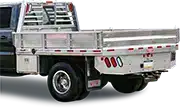
Stake pockets are rectangular steel receivers installed along the perimeter of a flatbed, equipment trailer, deckover, or utility trailer. Their traditional purpose is still useful: insert properly sized wood or steel stakes to create removable sides, retain long material, or support a temporary containment system. Modern trailer owners also use stake pockets with compatible flat hooks, chain attachments, removable D-ring inserts, spare-tire mounts, steps, and other accessories.
The important distinction is that a stake pocket is not automatically a rated tiedown point simply because a hook fits inside it. The pocket, welds, surrounding rail, removable insert, and attachment hardware must all be suitable for cargo securement. A properly engineered pocket tied into the trailer structure can provide a strong anchor, but there is no universal 3,000-, 4,000-, or 5,000-pound rating that applies to every stake pocket. Use the trailer manufacturer’s stated working load limit and the rating of the specific insert or hook. Do not estimate capacity from the thickness of the visible steel.
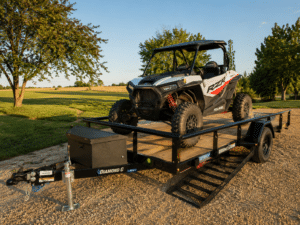
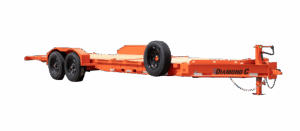
Diamond C uses stake-pocket systems on several current flatbed and equipment-trailer configurations. For example, the current Diamond C LPX low-profile extreme-duty equipment trailer is configured with a 2-inch by 3/8-inch rub rail incorporating stake pockets and pipe spools, along with four 5/8-inch D-rings. Diamond C also offers removable stake-pocket accessories, including a D-ring tie-down insert. The correct attachment method still depends on the trailer configuration, the accessory being used, and the verified rating of every component.
The flexibility is real. Stake pockets are distributed along the trailer perimeter, giving you more possible attachment locations than a small set of fixed floor anchors. Exact spacing varies by manufacturer, model, deck length, and trailer design, so it should not be assumed to be 24 inches on every trailer. More available positions make it easier to secure loads with unusual footprints, accommodate pallets of different lengths, or place straps near the strongest part of a machine or bundle.
Stake pockets are also useful when hauling lumber, pipe, sheet goods, or other material that benefits from removable side stakes. Those stakes can help contain the load, but containment does not automatically replace the required tiedowns. The load must still be secured against forward, rearward, lateral, and vertical movement with an appropriate combination of straps, chains, blocking, bracing, or other approved devices.
What stake pockets do not tolerate well is careless loading of an insert or hook. A removable anchor can twist, bind, or place concentrated force on one edge of the pocket when pulled in a direction it was not designed to handle. Some pocket attachments are intended for a mostly vertical or inward pull, while others are built to accommodate a wider range of angles. Follow the manufacturer’s loading direction and avoid side-loading a hook, insert, or pocket assembly unless that use is specifically permitted.
Rub Rail: Edge Protection That Doubles as a Tie-Down
A rub rail is a continuous steel member installed along the outside edge of many flatbed, deckover, car-hauler, and equipment trailers. It helps shield stake pockets, pipe spools, trailer edges, and securement hardware from routine side contact during loading and use. It can also create clearance for flat hooks, straps, chains, or removable side stakes so the securement hardware does not have to bear directly against the deck edge.
The name can create confusion because a basic rub rail is not necessarily a tiedown anchor. Some rails are primarily protective structures. Others are part of an engineered tie-down system with designated hook openings, stake pockets, pipe spools, banjo-style points, or formed slots. Only use a rail or opening as an anchor when the trailer manufacturer identifies it for that purpose. A random hole, light-gauge side rail, decorative top rail, or interior wall rub rail should not be treated as a cargo anchor.
Current trailer designs illustrate that difference. Diamond C’s GTF car hauler uses a formed rub-rail tie-down system with stake pockets for compatible flat hooks and shaped openings for wire hooks, in addition to four 360-degree D-rings. Current H&H car-hauler and equipment-trailer lines may combine rub rails, stake pockets, D-rings, banjo tie-downs, or integrated bulkhead points, depending on the model. Delco equipment and deckover configurations may include stake pockets and rub rails with optional D-rings, swivel D-rings, or strap winches. The hardware and quantity vary by model and build.
There is no dependable industry-wide working load limit of 1,500 to 2,500 pounds for a rub-rail opening. The capacity may be higher, lower, or not established for tiedown use at all. The trailer structure, opening design, welds, hook style, and direction of pull all affect the usable capacity. Before using a rub-rail system for a machine, vehicle, or concentrated load, confirm that the specific point is intended for securement and obtain its working load limit from the manufacturer or dealer.
Hook compatibility matters as much as capacity. A flat hook needs enough bearing surface to remain seated without loading one sharp corner. A wire hook needs an opening shaped and sized to prevent it from slipping free when the strap relaxes slightly. Chain should not be wrapped around a rail if doing so can damage the rail, bend a link, or place the chain across a sharp edge. Never force a hook into an opening just because it appears to fit.
What makes a properly designed rub-rail tie-down system attractive is convenience. It can provide many attachment locations along the side without requiring removable inserts. That is useful for vehicles, landscaping equipment, pallets, building materials, and other loads whose position changes from trip to trip. The limitation is that all of those anchors remain near the trailer perimeter. Depending on the cargo and strap geometry, an edge anchor may provide a useful combination of downward and lateral restraint, or it may create a shallow angle that does little to control vertical movement. Anchor location alone does not determine whether the load is secure.
Enclosed trailers deserve a separate note. Interior rub rails installed along walls are often intended to protect the wall lining from cargo contact, not to serve as structural anchors. Enclosed cargo is commonly secured with properly installed floor D-rings, wall or floor track, recessed anchors, wheel systems, or other manufacturer-approved hardware tied into the trailer’s structural framing.
D-Rings: The Heavy-Duty Standard
D-rings are steel loop anchors that may be surface-mounted, recessed into a deck pan, welded to a structural member, or built as a rotating or 360-degree assembly. They are commonly used on equipment trailers, car haulers, enclosed trailers, dumps, and flatbeds because they provide a clearly defined attachment point for chains, straps, hooks, and other securement hardware.
A D-ring’s diameter does not establish its working load limit. Two rings that both appear to be 1/2 inch or 5/8 inch can have different materials, construction methods, mounting plates, weld patterns, and ratings. A strong forged ring attached to a light mounting pan or unsupported deck is still limited by the weaker mounting structure. For that reason, the relevant number is the manufacturer’s working load limit for the complete installed anchor, not the ring’s apparent size or its breaking strength.
The current Diamond C LPX low-profile extreme-duty equipment trailer includes four 5/8-inch D-rings, with additional D-rings available by configuration. The LPX is offered in heavy-duty GVWR configurations that vary by axle and build, generally spanning approximately 15,500 to 24,000 pounds. That trailer rating does not mean every D-ring can individually support the trailer’s GVWR, and it does not replace the need to calculate cargo weight, payload capacity, tiedown working load limits, and the required number of tiedowns.
When chaining down a tractor, skid steer, compact track loader, or excavator, the chain should connect approved trailer anchors to designated securement points on the machine. The chain grade, chain size, hooks, binders, anchor points, and machine attachment points must all be rated for the load. The working load limit of the complete tiedown is the lowest working load limit of any of those components.
D-rings can offer better directional alignment than a narrow slot or fixed stake-pocket insert, particularly when the ring rotates or pivots toward the load. They are not automatically rated for a pull from any possible direction, however. Fixed and recessed rings can have limits on side loading, loading angle, or hook orientation. A hook should seat cleanly in the ring without bearing on its tip, twisting sideways, or loading a latch in a manner the hook manufacturer did not intend.
The limitation of D-rings is position. They are normally installed at predetermined locations, and those locations may not line up with every machine, pallet, vehicle, or irregular load. Four well-positioned rings can be ideal for one piece of equipment and inconvenient for the next. Adding D-rings after purchase requires more than welding a ring to the nearest visible piece of steel. The anchor must be connected to adequate structural framing, installed without weakening the trailer, finished against corrosion, and approved by the trailer manufacturer when warranty or structural integrity could be affected.
A Delco utility trailer, for example, may be ordered with D-rings as an available option, while Delco’s equipment and deckover lines can be configured with multiple fixed or swivel D-rings, stake pockets, rub rails, or strap winches. Current H&H utility models likewise use different D-ring locations and quantities depending on the trailer series. Always verify the actual build rather than assuming that every trailer from a brand has the same anchor package.
Comparing All Three: A Quick Reference
| Feature | Stake Pockets | Rub Rail Slots | D-Rings |
|---|---|---|---|
| Typical Working Load | No universal rating; verify the pocket, insert, hook, welds, and trailer structure | Use only manufacturer-designated tie-down openings; rating varies by system | Varies by ring, mounting plate, welds, and structure; use the installed-anchor WLL |
| Position Flexibility | High when pockets are distributed along the perimeter | Medium to high on a continuous engineered tie-down rail | Low to medium because locations are fixed, although rotating rings improve alignment |
| Hardware Required | Compatible flat hook, chain connection, or approved pocket insert | Compatible flat hook, wire hook, chain, or strap specified for the rail design | Properly sized chain or strap hook that seats correctly in the ring |
| Best Pull Direction | Within the pocket or insert manufacturer’s approved loading direction | In the direction intended for the designated opening without twisting or point-loading the hook | Aligned with the ring and within the installed anchor’s permitted load angle |
| Best Use Case | Flatbeds, deckovers, removable sides, and loads requiring adjustable anchor positions | Trailers with an engineered full-length tie-down system and frequently changing loads | Vehicles, equipment, machinery, and loads requiring defined structural anchor points |
When to Use Each (Real Scenarios)
Hauling a Riding Mower on a Utility Trailer
Riding mowers and zero-turn mowers vary substantially in weight. A small residential mower may weigh only a few hundred pounds, while a larger commercial zero-turn with a wide deck, fuel, bagging system, or other accessories can weigh well over 1,000 pounds. Check the mower’s actual operating weight rather than relying on a general estimate.
Four properly rated straps attached to manufacturer-approved points can provide practical control at the front and rear of the machine. A rub-rail tie-down system may be appropriate when the openings are specifically designed for hooks and the rail’s capacity has been verified. Otherwise, use integrated D-rings, stake-pocket anchors, floor track, or another approved attachment system.
Attach the straps to solid frame or manufacturer-designated tiedown locations, not to steering linkages, mower-deck adjustment hardware, plastic bodywork, discharge chutes, or other components that can bend or move. Set the parking brake, lower the deck or attachments as recommended, and use wheel chocks when needed to prevent rolling. The brake and chocks assist the securement system but do not replace rated tiedowns.
Arrange the tiedowns so the mower is restrained forward, rearward, laterally, and vertically. Crossing rear straps may help control lateral movement when the attachment points and strap manufacturer permit it, but crossed straps are not automatically stronger than straight straps. The working load limit, anchor strength, strap angle, and ability to prevent movement matter more than the appearance of the pattern.
Loading a Skid Steer onto a Flatbed
Skid steers and compact track loaders cover a wide range of operating weights. Smaller machines can weigh well under 8,000 pounds, while larger compact track loaders with buckets or specialized attachments can exceed 10,000 pounds. Use the machine’s operating weight with fuel, cab, counterweights, tracks or tires, bucket, forks, and other installed equipment. Do not use rated operating capacity as though it were the machine’s transport weight.
For commercial transportation, 49 CFR 393.130 applies specifically to wheeled or tracked heavy equipment weighing 10,000 pounds or more individually. That equipment must be restrained against forward, rearward, lateral, and vertical movement with at least four tiedowns. Each tiedown must be attached as close as practical to the front and rear of the machine or to mounting points designed for securement. Equipment under 10,000 pounds may be secured under the general cargo rules, the applicable vehicle rules, or the heavy-equipment method.
On a properly configured Diamond C equipment trailer, such as an LPX, the four standard 5/8-inch D-rings provide defined equipment-anchor locations, while the full-length rub rail with stake pockets and pipe spools adds positioning flexibility. Use the D-rings or other verified structural anchors for the primary chains when their location and rating fit the machine. Stake-pocket accessories can provide additional options, but they should not be treated as secondary simply because they are removable; every anchor used must be approved and adequately rated.
Lower the bucket, blade, boom, or other hydraulic attachment as required, and secure accessory equipment that could move independently. Articulated machinery must be restrained against articulation. Use the machine’s designated tiedown points, transport-grade chain of a known grade and size, compatible hooks, and properly rated binders. Protect web straps from tracks, cutting edges, and other abrasive surfaces if straps are used for any part of the load.
Four tiedowns are the federal minimum for machinery weighing 10,000 pounds or more, not a guarantee that four components of any size will be sufficient. The aggregate working load limit must still meet the cargo-securement requirement, and extra securement may be needed for an attachment, articulated section, unusually long machine, damaged tiedown point, or challenging load geometry.
Hauling Sheet Metal or Building Materials
Long loads such as lumber, siding, roofing panels, sheet metal, conduit, or bundled trim may not weigh as much as a machine, but they can create serious securement problems. Smooth material can slide, flexible panels can lift in the wind, and long pieces can move forward during braking. The load should be blocked, bundled, stacked, and tied down so individual pieces cannot work free.
Stake pockets are especially useful because they can accept properly fitted side stakes and provide multiple possible tiedown locations along the trailer. That makes it easier to position a strap near each bundle or at the intervals required for a long article. Stakes and sideboards help contain the material, but they are not a substitute for adequate tiedowns unless the complete containment system is specifically designed and strong enough to meet the applicable requirements.
Federal general-cargo rules base the minimum number of tiedowns partly on cargo length and weight when the article is not blocked against forward movement. An article 5 feet or less and weighing 1,100 pounds or less generally requires at least one tiedown. An article 5 feet or less that weighs more than 1,100 pounds, or one longer than 5 feet but not longer than 10 feet, generally requires at least two. For an article longer than 10 feet, the general rule calls for two tiedowns for the first 10 feet and one additional tiedown for each additional 10 feet or fraction of 10 feet.
Sharp sheet-metal edges can cut a strap even when the strap’s rated working load limit looks adequate. Edge protection is required in commercial cargo securement whenever a tiedown would be exposed to abrasion or cutting where it contacts the cargo. Use protectors that resist cutting, abrasion, and crushing, and position them so they cannot fall out as the load settles.
Can You Combine Them?
Yes. Many well-equipped trailers combine fixed D-rings, stake pockets, a rub-rail tie-down system, pipe spools, sliding ratchets, track, strap winches, or other anchors. Combining systems can make a trailer more versatile, but using all available anchor types is not automatically safer. The goal is to create one complete securement system in which every device has a purpose and every component is properly rated.
For equipment, D-rings may provide the primary chain locations at the front and rear. Stake pockets may provide better positioning for a separate attachment, pallet, or additional restraint. A manufacturer-approved rub-rail opening may work well for an over-the-top strap or a load positioned between fixed D-rings. Side stakes can help contain lumber or pipe while straps provide the required downward and directional restraint.
Do not mix anchors casually just to increase the number of visible straps. A strap attached at a poor angle may add little control. Two tiedowns pulling against each other can loosen if the cargo settles. A chain and a light strap should not be assumed to share a load evenly. Each device should restrain a specific direction of movement without damaging the cargo, trailer, or another tiedown.
Federal cargo-securement rules do not require the use of stake pockets, rub rails, or D-rings by name. They require a securement system strong enough to meet the performance criteria, prevent unacceptable movement, satisfy the minimum tiedown count, and provide sufficient aggregate working load limit. Trailer structures and anchor points must also be free of damage that would reduce their strength.
The aggregate working load limit of the securement system must be at least one-half the weight of the cargo being secured. That calculation is more specific than simply adding every number printed on the straps. A direct tiedown running from a trailer anchor to the cargo contributes one-half of its working load limit to the aggregate calculation. An indirect tiedown that runs from one trailer anchor over, through, or around the cargo and attaches to another trailer anchor contributes its full working load limit. The working load limit of each tiedown is determined by its lowest-rated component or anchor point.
Commercial drivers must inspect the cargo and securement before operating. Under federal rules, drivers of trucks and truck tractors must also inspect the load and tiedowns within the first 50 miles and make adjustments when necessary. The cargo and securement devices must then be reexamined following a change of duty status, after three hours of driving, or after 150 miles, whichever comes first, subject to the rule’s exceptions. Even when those commercial requirements do not apply to a private trip, stopping early to recheck straps and chains is sound practice because tires, suspension, lumber, pallets, and equipment can settle after the first few miles.
The trailers we carry at Spencer Trailers come in a range of tie-down configurations. The right arrangement depends on what you haul, where the machine’s securement points are located, how often the load changes, and whether you need removable sides or full-length attachment flexibility. Regular equipment haulers usually benefit from substantial frame-connected D-rings. Contractors moving different materials every week may value stake pockets and a continuous tie-down rail. Utility-trailer owners should look for approved anchors that match their mower, ATV, landscaping equipment, or general cargo rather than assuming the nearest rail is strong enough.
Buying a Trailer: Ask the Right Question
Before you commit to a trailer, ask how many tie-down points it has, what type they are, where they connect to the structure, which hooks they accept, and what working load limit applies to each installed anchor. Also ask whether the rating applies to a straight pull only or includes angled and lateral loading. A ring’s diameter, a heavy-looking weld, or a thick rub rail is not a substitute for an established rating.
GVWR and deck length still matter, but neither tells you the capacity of the cargo-securement system. GVWR is the maximum allowable loaded weight of the trailer. The usable payload is generally the trailer’s GVWR minus its unloaded trailer weight, subject to the ratings of the axles, tires, wheels, coupler, frame, suspension, and other components. A 14,000-pound GVWR trailer does not automatically have 14,000 pounds of payload, and it does not automatically have anchors capable of securing a 14,000-pound load.
The towing vehicle, receiver, hitch ball or gooseneck connection, coupler, safety chains, tires, brakes, and trailer loading must also be suitable for the combination. Tie-down hardware cannot correct an overloaded trailer, inadequate tow vehicle, excessive tongue weight, or poorly distributed cargo. Start with the actual weight of the loaded machine or material, confirm the trailer payload, and then design the securement system around that real load.
Brands such as H&H, Diamond C, and Delco identify available tie-down hardware in their current model information and build configurations. Depending on the model, that may include stake pockets, rub rails, formed tie-down openings, fixed D-rings, swivel D-rings, banjo points, strap winches, track, or integrated bulkhead anchors. Exact quantities and ratings can vary with trailer length, GVWR, frame design, and selected options, so confirm the specifications for the individual trailer rather than applying one model’s details to an entire brand.
Our team can walk you through which configuration fits your actual use: the weight and dimensions of the equipment, the location of its factory tiedown points, the type of chain or straps you already own, and the other loads the trailer will carry. That produces a better match than choosing a trailer by GVWR and deck length alone and trying to solve the anchor problem afterward.
Got a specific load you’re trying to figure out? Call or stop in and we’ll match the tie-down setup to the trailer before you buy. Or browse current inventory and note the tie-down equipment shown on each listing. Confirm anchor ratings, optional hardware, and current availability with our team. 291 West State Hwy 46, Spencer, IN. (812) 829-0226.