






How Tariffs on Imported Components Affect Trailer Prices
You walk onto a trailer lot expecting to pay roughly what you paid a few years ago, and the sticker stops you cold. The frame may look familiar, the tires may be the same size, and the trailer may still perform the same basic job. What has changed is the cost of the steel, aluminum, running gear, tires, electrical equipment, hydraulic parts, freight, labor, and financing required to put that finished trailer on the lot.
Tariffs are one part of that cost picture, but they should not be blamed for every price increase. A trailer built in the United States can still contain tariff-exposed components, while a domestically manufactured component can be affected indirectly when tariffs alter the wider market for steel, aluminum, copper, electronics, or replacement parts. Supply disruptions, manufacturer capacity, freight rates, wages, interest expenses, and changes in standard equipment also influence the final price.
A tariff is a customs duty owed by the importer of record when covered merchandise enters the United States. The foreign supplier does not simply receive a bill from the US government. The importer pays the duty and then decides whether to absorb it, negotiate with the supplier, change sources, reduce another cost, or pass some or all of the added expense through the distribution chain. That chain may run from an importer to a component distributor, then to a trailer manufacturer, dealer, and retail buyer. :contentReference[oaicite:0]{index=0}
The current metal-tariff system is more complicated than a single percentage applied to everything made of steel or aluminum. Federal Section 232 rules were expanded and modified again in 2025 and 2026. Depending on the product’s Harmonized Tariff Schedule classification, country of origin, metal origin, and applicable exception, covered articles may be subject to different rates and may be assessed on their metal content or full customs value. The 2026 schedules include 50 percent treatment for listed metal articles, 25 percent treatment for many listed derivative products, and temporary reduced treatment for certain listed machinery and equipment categories. Buyers should therefore be cautious about claims that every imported component, or every imported trailer, automatically receives the same tariff. :contentReference[oaicite:1]{index=1}
If you’re shopping for a flatbed, cargo trailer, equipment trailer, utility trailer, or dump trailer, understanding component sourcing will help you compare current prices more intelligently. It will also help you recognize why two trailers with similar dimensions can have very different costs, capacities, warranties, and long-term service support.
Which Components Are Commonly Imported
Not every part installed on a trailer is made in the same country, and country of origin can vary between brands, model years, suppliers, and even individual component sizes. The most accurate information comes from the manufacturer, the component identification tag, and the country-of-origin marking on the actual part.
- Axles, hubs, and brake components: Axle sourcing should be checked by manufacturer and model rather than assumed. Diamond C’s premium FMAX, HDT, LPT, LPX, WDT, and DEC lines use Lippert axles as standard equipment. Lippert operates axle-production facilities in the United States, including facilities in Indiana, Idaho, and Texas. Bearings, seals, brake magnets, ABS components, fasteners, and other subcomponents may still come through a broader global supply chain, so a US-produced axle assembly is not necessarily insulated from every import-related cost. :contentReference[oaicite:2]{index=2}
- Tires and wheels: Trailer tires are produced in several countries, and origin varies by manufacturer, product line, load range, and production batch. Common sizes such as ST205/75R15 and ST235/80R16 may be available from both domestic and international supply channels. Buyers should compare the tire’s load range, maximum load, speed rating, construction, date code, warranty, and country of origin instead of assuming that every tire of the same size is equivalent.
- Electronics and lighting: LED lamps, junction boxes, breakaway batteries, breakaway switches, connectors, camera components, wireless hydraulic controls, ABS electronics, and portions of wiring assemblies may contain globally sourced materials or components. The brake controller mounted in the tow vehicle is separate from the trailer’s own brake assemblies and breakaway system, although all of those systems must be compatible.
- Steel and aluminum: Structural steel, sheet steel, tubing, expanded metal, aluminum exterior skin, aluminum roof material, and aluminum framing are major cost inputs. A tariff is not collected on steel that is produced and sold entirely within the United States, but tariffs on competing imports can still affect domestic market prices, supplier availability, contract terms, and mill lead times. The amount of metal used also differs dramatically between a small utility trailer and a heavy equipment, dump, or gooseneck trailer.
- Hydraulic equipment: Dump trailers and hydraulic tilt trailers add pumps, cylinders, reservoirs, hoses, valves, solenoids, batteries, chargers, remotes, and control wiring. Some systems are assembled in the United States from a mix of domestic and imported parts. Tariff exposure can therefore occur at the complete-unit level, the subcomponent level, or both, depending on classification and origin.
- Couplers, jacks, ramps, and hardware: Couplers, safety-chain hardware, jacks, hinges, latches, locks, tie-down components, winches, tarp hardware, ramp-assist parts, bolts, nuts, and fasteners may come from several suppliers. Small increases multiplied across hundreds of individual pieces can materially change a manufacturer’s total build cost.
When tariffs apply to a covered part, the resulting retail increase is not necessarily equal to the tariff percentage. A 25 percent duty on one imported component does not mean the complete trailer automatically costs 25 percent more. The component may represent only a small portion of the trailer’s total cost, and the manufacturer or importer may absorb part of the increase. The opposite can also occur when a shortage forces a manufacturer to purchase a substitute component at a much higher spot-market price.
Dealers do set their own retail prices, promotions, trade allowances, and negotiated selling prices. What a dealer cannot control is the factory invoice, manufacturer surcharge, inbound freight, interest expense, or replacement cost attached to a new production run. That is why two otherwise similar trailers may be priced differently when they were ordered or built at different times.
How Supply Chain Pressure Shows Up on the Lot
Tariffs and sourcing changes usually reach buyers in two visible ways: the price of the trailer and the time required to obtain it. Neither effect is automatic, and there is no universal percentage or lead-time increase that applies to every manufacturer.
Price increases can begin with imported raw material, a finished component, or an imported completed trailer. A supplier may add a tariff surcharge, increase its base price, change minimum-order quantities, or require a manufacturer to buy a larger amount of inventory. Manufacturers then have to account for that increase along with fabrication labor, coating, flooring, tires, running gear, warranty reserves, and transportation to the dealer.
The timing also matters. A trailer already on the lot may have been purchased under an earlier factory price schedule, while an identical-looking replacement unit may carry a newer invoice. Conversely, a dealer may have higher carrying costs on an older unit that has remained in inventory. Model year alone does not tell you which unit should cost more. Compare the actual VIN-specific build, standard equipment, installed options, tire dates, warranty status, and current selling price.
On heavier trailers, small specification changes can produce substantial cost changes. Moving from tandem 7,000-pound axles to 8,000- or 10,000-pound running gear may also require different wheels, tires, suspension, frame construction, coupler, brakes, and certification. Adding hydraulic jacks, a winch, upgraded ramps, air suspension, disc brakes, ABS, or 17.5-inch tires changes much more than the appearance of the trailer.
Lead times can change when a supplier alters production, an importer holds less inventory, a shipment is delayed in customs, or a manufacturer must qualify a new source. Tariff changes can also create a rush to import before an effective date or a pause while companies determine the proper tariff classification. Those conditions can affect scheduling, but they are not the only causes of a longer factory wait. Demand, weather, labor availability, customization, production capacity, and transportation schedules matter too.
For that reason, an old statement that a trailer “normally takes four to six weeks” should not be treated as a current promise. A realistic lead time must come from the manufacturer or dealer for the exact model, length, GVWR package, options, and production period being quoted. A standard in-stock configuration may be available immediately while a highly customized trailer from the same product family may require a significantly longer wait.
Why US-Built Brands Have an Advantage Here
This is where brand selection becomes a real purchasing decision rather than a choice based only on paint color, price, or appearance.
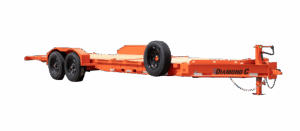
Diamond C was founded in 1985 and builds trailers in Mt. Pleasant, Texas. Its manufacturing operations include frame fabrication, assembly, and the multi-stage DM Difference Maker powder-coating process. That coating system includes steel-shot blasting, a multi-stage wash and pretreatment process, forced drying, zinc-epoxy primer, topcoat application, and final curing. Keeping major production processes under the manufacturer’s control can improve consistency, scheduling visibility, quality control, and warranty coordination. :contentReference[oaicite:3]{index=3}
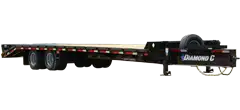
Diamond C also specifies Lippert axles across its premium lines rather than treating every axle source as interchangeable. Current FMAX gooseneck models range from single-wheel configurations beginning at 15,500 pounds GVWR to heavy dual-wheel configurations reaching 40,000 pounds GVWR, depending on the model. Current LPX equipment trailers are offered in approximately 15,500- to 24,000-pound GVWR configurations, with tandem 7,000-pound Lippert axles standard and heavier running-gear packages available. :contentReference[oaicite:4]{index=4}
US manufacturing does not make a trailer immune to tariffs. A domestic plant may still purchase imported tires, electronic assemblies, bearings, hydraulic parts, fasteners, aluminum sheet, or other materials. It may also pay a higher domestic price when tariff policy changes the overall supply-and-demand balance for metal. The advantage is that a manufacturer with established production facilities, qualified suppliers, engineering control, and a dealer network may have more options when a particular source becomes expensive or unavailable.
The same questions should be asked when comparing H&H, Liberty, Delco, Darkhorse Cargo, Legend, United, Wells Cargo, and other brands sold through Spencer Trailers. Find out where the particular trailer is built, which axle and hydraulic systems are installed, what the warranty covers, and whether normal service parts can be identified from a component tag or serial number. Spencer Trailers’ current inventory includes these brands, but construction and sourcing still vary by model and configuration. :contentReference[oaicite:5]{index=5}
Finished imported trailers can have broader tariff exposure than a domestically built trailer containing one or two imported components. In the 2026 Section 232 schedules, tariff classifications covering trailers for transporting goods and certain trailer parts are included among listed derivative articles. The exact duty still depends on classification, origin, applicable rate schedule, and current customs rules, so it is not accurate to apply one blanket percentage to every imported trailer. :contentReference[oaicite:6]{index=6}
Warranty and service support are equally important. A low purchase price loses its advantage quickly if a replacement hub, brake assembly, door latch, hydraulic control, or body panel cannot be identified. A strong dealer and manufacturer network gives the owner a clearer path for obtaining the correct part, documenting a warranty claim, and determining whether a substitute component is safe and compatible.
A Quick Look at How This Plays Out by Trailer Type
| Trailer Type | Key Tariff-Exposed or Globally Sourced Components | Price Sensitivity to Tariffs |
|---|---|---|
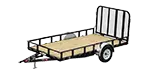
| Utility / Landscape | Structural steel, mesh, tires and wheels, lighting, coupler, jack, fasteners, and ramp hardware | Moderate |
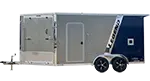
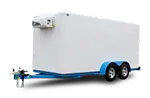
| Cargo / Enclosed | Steel or aluminum framing and skin, roof material, LED lighting, locks, hinges, door hardware, wheels, tires, and electrical parts | Moderate to High |
| Flatbed / Car Hauler / Equipment | Structural steel, axles and brake components, suspension, tires, wheels, couplers, winches, tie-downs, and loading ramps | High |
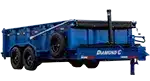
| Dump Trailer | Steel body and frame, hydraulic pump and cylinder, battery, controls, axles, brakes, tires, tarp hardware, and hinges | High |
| Gooseneck | Large-volume structural steel, higher-capacity running gear, 17.5-inch tires on many heavy configurations, jacks, coupler, wiring, braking components, and optional hydraulic equipment | High |
These categories describe general cost exposure, not a tariff rate. A steel utility trailer can be affected by a sharp move in steel prices even when most of its individual components are domestically sourced. An aluminum enclosed trailer may be especially sensitive to aluminum sheet and extrusion pricing. A dump trailer may be affected by steel, hydraulics, batteries, and electrical controls at the same time.
Actual exposure depends on the specific model, build date, material content, supplier contracts, country of origin, tariff classification, and trade rules in effect when the merchandise enters the United States. The table is a useful comparison tool, but it is not a substitute for the build sheet and current dealer quote.
What This Means If You’re Shopping Right Now
A few practical takeaways can help you purchase the right trailer without overreacting to headlines or relying on an outdated price.
Don’t wait on pricing speculation. Tariffs can be increased, reduced, expanded, exempted, or reclassified. Even when an input cost falls, retail prices may not fall immediately because manufacturers and dealers still have inventory purchased under earlier contracts, freight charges, labor costs, and financing expenses. The useful comparison is the trailer available now against the current cost and lead time of the configuration you actually need. Check current inventory and pricing directly rather than comparing a current unit with a memory, an expired advertisement, or a quote for a differently equipped trailer.
In-stock availability has real value. Buying a trailer already on the lot removes factory scheduling uncertainty and lets you inspect the exact unit before committing. You can verify the VIN label, GVWR, empty weight, axle tags, tire size, tire date codes, brake equipment, coupler rating, ramp system, floor, door operation, lighting, and installed options. That does not mean every in-stock trailer is automatically worth a premium, but immediate availability can be important when the trailer is needed for a scheduled job.
An in-stock Wells Cargo, United, Darkhorse Cargo, Legend, or other enclosed trailer also allows you to compare construction details directly. Look at the axle package, brakes, frame and wall spacing, floor material, roof construction, door hardware, interior height, tie-downs, electrical system, warranty, and replacement-parts support. Two enclosed trailers with the same exterior dimensions can have meaningfully different payloads and service lives.
Spec carefully before you buy. GVWR is the maximum loaded rating assigned by the trailer manufacturer; it is not the same as cargo capacity. Approximate payload is calculated by subtracting the trailer’s actual empty weight from its certified GVWR, with installed options and any permanently carried equipment reducing the remaining capacity. A trailer with a 7,000-pound GVWR cannot carry 7,000 pounds of cargo because the trailer itself may weigh thousands of pounds.
An axle change by itself does not automatically increase the legal or certified GVWR. The frame, suspension, tires, wheels, brakes, coupler, safety chains, and other components must support the rating, and the manufacturer must certify the completed trailer accordingly. Choose a factory-engineered GVWR package instead of assuming that heavier replacement axles convert a lighter trailer into a higher-rated model.
For example, the current Diamond C LPX is a low-profile extreme-duty equipment trailer offered from approximately 15,500 to 24,000 pounds GVWR, depending on the package. The standard configuration uses tandem 7,000-pound Lippert axles, with triple-7K, tandem-8K, and tandem-10K configurations available as part of properly engineered upgrade packages. It belongs in a different capacity and construction category from a basic 7,000-pound utility trailer. :contentReference[oaicite:7]{index=7}
If your normal cargo alone weighs 6,000 to 7,000 pounds, a 7,000-pound-GVWR trailer is generally not sufficient because its empty weight consumes part of that rating. The right comparison is your heaviest real load, attachments, pallets, fuel, tools, and accessories against the trailer’s available payload, axle ratings, tire capacities, deck dimensions, loading angle, and the tow vehicle’s ratings.
Brake equipment must also be treated as a safety and compliance requirement rather than a cosmetic upgrade. Under Indiana Code 9-19-3-3, a trailer or semitrailer with a gross weight of at least 3,000 pounds, when operated on a highway, must have brakes adequate to control, stop, and hold the vehicle. The brakes must be operable from the tow vehicle’s cab and must apply automatically if the trailer breaks away. Buyers should confirm that the tow vehicle has the correct brake controller or compatible braking interface and that the trailer’s breakaway system is functional. :contentReference[oaicite:8]{index=8}
Ask about parts and service availability. Record the axle manufacturer, axle serial number, hub or drum identification, bearing numbers, seal numbers, brake size, tire specification, hydraulic-pump model, cylinder information, coupler rating, and lighting part numbers. Ordering replacement parts from the VIN alone may not always be enough because component packages can change during a model year.
A trailer brand supported by a responsive manufacturer and established dealer network generally gives you a better route for locating the correct components and submitting warranty documentation. Common Lippert axle parts, for example, can be identified through the axle tag and service information, but the replacement still must match the axle capacity, spindle, bolt pattern, brake size, and original configuration.
A Note on Prices Changing
Trade policy moves, and manufacturer pricing can update during a model year. Tariff surcharges may appear, change, or be incorporated into a revised base price. Freight, steel, aluminum, tires, hydraulics, flooring, and finance costs can also move independently of tariffs. A price sheet or social-media advertisement from several months ago may not match the dealer’s current acquisition cost.
Quotes should therefore identify the exact trailer whenever possible: manufacturer, model, model year, stock number or VIN, dimensions, GVWR, axle package, tires, brakes, ramps, floor, hydraulic equipment, installed accessories, warranty, destination charges, and any dealer fees. A lower number is not a better deal if it represents a smaller GVWR package, fewer brakes, lighter tires, a different ramp system, or omitted options.
We keep current pricing on our inventory, and we’re honest about lead times when a trailer needs to be ordered. If you’ve been quoted a price elsewhere, bring the complete build information so the comparison can be made on equivalent trailers. Reach us at (812) 829-0226 or stop by 291 West State Hwy 46 in Spencer, Indiana. :contentReference[oaicite:9]{index=9}
No one can responsibly guarantee that trailer prices will return to a particular past year. Current trailers reflect today’s material, component, labor, regulatory, freight, warranty, and financing environment. The better strategy is to understand what is included in the price, choose enough trailer for the work, and buy from a dealer that can support the unit after the sale.
Start with what your next trailer must carry, how often it will be used, where it will travel, how it will be loaded, and what your tow vehicle is rated to handle. From there, compare payload, construction, running gear, tires, brakes, loading equipment, warranty, parts availability, and current price rather than choosing solely by the cheapest sticker.
Browse our full trailer inventory to see what’s in stock today.


