










There is a moment many trailer buyers know well. You find a unit online, call the number, and reach a recording or a salesperson who cannot explain the difference between a pintle-and-lunette setup and a ball coupler. Then the advertised price changes when mandatory dealer-added charges appear. The experience starts to feel less like buying a work tool and more like working through a franchise sales process.
That is not the approach Spencer Trailers was built around. Spencer Trailers is a family-owned and operated dealership with family business roots in Spencer dating to 1973. The trailer operation began in August 2001 and grew from a small group of trailers into a full-service dealership serving local buyers, customers across Indiana, and haulers from outside the state.
What Family-Owned Actually Means
The phrase “family-owned” gets used loosely. At Spencer Trailers, it describes how the business developed and how customers can work with the dealership. When you call or text (812) 829-0226, you are contacting the local team at the Spencer lot, not an anonymous online marketplace. That team can discuss current inventory, trade-ins, financing for qualified buyers, parts, service, delivery questions, and special-order possibilities when a participating manufacturer offers them.
The practical advantage is continuity. The people discussing your load, tow vehicle, hitch, and budget are connected to the dealership that will still be there after delivery. Manufacturer warranty claims may require advance approval and must follow the applicable warranty procedure, but a local dealer can help identify the correct next step, obtain VIN-specific information, and coordinate with the manufacturer or component supplier when appropriate.
That matters because a trailer is a working tool, not just a GVWR number on a listing. Choose too little trailer and you may overload the frame, axles, tires, coupler, brakes, or tow vehicle. Choose far more trailer than the job requires and you may add purchase cost, empty weight, hitch weight, tire expense, and towing demands without gaining useful capacity. The right match comes from comparing the actual cargo weight and dimensions with the trailer’s as-built empty weight, payload capacity, deck layout, ramp rating, axle and tire ratings, and the ratings of the truck, receiver, hitch, and ball or gooseneck connection.
Owen County Roots, Statewide Reach
Spencer Trailers is located at 291 West State Hwy 46, Spencer, Indiana 47460. The dealership’s south-central Indiana location puts it close to the contractors, farmers, landscapers, property owners, equipment operators, motorsports customers, and small businesses that use trailers as part of everyday work. One buyer may need a compact single-axle utility trailer. Another may be moving a skid steer, hauling materials in a dump trailer, protecting tools in a 7,000-lb enclosed trailer, or transporting equipment on a heavy-duty gooseneck.
Those applications cannot be matched responsibly by looking at length and advertised GVWR alone. A 14,000-lb or 15,500-lb GVWR does not mean the trailer can carry that much cargo; payload is the GVWR minus the trailer’s actual empty weight and any permanently installed equipment. Deck height, usable width, fender clearance, loading angle, tongue or pin weight, tiedown locations, brake type, tire capacity, and the machine’s concentrated axle loads can all change which trailer is appropriate. Local experience is valuable because the conversation starts with what is being hauled and how the trailer will be used.
The Brands on the Lot
A dealer’s product lineup tells you what kinds of buyers and applications it is prepared to serve. Spencer Trailers carries a broad mix of work, recreational, enclosed, refrigerated, and truck-body products, with current availability changing as units arrive and sell.
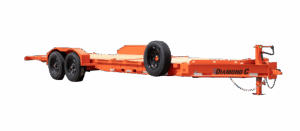
- Diamond C is a family-owned American manufacturer founded in 1985 and based in Mt. Pleasant, Texas. Its current premium lineup includes the LPX low-profile equipment trailer, rated from 15,500 to 24,000 lb GVWR depending on configuration, and the FMAX Flatbed Max gooseneck family, which ranges from 15,500 lb to as much as 40,000 lb GVWR by model and approved package. Current premium FMAX and LPX configurations use Lippert axles as standard. Diamond C also uses its multi-stage DM Difference Maker coating system, and available loading choices vary by model, including MAX Ramps, XDR Ramps, X-Ramp, hydraulic dovetails, and straight-deck configurations.
- Liberty Trailers covers utility, car-hauler, equipment, deckover, tilt, and dump applications. Its dump lineup includes 7,000-lb tandem-axle models and heavier configurations, while its utility and equipment offerings span several axle, deck-length, gate, and ramp combinations. The correct choice depends on the VIN-specific build and option package rather than the brand name alone.
- H&H Trailers builds steel and aluminum utility trailers along with dump, car-hauler, equipment, tilt, deckover, and enclosed models. That range gives buyers options for lighter homeowner and recreational use as well as commercial equipment hauling, but GVWR, frame design, axle package, deck material, and loading system must still be checked on the individual unit.
- Wells Cargo, along with Legend Trailers and United Trailers, serves the enclosed cargo side in different ways. Wells Cargo offers established steel-framed cargo and auto-hauler designs with aluminum exterior skin on many models. Legend is known for all-aluminum enclosed and open trailers. United offers both steel- and aluminum-framed enclosed cargo, race, and specialty configurations. Construction, payload, interior height, door opening, ramp capacity, and tiedown provisions vary by model.
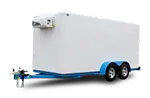
- Delco Trailers and Darkhorse Cargo, Baseline Trailers by Diamond C, and Polar King Mobile broaden the selection further. Delco covers dump, roll-off, equipment, and flatbed work; Darkhorse focuses on enclosed cargo and specialty builds; Baseline provides straightforward work-trailer choices; and Polar King Mobile serves refrigerated and freezer-trailer applications. Inventory changes, so buyers should confirm that a specific size, rating, and option package is available before traveling.
That variety does not mean every configuration is always sitting on the lot. It means the conversation can compare multiple construction styles and price points, and the team can identify an in-stock match or discuss an eligible special order. The most important document is still the specific trailer’s certification label and build information, not a general brochure or a similar-looking online listing.
Truck Beds Are Part of the Story Too
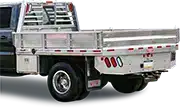
Spencer Trailers also carries Zimmerman and Martin truck beds and offers professional installation. Available inventory can include steel or aluminum flatbeds, skirted bodies, and service-oriented bodies with tool storage, lighting, gooseneck-hitch access, rear receiver provisions, rub rails, and other work-truck features. The exact equipment and ratings vary by bed, and towing capacity is limited by the lowest-rated part of the completed truck, body, hitch, receiver, axle, tire, and chassis combination. Truck-bed fitment requires more than matching the pickup badge: bed length, frame width, cab-to-axle measurement, single- or dual-rear-wheel configuration, fuel-fill placement, electrical connections, chassis ratings, and hitch requirements all matter. Buying through a dealer that can verify the bed and install it helps avoid an expensive mismatch and gives contractors, agricultural customers, and service businesses one place to discuss the full work-truck setup.
What Standing Behind a Sale Looks Like
Any dealer can process a transaction. Standing behind the sale means helping the customer understand the product before delivery and providing a clear path when parts, service, maintenance, or warranty questions come up later.
With a local family-run dealership, you can return to the same location and call the same published number used during the purchase. Spencer Trailers lists separate sales and service hours, maintains parts and service support, and can help determine whether an issue is routine maintenance, an installation concern, a trailer-manufacturer matter, or a component-manufacturer claim. Warranty coverage is never unlimited, and authorization requirements vary, so owners should keep the bill of sale, VIN, warranty documents, and maintenance records.
Standing behind a sale also begins with saying when a trailer is not the right fit. A responsible recommendation should account for the heaviest expected load, future equipment growth, load distribution, loading method, travel distance, road conditions, tow-vehicle ratings, and the driver’s licensing or commercial-use requirements. The goal is not simply to move a unit off the lot. It is to put the customer in a trailer that can perform the intended job within every applicable rating.
A Few Things Worth Knowing Before You Buy
Not everyone walks onto a trailer lot knowing the exact model or option package they need. A few fundamentals make the conversation more productive:
GVWR is a hard ceiling, and it is not the same as payload. Gross Vehicle Weight Rating is the maximum allowable loaded weight of the trailer. Available payload is generally the GVWR minus the trailer’s actual empty or curb weight, including installed options. The certification label, tire ratings, axle ratings, coupler, frame, brakes, and other component limits still apply, and the tow vehicle, receiver, hitch, and combined-weight ratings may impose a lower limit. Build in sensible capacity for realistic load variation, but never plan to exceed a published rating.
- Single axle vs. tandem axle. A single-axle trailer is usually lighter, has fewer tires and hubs to maintain, and can be easier to maneuver by hand. A tandem-axle trailer can distribute weight across more tires, offer a longer or heavier platform, and track differently on the road, but it also weighs and costs more and scrubs tires during tight turns. A second axle is not permission to continue driving after a tire or bearing failure; stop safely and inspect the trailer. Choose the axle arrangement from the required payload, deck size, braking system, maneuverability, maintenance needs, and the specific manufacturer’s rating.
- Floor material matters. Pressure-treated wood is common on utility and equipment trailers because it is replaceable, relatively forgiving, and provides useful traction for many machines. Steel floors are common in dump and debris applications and can be easier to shovel or wash, but they add weight, can become slick, and require coating maintenance where wear exposes metal. Aluminum can reduce empty weight and resist red rust, but it costs more, has different wear and galvanic-corrosion considerations, and is not automatically the best surface for every point load. Match the deck and tiedown system to the cargo.
- Brake requirements. Indiana law requires a trailer or semitrailer with a gross weight of at least 3,000 lb, when operated on a highway, to have brakes adequate to control, stop, and hold it. The braking system must be operable from the tow vehicle’s cab and must apply automatically if the trailer breaks away. Many work trailers use electric drum brakes, while some heavier or specialized units use hydraulic or electric-over-hydraulic systems. Confirm that the tow vehicle has the correct brake controller, connector, breakaway-battery setup, and sufficient electrical or hydraulic compatibility before towing.
Why Local Still Wins
You can shop for a trailer online. Online inventory and manufacturer pages are useful for comparing categories, lengths, GVWR ranges, and available options, and they can narrow the search before a visit. They should not replace verification of the exact unit’s certification label, as-built weight, option list, and condition.
A trailer is not a completely interchangeable commodity. Seeing it in person lets you measure the actual deck and door opening, check fender and machine clearance, inspect tiedown locations, evaluate the ramp or tilt approach angle, confirm ramp capacity, verify the coupler or gooseneck setup, and look at jack placement and spare-tire access. It also gives the dealer a chance to compare those details with the machine dimensions, weight distribution, tow-vehicle hitch height, and intended loading surface.
Local support matters after the sale as well. Wear items, brake adjustment, wheel-bearing service, tires, wiring, hydraulic systems, damaged ramps, and warranty questions are easier to address when there is a physical dealership and service contact. Manufacturer and component policies still govern coverage, but a local dealer can help the owner gather the VIN, photographs, maintenance history, and other information needed to move the process forward.
Come Out and See What’s on the Lot
The best way to find the right trailer is to walk the current inventory, ask detailed questions, and explain what you will actually haul. Spencer Trailers’ current and recently sold inventory spans Diamond C, Baseline Trailers by Diamond C, Liberty, H&H, Delco, Darkhorse Cargo, Legend, United, Wells Cargo, and Polar King Mobile, along with Zimmerman and Martin truck bodies. Availability changes daily, and not every brand, model, length, GVWR, or option package is always in stock, so call before making the trip when you need a specific unit.
You can browse current inventory online to see what is listed, or check recently sold units to understand the range of trailers and truck bodies that move through the dealership. When you are ready to discuss a particular load, reach out directly or call or text (812) 829-0226. Bring the machine’s operating weight and dimensions, attachment weights, tow-vehicle ratings, hitch information, and expected travel use so the conversation can be specific. Spencer is in Owen County in south-central Indiana, and the right comparison is worth making before the trailer goes to work.
What are you hauling?


