





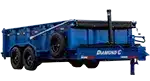


Most people buying a trailer spend their research time on specifications: GVWR, payload capacity, deck length, axle ratings, loading system, coupler type, brakes, tires, and empty weight. That’s smart. But there is another factor that can shape the ownership experience just as much, and many buyers overlook it entirely: the dealer standing behind the trailer after the sale.
Spencer Trailers was recognized by Diamond C Trailers as its 2025 Dealer of the Year for a single-location dealership and also received a 2nd Place Equipment Award. Those honors recognize dealer performance and partnership, but they should not be confused with a separate regulatory certification or a guarantee that every transaction will be perfect. What they do provide is meaningful evidence of an established relationship with Diamond C, substantial experience selling the product, and a track record that the manufacturer considered worthy of recognition. This post explains what that recognition can mean for buyers and what you should still verify before purchasing.
What Dealer Recognition Programs Actually Are
Manufacturers such as Diamond C distribute trailers through authorized dealer partners rather than selling every trailer directly from the factory. Diamond C describes its dealers as trusted partners that provide in-stock trailers, custom-order assistance, product guidance, and a local point of contact. The manufacturer also recognizes standout dealers for performance and partnership. Diamond C does not publish a complete consumer-facing scoring formula for every dealer award, so buyers should not assume that an award represents a specific government-approved checklist of employee training hours, inventory counts, or service-bay requirements.
What a manufacturer award can tell you is that the dealership has developed a meaningful working relationship with the brand. For a buyer, the most useful way to evaluate that relationship is to look for strength in at least three areas:
- Product knowledge: Staff should be able to explain the differences among current Diamond C models, GVWR packages, axle configurations, loading systems, hitch types, brake options, deck widths, and application limits. They should also know when to verify a specification on the trailer’s VIN label or current factory documentation rather than relying on memory.
- Inventory experience: A serious dealer should regularly stock or order enough Diamond C trailers to understand how the available models and options differ in actual use. The ability to inspect several configurations in person is especially valuable because published specifications, model-year equipment, and optional packages can change.
- Service and warranty support: The dealership should be prepared to explain maintenance needs, identify component manufacturers, help initiate warranty claims, obtain factory authorization when required, and either perform approved repairs or direct the customer to the appropriate repair facility.
A dealer award is therefore best treated as evidence of experience and manufacturer engagement, not as a substitute for asking questions. Diamond C’s authorized dealer network is central to sales and warranty support, and the company’s current warranty instructions tell owners to contact a local authorized Diamond C dealer before beginning a claim. That makes the quality and responsiveness of the dealership important long after the purchase paperwork is signed.
Diamond C’s Line Demands Knowledgeable Dealers
Diamond C builds a broad range of trailers, and current model names and ratings matter. The LPX Low Profile Extreme Duty Equipment Trailer is offered in published GVWR packages from 15,500 to 24,000 pounds, with standard bed widths generally ranging from 80 to 82 inches and an optional 102-inch max-width package on compatible configurations. The FMAX207 is a 15,500-pound-GVWR, 102-inch-wide single-wheel tandem-axle gooseneck equipped with two 7,000-pound Lippert axles. Buyers needing more capacity may move to models such as the 25,000-pound-GVWR FMAX210, the approximately 25,900-pound-GVWR FMAX212, or an FMAX216 tandem-dual-wheel configuration available in ratings up to 40,000 pounds. Air-ride suspension is an available option on select FMAX configurations, not the standard axle setup across the line.
Those trailers are not interchangeable purchases. A GTU Premium Tandem Axle Utility Trailer, for example, is a 7,000-pound-GVWR utility trailer built with a 4-inch channel frame and two 3,500-pound Lippert axles. The GTF Single Car Hauler is a separate 83-inch-wide car-hauler model offered in 7,000- to 9,890-pound GVWR configurations, with two 3,500-pound Lippert drop axles in its standard package and higher-capacity options available. If you are transporting a skid steer, excavator, truck, passenger car, palletized material, or landscaping equipment, the right choice depends on the actual loaded weight, wheelbase, track width, ground clearance, weight distribution, tie-down needs, loading angle, and tow-vehicle limits.
And the line is broad. Diamond C currently produces the HDT Low Profile Hydraulically Dampened Tilt Trailer in GVWR packages from 15,500 to 24,000 pounds, the LPX equipment trailer, the LPT Heavy Duty Low Profile Telescopic Dump Trailer, the GST Single Axle Telescopic Dump, the MDT Medium Duty Telescopic Dump, the DOD Deck Over Dump, the DEC Heavy Duty Deck Over Equipment Trailer, utility trailers, car haulers, and multiple FMAX gooseneck models. Current premium configurations use Lippert axles, while loading choices can include MAX Ramps, XDR Ramps, an X-Ramp, flip-knee ramps, hydraulic dovetails, or tilt decks depending on the model. Matching those systems to the equipment being loaded takes more than recognizing a model badge; it takes real product knowledge and verification of the exact unit being sold.
Inventory Depth: Why It’s More Than Convenience
There is a practical side to inventory depth that goes beyond having something attractive to display on the lot. When a dealer keeps a meaningful selection of Diamond C units, you can compare real differences in deck height, usable deck length, fender clearance, ramp geometry, coupler position, jack placement, storage, tie-down access, and empty weight. Seeing a 16-foot trailer next to a 20-foot trailer, or comparing a GTU with two 3,500-pound axles against an LPX207 with two 7,000-pound Lippert axles, makes the decision more concrete than reading model descriptions online.
It also helps prevent a common ratings mistake. The sum of the axle ratings does not automatically equal the trailer’s GVWR or payload. A portion of the loaded weight is carried through the coupler by the tow vehicle, the manufacturer establishes the trailer’s certified GVWR, and payload is determined by subtracting the trailer’s actual empty weight from that GVWR. A knowledgeable dealer should direct you to the VIN certification label and the weight information for the specific trailer rather than calculating capacity from axle numbers alone.
Deeper inventory can also indicate that the dealer works with the manufacturer and its component suppliers regularly, but buyers should not assume that every part will be stocked or that a high-volume dealer automatically receives every component faster. Diamond C trailers use a combination of Diamond C-built structures and supplier components such as axles, brakes, couplers, jacks, hydraulics, tires, lights, batteries, and suspension parts. Ask what the dealer keeps locally, what must be ordered, who handles each component warranty, and what lead time is typical for the exact part involved.
Service After the Sale: The Part Most Buyers Skip
Buying a trailer is the easy part. Owning it through years of work, weather, road salt, loading cycles, and routine maintenance is where dealer support becomes more important.
Diamond C construction varies substantially by model and rating. The GTU uses a 4-inch channel frame, while equipment models such as the LPX and HDT use I-beam or engineered-beam structures depending on the GVWR package and length. FMAX goosenecks use Diamond C’s Fleetneck engineered-beam construction, and current trailers receive the company’s DM Difference Maker multi-stage coating system. None of that eliminates normal maintenance. Owners still need to inspect and service tires, wheel fasteners, hubs, bearings, brakes, suspension components, breakaway systems, wiring, lights, couplers, jacks, hydraulic systems, ramps, hinges, safety chains, tie-down points, and wood or steel flooring as applicable.
A capable dealer’s service department should understand how those systems are configured on the model being inspected. That matters because a brake-controller warning, uneven tire wear, hydraulic problem, loose ramp, hub temperature concern, or suspension noise can have several causes. A technician should diagnose the trailer rather than guess from a description, and the repair procedure may differ among electric drum brakes, electric-over-hydraulic disc brakes, slipper-spring suspensions, torsion axles, and the heavier axle packages used on commercial equipment trailers.
This is also where warranty procedures matter. Diamond C’s Warranty 2.0 applies to 2026 and later models and provides a six-year limited structural warranty plus two-year comprehensive coverage, subject to the written terms, exclusions, maintenance requirements, and claim approval. Pre-2026 trailers fall under the warranty terms applicable to their model year, including the earlier three-year structural program. Tires, axles, brakes, couplers, jacks, batteries, lumber, and other supplier components may also involve their individual manufacturers’ warranties.
Owners should contact an authorized Diamond C dealer before authorizing warranty repairs. Diamond C states that warranty claims are subject to approval, and repairs performed without the required prior authorization may not be reimbursed. A good purchase dealer will help document the problem, identify whether the issue falls under Diamond C’s structural or comprehensive coverage or a component manufacturer’s warranty, and explain who is responsible for transportation, inspection, labor, and uncovered maintenance items.
What to Ask Before You Buy
Walking into any Diamond C dealership, including an award-winning one, ask these questions before you sign anything:
- How much current Diamond C experience does your staff have? Ask which models the dealership sells most often and whether the salesperson regularly works with FMAX, LPX, HDT, LPT, GTU, GTF, and other relevant configurations. Sales volume is not a guarantee of quality, but consistent experience can help a dealer catch application and specification problems before the sale.
- What service can you perform here? Ask whether the dealership works on brakes, hubs, bearings, suspension, wiring, hydraulics, couplers, jacks, floors, ramps, and structural concerns. Also ask whether its technicians perform Diamond C warranty inspections and how the dealership handles repairs that require factory approval or specialized equipment.
- What parts do you stock, and how do you source the rest? Common service items may include lights, breakaway components, bearings, seals, brake assemblies, hydraulic parts, couplers, jacks, and trailer hardware. No dealership can reasonably stock every component for every axle and GVWR package, so a clear sourcing and warranty process is more important than a vague claim that everything is available immediately.
- Can you verify the exact trailer against my load and tow vehicle? The answer should include the trailer’s certified GVWR, GAWR, empty weight, estimated payload, deck dimensions, hitch requirements, loaded tongue or pin weight, tire ratings, brake type, ramp capacity, and the tow vehicle’s receiver, payload, rear-axle, GCWR, and towing limits. The VIN label and current factory specifications should control whenever a website description or salesperson’s memory differs.
These are not trick questions. A confident dealer should answer them directly and should be willing to verify anything that can change by model year or option package. The dealer should also understand that trailer rating and driver-licensing rules are separate issues. In Indiana, a trailer above the 3,000-pound braking threshold must have adequate brakes. When CDL rules apply, a Class A CDL is generally triggered by a combination rating of at least 26,001 pounds when the towed vehicle has a GVWR above 10,000 pounds; a trailer does not create that threshold by itself without considering the rated combination and any applicable exemptions. Indiana buyers must also complete title and registration requirements within the state’s 45-day window. A dealer can help with paperwork and basic guidance, but the buyer remains responsible for confirming towing, licensing, registration, insurance, and operating requirements for the intended use.
Spencer Trailers and the Diamond C Line
Spencer Trailers carries Diamond C trailers at 291 West State Hwy 46 in Spencer, Indiana. The family-owned dealership has been serving trailer buyers for more than two decades and also represents brands that include Liberty, H&H, Delco, Legend, Wells Cargo, Darkhorse, United, and others. Inventory changes as trailers arrive and sell, so buyers should confirm that a particular model, GVWR package, loading system, deck length, and option combination is still available before traveling.
For the 2025 sales year, Diamond C named Spencer Trailers its Dealer of the Year in the single-location category and presented the dealership with a 2nd Place Equipment Award. Those recognitions do not change the specifications or warranty of any trailer, but they do show that Spencer Trailers has an active, established relationship with Diamond C and significant experience selling equipment-focused models. The dealership also lists regular service-department hours and maintains a trailer-parts operation with items such as bearing kits, hub and drum assemblies, brake components, couplers, jacks, and other service parts.
Browse what’s currently on the lot at the full inventory page or call (812) 829-0226 with questions about a specific model or configuration. Have your equipment weight, dimensions, wheelbase, track width, desired loading method, and tow-vehicle information available so the staff can compare appropriate configurations. If you want to talk through which Diamond C trailer fits your load and tow vehicle, the contact page is the fastest way to reach someone who can help.
What Counts in Dealer Quality
A Diamond C trailer does not gain extra GVWR, stronger axles, or a different frame because it was purchased from an award-winning dealership. The certified rating, structure, Lippert axle package, brakes, tires, coupler, loading system, and installed options belong to the trailer itself. Those details should always be confirmed on the actual unit and its documentation.
What changes at the dealer level is the likelihood of being matched to an appropriate model, receiving an accurate explanation of the configuration, getting complete paperwork, and having a knowledgeable point of contact when maintenance, parts, or warranty questions arise. Diamond C’s recognition of Spencer Trailers for dealer performance and equipment sales is meaningful evidence of experience, but buyers should still evaluate the dealership’s answers, service process, written quote, and support commitments.
Before driving to whoever is closest or choosing only by the lowest advertised price, ask how long the dealership has represented Diamond C, which current models it regularly stocks, how it verifies payload and tow-vehicle compatibility, what its service department can repair, and how warranty authorization is handled. A knowledgeable salesperson should understand the difference between a 7,000-pound GTU utility trailer, a 15,500-pound LPX or HDT package, and a 25,000-pound FMAX210, while also being willing to confirm exact specifications instead of improvising.
Ready to see Diamond C trailers in person? Check current inventory and come out to the lot on Hwy 46.


