







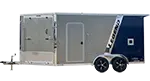
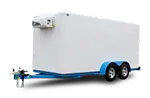


You’re on a lot, looking at two trailers side by side. The prices are close, and the specifications on the window stickers appear similar. One trailer has a small red, white, and blue NATM decal attached to its frame or tongue area. The other does not. Many buyers walk past that decal without asking what it represents. They should take a closer look.
NATM is the National Association of Trailer Manufacturers. Its compliance decal is available only to trailer-manufacturing members that successfully complete the association’s Compliance Verification Program. The decal is not a government approval or a substitute for the manufacturer’s legally required federal certification label, but it is meaningful evidence that the manufacturer has submitted its compliance processes to an outside review.
What NATM Actually Is
NATM is a trailer-industry trade association founded in 1987. It represents manufacturers of light- and medium-duty trailers, along with suppliers, dealers, service providers, and tow-vehicle manufacturers. Its stated mission is to promote trailer safety and the success of the trailer-manufacturing industry through education and advocacy.
One of NATM’s most important programs is the Compliance Verification Program, commonly called the CVP. Participation is mandatory for NATM trailer-manufacturer members. The program is built around NATM’s Guidelines for Minimum Recommended Manufacturing Practices, which organize applicable Federal Motor Vehicle Safety Standards, federal regulations, and recognized industry practices into a working compliance resource for manufacturers.
The process is more specific than simply paying membership dues and receiving a logo. NATM provides the manufacturer with an extensive checklist and supporting compliance materials. A trained NATM compliance consultant then conducts an onsite consultation at the manufacturing facility. The consultant reviews administrative records, required policies and procedures, the manufacturing operation, and a sample of trailers available at the facility. The objective is to determine whether the manufacturer has the processes in place to build trailers in accordance with applicable federal requirements and industry best practices.
The consultant is independent of the manufacturer, but the visit should not be confused with a government inspection, a structural engineering certification, or NHTSA approval of a particular trailer design. NHTSA does not preapprove or endorse trailers before they are sold. Under the federal self-certification system, each manufacturer is responsible for determining that its trailers comply with all applicable standards and for affixing the required federal certification label. NATM’s role is to review the manufacturer’s compliance processes and help identify deficiencies.
If the consultation identifies noncompliant items, the manufacturer receives a written report and normally has 60 days to make corrections, with an extension process available when appropriate. After the manufacturer successfully completes the program, it receives a certificate and becomes eligible to purchase and apply NATM compliance decals. The certificate is generally effective for two years, after which the consultation process is repeated.
What the NATM Compliance Decal Means for You
When you see a current NATM compliance decal on a trailer, you can reasonably take several specific points from it:
- The trailer was built by an NATM trailer-manufacturer member that successfully completed the association’s Compliance Verification Program.
- The manufacturer’s facility underwent a biennial onsite consultation conducted by an NATM compliance professional who was independent of the manufacturer’s internal quality-control department.
- The consultation reviewed whether the manufacturer had documented processes for complying with applicable federal regulations, Federal Motor Vehicle Safety Standards, and recommended industry practices.
- The review included records, manufacturing procedures, a facility walkthrough, and a sample of trailers available at the time of the consultation.
- The manufacturer must continue participating in the biennial process to maintain its program status and continued eligibility to use the decal.
Those points are valuable, but the limits of the decal are just as important. The decal is not a warranty, an insurance policy, an engineering stamp, or a guarantee that an individual trailer will never contain a defect. It does not mean NATM tested the trailer’s frame to destruction, independently calculated its payload, inspected every weld on every unit, or approved the trailer for your particular tow vehicle and cargo. It also does not replace the manufacturer’s separate federal certification label.
What the decal does provide is evidence of an additional layer of accountability. The manufacturer has allowed an outside industry compliance professional to review its records, production processes, and representative products, and it has corrected the deficiencies required for successful program completion.
The Standards Behind the Sticker
NATM’s compliance guidelines bring together numerous requirements that can apply to trailers. These include federal rules covering manufacturer identification, VIN assignment, certification labeling, lighting, reflectors, tires, rims, load ratings, brake-related components, recordkeeping, recalls, and owner information. Not every regulation applies identically to every trailer. Requirements can vary according to trailer type, dimensions, GVWR, braking system, intended use, and other design characteristics.
That distinction matters because the NATM decal is not a generic claim that every trailer was built from the same components. It indicates that the manufacturer has been reviewed for the processes needed to identify and apply the correct requirements to the trailers it produces.
Lighting and Electrical
FMVSS 108 governs original and replacement lamps, reflective devices, and associated equipment. Depending on a trailer’s width, length, and configuration, the required equipment can include tail lamps, stop lamps, turn signals, side-marker lamps, clearance lamps, identification lamps, reflex reflectors, license-plate illumination, and conspicuity material. The lamps must be the correct type, installed in the required locations, and visible within the applicable angles.
The manufacturing process also needs to address practical electrical issues that affect long-term reliability. Wiring should be supported and routed away from sharp edges, excessive heat, moving suspension components, and places where cargo can crush or abrade it. Connections, grounds, junction boxes, and grommets should be appropriate for road exposure. These installation details are part of sound manufacturing practice even when the underlying federal standard is focused primarily on the performance and placement of the lighting equipment.
A loose ground or damaged harness can cause intermittent lights that appear to work on the lot but fail after the trailer encounters vibration, rain, or road salt. On a wide equipment trailer or a long enclosed trailer traveling after dark, properly functioning stop lamps, markers, and reflectors are critical to helping other drivers judge the trailer’s position and movement.
Brakes
Trailer-brake requirements are frequently misstated because federal manufacturing rules, federal commercial-vehicle rules, and state highway laws are not the same thing. There is not a universal federal rule stating that every privately used trailer axle carrying more than 3,000 pounds must have brakes. Federal requirements address certain brake systems and components, while FMCSA regulations apply to commercial motor vehicles and combinations subject to those regulations. For ordinary highway use, the applicable state law must also be followed.
In Indiana, a trailer or semitrailer with an actual gross weight of at least 3,000 pounds must have brakes adequate to control, stop, and hold the trailer. The driver must be able to apply the brakes from the tow vehicle’s cab, and the system must apply automatically if the trailer accidentally separates. Indiana also generally requires service brakes on all wheels of a new trailer sold in the state and operated on its highways, with an exception for trailers weighing less than 3,000 pounds.
That means a new tandem-axle utility trailer operating at 3,000 pounds or more in Indiana is not compliant merely because one axle has brakes. On a typical 7,000-pound-GVWR tandem trailer with two 3,500-pound axles, the expected Indiana configuration is service brakes on both axles, along with an appropriate in-cab control system and automatic breakaway operation.
During a manufacturing compliance review, the relevant questions include whether the brakes are appropriate for the axle and trailer configuration, whether the required axles are equipped, whether the wiring and controls are correctly integrated, and whether the breakaway equipment is installed as required. Adjustment and maintenance remain the owner’s responsibility after purchase. Even a correctly built electric-drum system can perform poorly if the brakes are never burnished, adjusted, inspected, or supplied with the correct controller output.
Couplers, Safety Chains, and Breakaway Systems
The coupler, hitch ball, ball mount, receiver, safety connections, and tow vehicle must be treated as one towing system. A heavy coupler does not make an underrated receiver safe, and a properly rated receiver does not compensate for an undersized hitch ball. Each component should have a rating adequate for the trailer’s actual loaded weight and tongue weight, without exceeding the trailer, hitch, or tow-vehicle ratings.
Indiana requires the chain or other secondary connection and its attachment points to be strong enough to haul the loaded trailer. Safety chains on a conventional bumper-pull trailer should be attached to designated points on the tow vehicle, with enough slack for turning but not so much that they drag. Crossing the chains beneath the tongue is standard safe-towing practice because it can help support the tongue if the primary coupling separates. Commercial combinations subject to FMCSA rules have additional coupling and safety-device requirements.
For an Indiana trailer required to have brakes, the brakes must also apply automatically in an accidental breakaway. On an electric-brake trailer, that normally involves a charged breakaway battery, switch, cable, and functioning brake circuit. The breakaway cable should be secured to the tow vehicle independently of the safety chains and positioned so it can activate if the trailer separates. It should not be wrapped around the hitch ball or attached to a removable part that could leave with the trailer.
The NATM program does not relieve the owner of checking these items before each trip. The coupler latch must be fully engaged and secured, the ball must match the coupler size, the safety-chain hooks must be properly connected, and the breakaway battery and switch must be tested according to the trailer manufacturer’s instructions.
Tires and Wheels
Trailer tire capacity should be evaluated against the certified GAWR of the axle on which the tires are installed. Under FMVSS 120, the combined maximum load ratings of the tires fitted to an axle cannot be less than that axle system’s GAWR. That is more accurate than dividing the trailer’s total GVWR by the number of tires because a portion of a conventional trailer’s loaded weight is carried at the tongue or gooseneck connection rather than by the trailer axles.
For example, if an axle has a 7,000-pound GAWR and uses two tires, the two tires together must provide sufficient rated capacity for that axle at the specified cold inflation pressure. The tire size, load range or load index, rim size, rim rating, valve hardware, and inflation pressure must work together. A high load range printed on the sidewall does not help if the tire is mounted on an unsuitable rim or operated below the pressure needed to carry the load.
Buyers should compare the tires and rims installed on the trailer with the information on the certification and tire labels. They should also inspect tire age, sidewall condition, tread, inflation, and evidence of rubbing or uneven loading. Wheel fasteners must be tightened to the wheel or hub manufacturer’s specified torque and rechecked according to the owner’s manual, especially after a new trailer’s first trips or after a wheel has been removed.
Which Brands Carry the Decal
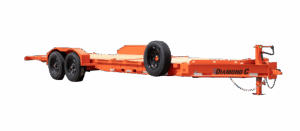
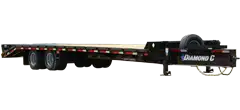
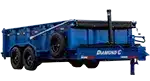
Several manufacturers represented at Spencer Trailers participate in the NATM program. Diamond C Trailers appears in NATM’s current manufacturer directory and has been an NATM member since 1995. Diamond C is a family-owned manufacturer founded in 1985 and builds its trailers in Mt. Pleasant, Texas. NATM also maintains current manufacturer-directory listings for H&H Trailers and Delco Trailers facilities.
Membership and compliance status can change, and a manufacturer may operate more than one facility. That is why buyers should inspect the actual trailer rather than relying on an old advertisement, an undated website statement, or a decal shown on a different unit. Look for the NATM compliance decal on the trailer being purchased and confirm that the manufacturer’s name on the federal certification label matches the company represented by the decal.
NATM participation is not proof that every participating manufacturer builds trailers to the same price point, frame design, payload, warranty, or feature level. Diamond C, H&H, Delco, and other manufacturers each make different product lines for different applications. NATM status addresses the manufacturer’s compliance processes; it does not turn unlike trailers into identical products.
Still, manufacturers that repeatedly prepare for outside compliance consultations must maintain records, identify applicable regulations, train employees, and correct documented deficiencies. That additional discipline is useful information when you are comparing manufacturers whose trailers look similar from a few feet away.
A Quick Comparison: NATM Versus No Certification
| What Gets Checked | Manufacturer Eligible to Use NATM Decals | Manufacturer Without an NATM Decal |
|---|---|---|
| Biennial onsite compliance consultation | Required for NATM trailer-manufacturer membership and continued decal eligibility | Not demonstrated through the NATM program; another review system may or may not exist |
| Manufacturing processes for applicable FMVSS and federal regulations | Reviewed using NATM’s compliance checklist and guidelines | Manufacturer remains legally responsible for compliance, but NATM has not verified its processes |
| Administrative records and compliance procedures | Reviewed as part of the consultation | Not independently reviewed by NATM |
| Facility walkthrough and representative trailers | Included in the NATM consultation | Not included in an NATM consultation |
| Federal certification label and VIN | Still legally required on each applicable new trailer | Still legally required on each applicable new trailer |
| Individual-trailer warranty or defect guarantee | No; the decal is not a warranty or unit-by-unit guarantee | No NATM representation; warranty depends on the manufacturer |
| Ongoing program requirement | Successful consultation is generally renewed every two years | No NATM renewal requirement |
The column on the right does not automatically describe an unsafe or illegally built trailer. A manufacturer can be legally compliant without joining NATM, and some companies use other quality systems, engineering reviews, or third-party programs. Federal law still requires every manufacturer of a new trailer offered for sale in the United States to certify that the trailer conforms to all applicable Federal Motor Vehicle Safety Standards.
The difference is evidence. Without the NATM decal, you cannot use NATM’s biennial consultation process as one of the factors in your buying decision. You must rely on the manufacturer’s federal certification, documentation, reputation, warranty, component specifications, dealer support, and any other independent verification it can provide.
What to Look for When You’re Buying
The NATM decal is a useful starting point, but it should be part of a broader inspection. Buyers should verify the specific trailer’s identity, ratings, components, condition, and suitability for the intended tow vehicle and load.
The federal certification label and VIN. A new trailer should have a legible VIN and a certification label identifying the manufacturer, date of manufacture, GVWR, GAWR for each axle system, and the applicable tire and rim information. The label should also contain the manufacturer’s statement that the vehicle conforms to the applicable federal standards in effect on its manufacture date. A missing, altered, contradictory, or unreadable label is a serious warning sign.
Axle ratings versus GVWR. Do not automatically reject a trailer merely because the sum of its GAWR figures is lower than its GVWR. A trailer transfers part of its loaded weight to the tow vehicle through the tongue or gooseneck. The relevant calculation is whether the axle systems are rated for the maximum weight they are intended to carry while the coupling supports the designed tongue or pin load.
A current Diamond C LPX, for example, begins at 15,500 pounds GVWR with two 7,000-pound Lippert axles as the standard axle package. The 14,000-pound combined axle rating does not make that configuration inherently overrated because part of the trailer’s loaded weight is intended to be supported at the hitch. The trailer must still be loaded so that neither axle GAWR, tire rating, coupler rating, tongue-weight limit, tow-vehicle payload, receiver rating, nor GCWR is exceeded.
Actual payload. GVWR is the maximum permitted loaded trailer weight, not the amount of cargo the trailer can carry. Payload is approximately the trailer’s GVWR minus its actual empty weight as configured. Options such as spare tires, hydraulic jacks, winches, toolboxes, upgraded ramps, heavier flooring, extra axles, batteries, and attachments add empty weight and reduce available payload. Use the weight shown for the completed trailer or weigh it rather than relying only on a broad catalog range.
Wiring and plug type. A 4-way flat connector is common on small trailers that need basic running, stop, and turn-signal circuits but do not have electric service brakes. Most modern bumper-pull and gooseneck trailers with electric brakes use a 7-way RV-style blade connector, which can carry the lighting circuits, electric-brake signal, auxiliary power, and other connections. A 7-way round-pin commercial connector is a different design, so do not assume that every connector described as “7-way” is interchangeable.
Confirm that the tow vehicle has the correct receptacle, that the brake-controller output reaches the trailer, that the ground and charging circuits are functional, and that the controller is compatible with the trailer’s braking system. Electric-over-hydraulic brakes, in particular, may require a controller specifically approved for that type of actuator.
Coupler size and ball rating. Trailer balls commonly include 1-7/8-inch, 2-inch, and 2-5/16-inch sizes, but the correct size is the one permanently marked on the trailer’s coupler. Many heavier bumper-pull equipment and dump trailers use a 2-5/16-inch coupler, while some 7,000-pound trailers use properly rated 2-inch systems. Ball size alone does not establish capacity.
Read the coupler rating, ball rating, ball-mount rating, receiver rating, and tow-vehicle limits. Confirm that the ball is the exact diameter required by the coupler and that the mounting shank is compatible with the ball mount. A coupler can appear to latch over an undersized ball and still separate when the trailer encounters a bump or changes angle.
Brakes and breakaway equipment. Verify that each axle required to have brakes is actually equipped, that the breakaway switch is securely mounted, and that its battery is present and charged. Inspect the cable, wiring, junction box, and connectors for damage. Test service-brake response with the controller and test the breakaway system according to the manufacturer’s instructions without leaving the switch pin removed longer than necessary.
Tires, wheels, and visible workmanship. Compare tire and rim information with the labels, inspect welds for visible cracks or incomplete areas, look for unsupported wiring, and check the frame, tongue, coupler, suspension, deck, ramps, hydraulic components, and safety-chain attachments for damage or loose hardware. A visual inspection cannot confirm engineering adequacy, but it can reveal handling damage, poor finishing, missing components, or obvious assembly problems before money changes hands.
Does NATM Certification Cost More?
NATM refers to its program as compliance verification, not government certification, and there is no universal “NATM price premium” that can be separated from the rest of a trailer’s cost. Manufacturers incur expenses for compliance staff, recordkeeping, training, consultations, corrective work, labeling, recalls, quality control, and compliant components. Those costs are part of manufacturing a road-legal product, whether or not the manufacturer belongs to NATM.
The final price of a trailer is influenced much more visibly by steel quantity and grade, frame design, axle capacity, tires, brakes, suspension, coupler, deck material, hydraulic equipment, ramps, coating, dimensions, options, warranty, freight, and dealer preparation. Two trailers with NATM decals can differ substantially in price because one has a heavier frame, greater payload, larger axles, upgraded tires, hydraulic features, or a more expensive finish.
For a current example, Diamond C lists the LPX Low Profile Extreme Duty Equipment Trailer at a base MSRP of approximately $10,012, with a published GVWR range of 15,500 to 24,000 pounds. The standard entry axle package is two 7,000-pound Lippert axles, with heavier packages available. That base MSRP is not an out-the-door quote and can increase with trailer length, GVWR package, ramps, tires, coupler, hydraulic options, freight, dealer preparation, taxes, registration, and other selected equipment.
That current manufacturer information is more useful than a broad claim that an LPX is a 14,000-pound trailer costing somewhere between $7,000 and $10,000. Specifications and pricing change, and an advertised base model should not be compared with a fully optioned in-stock trailer or an auction unit that excludes freight, preparation, warranty support, or required equipment.
When comparing prices, ask for an itemized, apples-to-apples comparison. Confirm the exact GVWR, empty weight, payload, axle brand and ratings, brake configuration, tire and wheel specifications, frame construction, ramp system, coupler, finish, warranty, included options, freight, and total delivered price. A lower number is not a bargain if it comes from a lower rating, missing equipment, lighter components, poor parts availability, or weak after-sale support.
For a trailer that earns money, transports valuable equipment, or spends years operating on public roads, compliance documentation and manufacturer support are part of the value calculation. They should not be the only considerations, but they should not be ignored to save a small percentage of the purchase price.
What Counts: The Decal in Context
The NATM compliance decal is not magic, and it should never be treated as permission to skip your own inspection. It does not replace reading the certification label, checking the trailer’s actual payload, verifying the tow vehicle’s ratings, inspecting the tires and brakes, testing the lights, securing the coupler, connecting the safety chains, and confirming that the breakaway system works.
It also does not mean the buyer can overload the trailer. The GVWR, each GAWR, tire capacities, wheel ratings, coupler limits, tongue or pin load, tow-vehicle payload, receiver rating, and GCWR must all remain within their respective limits. The lowest applicable rating controls, even when a different part of the combination is capable of carrying more.
What the decal tells you is narrower but still important: the manufacturer is participating in a mandatory industry compliance program, its facility and processes have undergone an outside biennial review, representative products and records were examined, and identified deficiencies had to be addressed before the manufacturer became eligible to use the decal.
In a market where terms such as “commercial grade,” “extreme duty,” and “heavy duty” can be used as advertising language without telling you the trailer’s actual ratings, documented compliance processes matter. The decal gives you one more verifiable point to consider alongside the federal certification label, component specifications, build quality, warranty, dealer support, and suitability for the job.
To see how NATM-compliant trailers are labeled and equipped in person, browse our current inventory or reach out to us directly at (812) 829-0226. We’re happy to walk through the certification label, GVWR, GAWR, payload, Lippert axle package, brakes, tires, coupler, ramps, and other build specifications on any applicable trailer on the lot and explain exactly how its ratings work.


