







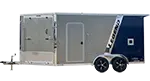
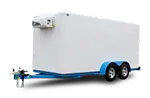
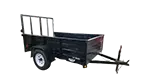

Most contractors do not sit down one morning and decide to build a trailer fleet. It happens a job at a time and a trailer at a time, until one day you look across the lot and realize the operation you are running looks nothing like the one-person business that started out hauling tools, mulch, and scrap in a borrowed pickup.
That path is well-worn around Owen County. A solo operator lands a first substantial contract, buys a utility trailer to eliminate extra trips, adds a dump trailer when unloading starts consuming billable hours, and eventually needs dedicated equipment-hauling capacity. Each stage creates new payload, loading, towing, and scheduling requirements. Each requirement points toward a particular type of trailer, axle package, deck layout, and tow vehicle.
The important part is not simply buying a larger trailer every time the business grows. It is choosing equipment that fits the actual load, leaves a reasonable capacity margin, works with the available trucks, and does not create an unexpected licensing or compliance problem. Every decision made early can either support the next stage of growth or become an expensive limitation later.
Here is a look at how that progression typically unfolds and what the smarter trailer decisions look like at each stage.
Stage One: The First Real Trailer
Before the fleet, there is usually just a truck. It may be a half-ton or three-quarter-ton pickup with tools in the bed, materials resting against the tailgate, and a schedule that requires one too many trips across town. The work is there, but the available cargo space and payload capacity are not.
The first trailer purchase for many small contractors is an open utility trailer in roughly the 5′ x 10′ through 7′ x 14′ range. A single-axle model may be sufficient for hand tools, lumber, brush, a compact mower, or light jobsite supplies. Contractors carrying zero-turn mowers, compact equipment, pallets, or denser materials may be better served by a tandem-axle utility trailer from the beginning.
GVWR is only the starting point. The usable payload is the trailer’s GVWR minus its actual empty weight, including installed ramps, spare tires, toolboxes, expanded-metal sides, and other options. A trailer with a 3,500 lb axle is not automatically a 3,500 lb GVWR trailer, and the axle rating should never be treated as the amount of cargo that can be loaded onto the deck.
At this stage, Diamond C offers two useful paths. The PSA Premium Single Axle Utility Trailer is available in 10′ through 14′ lengths, with 77″ or 83″ bed-width configurations and GVWR packages ranging from 2,990 lb to 6,000 lb. A common contractor-friendly example is a 77″ x 12′ PSA135 with a 2,990 lb GVWR and a 3,500 lb axle. The PSA uses a 4″ engineered channel frame and can be equipped with loading-gate and storage options suited to everyday work.
A contractor who already knows that heavier mowers, compact tractors, or larger material loads are coming may prefer the Diamond C GTU General Tandem Axle Utility Trailer. The GTU is an 83″-wide bumper-pull utility available in 14′ through 20′ lengths. It carries a 7,000 lb GVWR on two 3,500 lb Lippert brake axles and uses a 4″ channel frame. That added stability and braking capacity can make the GTU a more practical long-term purchase for a growing landscaping, property-maintenance, or light-construction operation.
What often gets overlooked at Stage One is the truck-and-hitch side of the equation. A receiver labeled Class III, Class IV, or Class V does not establish the complete towing capacity by itself. The contractor must verify the pickup’s specific tow rating, GCWR, payload rating, rear-axle rating, receiver rating, ball mount, hitch ball, and allowable tongue weight. Cab style, engine, axle ratio, drivetrain, wheelbase, and installed options can cause two visually identical pickups to have very different ratings.
Tongue weight also counts against the truck’s available payload along with the driver, passengers, tools, fuel, and anything carried in the bed. A trailer can be below its GVWR while still overloading the pickup’s payload or rear axle. Weight-distribution equipment should be used only when it is required or permitted by the truck, receiver, hitch, and trailer manufacturers, and it does not increase the ratings printed on any component.
Indiana braking requirements matter at this first step as well. A trailer or semitrailer with a gross weight of at least 3,000 lb must have brakes that the driver can operate from the tow vehicle, along with an automatic breakaway function. That makes the truck’s brake-controller compatibility and the condition of the trailer’s breakaway battery part of the buying decision, not accessories to address later.
Stage Two: The First Dump Trailer
At some point, unloading debris by hand gets old fast. A landscaper, site-cleanup contractor, roofer, remodeler, or small excavation operator eventually reaches the same conclusion: loading may be manageable, but spending another 30 to 45 minutes unloading at the end of every trip is consuming labor that could be used on the next job.
That is the moment a dump trailer stops being a convenience and starts becoming a productivity tool. The right dump trailer can reduce unloading time, improve material control, keep the truck bed available for tools, and allow a contractor to handle debris or bulk-material work that would otherwise require another company.
A 7′ x 12′ or 7′ x 14′ tandem-axle dump in the 14,000 lb class is common among established contractors, but it is not the correct starting point for every operation. Smaller single-axle and medium-duty dumps can be a better match for lighter debris, mulch, brush, and residential work, especially when the available tow vehicle cannot safely manage a fully loaded heavy-duty dump.
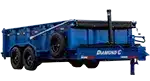
Diamond C’s current dump lineup illustrates the available progression. The GST Single Axle Telescopic Dump carries a 6,000 lb GVWR and is intended for smaller hauling requirements. The MDT Medium Duty Telescopic Dump has a 9,890 lb GVWR, 77″ bed width, 10′ to 12′ lengths, tandem 6,000 lb Lippert drop axles, a three-stage telescopic cylinder, and a 45-degree dump angle. It provides useful dump capacity without immediately moving into the weight and truck requirements of the largest bumper-pull models.
For more demanding commercial work, the Diamond C LPT Heavy Duty Low Profile Telescopic Dump is available in 12′ through 16′ lengths with an approximately 81″ to 82″ bed width and GVWR packages from 15,500 lb through 24,000 lb. The base 15,500 lb package uses two 7,000 lb Lippert axles, while higher-capacity configurations can use triple 7,000 lb axles or heavier 8,000 lb and 10,000 lb axle packages. The LPT uses a front-mounted three-stage telescopic cylinder and reaches a 45-degree dump angle. Higher-GVWR packages also incorporate configuration-specific frame, coupler, tire, brake, and ramp upgrades.
H&H Trailers also offers current contractor-oriented dump options in this range. Its Industrial Dump Trailer is offered with an 83″ bed width, 12′ through 16′ bed lengths, and GVWR configurations from 14,000 lb to 16,000 lb. H&H’s Telescopic I-Beam Dump and heavier TOPLINE telescopic models provide additional choices for contractors who want telescopic lifting systems and higher-capacity packages. The correct comparison should be based on the specific trailer’s VIN label, empty weight, hoist, axle package, floor and side construction, gate arrangement, tire ratings, and installed options rather than the brand name alone.
Dense material is where new dump-trailer owners most often misjudge capacity. A trailer body may have enough physical volume to hold a large pile of soil, gravel, broken concrete, or wet roofing debris while exceeding its legal payload long before the body looks full. The allowable cargo weight is the trailer’s GVWR minus its actual empty weight and any tools, ramps, tarp equipment, spare tires, or accessories carried on it. Material volume must always be checked against estimated weight.
The step up to a tandem-axle dump may require a different tow vehicle, but there is no universal rule that every 14,000 lb trailer requires one particular truck class. A properly configured three-quarter-ton or one-ton pickup may be suitable, while another truck with the same badge may not be. The deciding numbers are the truck’s published ratings, receiver and hitch limits, available payload, anticipated tongue weight, and the gross combination rating.
Heavy bumper-pull dump trailers commonly use a 2-5/16″ coupler and electric brakes, but the coupler, ball, ball mount, receiver, safety chains, breakaway system, wiring, and brake controller must each be rated and adjusted for the actual combination. The lowest-rated component establishes the limit. Matching the truck and trailer correctly at Stage Two prevents premature brake wear, overheated transmissions, poor handling, and avoidable liability later.
Stage Three: Equipment Starts Moving
A contractor who begins adding skid steers, mini excavators, riding mowers, compact track loaders, trenchers, or attachments can run into the practical limits of a dump or general-purpose utility trailer quickly. The deck may be too narrow, the loading angle too steep, the concentrated machine weight too high, or the available ramps too lightly rated for the equipment being moved.
This is when a dedicated equipment trailer enters the fleet.
A workhorse equipment trailer for a growing operation is often 18′ to 22′ long, although the correct deck length depends on the machine, attachments, weight distribution, and required tongue weight. Many conventional equipment trailers use tandem 7,000 lb axles, but two 7,000 lb axles do not automatically establish the trailer’s published GVWR or payload. The finished trailer’s certification label and manufacturer specifications control.
Machine operating weight is only part of the load calculation. Buckets, forks, breakers, augers, spare tracks, fuel, chains, binders, and other attachments must be included. The trailer must also provide properly rated securement points in positions that allow the equipment to be restrained in every direction without routing chains over vulnerable hydraulic lines or bodywork.
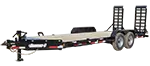
Diamond C’s LPX Low Profile Extreme Duty Equipment Trailer is a current option for this stage. The bumper-pull LPX is available in 16′ through 30′ lengths, approximately 80″ to 82″ bed widths, and GVWR configurations from 15,500 lb to 24,000 lb. Its standard 15,500 lb package uses two 7,000 lb Lippert axles, with available triple-7,000 lb, tandem-8,000 lb, and tandem-10,000 lb configurations depending on trailer length and package.
The LPX’s low-profile layout reduces the breakover challenge compared with taller deckover designs. Loading configurations can include Diamond C MAX Ramps, and eligible max-width builds can use the X-Ramp system with frame extensions and drive-over fenders. Ramp selection should be based on machine weight, tire or track width, ground clearance, loading angle, and the manufacturer’s rating for the exact ramp package.
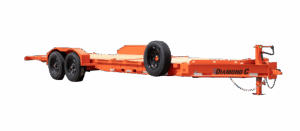
For contractors who prefer a tilt deck, the Diamond C HDT Hydraulically Dampened Tilt is available in 16′ through 28′ bumper-pull lengths with GVWR packages from 15,500 lb to 24,000 lb. Like the LPX, the standard HDT configuration uses two 7,000 lb Lippert axles, with heavier tandem and triple-axle packages available on qualifying lengths.
The standard HDT uses a gravity-fed hydraulic dampening system. The hydraulic system controls deck movement, but the basic operation is not the same as a conventional powered hydraulic cylinder lifting the deck. The operator unlatches the deck, allows it to tilt, loads the equipment, and returns it to the travel position. Diamond C’s optional Pro Tilt system adds the ability to switch between gravity operation and powered tilt for situations involving uneven weight distribution, multiple machines, or difficult terrain.
Tilt decks eliminate the need to carry and position separate loading ramps, but they are not automatically right for every machine. Equipment with low ground clearance, unusual wheelbases, rear-mounted attachments, or heavily offset weight may work better on a fixed-deck trailer with the appropriate ramp system. The loading method should be tested against the actual equipment before a fleet specification is standardized.
At this stage, the fleet typically looks like this:
- One utility or cargo trailer for tools and smaller materials
- One dump trailer for debris and bulk materials
- One equipment trailer for the machines themselves
Three trailers perform three different jobs, and each one may have a different empty weight, tongue-weight range, brake-gain requirement, tire specification, and tow-vehicle demand. They may also need to be shared across several trucks and drivers. That is when the question of fleet standardization becomes important.
This is also the stage at which contractors must review commercial licensing thresholds carefully. A Class A CDL is generally triggered when the combination has a GCWR of 26,001 lb or more and the towed unit has a GVWR over 10,000 lb. A trailer rated over 10,000 lb does not create that CDL requirement by itself when the entire combination remains below 26,001 lb, but the truck and trailer ratings can cross the combined threshold sooner than an owner expects.
Stage Four: Fleet Standardization
The hidden cost in a mixed fleet is time. When trailers use different coupler sizes, electrical connectors, brake systems, tire sizes, jack styles, ramp layouts, and tie-down arrangements, drivers spend more time finding the correct hitch parts and checking unfamiliar equipment. Hookup mistakes become more likely, loading takes longer, and maintenance inventory becomes harder to manage.
Contractors who grow beyond five or six trailers often standardize as much as their work allows. That does not necessarily mean forcing every trailer to use the same coupler. A light single-axle utility may appropriately use a 2″ coupler and a four-way electrical plug, while braked tandem utilities, dumps, and equipment trailers commonly use 2-5/16″ couplers and seven-way connectors. Standardization works best within each duty class.
A practical fleet policy may specify approved ball mounts, labeled hitch-ball sizes, minimum receiver ratings, common electrical connectors for braked units, compatible breakaway-battery systems, and a limited selection of tire and wheel sizes. Trucks can be assigned numbered hitch assemblies, and trailers can be labeled with required ball size, loaded tongue-weight range, brake type, tire pressure, wheel-torque specification, and maximum cargo capacity.
Brake-controller settings should still be checked whenever trailers or loads change. Even two trailers with similar GVWR ratings can require different gain because of brake condition, axle count, empty weight, cargo weight, and road conditions. Standardization makes setup easier; it does not eliminate the driver’s responsibility to perform a pull test, brake check, light check, coupler inspection, safety-chain check, and breakaway-system inspection before departure.
Diamond C is a common choice for fleet standardization because its current lineup covers utility, dump, equipment, tilt, deckover, and gooseneck applications. Diamond C has manufactured trailers in Mt. Pleasant, Texas, since 1985, and its premium lines use Lippert axles as standard. Its trailers also use the DM Difference Maker multi-stage coating process, although coating care, chip repair, washing, and routine inspection remain important in Indiana road-salt conditions.
H&H covers many of the same work categories, while Liberty Trailers provides additional utility, equipment, and dump configurations. Some operations intentionally split the fleet by use, selecting one manufacturer for dump work, another for equipment transport, and another for lighter utility or enclosed cargo service. The goal is not brand uniformity for its own sake. It is reducing unnecessary variation while choosing the right trailer for each job.
The table below shows a sample standardized fleet build for a mid-size landscaping or site-preparation contractor:
| Trailer Type | Model Example | GVWR | Primary Use |
|---|---|---|---|
| Open Utility | Diamond C GTU 83″ x 16′ Utility | 7,000 lb | Tools, supplies, mowers, and small equipment |
| Dump Trailer | H&H 83″ x 14′ Industrial Dump | 14,000-16,000 lb, by configuration | Debris, soil, gravel, brush, and bulk materials |
| Equipment Trailer | Diamond C LPX 20′ Equipment | 15,500-24,000 lb, by package | Skid steers, compact track loaders, and mini excavators |
| Enclosed Cargo | Darkhorse DHW 7′ x 16′ Tandem Cargo | 7,000 lb | Secured tools, jobsite supplies, and company branding |
The enclosed cargo trailer at the end deserves a note. Wells Cargo and Darkhorse Cargo enclosed trailers can perform two jobs for a growing contractor. They keep tools and supplies out of direct weather, conceal equipment from casual view, and provide a large surface for company graphics. They can also be organized with shelves, cabinets, lighting, charging equipment, and dedicated storage so crews spend less time loading and unloading tools at the beginning and end of each day.
An enclosed trailer should still be selected by payload and structure rather than exterior dimensions alone. Shelving, generators, compressors, fastener stock, extension cords, ladders, and permanently mounted equipment all reduce available payload. Heavy items must be secured to suitable structural points, and roof or wall members should not be treated as load-bearing mounting locations unless the manufacturer approves the installation.
Locks and enclosed walls can discourage opportunistic theft, but they do not make a trailer theft-proof. A useful fleet-security plan combines quality coupler and door locks with controlled key access, visible identification numbers, recorded VINs, adequate insurance, secure overnight parking, and tracking equipment where appropriate.
What Makes Each Stage Easier
The contractors who move through these stages without repeated, expensive detours tend to share a few habits.
They buy with the next realistic job in mind, not merely the current load. That does not mean automatically buying the highest-GVWR trailer available. A larger trailer brings more empty weight, higher tongue weight, more expensive tires and brakes, greater truck requirements, and the possibility of crossing commercial-license thresholds. The smarter approach is to calculate the heaviest recurring load, add the trailer’s actual empty weight, include attachments and jobsite gear, and choose a configuration with a useful safety and growth margin.
A 10,000 lb dump may be the correct tool for mulch, brush, light debris, and residential work. A contractor routinely moving dense fill, broken concrete, or excavation spoil may quickly outgrow it. Conversely, purchasing a 15,500 lb or 24,000 lb trailer does not create useful capacity when the available truck, hitch, driver credentials, or jobsite access cannot support it.
They think about tow vehicles before they commit to trailers. A trailer rated for 16,000 lb GVWR sitting behind a pickup rated to tow 8,500 lb is not a capacity solution. The owner must compare the trailer’s anticipated loaded weight and tongue weight with the truck’s tow rating, payload, rear-axle rating, GCWR, receiver rating, hitch components, and tire capacities. The same review should be repeated whenever a truck, body, toolbox, fuel tank, snowplow, or other major accessory is added.
They calculate payload instead of relying on axle count or model reputation. GVWR minus the trailer’s actual empty weight establishes the maximum theoretical payload, and the load must also remain within individual axle, tire, wheel, coupler, hitch, and tow-vehicle limits. Correct fore-and-aft placement matters because a poorly balanced load can create too little tongue weight and trailer sway or too much tongue weight and an overloaded truck rear axle.
They ask detailed questions before buying. The right dump trailer for a landscaper moving mulch and brush differs from the right trailer for an excavation contractor moving rock and concrete. Hoist design, body length, side height, floor construction, gate style, tarp system, loading ramps, hydraulic capacity, battery access, and ground clearance all affect real-world productivity.
The same principle applies to equipment trailers. A wheeled skid steer, tracked loader, mini excavator, scissor lift, and compact tractor place weight on the deck differently. The required deck length and ramp arrangement depend on wheelbase, track length, ground clearance, attachments, tie-down locations, and how the machine must be positioned to maintain safe tongue weight.
They also build maintenance into the fleet plan. Wheel-bearing service, brake adjustment, breakaway-battery testing, tire-age inspection, air-pressure checks, wheel-torque verification, hydraulic-fluid inspection, cylinder and hose checks, lighting repairs, deck maintenance, and coating touch-up should be documented by trailer rather than handled only when a problem appears.
Indiana paperwork and licensing should be addressed as soon as a trailer is purchased. Buyers generally have 45 days from the purchase date to apply for an Indiana title before an administrative penalty is assessed. Registration, plate requirements, insurance, and any commercial operating obligations should be confirmed for the trailer’s intended use rather than postponed until the first roadside inspection.
Business owners should also discuss the purchase with a qualified tax professional. Current federal rules restored a 100% additional first-year depreciation deduction for eligible qualified property acquired and placed in service after January 19, 2025. A business-use trailer may qualify when the applicable requirements are met, but eligibility, business-use percentage, basis, financing, depreciation elections, and interactions with other deductions depend on the taxpayer’s circumstances. A tax deduction should support a sound equipment decision, not replace one.
Spencer Trailers Stocks the Full Range
Whether you are buying a first open utility trailer or filling the third or sixth equipment slot in a growing fleet, Spencer Trailers can help match the trailer to the work, payload, tow vehicle, and loading method. Spencer Trailers is a family-owned and operated business whose family roots in Spencer date to 1973, with the trailer operation beginning in 2001 and growing from a small starting inventory into a large regional dealership.
Spencer’s inventory regularly includes Diamond C, H&H, Liberty, Darkhorse Cargo, and other established trailer manufacturers, with Wells Cargo units also represented in the dealership’s sales history. Available brands, models, configurations, model years, prices, and quantities change, so current listings and the trailer’s individual specification sheet should be checked before making a trip or building a fleet plan around a particular unit.
The team can help compare a Diamond C PSA with a GTU, decide whether a contractor’s dump work fits a GST, MDT, H&H Industrial Dump, or Diamond C LPT, and determine whether an LPX ramp trailer or HDT hydraulically dampened tilt is the better equipment-hauling solution. That conversation should include the machine’s operating weight, attachments, desired deck length, trailer payload, axle package, tire rating, loading system, coupler, brakes, and the exact truck that will tow it.
You can browse current inventory at spencertrailers.com/all-inventory or stop in at 291 West State Hwy 46, Spencer IN 47460. If you are working through a fleet decision and want to talk it through before committing, call or text the team at (812) 829-0226 or reach out through the contact page. There is no reason to guess at payload, tow ratings, axle configurations, coupler requirements, or loading systems when someone who works with trailers every day is available to review the combination with you.
What does your current haul situation look like? If your crew is still moving equipment on a trailer designed for a different load, making repeated trips because payload is too limited, or spending billable time unloading by hand, that conversation may be worth having sooner than you think.


