








You rented a Ditch Witch SK1050 for a landscape job, watched the rental yard load it, and now you’re thinking about buying one. Smart move. But the trailer situation catches a lot of new mini skid owners flat-footed. These machines are heavier than they look, sit lower than many full-size machines, and ride on rubber tracks that can expose a poor loading angle immediately.
Get the trailer specifications right before you buy. Getting them wrong can leave you with a machine that bottoms out during loading, a ramp or gate that is not rated for the concentrated track load, or a trailer whose actual payload capacity is lower than the machine-and-attachment combination you need to haul.
How Heavy Are Mini Skid Steers, Actually?
This is where people get surprised. Mini skid steers and compact utility loaders are small, but they are dense. Published weight also varies by track width, engine, counterweights, fluids, bucket, and other installed equipment. Here is a practical snapshot of several machines commonly encountered in the field:
- Ditch Witch SK1050: approximately 3,435 lbs with fluids and no attachment
- Toro Dingo TX 1000 Turbo: approximately 2,826 lbs for the narrow-track version and 2,911 lbs for the wide-track version, before adding an attachment
- Toro Dingo TX 525: approximately 1,904 lbs in the narrow-track configuration and about 2,001 lbs in the wide-track configuration, without an attachment
- Vermeer CTX160: approximately 4,120 lbs with a standard bucket, diesel engine, and 9-inch tracks
- Boxer 600HD: approximately 2,240 lbs without an attachment
Those numbers are starting points, not substitutes for the identification plate and operator’s manual for the exact machine. A bucket may add a few hundred pounds, while a grapple, trencher, auger, soil cultivator, or other powered attachment may add substantially more. Fuel, installed counterweights, tools, chains, spare attachments, and material left in a bucket also count against the trailer’s payload.
For example, an SK1050 that weighs approximately 3,435 lbs before an attachment can move well beyond 3,700 lbs once a bucket or other attachment is installed. A CTX160 with its standard bucket is already listed at approximately 4,120 lbs. That matters when you calculate payload capacity.
A 3,500 lb GVWR single-axle utility trailer is not an appropriate match for these larger machines. GVWR includes the empty trailer itself, so a trailer weighing 1,000 to 1,300 lbs may provide only about 2,200 to 2,500 lbs of nominal payload before options, cargo, and supplies are considered. Always use the trailer’s certification label and actual empty weight rather than assuming axle capacity equals payload capacity.
Deck Length: Shorter Than You Think, But Not Too Short
Mini skid steers are compact machines, and that is the point. But “compact” does not mean every machine will fit properly on an 8-foot landscape trailer. Published machine length can also be misleading because manufacturers may list the loader without an attachment, with a standard bucket, or at a particular boom position.
The Ditch Witch SK1050 is approximately 86 inches long without an attachment, while a bucket extends the transported length. The Toro TX 1000 Turbo is approximately 83 inches long without a bucket and about 104 inches with a bucket. The Vermeer CTX160 is approximately 92.5 inches without its standard bucket and 116 inches with it. The Boxer 600HD is approximately 73.4 inches without an attachment and 96 inches with a bucket.
A 12-foot deck can physically accommodate many smaller machines, including equipment in the TX 525 and Boxer 600HD size range, but fit alone does not make a trailer suitable. You still need adequate payload, an appropriately rated loading system, usable tie-down geometry, and enough fore-and-aft room to establish proper tongue weight.
For an SK1050, TX 1000 Turbo, CTX160, or similar machine, a 14-foot deck is usually a more practical starting point. The additional space lets you move the machine forward or rearward to balance the trailer, keeps the attachment clear of the front rail or bulkhead, and provides room to connect securement devices without forcing them into poor angles.
A 16-foot deck is the more versatile option if you haul different machines, carry a second attachment, or need space for a walk-behind trencher, compactor, or jobsite supplies. Do not assume that open deck space automatically authorizes more cargo, however. Every additional attachment or bundle of material must fit within the trailer’s remaining payload and must be secured independently when required.
Before choosing a deck length, measure the machine in its actual transport position with the attachment lowered. Then confirm that you can position the machine to obtain stable tongue weight without exceeding the trailer axle ratings, tire ratings, coupler rating, hitch rating, or tow-vehicle limits.
GVWR and Axle Rating: Do the Math Before You Buy
Many mini skid hauling combinations fall into the 7,000 to 9,990 lb trailer-GVWR range, while the heaviest mini loaders, multiple attachments, and mixed-equipment loads may justify a heavier equipment trailer. The calculation must use payload capacity, not GVWR by itself:
- Machine weight: use the exact configured weight, including fluids, tracks, counterweights, and installed attachment
- Additional cargo: include spare attachments, buckets, tools, chains, fuel containers, and job materials carried on the trailer
- Trailer weight: use the trailer’s actual empty or curb weight with installed options whenever available
- Required GVWR: the loaded trailer weight must remain at or below the certified GVWR, with neither axle, tire, wheel, coupler, nor other component overloaded
As an example, a 3,435 lb SK1050, a 300 lb attachment, and 150 lbs of securement equipment and supplies create approximately 3,885 lbs of cargo. If the trailer weighs 1,800 lbs as equipped, the loaded trailer would be approximately 5,685 lbs. A properly configured 7,000 lb GVWR tandem trailer may have enough capacity for that combination, but only after its certification label, actual empty weight, ramp rating, deck rating, axle ratings, and tire ratings are verified.
The same calculation changes significantly with a Vermeer CTX160. At approximately 4,120 lbs with its standard bucket, the machine consumes much more of a 7,000 lb trailer’s available payload. A 14-foot H&H tandem rail-side utility trailer, for example, is listed at approximately 1,610 lbs empty in its standard configuration, leaving a nominal payload of about 5,390 lbs before options and other cargo. That may accommodate the CTX160 and bucket, but the remaining margin is far smaller than it would be with a TX 525.
If you plan to carry a heavier attachment, several attachments, another machine, or a meaningful quantity of pipe or material, calculate the complete load rather than automatically selecting a 10,000 lb trailer. Two nominal 5,200 lb axles do not necessarily create a 10,400 lb legal trailer rating. The manufacturer assigns the GVWR, and the certification label controls. Common trailers in this category may be certified at 9,900 or 9,990 lbs even when their axle capacities total slightly more.
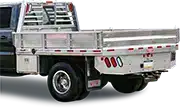
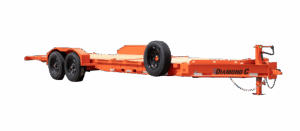
Current Diamond C choices for ordinary mini skid loads include the 7,000 lb GVWR GTU premium tandem-axle utility trailer and the GTF car hauler, which is offered in 7,000 and 9,890 lb GVWR configurations. The GTU uses two 3,500 lb Lippert brake axles, an 83-inch bed, and lengths from 14 to 20 feet. The GTF is available in 14- to 22-foot lengths, with an 83-inch bed and Lippert axle packages appropriate to its selected GVWR.
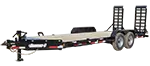
The Diamond C LPX belongs to a substantially heavier equipment-trailer class. Current LPX bumper-pull configurations begin at 16 feet and 15,500 lbs GVWR, with two 7,000 lb Lippert axles standard and heavier packages available. It can be a useful choice when a contractor also hauls larger compact equipment, but it is considerably more trailer than a small TX 525 ordinarily requires. A heavier trailer also demands more from the tow vehicle and reduces available payload by its own increased empty weight.
Ramp Angle: The Spec That Kills Deals
Mini skid steers ride on rubber tracks, and their loading behavior differs from that of a wheeled mower or compact tractor. The undercarriage, attachment, and rear operator platform must clear the transition from the ground to the ramp and from the ramp to the deck. If the approach or breakover angle is too sharp, the machine can drag, lose traction, or become high-centered at the transition.
The loading geometry is controlled by the ramp or gate length, trailer deck height, rear transition design, ground conditions, and the machine’s own ground clearance and departure angle. A dovetail can soften the transition, but its length and angle matter. A low deck can help, but it does not make a short or lightly constructed ramp suitable for every tracked machine.
Ramp capacity is just as important as ramp angle. A tracked machine applies concentrated loads as it moves from the ground onto the ramps. Do not infer ramp capacity from trailer GVWR. Confirm that the manufacturer approves the particular ramp or gate system for the machine’s weight and track loading. The ramp rating, hinge structure, supports, deck, and rear frame all must be adequate.
Longer ramps generally reduce the approach angle. A 60-inch ramp reaching a given deck height will be steeper than a 72- or 84-inch ramp reaching the same height. However, a simple length recommendation cannot guarantee clearance because machine geometry and the trailer’s rear transition vary. Measure the loaded deck height and compare it with the machine’s ground clearance, track length, attachment position, and departure angle.
A dovetail can make a meaningful difference. The current Diamond C LPX, for example, uses a 24-inch dovetail and is offered with equipment-loading ramp systems, including its standard extra-wide heavy-duty flip-knee ramps and optional MAX Ramps. Current ramp packages and capacities can vary by trailer configuration, so they should be confirmed on the specific trailer rather than assumed from a model name alone.
Utility-trailer ramp gates also vary. The Diamond C GTU uses an EZ Bi-Fold Gate, while H&H rail-side utility configurations use their own rear-gate designs. A mesh gate that works well for mowers is not automatically suitable for a 3,000- or 4,000-lb tracked loader. Confirm both the gate’s rating and the machine’s clearance before purchase.
The best test is a controlled loading demonstration on level, firm ground. Use the attachment position prescribed by the machine manufacturer, keep bystanders clear, travel slowly, and follow both the machine and trailer manuals. Do not improvise with loose boards, blocks, or unsupported ramp extensions at a muddy jobsite.
Tie-Down Points and D-Ring Placement
Mini skid steers do not all share the same transport points. Approved tie-down locations vary by manufacturer and model, and a convenient-looking hydraulic cylinder, lift arm, step, hose guard, or attachment plate may not be a structural securement point.
Use the transport instructions and marked tie-down locations in the operator’s manual for the exact machine. Lower the loader arms and attachment into the prescribed transport position, shut the machine down, remove the key, engage the parking brake when instructed, and relieve hydraulic pressure before applying the securement devices. Articulating or movable attachments may require separate restraint.
Your trailer needs anchors positioned so the chains or rated straps can pull in useful forward, rearward, and lateral directions without rubbing tires, tracks, hoses, or sharp deck edges. Four properly placed anchors are often a practical arrangement, but the number and type of securement devices must follow the machine manufacturer’s instructions and any regulations applicable to the operation.
Do not specify an anchor only by its bar diameter. The D-ring, weld, mounting plate, deck structure, chain, hooks, binders, and attachment points must all have adequate working load limits. The securement system is limited by its weakest component. Inspect every component for bent hardware, cracked welds, stretched links, damaged webbing, illegible tags, or excessive wear before use.
Diamond C and H&H trailers may be equipped with D-rings, stake pockets, rub rails, or other anchor arrangements depending on model and option package. Confirm the number, location, and rated capacity on the actual trailer. If the anchors do not line up well with the machine’s approved transport points, select a different configuration or have properly engineered anchors installed rather than accepting poor chain angles.
Federal cargo-securement rules apply to commercial motor vehicles operating in interstate commerce. Equipment weighing less than 10,000 lbs may be secured under the applicable general freight provisions or the equipment-specific provisions, depending on the operation. State and intrastate requirements can also apply. Commercial operators should build their securement procedure around the applicable rules and the equipment manufacturer’s instructions, not a universal assumption that any four chains are automatically sufficient.
What About a Single-Axle Trailer?
A properly rated single-axle trailer can be a legitimate option for a lighter compact utility loader, but the decision must be based on the complete payload calculation. A Toro TX 525 weighs approximately 1,904 to 2,001 lbs without an attachment, depending on track configuration. After adding a bucket, tools, securement equipment, and the trailer’s own weight, a 2,990 or 3,500 lb GVWR trailer can run out of capacity quickly.
A 6,000 or 7,000 lb GVWR single-axle trailer may provide more usable payload, but GVWR alone does not establish suitability. Verify the axle, tires, wheels, springs, frame, coupler, deck, ramp system, brakes, and certification label. The trailer also must be long and wide enough to position the machine correctly and obtain stable tongue weight.
Single-axle trailers can be easier to maneuver in tight residential locations, but they are less forgiving of poor fore-and-aft loading. Moving a dense tracked machine only a few inches can materially change hitch load. A tandem-axle trailer generally provides a longer load-balancing zone and more tire contact, but tandem axles do not excuse overloading or eliminate the need to stop safely after a tire failure.
For machines above roughly 2,500 lbs, a tandem-axle trailer is usually the more practical choice, especially for frequent commercial use. That is a recommendation rather than a legal weight threshold. A lighter machine may still benefit from tandem axles, while a heavier machine can only use a particular trailer if every applicable rating and loading requirement is satisfied.
Do not rely on a fixed claimed price difference between single- and tandem-axle trailers. Pricing changes with steel costs, axle packages, brakes, tires, ramp systems, flooring, options, freight, and dealer inventory. Compare current out-the-door quotations for trailers equipped to perform the same job.
Trailer Brands That Fit This Job
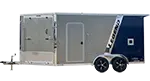
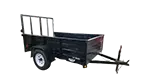
For mini skid steer hauling, the correct trailer depends on the machine, attachment, desired deck length, and loading system. These current product families cover several useful weight classes:
| Trailer | Deck | GVWR | Loading System |
|---|---|---|---|
| Diamond C GTU | 14-20 ft x 83 in. | 7,000 lbs | EZ Bi-Fold Gate |
| H&H Rail Side Utility | 14-24 ft; widths vary by configuration | Up to 7,000 lbs | Rear ramp gate; configuration varies |
| Diamond C GTF | 14-22 ft x 83 in. | 7,000-9,890 lbs | Equipment-loading ramp options vary by build |
| H&H Heavy Duty Rail Side Utility | 14-24 ft x 82 in. | 9,900 lbs | Rear ramp gate; configuration varies |
The Diamond C GTU is a sensible starting point for lighter and mid-sized mini skid combinations that fit within its actual payload. It uses two 3,500 lb Lippert brake axles and a 4-inch channel frame. Its 14-, 16-, 18-, and 20-foot lengths give buyers several load-balancing options. The bi-fold gate must still be confirmed for the exact tracked machine and loading conditions.
The Diamond C GTF provides an open car-hauler-style deck and is available with higher GVWR configurations than the GTU. Depending on the selected package, it can offer more useful payload for a heavier mini skid and attachment. Verify the ramp package, dovetail or rear-deck configuration, empty weight, and certified GVWR on the individual trailer.
For contractors who also haul larger compact loaders, excavators, or heavier attachments, the Diamond C LPX may be worth considering. It is an extreme-duty low-profile equipment trailer with current GVWR choices from 15,500 to 24,000 lbs, lengths beginning at 16 feet, an 80- or 82-inch bed depending on configuration, and Lippert axles. That extra capacity is valuable only when the tow vehicle, receiver, hitch, brake controller, and driver’s licensing requirements also match the heavier combination.
Whatever model you choose, inspect the certification label and build sheet. Model-family descriptions do not identify the exact curb weight, payload, ramp package, tire rating, or installed options of every trailer sitting on a dealer lot.
Tow Vehicle Considerations
A half-ton truck may be capable of towing some 7,000 or 9,990 lb GVWR trailers, but neither the truck class nor the trailer’s advertised GVWR proves that a particular combination is legal or safe. Check the tow vehicle’s certification labels, owner’s manual, manufacturer towing guide, gross vehicle weight rating, gross axle weight ratings, gross combined weight rating, conventional trailer rating, receiver rating, and maximum allowable tongue weight.
Tongue weight must be measured or calculated from the loaded trailer, not guessed from the machine alone. For conventional bumper-pull trailers, a commonly used target is approximately 10% to 15% of the loaded trailer weight, subject to the tow vehicle and trailer manufacturers’ instructions. A 6,000 lb loaded trailer might therefore place roughly 600 to 900 lbs on the hitch, but the actual figure depends on machine position, attachments, deck geometry, and other cargo.
That tongue weight also counts as load carried by the truck. Passengers, tools, hitch hardware, fuel, and cargo consume available payload and can overload the truck’s rear axle before the advertised trailer-tow rating is reached. A three-quarter-ton or one-ton truck generally offers more payload, axle capacity, receiver capacity, and braking reserve, but its labels and towing guide still control.
Use a receiver, ball mount, hitch ball, coupler, safety chains, and breakaway system rated for the loaded combination. Receiver classes are broad categories, and their ratings are not universal. A particular Class IV receiver may be appropriate for some 10,000 lb combinations, but the rating stamped on the receiver and hitch components is more important than the class name. Match the ball diameter to the coupler; many trailers in this category use a 2-5/16-inch coupler, but the actual coupler marking controls.
A weight-distribution hitch is not automatically required or automatically permitted. Follow the truck, receiver, and trailer manufacturers’ instructions. Some combinations require weight distribution above a specified trailer or tongue weight, while certain trailer structures or surge-brake systems may have restrictions.
Indiana requires a trailer or semitrailer with an actual gross weight of at least 3,000 lbs, when operated on a highway, to have brakes adequate to control, stop, and hold it. The brakes must be controllable from the tow vehicle’s cab and must apply automatically in an accidental breakaway. A functioning compatible brake controller and charged breakaway system are therefore essential for the loaded trailers discussed here.
For commercial driving, do not treat 10,001 lbs as an automatic CDL threshold. A Class A CDL generally becomes relevant when the combination has a gross combination weight rating of 26,001 lbs or more and the towed vehicle has a GVWR greater than 10,000 lbs, subject to federal definitions, use, and any applicable exemptions. A trailer exceeding 10,000 lbs GVWR does not by itself create that Class A threshold if the rated combination remains below 26,001 lbs. Commercial vehicle, DOT-number, medical-card, insurance, inspection, and hours-of-service requirements can arise under different thresholds and should be reviewed separately for the operation.
What Spencer Trailers Has in Stock
We carry Diamond C and H&H trailers at our lot in Spencer, Indiana, including tandem utility, car-hauler, and equipment configurations that can work well for mini skid steers. Inventory changes, so call us at (812) 829-0226 before you make the drive. Tell us the exact machine model, track configuration, attachment, machine weight, and tow vehicle, and we will confirm what is currently available.
You can also browse current inventory online or send us a message with your machine weight and hauling setup. We will help you compare certified GVWR, actual payload, deck dimensions, axle and tire ratings, ramp capacity, loading angle, tie-down placement, tongue weight, and tow-vehicle limits before you buy.
If you already own a trailer and are not sure it is right for a machine you are considering, bring us the information from its certification label along with the machine and attachment specifications. We will compare the ratings and loading geometry and give you a straight answer about whether the combination works or whether an upgrade is needed.
Indiana residents must apply for title and register a newly acquired, unregistered trailer within 45 days of purchase or acquisition to avoid the applicable administrative penalty. Keep the purchase paperwork, title documents, and trailer identification information together so the process does not get delayed.
The right mini skid trailer is not simply the shortest deck the machine will fit on. It is the trailer that carries the complete configured load within every rating, lets the machine load without striking the deck transition, provides properly positioned rated anchors, produces manageable tongue weight, and remains within the tow vehicle’s limits. Work through those numbers before buying, and the trailer will support the machine instead of becoming the weak link in your operation.


