



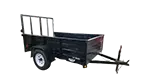

You back your dump trailer up to the pile, hit the switch, and the bed hesitates, rises crooked, or refuses to move. The immediate problem may look like a hoist failure, but cylinder count is only one part of the diagnosis. A weak battery, poor electrical connection, low or contaminated hydraulic fluid, a sticking tailgate, an overloaded body, material packed ahead of the hinge, uneven ground, damaged pivot hardware, or an improperly distributed load can all make a dump trailer strain or twist during the lift cycle.
Single-cylinder and dual-cylinder systems do behave differently, but neither configuration automatically wins. The mounting location, cylinder size, hoist geometry, hydraulic power unit, frame construction, body structure, hinge design, dump angle, and factory-rated capacity matter more than the number of cylinders by itself. Here is how to evaluate the complete system and choose a dump trailer that fits the work you actually perform.
How a Dump Hoist Actually Works
A dump trailer’s hydraulic pump sends pressurized fluid to one or more cylinders. The cylinder then converts that hydraulic pressure into linear force. In a direct-push telescopic system, the cylinder acts directly between the trailer frame and the front portion of the dump body. In a scissor-hoist system, the cylinder moves a hinged linkage that transfers lifting force into the body. In either design, the dump body rotates around its rear hinge as the hoist extends. The greatest demand commonly occurs near the beginning of the lift, when the load’s center of gravity is far from the rear hinge and the hoist has less favorable mechanical leverage.
Modern dump trailers use several factory-engineered arrangements, including front-mounted multi-stage telescopic cylinders, single-cylinder scissor hoists, and twin direct-push cylinders. A telescopic cylinder nests several stages inside one another so it can provide a long extension from a comparatively short retracted package. A scissor hoist uses a linkage to obtain the required body travel from a conventional cylinder. Many trailer systems are power-up and gravity-down, meaning hydraulic pressure raises the body and gravity returns it, although power-down configurations are also available on selected trailers. The important comparison is the complete hoist and frame design, not cylinder count in isolation.
Single Cylinder Hoists: Capable and Common
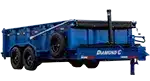
A single-cylinder system normally places the lifting force near the trailer’s centerline. It may use a front-mounted telescopic cylinder that pushes directly on the dump body or a cylinder operating through a scissor linkage. Diamond C currently uses front-mounted telescopic-cylinder technology throughout much of its dump lineup. That includes the 6,000 lb GVWR GST Single Axle Telescopic Dump, the 9,890 lb GVWR MDT Medium Duty Telescopic Dump, the 15,500 to 24,000 lb GVWR LPT Heavy Duty Telescopic Dump, and heavier DOD and WDT configurations. Stage count, cylinder dimensions, pump specifications, and available options can vary by model year and build, so the trailer’s current factory specification and VIN-specific build information should control.
The main advantage is a lower component count. One cylinder generally means fewer cylinder seals, fewer mounting points, and fewer hydraulic connections than a comparable twin-cylinder layout. That can simplify troubleshooting and replacement. It does not make every repair inexpensive, however. A heavy multi-stage telescopic cylinder, matched hydraulic power unit, specialized mounting hardware, or model-specific replacement assembly can cost substantially more than a basic single-stage cylinder. Parts and labor prices vary by cylinder size, manufacturer, freight, accessibility, and whether related hoses, pins, bushings, wiring, batteries, or hydraulic components also need attention.
A properly engineered single-cylinder system is not limited to light-duty work, and it should not automatically be rejected because a load might be slightly imperfect. A front-mounted telescopic cylinder can provide strong leverage near the front of the body and transfer force through an engineered centerline load path. Diamond C specifically uses that layout to reduce stress on the main frame and improve performance with imperfectly balanced material compared with its traditional scissor-hoist designs. That does not make side-loading safe. Every dump trailer can become unstable when material is concentrated heavily on one side, the trailer is parked across a slope, or part of the load hangs in the body while the opposite side releases. Payload is determined by the trailer’s certified ratings and actual empty weight, not by whether it has one cylinder or two.
Dual Cylinder Hoists: Stability Under Pressure
A dual-cylinder hoist uses two lifting cylinders, commonly positioned on opposite sides of the trailer centerline. In a properly designed system, the two lift points can share the work and transfer force into separate areas of the body or subframe. The cylinders may be connected in parallel or controlled through additional hydraulic components. They are not automatically synchronized simply because they share a pump. Flow dividers, mechanically linked structures, matched cylinders, or other equalization methods may be used on a particular design, but those components should never be assumed without checking the manufacturer’s hydraulic schematic and specifications.
The potential benefit is distributed lifting force. When both cylinders extend at the intended rate and the trailer remains properly loaded, two lift points can reduce the amount of force concentrated at one mounting location. The limitation is that differences in cylinder friction, hose restriction, trapped air, seal condition, mounting alignment, or load resistance can allow one side to move ahead of the other. A twin-cylinder arrangement therefore does not guarantee that the body will remain level under a severely off-center load. Loading dense material against one corner and relying on the second cylinder to correct the imbalance is unsafe operating practice.
Current manufacturer lineups also show why buyers should not equate heavy-duty capacity with two cylinders. H&H offers its Industrial Dump Trailer with a scissor hoist and also sells Telescopic I-Beam and TOPLINE Telescopic dump models with front-mounted telescopic systems. Diamond C’s LPT uses a heavy-duty front-mounted telescopic cylinder across factory GVWR packages from 15,500 to 24,000 lb, while its current WDT is published in the 25,000 to 30,000 lb GVWR range with a telescopic hoist. Diamond C premium trailers use Lippert axles as standard. Liberty dump-trailer hoists and structural specifications vary by model, size, GVWR package, and production configuration, so the certification label and build sheet should be checked instead of applying one specification to every Liberty dump.
The trade-off with two cylinders is the additional number of components that must remain healthy and balanced. There are two cylinder assemblies, additional pins and mounts, more seals, and usually more hose and fitting connections. If one cylinder begins bypassing internally, binds at a pivot, receives restricted flow, or develops a leak, the body may rise unevenly. A flow divider requires inspection only when the trailer is actually equipped with one; there is no universal annual calibration requirement that applies to every dual-cylinder dump trailer. Follow the manufacturer’s service schedule, inspect both sides for equal movement, and stop immediately if the body begins to rack or one cylinder leads noticeably.
Scissor vs. Telescopic: The Context That Changes Everything
A scissor hoist is usually a centered assembly operated by one conventional hydraulic cylinder. The linkage folds compactly beneath the body and converts cylinder travel into body rotation. Scissor systems are common because they can be packaged cleanly between the frame rails and can deliver dependable lifting when matched correctly to the trailer. They also contain several pivots and bushings that must remain aligned and lubricated. Because lifting force is transferred through the scissor structure and its mounting points, frame and subframe design are critical. A larger advertised hoist does not compensate for weak mounting structure or neglected pivot hardware.
A front-mounted telescopic hoist takes a more direct approach. The multi-stage cylinder pushes near the front of the dump body, providing favorable leverage and fewer linkage pivots. The nested stages supply the long stroke needed to reach the trailer’s designed dump angle while fitting within the available space when retracted. Current Diamond C telescopic dump models are generally designed around a 45-degree dump angle. The stages may extend at different speeds as effective piston area changes, but that progression is a hydraulic characteristic, not a special operator-controlled speed feature. The body should be raised only within the factory-designed operating range and never used as an improvised lifting platform.
Neither design tolerates abusive side loading. Telescopic stages must remain aligned with the direction of force; a bent stage, worn mount, twisting body, or continued operation on uneven ground can damage seals and cylinder surfaces. A scissor hoist can also bind, distort its pivots, or transfer twisting force into the subframe when the body is loaded unevenly. The safest procedure is the same with either design: keep the tow vehicle and trailer aligned on firm, level ground, distribute material as evenly as practical, remain within the certified payload, release the tailgate correctly, keep people clear, and stop the lift if the body twists, stalls, or rises abnormally.
A Side-by-Side Look
| Factor | Single Cylinder | Dual Cylinder |
|---|---|---|
| Load stability | Depends on hoist geometry and frame design; a centered front-mounted telescopic system can handle reasonable load imbalance effectively, but the load must still be distributed safely | Two lift points can share force, but unequal flow, friction, or loading can let one side lead; two cylinders do not make severe side-loading safe |
| Lift angle | Determined by the body hinge and hoist geometry; current Diamond C telescopic dump models commonly use a 45-degree design | Also determined by the complete trailer design; cylinder count alone does not establish dump angle |
| Cylinder replacement cost | One cylinder assembly, but multi-stage telescopic units can still be costly; obtain a model-specific parts and labor quote | Two cylinder assemblies plus additional hoses, fittings, and possible control components generally create greater parts and labor exposure |
| Best hoist pairing | Common with front-mounted telescopic systems and with centered scissor-hoist linkages | Commonly used as a twin direct-push arrangement; the equalization and mounting design must be evaluated as part of the system |
| Typical GVWR range | Used from compact dumps through heavy commercial trailers; current Diamond C telescopic applications span from 6,000 lb GVWR to WDT configurations rated as high as 30,000 lb | Available on selected light, medium, and heavy models from various manufacturers; not a reliable indicator of GVWR or payload by itself |
| Maintenance complexity | Fewer cylinder assemblies and connections, although a telescopic cylinder contains multiple stages and seals that require proper alignment and clean fluid | More seals, hoses, mounts, and fittings, with additional potential for unequal cylinder movement or hydraulic imbalance |
What the Weight Numbers Actually Mean
Hoists are often marketed with ratings expressed in tons, but that number should not be treated as the trailer’s payload rating. The theoretical extension force of a hydraulic cylinder is based largely on hydraulic pressure and effective piston area, while the force actually available to raise the body is affected by mounting geometry, cylinder angle, linkage leverage, friction, the weight of the dump body, and the position of the load’s center of gravity. On a multi-stage telescopic cylinder, available thrust can also change as progressively smaller stages extend. A hoist rating is therefore meaningful only within the configuration and test conditions for which the hoist was designed.
The trailer’s legal and structural carrying capacity is established by its certified GVWR and the ratings of the frame, body, axles, suspension, wheels, tires, coupler, safety equipment, and other components. Available payload is approximately the trailer’s GVWR minus its actual empty weight, including installed options and equipment. Installing a cylinder with greater theoretical push does not increase GVWR or payload. Increasing pump relief pressure, changing cylinder dimensions, or substituting a larger hoist without written manufacturer approval can overload the body, hinge, mounts, or main frame before the hydraulic system reaches its own limit.
Factory-engineered commercial trailers match the hoist to the complete structure. Diamond C’s LPT, DOD, and WDT dump trailers use telescopic-hoist designs integrated with the intended frame and body packages. H&H currently offers both its scissor-hoist Industrial Dump Trailer and separate telescopic I-Beam and TOPLINE Telescopic models. Those are different engineered systems, not interchangeable cylinder-count upgrades. When two trailers have different prices, compare empty weight, payload, frame construction, floor and side material, axle package, tires, brakes, suspension, pump, battery capacity, charger, gate, tarp, warranty, and hoist design. Published MSRP and dealer prices change by model year, options, freight, region, and availability, so a fixed price comparison quickly becomes misleading.
Questions Worth Asking Before You Buy
What are you hauling, and how do you load it? Gravel, soil, demolition material, logs, brush, and equipment place very different demands on the body and hoist. Material dropped from an excavator should be placed progressively and as close to the centerline as practical; it should not simply be allowed to collect in one corner. Dense material can exceed payload long before the body appears full, while bulky brush may fill the body without approaching the weight limit. Ask for the trailer’s actual empty weight, calculated payload, floor thickness, side construction, hoist type, and factory-approved loading practices.
How often are you dumping per day? High-cycle work affects more than cylinder seals. The battery must supply the pump’s electrical demand, the charging system must replace the energy used between cycles, and the pump must remain within its duty-cycle and temperature limits. Inspect battery terminals, grounds, wiring, hydraulic fluid, hoses, fittings, cylinder surfaces, hinge pins, body pivots, and scissor bushings where applicable. A dual-cylinder system adds components, but a neglected single telescopic cylinder can also fail prematurely if operated with contaminated fluid, weak voltage, damaged mounts, or repeated side loading.
What’s the dump clearance at your sites? Do not estimate clearance from dump angle alone. The raised height depends on bed length, hinge location, body depth, side extensions, tarp hardware, and the hoist’s full geometry. Obtain the manufacturer’s raised-body dimensions for the exact length and configuration you are purchasing. Never raise a dump body beneath power lines, inside a low building, under tree limbs, or near another overhead obstruction. Keep the trailer connected to the properly rated tow vehicle unless the manufacturer specifically authorizes another procedure, secure the area, and never enter beneath a raised body unless the approved body-prop system is correctly installed.
Where to Start
Do not choose a single cylinder merely because the trailer is below a certain GVWR, and do not choose dual cylinders merely because the work is commercial. Current factory designs demonstrate that a centered front-mounted telescopic cylinder can serve everything from a 6,000 lb GVWR compact dump to heavy commercial configurations approaching 30,000 lb GVWR. A properly engineered scissor hoist can also be a dependable choice when its linkage, frame, hydraulic system, and rated capacity match the job. The winning setup is the complete factory-engineered package with the right payload, body, frame, axle, tire, brake, battery, pump, and hoist specifications for your material and operating conditions.
We carry dump trailers from Diamond C, H&H, Liberty, and other manufacturers across a range of factory hoist configurations. Browse our current dump trailer inventory to see which models and specifications are available, or contact us at (812) 829-0226 with the material you haul, the equipment used to load it, the weight you expect to carry, and the number of dump cycles you perform. We will help you compare the entire trailer instead of treating cylinder count as a shortcut for capacity, stability, or quality.


