











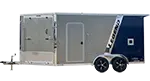
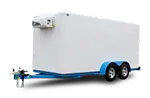


You’re setting up a jobsite and need something that will stay on-site for the duration of the project. Your foreman wants a dry, comfortable place to review blueprints, make calls, hold short meetings, and keep permits organized. Your crew needs a locked space for power tools, generators, fasteners, and materials. Those are two different problems, and contractors who try to solve both with one basic enclosed trailer often end up with an uncomfortable office and an undersized storage area.
A towable mobile office and a construction storage trailer may both start with an enclosed trailer body, but their intended use, interior systems, payload requirements, access, security, and site-compliance considerations are different. The correct choice depends on whether the trailer’s primary job is supporting people or protecting cargo.
What a Mobile Office Trailer Actually Is
A mobile office trailer is a towable or transportable workspace designed for regular human occupancy. In a cargo-based office conversion, that normally means insulation, interior wall and ceiling finishes, durable flooring, adequate lighting, heating and cooling, receptacles, a properly sized electrical panel, and an entry arrangement suitable for repeated daily use. Desks, plan tables, filing cabinets, data wiring, exterior lighting, stabilizers, and shore-power connections may also be included.
A standard enclosed cargo trailer does not automatically become a compliant office simply because insulation, an air conditioner, and furniture have been added. The completed unit may need to satisfy local building, fire, electrical, accessibility, zoning, anchoring, stair, landing, handrail, and emergency-egress requirements. Requirements vary by project owner and local authority, so contractors should confirm the rules for the actual jobsite before ordering or converting a trailer. The trailer’s highway VIN and certification label address its road-going configuration; they do not, by themselves, certify the interior as an occupied commercial workspace.
Wells Cargo’s Road Force and current Legend enclosed trailers are cargo platforms rather than dedicated office models. They can be considered as starting points for a properly engineered office-style build, but the final specification must account for insulation, HVAC loads, electrical service, added interior weight, ventilation, doors, windows, and the manufacturer’s approved options. A basic Road Force or Legend cargo trailer should not be represented as an office trailer unless it has actually been built and equipped for that purpose.
Towable cargo-based office builds commonly use 7-foot, 8-foot, or 8.5-foot-wide bodies with lengths from approximately 12 to 28 feet. Larger 40-foot and longer mobile offices also exist, but those are generally modular or semitrailer-style units delivered and set by specialized equipment rather than ordinary bumper-pull cargo trailers.
An 8.5-by-20-foot body has a gross rectangular footprint of about 170 square feet, but usable interior space is lower after accounting for wall thickness, the nose profile, cabinets, HVAC equipment, electrical components, and required clearances. It can work well for one or two people, a plan table, and basic office equipment. It becomes cramped quickly when used for full-crew meetings or when a large section of the floor is also reserved for tools.
GVWR should be selected from the finished trailer’s actual weight and the cargo that will be carried, not from length alone. Tandem-axle enclosed platforms in the 20-foot range are commonly available at 7,000, 9,900 or 9,990, and 14,000 pounds GVWR, depending on the manufacturer and configuration. Insulation, wall panels, cabinets, an air conditioner, batteries, steps, furniture, and electrical equipment all consume payload. The finished empty weight should be documented before anyone assumes how much equipment can still be carried.
What a Construction Storage Trailer Is
A construction storage trailer is designed primarily to protect and organize cargo. The interior may have engineered-wood wall lining, a plywood or composite floor, roof and wall vents, interior lights, shelves, E-track or Cross-Track, D-rings, tool cabinets, and a rear ramp or double doors. It normally does not include the insulation, finished ceiling, HVAC system, office electrical loads, or occupant-focused layout expected in a mobile workspace.
Floor capability cannot be judged by plywood thickness alone. Deck material, crossmember size and spacing, frame construction, ramp-door capacity, fasteners, and the concentration of weight under small wheels all matter. A standard 3/4-inch enclosed-trailer floor may be suitable for general tools, rolling cases, compact equipment, and distributed loads, but that does not automatically make it pallet-jack or forklift rated. Loaded pallet jacks and forklifts create concentrated wheel loads that require a manufacturer-approved floor, ramp, and frame configuration.
H&H’s current HH Series flat-top enclosed cargo lineup includes 8.5-by-20-foot configurations at 7,000, 9,900, and 14,000 pounds GVWR. Published approximate curb weights for those configurations are 3,100, 3,370, and 3,650 pounds, producing approximate payload capacities of 3,900, 6,530, and 10,350 pounds before accounting for changes or additional options. H&H’s TOPLINE enclosed cargo series extends to 24-foot bodies and offers additional heavy-duty GVWR configurations. Buyers should match the exact model and data plate rather than assuming every trailer of the same length carries the same weight.
Darkhorse Cargo’s DHW enclosed trailers are another current storage-oriented option. For example, a 2026 Darkhorse DHW 8.5-by-24-foot unit listed by Spencer Trailers carries a 9,990-pound GVWR, two 5,200-pound axles, electric brakes, a 4,350-pound listed empty weight, and a 5,640-pound listed payload capacity. Its build includes 16-inch-on-center floor and wall framing, a 3/4-inch high-performance floor, rear ramp door, four D-rings, wall and floor track, vents, interior lighting, and GPS tracking. The two axle ratings do not turn it into a 10,400-pound-GVWR trailer; the certified GVWR on the trailer’s identification label remains the controlling limit.
A storage trailer built on the same chassis as an office conversion will usually have more usable payload because it does not carry the weight of insulation, cabinetry, HVAC, desks, and a larger electrical system. That does not mean every storage trailer automatically out-hauls every office trailer. Payload always equals the trailer’s certified GVWR minus its actual loaded or empty weight, subject to axle, tire, coupler, hitch, and tow-vehicle limits.
Security: Where These Two Types Diverge Sharply
Jobsite theft is a persistent construction-industry problem. Tools, compact equipment, batteries, copper, building materials, and even entire trailers are attractive targets because they can be moved and resold quickly. Neither an office trailer nor a storage trailer is impenetrable, so security should be treated as a layered system rather than a feature promised by the trailer’s category.
A storage-oriented build can be specified without windows and with bar-lock ramp hardware, reinforced latch areas, protected padlock locations, a locked side door, GPS tracking, and interior tie-down or shelving systems that make equipment more difficult to remove. Current specifications vary considerably by manufacturer and individual build sheet, however. Buyers should inspect the actual door frame, hinges, latch rods, side-door hardware, ramp locks, roof vent, wall construction, and emergency-release provisions instead of relying on a generic claim that all cargo trailers provide “high security.”
Office trailers often have more openings, more valuable electronics, and doors selected for convenient daily entry. Windows improve daylight and visibility but add glass and additional framing that must be secured. Security film, alarms, cameras, motion lighting, GPS tracking, locked cabinets, coupler locks, wheel locks, and controlled key access can reduce risk. Any security hardware installed on an occupied trailer must still permit unobstructed emergency escape from inside; exterior bars or locks should never trap employees in the unit.
Use the storage trailer for high-value saws, compressors, batteries, and bulk tools. Keep laptops, drawings, and permits in the office trailer only when they are secured, backed up, and removed when practical. Neither trailer should be left disconnected with only a common padlock protecting it. A coupler lock, wheel immobilizer, visible site lighting, camera coverage, asset marking, and an inventory log provide much better protection together.
Use Cases by Trade
Residential and Light Commercial Contractors
Residential and light-commercial project schedules vary widely, but a 16-foot or 20-foot office-configured trailer can give the superintendent a dry, climate-controlled place to review drawings, coordinate subcontractors, conduct safety paperwork, and manage deliveries. Before choosing a size, lay out the desks, plan table, printer, filing storage, HVAC equipment, electrical panel, and required clear path to the exit. A body that looks large while empty can feel much smaller after permanent fixtures are installed.
A separate 20-foot or 24-foot storage trailer can then be selected around the actual tool inventory and material-handling method. Measure the widest and tallest equipment, calculate total loaded weight, confirm ramp capacity, and leave room for safe aisles and load securement. Long materials may require shelving or racks designed so they do not block doors, lighting, vents, electrical equipment, or emergency access.
If the site cannot accommodate two trailers, a combination unit with an office compartment at the nose and a cargo compartment behind it may work. The partition should be durable, secured to appropriate framing, and designed around ventilation and egress. Fuel, propane cylinders, flammable liquids, and gasoline-powered equipment should not be stored or operated in an occupied office compartment. A combo trailer saves space, but the office loses floor area and the cargo section loses usable length, so the compromise should be planned deliberately.
Utility and Civil Work
Utility and civil projects can expose trailers to gravel access roads, mud, repeated relocation, heavy loading cycles, and long periods without utility service. Select the trailer by certified GVWR, actual payload, tire and wheel capacity, ground clearance, frame construction, crossmember spacing, ramp rating, door opening, brake configuration, and spare-tire support. Two 5,200-pound axles can be appropriate on a 9,900- or 9,990-pound-GVWR enclosed trailer, but axle size alone does not determine whether the floor, ramp, frame, tires, or hitch are suitable for a specific machine.
Coupler type should also match the tow vehicle and the approved trailer configuration. A 2-5/16-inch ball coupler is common on tandem enclosed cargo trailers. A pintle connection may suit some commercial fleets, but it should be supplied or approved for that trailer rather than added casually in the field. The tow vehicle’s receiver, hitch rating, brake controller, GCWR, payload allowance, and tongue-weight capacity must all support the completed combination.
An office used on generator power needs more than a household extension cord. Determine the load from the air conditioner, heater, computers, printer, lighting, battery charger, microwave, and other equipment before selecting 30-amp, 50-amp, or 120/240-volt service. Use a properly installed shore-power inlet, listed distribution equipment, correct grounding and overcurrent protection, and GFCI protection where required. A portable generator should remain outdoors and away from doors, windows, and air intakes, and it should never be connected by backfeeding a receptacle. Any connection to the trailer’s electrical system should use properly designed transfer or inlet equipment installed by a qualified professional.
Event and Short-Term Deployments
Festivals, outdoor markets, temporary vendor operations, and production crews sometimes use office-configured trailers as ticket offices, administrative spaces, changing rooms, or coordination centers. Enclosed storage trailers can secure audio equipment, signs, barriers, tents, electrical distribution equipment, and vendor supplies between operating hours.
Public-facing use adds requirements that do not normally apply to a basic cargo trailer. Entry steps, ramps, landings, handrails, accessible routes, emergency exits, fire extinguishers, ventilation, occupancy limits, electrical connections, and local permits may need review. A trailer intended as a first-aid room may also need climate control, sanitation provisions, privacy, reliable power, and access suitable for the services being provided.
Rental often makes sense for a single short deployment because delivery, setup, pickup, and maintenance can be included. Ownership becomes more attractive when the same configuration is used repeatedly and the company has a secure place to store, maintain, insure, and transport the unit between events.
A Quick Comparison
| Feature | Mobile Office Trailer | Construction Storage Trailer |
|---|---|---|
| Primary use | Supervision, meetings, drawings, paperwork, communications | Tools, materials, equipment, parts, and jobsite supplies |
| Interior finish | Insulated and finished for regular occupancy, with HVAC and electrical systems sized for office loads | Engineered-wood or minimal lining, with optional shelves, track, tie-downs, vents, and lighting |
| Windows | Optional and layout-dependent; code and egress requirements vary by jurisdiction and use | Usually omitted for security, though vents or optional windows may be installed |
| Floor rating | Based on the underlying chassis and floor; permanent office equipment consumes payload | Based on decking, crossmembers, ramp, and concentrated-load limits; forklift or pallet-jack use requires approval |
| Security level | Depends on door and window hardware, locks, alarm, lighting, and site controls | Can be optimized with fewer openings, bar locks, protected hasps, GPS, and layered site security |
| Typical GVWR (20 ft) | 7,000–14,000 lbs for many cargo-based conversions; verify the completed unit’s data plate and empty weight | 7,000–14,000 lbs commonly available, with payload varying substantially by model and options |
| Example brands | Purpose-built mobile-office suppliers or properly specified conversions based on Wells Cargo, Legend, or another approved platform | H&H, Darkhorse Cargo, Wells Cargo, Legend, and United |
The Cost Question
Pricing depends on dimensions, GVWR, frame and axle package, door configuration, interior height, track systems, spare tire, GPS, shelving, electrical equipment, and current freight and material costs. At the time this guide was updated, Spencer Trailers listed 2026 Darkhorse storage-oriented enclosed trailers at approximately $8,300 for certain 7-by-16-foot, 7,000-pound-GVWR units and $13,800 for an 8.5-by-24-foot, 9,990-pound-GVWR unit. Inventory, specifications, incentives, and prices can change, so those figures should be treated as current examples rather than permanent price ranges.
An office-configured trailer costs more than the underlying cargo shell because the build may require insulation, finished walls and ceiling, HVAC, shore-power equipment, a distribution panel, receptacles, lighting, windows, cabinets, flooring, desks, stabilizers, steps, and professional labor. The correct comparison is a written quote for a completed, usable office against a written quote for a storage trailer, not a bare cargo trailer against a finished mobile workspace.
Used trailers should be evaluated by condition rather than by a fixed depreciation percentage. On an office unit, inspect the roof, seams, wall and floor moisture, HVAC operation, electrical system, windows, doors, steps, cabinets, plumbing if equipped, tires, brakes, bearings, frame, and title. On a storage trailer, inspect for soft flooring, overloaded tie-downs, damaged ramp hinges, bent crossmembers, water intrusion, wall separation, tire age, brake condition, coupler wear, and evidence that the trailer was routinely loaded beyond its rating.
There is no universal 18-month point at which buying automatically becomes cheaper than renting. Compare the purchase price, financing, tax, title and registration, insurance, maintenance, repairs, delivery, jobsite setup, storage between projects, towing cost, and expected resale value against the complete rental rate for the same period. Ownership normally makes more sense when the trailer will be used repeatedly and the company can maintain and store it efficiently. Rental may remain the better choice when the required size changes from project to project or the unit is needed only for a short mobilization.
Do not leave towing and licensing costs out of the calculation. Indiana requires brakes on trailers with a GVWR over 3,000 pounds, so the tandem 7,000-pound and heavier trailers discussed here must have properly functioning brakes. For commercial combinations, the Class A CDL threshold is based on a combination rating of 26,001 pounds or more when the trailer’s GVWR exceeds 10,000 pounds; a trailer weighing more than 10,000 pounds does not create the CDL threshold by itself. The tow vehicle, hitch, brake controller, tires, registration, insurance, and driver qualifications all need to match the selected trailer and its use.
What Spencer Trailers Carries
We carry enclosed cargo trailers from Darkhorse Cargo, H&H, Legend, United, and Wells Cargo at our location in Spencer, Indiana. Current inventory ranges from compact single-axle enclosed trailers to tandem-axle work trailers, including Darkhorse DHW models up to 8.5-by-24 feet. Exact brands, body sizes, GVWRs, axle packages, doors, interior heights, floors, track systems, and prices change as units are sold and new trailers arrive.
Most trailers sitting on the lot are storage or general cargo configurations. An office-style enclosed trailer is normally a specification and ordering discussion because the insulation, HVAC, electrical service, windows, interior finish, steps, furniture, and site requirements must be selected together. We can review the intended use, tow vehicle, project location, number of occupants, electrical loads, security needs, and cargo requirements before recommending a platform or discussing a custom build.
If you’re not sure which direction fits your project, call us at (812) 829-0226 or reach out through the contact page and describe the job. Tell us how many people will use the office, what tools or materials need to be stored, how often the trailer will move, what power is available, and what tow vehicle you plan to use. We’ll tell you honestly whether a dedicated storage trailer, an office-configured unit, or a properly planned combination trailer makes more sense. You can also browse current inventory to see what is available before you make the drive to Spencer.
One trailer rarely performs both jobs equally well. Decide whether your biggest problem is providing a safe, functional workspace or securing and transporting equipment. Solve that primary need with the correct trailer first, then add a second dedicated unit when the project size and workload justify it.

