








You’ve got a killer recipe, a loyal following at the farmers market, and a friend who keeps saying “you should take that on the road.” So you start looking at food trailers and immediately hit a wall of questions: How big does the trailer need to be? Where does the generator go? Do I need a permit before I even buy the thing? And what’s the difference between a purpose-built concession trailer and converting an enclosed cargo trailer?
These aren’t small questions. The wrong answers can cost you time, money, payload capacity, or an opening date. The right trailer depends on your menu, equipment list, expected crew, operating locations, power source, water demand, and tow vehicle. Here’s what you actually need to know before you commit.
Start With the Base: Enclosed Trailers vs. Purpose-Built Concession Units
Many concession trailers use the same basic construction methods as enclosed cargo trailers: a welded steel or aluminum frame, exterior skin, roof, floor system, side entry door, and rear ramp or cargo doors. The similarities end once the unit is equipped for commercial food service. Serving openings, plumbing, electrical distribution, propane systems, ventilation, fire suppression, washable interior finishes, appliances, counters, and water tanks all affect the finished structure and weight.
A purpose-built concession trailer is ordered with the intended food-service layout incorporated during manufacturing or completed by a qualified concession builder. Serving windows, equipment supports, wiring pathways, plumbing provisions, ventilation framing, and interior finishes can be planned before the walls are closed. This approach is efficient when you already know your menu and workflow, and it reduces the chance that later modifications will cut through structural members or interfere with wiring. The tradeoff is higher initial cost and less flexibility if your concept changes.
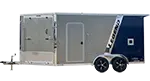
A straight enclosed cargo trailer gives you a blank slate, but the base trailer must be selected with the finished conversion in mind. Wells Cargo offers several enclosed steel-frame product families in useful concession sizes, including tandem-axle models in 7-foot and 8.5-foot widths. United Trailers builds commercial enclosed trailers with extensive factory customization options. Darkhorse Cargo also offers enclosed trailers that may be suitable for vending or food-service conversions when ordered with the necessary frame, axle, floor, and height configuration. Legend Manufacturing produces all-aluminum enclosed models that reduce corrosion concerns and can provide useful payload efficiency, although aluminum construction does not eliminate the need for sealed, smooth, nonabsorbent food-service finishes.
The honest take: start with a complete menu, equipment schedule, utility plan, and scaled floor plan before choosing either route. A professionally designed conversion can give you precise placement of the service window, electrical panel, tanks, sinks, refrigeration, cooking appliances, and storage. However, cutting openings or adding major equipment can affect the trailer’s structure, warranty, weight distribution, and certification. Coordinate with the trailer manufacturer, concession builder, local health department, building officials, and fire authority before irreversible work begins.
Size and GVWR: Don’t Guess
Commercial kitchen equipment is heavy, and catalog weights vary widely. A commercial range or oven may weigh several hundred pounds. Stainless sinks, tables, refrigerators, freezers, fryers, griddles, hood components, fire-suppression equipment, batteries, electrical panels, propane cylinders, generators, water tanks, food, and packaging all count against available payload. Water alone weighs about 8.34 pounds per gallon, so 30 gallons of fresh water weighs approximately 250 pounds. Wastewater collected during service adds weight even as fresh water is consumed.
This is why the GVWR conversation matters before you pick a trailer. GVWR is the maximum allowable loaded weight of the trailer, not the amount of cargo it can carry. Payload is approximately the trailer’s GVWR minus its actual empty or curb weight, and a conversion increases that empty weight permanently. A nominal 7,000-pound tandem-axle trailer that weighs around 2,000 pounds before conversion may begin with roughly 5,000 pounds of theoretical payload, but the final capacity must account for every installed component and the limits shown on the finished trailer’s certification and tire-loading labels.
Do not rely on a generic weight published for another trailer of the same length. Options such as additional height, heavier wall and roof framing, thicker flooring, windows, cabinets, insulation, air conditioning, larger axles, and finished interiors change empty weight. Obtain a certified scale weight after the conversion is complete, then weigh the operating trailer with water, fuel, propane, food, supplies, and equipment aboard. Verify the total trailer weight, individual axle loads, tire capacities, wheel ratings, and tongue weight. None of those limits may be exceeded.
Many food trailer operators consider sizes from approximately 7×16 through 8.5×20, but that is a planning range rather than a rule. A compact menu may work in a smaller unit, while a multi-station kitchen may require more width, length, interior height, and GVWR. A 7-foot-wide trailer can be easier to maneuver, while an 8.5-foot-wide trailer offers more aisle and equipment space but is wider, heavier, and usually more demanding to tow. Choose the finished floor plan first, calculate the loaded weight conservatively, and retain useful capacity for future equipment and inventory.
Power: Generator, Shore Power, or Both
Power is where mobile food operations get complicated fast. The practical options are an onboard or properly separated generator, shore power supplied by an event or commissary, or a system designed to use either source. Solar panels and batteries can support lighting, controls, point-of-sale equipment, or limited refrigeration in some builds, but they do not automatically replace a generator or adequate shore service for high-draw cooking and HVAC loads.
Generator size cannot be selected from trailer length alone. Create an electrical load schedule listing every appliance’s voltage, running amperage or wattage, starting demand, duty cycle, and whether it may operate simultaneously. Electric fryers, water heaters, air conditioners, refrigeration compressors, hood fans, warmers, and cooking appliances can create substantial loads. A single commercial electric fryer can consume more power than a small portable generator can provide. Fuel-fired cooking equipment reduces electrical cooking demand but introduces propane, combustion-air, ventilation, carbon-monoxide, and fire-code requirements.
A generator’s advertised wattage is not necessarily its continuous usable output, and motors or compressors can require additional starting capacity. The electrical system also needs correct overcurrent protection, grounding and bonding, conductor sizing, transfer or source-selection equipment, and ground-fault protection where required. Have a qualified electrician calculate the load and design the system in accordance with the applicable electrical code and the requirements of the authority having jurisdiction.
Generator placement matters. An engine-driven generator must not discharge exhaust into the occupied trailer or toward doors, serving openings, air intakes, neighboring units, or customer areas. A permanently mounted generator requires a properly engineered exterior compartment or mounting arrangement with appropriate ventilation, heat protection, fuel-system design, exhaust routing, service access, and separation from the food-service interior. Portable generators must be operated outdoors in an approved location and protected from customer contact. Follow the generator manufacturer’s clearances and the fire authority’s placement rules, and provide listed carbon-monoxide detection where required.
Shore power is often provided through a listed inlet and appropriately rated cord set. A 50-amp, 120/240-volt service can theoretically provide up to 12,000 volt-amperes when a true 120/240-volt supply is available, but that does not mean every venue supplies that service or that the full rating is available for continuous loads. Some event hookups provide only 120 volts, lower amperage, or shared circuits. Confirm the receptacle type, voltage, frequency, available current, grounding arrangement, cord-length limit, and generator policy with every venue. Wiring for compatible shore power during the initial build is generally easier than adding it after cabinets and wall finishes are installed.
Water: Fresh, Gray, and Health Department Math
Your menu and local regulatory authority determine the required water-system capacity. Indiana’s food rules require enough hot and cold potable water for food preparation, handwashing, utensil washing, cleaning, and the full planned operation. There is not one universal minimum fresh-tank size that fits every mobile food business. A unit selling only qualifying prepackaged products may have different facility requirements from a trailer preparing raw ingredients and washing cookware throughout the day.
When liquid waste is generated, Indiana requires a permanently installed wastewater retention tank with at least 15 percent more capacity than the water-supply tank. A 30-gallon fresh-water tank therefore requires at least 34.5 gallons of wastewater capacity; selecting a nominal 40-gallon tank can provide additional operating margin. The tank must be properly installed, drainable, protected from contamination, and serviced without discharging wastewater while the unit is moving.
Hot water is essential whenever sinks and food-service procedures require it. The water heater must recover quickly enough to supply the handwashing sink and warewashing operation during peak use. Some Indiana county guidance specifies a minimum tank-type capacity or accepts an on-demand heater that can continuously maintain the required supply and temperature. Do not assume a compact on-demand heater is adequate merely because it fits: confirm its fuel type, flow rate, temperature rise, venting, electrical demand, listing, and approval with the health and fire authorities.
Plumbing should be planned before walls, counters, and equipment are permanently installed. Materials must be approved for potable water use and installed according to the manufacturer’s requirements. PEX is frequently selected for mobile applications because it is flexible and easier to route than rigid pipe, but no plumbing system should be allowed to freeze. Tanks, pumps, hoses, fill connections, vents, backflow protection, and drains must be accessible for inspection, cleaning, sanitizing, winterization, and repair.
The potable-water fill equipment must be protected from contamination and used only for drinking water. Wastewater connections should be clearly different from and positioned to avoid contaminating potable-water fittings. Wastewater must be discharged into an approved sanitary sewer or at an approved commissary or servicing location, never onto pavement, into a storm drain, or onto the ground. Confirm whether your operation must return to an approved commissary or servicing area each operating day.
Permits: The Step Most People Skip Until It’s Too Late
Indiana mobile food regulation involves the state food code and the regulatory authority responsible for the location where you operate. In practice, operators commonly work with a county or local health department for plan review, licensing or registration, and a pre-operational inspection. Do not assume that one generic state permit automatically authorizes operation in every Indiana county or municipality. Current statewide registration, reciprocity, and local licensing rules should be confirmed with the Indiana Department of Health and each relevant local authority.
A new build, remodel, or cargo-trailer conversion generally requires plan review before construction. The submission may include a scaled floor plan, complete menu, equipment specifications, plumbing and water-system details, electrical service, mechanical ventilation, commissary or servicing agreement, finish materials, and operating procedures. The menu drives the equipment and facility requirements, so regulators cannot meaningfully approve a trailer based only on its exterior dimensions.
Submit the proposed layout before cutting the serving window, purchasing appliances, or closing the walls. After plans are approved, material changes may need additional approval. A completed unit normally must pass a pre-operational inspection before food service begins. Some jurisdictions request applications at least 30 days before the planned opening, and review time can increase when documents are incomplete.
Beyond food-safety approval, counties, cities, and event organizers may impose zoning, vendor, business, parking, commissary, and event-specific requirements. Owen County procedures may differ from Monroe County procedures, and Indianapolis events may have additional organizer or municipal rules. If you plan to travel, maintain a permit-tracking file showing the responsible authority, application deadline, fee, inspection status, expiration date, commissary documentation, and event requirements for every operating location.
Fire code is separate from health code. Propane cylinders and piping, fuel-fired appliances, generators, electrical systems, cooking that produces grease-laden vapors, commercial hoods, and fire-suppression systems may require review or inspection by the local fire department or other authority having jurisdiction. A hood and listed suppression system may be required based on the appliances and cooking process, not simply the trailer’s size. Ask the relevant fire authority about extinguishers, carbon-monoxide alarms, cylinder placement, emergency shutoffs, generator clearances, exhaust termination, and inspection documentation before finalizing the equipment package.
Layout Principles That Actually Work
The most common layout mistake is designing around where equipment fits rather than how the crew will actually work. A good food trailer layout follows the logic of the menu: receiving and cold storage, preparation, cooking, holding, assembly, service, warewashing, and waste handling. Raw-food movement should not cross ready-to-eat food or clean utensil storage, and employees should be able to reach the dedicated handwashing sink without obstruction.
For a 7×16 trailer, one possible layout puts the service window on the curb or passenger side, cooking appliances and the approved hood along one wall, preparation and assembly surfaces near the service area, refrigeration near an access point for restocking, and sinks where plumbing runs remain short and serviceable. That is only an example. Window location, exit access, axle position, wheel boxes, tongue weight, customer queue direction, appliance clearances, and the approved workflow may justify a different arrangement.
Heavy items such as water tanks, generators, batteries, refrigerators, and propane systems must be positioned with weight distribution in mind. Do not simply place every utility component on the tongue or at the rear. The completed trailer needs stable side-to-side loading and suitable loaded tongue weight without exceeding the hitch, receiver, tow vehicle, jack, frame, tire, axle, or GVWR limits. Secure equipment for transport using mounts designed for the expected road loads.
Ceiling height matters more than most people think. Interior height varies by manufacturer, model, width, roof design, and optional height package; it should be verified on the actual build order rather than assumed from the exterior description. A commercial hood occupies space above and in front of the cook line, while air-conditioning equipment, lighting, ductwork, and ceiling finishes can reduce usable clearance. Extra interior height can improve comfort and equipment clearance, but it also adds wall area, cost, weight, wind exposure, and sometimes overall travel height.
Plan for staff movement with doors, refrigerator drawers, oven doors, and cabinet doors open. Protect required exits and keep access to electrical disconnects, propane shutoffs, fire extinguishers, suppression-system controls, water pumps, drains, and service panels unobstructed. The finished floor, walls, ceilings, counters, and equipment surfaces must meet the applicable requirements for durability, cleanability, moisture resistance, and food safety.
What to Ask Before You Buy
- What are the exact GVWR, GAWR, tire ratings, wheel ratings, empty weight, and available cargo capacity for this specific VIN and option package?
- What are the floor construction, crossmember spacing, concentrated-load limits, and approved methods for mounting heavy appliances, tanks, and equipment?
- What material is used for the floor substrate, and how will seams, fastener penetrations, wall junctions, and service openings be sealed against moisture?
- Does the trailer come with an unfinished cargo interior, or can it be ordered with smooth, durable, nonabsorbent, and easily cleanable food-service finishes approved by the regulatory authority?
- What axle rating and brake configuration does the trailer have? Indiana requires adequate brakes on a trailer or semitrailer with a gross weight of at least 3,000 pounds, operable from the towing vehicle, along with automatic breakaway application as required by law.
- Does the tow vehicle have a compatible brake controller, correctly rated hitch and receiver, suitable electrical connection, and enough payload capacity for passengers, cargo, and loaded tongue weight?
- Can the manufacturer or an approved upfitter frame the serving-window, hood, air-conditioner, and utility openings before delivery without compromising structural members or warranty coverage?
- Will the completed conversion receive updated weight information, applicable certification, operating manuals, wiring diagrams, plumbing diagrams, and inspection documentation?
- Who is responsible for health-department plan review, fire review, electrical work, propane-system inspection, hood and suppression certification, and the final pre-opening inspection?
If you’re working through a builder for a custom concession conversion, get a project scope in writing that specifies materials, manufacturers, model numbers, listings, capacities, installation standards, warranty responsibilities, and inspection deliverables, not just outcomes. “Food-safe wall panels” is not a complete specification. The agreement should identify the panel material, substrate, adhesives, trim, seam treatment, temperature limitations, cleanability, and approval responsibility.
A Quick Comparison: Common Base Trailer Options
| Trailer | Size | GVWR | Best For |
|---|---|---|---|
| Wells Cargo FastTrac | 7×16 configuration | Typically 7,000 lb in current tandem-axle 7-foot-wide configurations; verify the specific model and VIN | Light vending or a carefully weight-budgeted concession conversion |
| United UXT | 8.5×20 configuration | Configuration-dependent; axle, tire, frame, and GVWR packages must be confirmed on the build order | Custom commercial build requiring more aisle and equipment space |
| Darkhorse Cargo tandem-axle enclosed | 7×14 configuration | Configuration-dependent; verify the certification label and installed axle package | Vending, merchandise, or limited-menu food service after an approved weight study |
| Legend Deluxe aluminum enclosed | 7×18 configuration | Current tandem-axle model family is offered in approximately 7,000 to 8,500 lb GVWR configurations | Operators prioritizing lower base weight and corrosion-resistant aluminum construction |
These are starting points, not guaranteed concession packages. Specifications vary by model, build year, axle option, tire and wheel package, interior height, and installed equipment. A trailer’s family name and nominal dimensions are not enough to establish payload capacity. Always confirm the current build sheet, certification label, GAWR, GVWR, tires, wheels, floor structure, curb weight, and conversion suitability with the dealer and builder before purchase.
The Tow Vehicle Question
A completed 7×16 food trailer can weigh substantially more than the empty cargo trailer on which it was based. Depending on the build, equipment, water, fuel, food, and supplies, loaded weight may reach or exceed 6,000 to 7,000 pounds. Larger commercial kitchens can be considerably heavier. Do not select a tow vehicle from trailer length or a broad label such as half-ton, three-quarter-ton, or one-ton alone.
Check the tow vehicle’s specific VIN-based ratings, including maximum trailer weight, GCWR, GVWR, rear GAWR, payload capacity, receiver rating, hitch rating, and any limits that change with passengers, cargo, bed equipment, drivetrain, axle ratio, or weight-distribution equipment. Loaded tongue weight consumes tow-vehicle payload and rear-axle capacity. The towing setup must also provide compatible brakes, breakaway equipment, safety chains, lighting, mirrors, tires, and hitch components.
Commercial operation can introduce additional requirements. Under the federal and Indiana CDL framework, a Class A CDL threshold generally applies when the combination has a GCWR or qualifying combined rating or weight of at least 26,001 pounds and the towed unit has a GVWR or qualifying weight over 10,000 pounds. A trailer rating over 10,000 pounds by itself does not automatically create that Class A CDL threshold when the qualifying combination remains below 26,001 pounds. Commercial use may still trigger USDOT-number, motor-carrier, insurance, inspection, hours-of-service, or other requirements at lower weights, particularly in interstate commerce, so confirm your specific operation with the Indiana BMV, Indiana Department of Revenue, and FMCSA.
Indiana purchasers should also title and register the trailer promptly. The state’s penalty-free title-application period is generally 45 days from acquisition; temporary permits and commercial registration classifications have separate rules. Keep the bill of sale, manufacturer’s certificate of origin or assigned title, conversion records, scale tickets, and equipment documentation together.
Don’t size your trailer only to your current truck. Size the trailer to the approved business plan, calculate its realistic operating weight, and then select a tow vehicle with adequate ratings and usable margin. An overloaded trailer or tow vehicle is a braking, handling, tire, insurance, and liability problem, not merely a performance inconvenience.
Ready to talk specifics? Browse enclosed trailers in our current inventory to see what’s available in sizes that may work for concession builds, or reach out to the team at Spencer Trailers to talk through your menu, equipment list, expected loaded weight, and towing setup before you commit to a size. Getting that conversation right early is the difference between a trailer that limits your operation and one that can support your business for years.


