







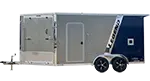
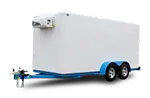
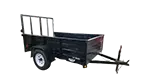

Most People Overbuy on Gooseneck. Here’s When That’s a Mistake.
Picture this: A contractor walks into a trailer dealership towing a Ford F-250. He hauls a compact excavator four or five times a year and pulls a lighter utility trailer the rest of the time. He has already decided he wants a gooseneck because his buddy has one and it looks like the more professional setup. But he has not weighed the excavator with its buckets, measured the truck’s available payload, checked the receiver rating, or compared the actual loaded weight of a bumper-pull equipment trailer with a comparable gooseneck.
He may genuinely need the gooseneck. He may also be preparing to buy a longer, heavier trailer and install an in-bed hitch that adds no useful capacity for the loads he actually moves. If the truck has an OEM gooseneck-prep package, setup may require only the correctly rated ball and safety-chain anchors. A truck without factory preparation may need a complete under-bed hitch, installation labor, bed openings, and an optional in-bed 7-way connector. The truck-side hardware is a gooseneck hitch system, not a fifth-wheel receiver unless a separate fifth-wheel assembly is being installed. :contentReference[oaicite:0]{index=0}
This happens in the other direction too. A landscaping company may run a bumper-pull dump trailer close to the ratings of its receiver, ball mount, truck payload, and rear axle every day, then wonder why the combination feels unsettled at highway speed. The cause may be excessive or insufficient tongue weight, an overloaded truck, underinflated tires, worn suspension components, an underrated hitch component, poor load placement, or a trailer that is simply too heavy for that particular tow-vehicle configuration. Changing to a gooseneck can improve the geometry, but it does not correct an overloaded or poorly maintained combination.
The decision becomes much clearer once you compare actual scale weights, hitch load, truck ratings, deck requirements, bed use, and driving conditions. Here is the full breakdown.
The Mechanical Difference Is More Important Than You Think
A bumper-pull trailer connects to a hitch ball behind the truck’s rear axle. Depending on the truck, the ball may be carried by a receiver-mounted ball mount or another manufacturer-approved conventional hitch assembly. Because the connection is behind the axle, tongue weight acts through a lever arm. As tongue weight increases, it adds load to the rear axle and can remove some load from the front axle. That does not automatically make a properly matched bumper pull unsafe, but it makes correct loading, receiver capacity, suspension condition, and any manufacturer-approved weight-distribution requirements especially important.
A gooseneck trailer extends over the pickup bed and connects to a 2-5/16-inch ball mounted in the bed, normally above or slightly forward of the rear axle. Moving the connection point forward reduces the leverage created by a conventional hitch behind the truck. That geometry is one reason a correctly loaded gooseneck often feels more settled when towing a long or heavy trailer. :contentReference[oaicite:1]{index=1}
The important correction is that a gooseneck does not make weight disappear. Its hitch load still counts against the truck’s payload, gross vehicle weight rating, rear gross axle weight rating, tire capacities, and hitch rating. A heavy gooseneck may place several thousand pounds in the bed. That can overload a single-rear-wheel pickup even when the truck has enough advertised trailer-towing capacity. The exact VIN, cab, engine, drivetrain, wheelbase, axle ratio, tire package, passengers, tools, fuel, and other cargo all affect the available capacity. The truck badge alone does not settle the question. :contentReference[oaicite:2]{index=2}
Weight Ratings: The Hard Numbers
This is where most buying decisions should start, but GVWR is only the first number. You also need the trailer’s empty weight, usable payload, axle ratings, tire ratings, coupler rating, safety-chain rating, loaded hitch weight, and the limits printed on the truck and hitch components. The current Diamond C lineup also shows why a simple “bumper pulls stop at 14,000 pounds” rule is inaccurate: several heavy-duty bumper-pull models are offered above that rating, while entry FMAX goosenecks begin at 15,500 pounds. Ratings overlap, even though the two hitch styles behave differently. :contentReference[oaicite:3]{index=3}
| Spec | Bumper Pull | Gooseneck |
|---|---|---|
| Current Diamond C GVWR examples | GTU: 7,000 lb; LPT, LPX, and HDT configurations: approximately 15,500 to 24,000 lb | FMAX configurations: approximately 15,500 to 40,000 lb; LPT-GN, LPX-GN, and HDT-GN configurations: approximately 15,500 to 24,000 lb |
| Typical loaded hitch weight | Often approximately 10 to 15% of loaded trailer weight, subject to the trailer and tow-vehicle instructions | Often approximately 15 to 25% of loaded trailer weight, subject to the trailer and tow-vehicle instructions |
| Required hitch equipment | Rated receiver, ball mount, hitch ball, coupler, pin, and safety chains; weight distribution only when approved and properly rated | Rated OEM-prep ball and anchors or an aftermarket under-bed gooseneck hitch, plus correctly rated safety chains and attachment points |
| Truck selection | Determined by the exact truck’s trailer rating, payload, GVWR, axle ratings, receiver ratings, tires, and loaded tongue weight | Determined by the same ratings, with special attention to available payload and rear-axle capacity for the in-bed hitch load |
| Backing behavior | Responds relatively quickly to steering input; familiar to many drivers but easy to overcorrect | Pivot location changes the timing of the response; often allows smoother corrections but still requires practice |
| Turning and clearance | Truck rear overhang swings opposite the turn, and the trailer can contact the bumper or body at an excessive angle | Can articulate sharply, but cab-to-neck clearance, bed-rail clearance, trailer off-tracking, and rear tail swing must be watched |
| Truck bed use | Trailer connection does not occupy the pickup bed | Trailer neck occupies bed space while coupled; removable or turnover hardware can restore most bed use after uncoupling |
| Installation variables | Many pickups already have a factory receiver, but every ball mount and hitch component still needs the correct rating and height | May require only an OEM-prep kit or may require a complete under-bed hitch installation, bed openings, and optional in-bed wiring |
Consider the hitch-load math. At a 14,000-pound actual loaded trailer weight, a conventional trailer carrying 10 to 15% on the hitch would place approximately 1,400 to 2,100 pounds on the ball. That load must fit within the receiver’s applicable weight-carrying or weight-distributing rating, the ball mount and ball ratings, and the truck’s remaining payload and axle capacity. Passengers, a toolbox, fuel, cargo, and accessories have already consumed part of that payload before the trailer is attached. The lowest-rated component controls.
At a 20,000-pound actual loaded gooseneck weight, a 15 to 25% hitch-load range would be approximately 3,000 to 5,000 pounds in the pickup bed. The connection point is better positioned for that kind of load, but the truck still needs enough payload, rear-axle capacity, tire capacity, and gooseneck-hitch capacity to carry it. A gooseneck should never be treated as permission to exceed the truck’s labels.
Legal thresholds need to be calculated separately from trailer capability. Indiana requires adequate brakes on a trailer or semitrailer with a gross weight of at least 3,000 pounds, with the brakes controllable from the towing vehicle and an automatic breakaway function. For commercial licensing, a Class A CDL is generally triggered when the combination has a GCWR of 26,001 pounds or more and the towed unit has a GVWR greater than 10,000 pounds. A 26,001-pound trailer by itself is not the wording of the Class A threshold; it is the combined rating, together with the over-10,000-pound trailer condition. Applicable farm, recreational, intrastate, and other exemptions should be checked for the specific operation rather than assumed. :contentReference[oaicite:4]{index=4}
Bumper Pull: What It Does Well
Do not let the existence of higher-capacity goosenecks talk you out of a bumper pull when the bumper-pull configuration fits your actual work. It keeps the pickup bed available, works with a conventional receiver system, and can be easier to move among compatible tow vehicles. It is also available in far more than light-duty utility-trailer form. Diamond C’s current heavy-duty bumper-pull offerings include LPT dump trailers and LPX and HDT equipment trailers with model-dependent GVWR choices from approximately 15,500 to 24,000 pounds. Those ratings do not mean every pickup can tow every configuration; they mean the trailer platform itself is available at those ratings. :contentReference[oaicite:5]{index=5}
A Diamond C LPT dump trailer can be an effective bumper-pull work trailer when the selected GVWR, loaded weight, tongue weight, receiver system, and tow vehicle all match. For equipment rather than bulk material, the LPX provides a low-profile deck and ramp-based loading, while the HDT provides a hydraulically dampened tilt deck. Current premium Diamond C lines use Lippert axle packages, with the number and rating of the axles varying by model and selected GVWR. Correct setup still includes a properly rated 2-5/16-inch ball, a level or slightly manufacturer-approved trailer attitude, functioning brakes, an adjusted brake controller, attached safety chains, and a charged breakaway system.
Bumper-pull handling depends heavily on load placement. Too little tongue weight can promote sway. Too much can overload the hitch or rear axle and reduce front-axle loading. Dense material in a dump trailer should not simply be piled wherever it fits; the load needs to remain within the trailer’s payload and axle limits while producing the hitch-weight range specified by the manufacturer. A 24,000-pound-GVWR trailer is not a 24,000-pound payload trailer, and its maximum rating does not override the tow vehicle’s lower limit.
The backing difference is real, but it is not defined by a universal jackknife angle. A bumper pull usually reacts sooner to steering corrections because the pivot is behind the truck. That can be useful when placing a shorter trailer through a gate or into a storage bay, but it also makes overcorrection easy. The safe maximum articulation angle depends on the truck, bumper, hitch extension, tongue structure, jack location, trailer body, and terrain. Drivers should stop before contact, pull forward to reset the angle, and use a spotter when clearance cannot be seen.
Gooseneck: When the Neck Earns Its Cost
The Diamond C FMAX207 and FMAX210 illustrate how much variation exists within the FMAX family. The current FMAX207 is a 15,500-pound-GVWR Flatbed Max gooseneck built with tandem 7,000-pound Lippert axles. The FMAX210 is a 25,000-pound-GVWR configuration using tandem 10,000-pound Lippert axles. Diamond C also offers other current FMAX configurations between and above those ratings, with the heaviest model-dependent packages reaching 40,000 pounds GVWR. Buyers therefore need to read the complete model code and build sheet rather than treating “FMAX” as one fixed-capacity trailer. :contentReference[oaicite:6]{index=6}
The FMAX is a flatbed gooseneck platform suitable for equipment, pallets, building materials, steel, and other properly secured cargo. Depending on model and configuration, current loading choices include systems such as MAX Ramps, XDR Ramps, hydraulic dovetails, and straight-deck arrangements. Contractors who want a lower equipment deck can also compare an LPX-GN, while operators who frequently load rolling equipment without handling ramps may prefer an HDT-GN tilt configuration. A gooseneck is not automatically the right trailer for every skid steer or mini excavator, but the available deck lengths, higher model ratings, and connection geometry make it the appropriate category for many heavier combinations. :contentReference[oaicite:7]{index=7}
Only the gooseneck’s hitch load is transferred into the pickup bed; the trailer axles still carry most of the trailer’s weight. Placing the hitch load over or slightly ahead of the rear axle reduces the leverage of a rear-mounted conventional hitch and often improves the driver’s sense of stability. It does not eliminate sway caused by incorrect loading, worn tires, excessive speed, crosswinds, or abrupt steering, and it does not replace proper cargo securement. Heavy equipment still needs chains, binders, attachment points, and working-load limits appropriate for the machine and applicable regulations.
Truck-side gooseneck systems vary. Some pickups have a factory puck or gooseneck-prep package that accepts a removable ball and safety-chain anchors. Others use an aftermarket under-bed hitch with a ball that turns over, folds down, or removes when the trailer is disconnected. Fixed hardware can interfere more with cargo, while removable systems can leave the bed largely flat when not towing. While coupled, however, the neck and coupler occupy the center-front portion of the bed, so loose cargo, toolboxes, auxiliary tanks, and bed-mounted accessories must be arranged with adequate clearance. :contentReference[oaicite:8]{index=8}
Gooseneck turning also requires more than the claim that the trailer simply “swings wider.” Because the pivot is near the rear axle, the truck and trailer can articulate sharply. The trailer’s axles will off-track toward the inside of a turn, while the rear of a long deck can swing outward. Short-bed trucks require particular attention to cab-to-neck clearance during sharp turns, and every combination needs adequate clearance between the trailer structure, bed rails, tailgate, cab, and any toolbox or tank. Hitch height must also be adjusted so the trailer rides correctly without sacrificing bed-rail clearance or overloading one axle group. :contentReference[oaicite:9]{index=9}
The Setup Costs Nobody Mentions
Switching from bumper pull to gooseneck is not just a trailer purchase. The exact cost cannot be stated accurately without knowing the truck, because a factory-prepped pickup and a truck requiring a complete aftermarket installation involve very different parts and labor. The setup may include:
- A correctly rated OEM ball-and-anchor kit or an aftermarket under-bed gooseneck hitch, installed according to the hitch and truck manufacturers’ instructions
- An optional in-bed 7-way connector for easier cable routing, or confirmation that the existing rear connector can be reached without stretching, pinching, or dragging the cord
- Drilling or cutting required by the selected hitch, plus appropriate modification of a drop-in liner, spray-in liner, bed mat, or other bed equipment
- Verification of coupler height, trailer level, bed-rail clearance, tailgate clearance, cab clearance, safety-chain attachment, and electrical-cable clearance
- A compatible brake controller, correctly adjusted trailer brakes, working lights, a charged breakaway battery, and a breakaway cable attached independently of the safety chains
- Enough truck payload and rear-axle capacity after accounting for occupants, tools, fuel, auxiliary tanks, toolboxes, and all other cargo
- Driver practice for the different pivot point, off-tracking, tail swing, hookup position, and backing response
None of those requirements is a reason to avoid a gooseneck when the trailer’s weight, length, and work cycle justify it. They are reasons to compare complete installed systems rather than comparing only trailer prices. A factory gooseneck-prep package can make the change relatively simple. A non-prepped truck may require substantially more work, and the installer should confirm that the chosen hitch is approved for the exact truck and does not conflict with fuel tanks, exhaust components, frame equipment, suspension modifications, or bed accessories.
If your real loaded trailer weight is 10,000 or 12,000 pounds, a gooseneck may still offer useful deck length or handling characteristics, but it is not automatically necessary. Conversely, a 15,500-pound-GVWR bumper pull is not automatically appropriate just because the truck can move it. The buyer has to compare the actual load with every trailer, hitch, and truck rating and then decide whether preserving the bed and using a conventional hitch is more valuable than the gooseneck’s connection geometry.
Real-World Scenarios
The Weekend Farm Hauler
You are moving hay, fencing supplies, a compact tractor, and attachments, and the complete trailer regularly weighs about 8,000 pounds when loaded. A properly selected bumper pull can be a practical choice. It keeps the pickup bed available for posts, feed, tools, or other material and avoids installing an in-bed hitch solely for occasional towing. The trailer still needs sufficient payload for the tractor, correct tongue weight, working brakes and breakaway equipment, and a receiver system rated for the load. A Silverado 2500, Ford F-250, Ram 2500, or any other model name is not automatic approval; the exact truck configuration and labels control.
The Landscaping Crew
You are running a dump trailer at an actual loaded weight of approximately 12,000 to 14,000 pounds most working days. A Diamond C LPT dump trailer can be configured as a heavy-duty bumper pull, and that setup may work well when the truck’s receiver, ball mount, payload, rear axle, tires, GCWR, and brake controller all support the measured load. Daily use near a truck or receiver limit is different from occasional use, however. The company should obtain loaded scale tickets and compare a bumper-pull LPT with an LPT-GN rather than assuming that 14,000 pounds is a universal dividing line. The gooseneck may earn its cost through better hitch-load placement and available truck capacity, but the decision comes from the complete combination, not the trailer weight alone. :contentReference[oaicite:10]{index=10}
The Equipment Hauler
You are moving a compact track loader weighing about 9,000 pounds, approximately 1,500 to 2,000 pounds of attachments, and a trailer that may itself weigh several thousand pounds. The complete loaded trailer can quickly reach 16,000 to 18,000 pounds or more. That is where a gooseneck commonly starts to earn its space and installation cost, but the correct FMAX model still matters. A 15,500-pound FMAX207 would not have enough GVWR for an 18,000-pound loaded trailer. An 18,000-pound FMAX208 could leave little or no operating margin at that weight. A 25,000-pound FMAX210 may provide appropriate trailer capacity, subject to its actual empty weight, payload, axle and tire ratings, cargo distribution, and the truck’s ratings. Compare the complete build sheets and actual weights in Spencer’s inventory instead of choosing by deck appearance alone. :contentReference[oaicite:11]{index=11}
Pick One. Here’s the Frame.
Go bumper pull if: The actual loaded trailer weight and loaded tongue weight fit the ratings of the trailer, receiver, ball mount, hitch ball, truck, axles, and tires; you need to preserve the pickup bed; you move the trailer among multiple properly rated tow vehicles; or the available bumper-pull deck and payload meet the job without forcing the truck to operate at its limits. Do not use 14,000 pounds as a universal ceiling. Current heavy-duty Diamond C bumper-pull models can carry higher GVWR labels, but the tow vehicle and hitch may establish a lower practical limit.
Go gooseneck if: Your measured loads, required deck length, hitch-weight requirements, and work frequency justify an in-bed connection; you need an FMAX configuration in the 15,500-to-40,000-pound model range; or the truck has enough payload and rear-axle capacity to benefit from the gooseneck geometry. The strongest reason is not that a gooseneck looks more commercial. It is that the selected trailer and truck form a better-rated, better-balanced combination for the actual equipment and routes you run.
The honest take: if your maximum load is close to the limit of either setup, do not decide from an equipment brochure or a truck’s advertised maximum towing number. Weigh the truck by itself in working condition, weigh the loaded trailer, determine the actual hitch load when possible, and compare those figures with the certification labels and towing guide for the exact truck. Leave useful capacity for variations in attachments, fuel, mud, pallets, passengers, and tools. A combination that is technically one pound below a rating under ideal conditions may still be the wrong everyday work setup.
Also calculate licensing and registration obligations before taking delivery. Commercial operators approaching a combined rating of 26,001 pounds need to evaluate the Class A CDL rule together with the trailer’s over-10,000-pound GVWR, while Indiana buyers generally need to apply for title within 45 days to avoid an administrative penalty. Those obligations are separate from whether the trai


