





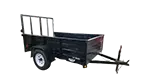

Park a scissor-hoist dump trailer beside a telescopic-cylinder trailer and, from ten feet away, they can look like the same machine. Both raise the dump body around a rear hinge, and both may be engineered for a dump angle in the mid-40-degree range. The meaningful differences are in the lifting geometry, the way force travels through the trailer, the number of moving joints, and how the hydraulic system behaves through the lift cycle. One important point comes first: a properly loaded and maintained hoist should complete its rated lift smoothly. If a dump body stalls, shudders, twists, or stops well below its specified angle, stop operating it and check for overloading, poor load distribution, a weak battery, low or contaminated hydraulic fluid, damaged pivots, structural misalignment, or another mechanical or hydraulic problem.
How the Geometry Actually Works
A scissor hoist places a hydraulic cylinder inside or alongside a pivoting linkage beneath the dump body. As the cylinder extends, the linkage opens and converts the cylinder’s relatively short stroke into a much larger movement at the body. The exact layout varies by manufacturer, so not every scissor hoist uses the same arm shape, pivot spacing, cylinder size, or mounting position. The linkage can add rigidity between the trailer frame and dump body, but it also adds pivot pins, bushings, grease points, and structural mounting locations that must remain aligned and properly maintained.
The lifting force and body speed of a scissor system are not perfectly constant. Both change as the arms rotate through their travel. A properly engineered system is designed to provide the leverage needed during the difficult beginning of the lift, when the dump body is nearly horizontal and the load creates the greatest resistance. As the linkage opens, the body may rise faster because the mechanical relationship between the cylinder, arms, frame, and dump body changes. That changing geometry is one reason buyers should compare the complete hoist rating and trailer design rather than judging a scissor system only by the cylinder’s bore or pressure rating.
A telescopic cylinder is a direct-acting system mounted toward the front of the dump body. Its lower end is secured to the trailer structure, while its upper end pushes directly against the body as the body rotates around the rear hinge. The cylinder contains multiple nested stages. The larger stage normally extends first, followed by progressively smaller stages until the body reaches its designed dump angle.
At a given hydraulic pressure, a larger piston area can produce more extension force than a smaller piston area. That means the available cylinder force generally changes as a telescopic cylinder moves from its larger stage to its smaller stages. The force required to continue raising the body also changes as the body angle and load position change. The cylinder size, stage dimensions, stroke, mounting points, rear hinge location, bed length, hydraulic pressure, and frame design therefore have to be engineered as one complete system.
The practical tradeoff is not that one design always supplies constant force while the other does not. A scissor hoist uses linkage geometry to multiply and redirect cylinder force, while a telescopic cylinder applies force more directly to the front of the body. The scissor system has more linkage joints and can package substantial travel into a compact space. The telescopic design has fewer external hoist pivots and provides strong front-of-body dumping leverage. Neither design, by itself, determines the trailer’s legal payload, maximum dump angle, stability, or service life.
Dump Angle: What the Number Really Means
Dump-angle claims should be checked on the specification sheet for the exact trailer. Scissor-hoist trailers can be engineered for angles in the mid-40-degree range, and telescopic-cylinder trailers are commonly engineered in the same general range. It is not accurate to assume that every scissor hoist stops at 40 degrees or that every telescopic cylinder automatically lifts higher. The final angle depends on the body length, rear hinge, cylinder stroke, hoist geometry, frame clearance, and manufacturer specifications.
The current Diamond C LPT is specified with a 45-degree dump angle and a front-mounted multi-stage telescopic cylinder. That is the designed full-lift position, not an angle an operator should attempt to exceed by adjusting the relief valve, altering the cylinder mounts, or modifying the rear hinge. The power unit, cylinder, frame, body, hinge, and hydraulic pressure are matched at the factory. Changes to any of those components can create dangerous loads in parts of the trailer that were not designed to carry them.
Material release depends on more than the final angle. Moisture, compaction, particle shape, frozen material, the condition of the steel floor, the way the trailer was loaded, side-to-side balance, gate configuration, and whether the load has bridged against the sides can all affect unloading. Wet clay may remain stuck in a 45-degree body, while dry gravel may begin moving much earlier. A difference of a few degrees can help, but no normal dump angle guarantees that every sticky load will slide out without assistance.
Diamond C’s DM Difference Maker multi-stage coating system protects the finished steel surfaces, but it should not be confused with a low-friction dump-bed liner. Likewise, the LPT’s overlapped floor-seam construction is intended to help keep moisture out of vulnerable corners; it does not make the floor self-cleaning. Keeping the floor free of hardened material, rust scale, protruding fasteners, and damage is still important when hauling material that tends to stick.
Never try to release a stubborn load by driving with the bed raised, jerking the tow vehicle, sharply applying the brakes, striking the body, or repeatedly holding the hydraulic control against the relief valve. Lower the body, place the trailer on firm and level ground, reassess the load, and use a safe unloading method. No hoist design makes dumping on a side slope or with a severely off-center load safe.
Capacity and Frame Stress
Scissor-hoist and telescopic-cylinder systems place force into the trailer differently. A scissor system creates reactions at its cylinder mounts, linkage pivots, dump-body attachment points, rear hinge, and the frame members supporting those locations. A telescopic system creates major reactions at the front cylinder mount, its dump-body connection, the rear hinge, and the surrounding frame structure. Calling one system “distributed” and the other “concentrated” is too simplistic because the actual load path depends on the complete engineering of the trailer.
Diamond C uses a direct-push telescopic layout to provide front-of-body leverage while reducing unnecessary stress on the main frame compared with its traditional scissor-hoist design. On the current LPT, the cylinder mounting structure, dump-body frame, main frame, crossmembers, and rear hinge are engineered to work together. Depending on the GVWR package, the LPT uses either an 8-inch I-beam main frame or Diamond C’s Engineered Beam design. The dump body is supported by a rectangular-tube body frame, with a 10-gauge integral body and sides listed as standard and a heavier 7-gauge body upgrade available for demanding applications.
Neither hoist type creates payload capacity on its own. GVWR is established for the complete trailer and considers the frame, suspension, axle package, tires, wheels, hubs, bearings, brakes, coupler, safety equipment, body, and other components. The current bumper-pull Diamond C LPT is offered from 15,500 to 24,000 pounds GVWR. Its standard axle configuration is two 7,000-pound Lippert axles, with configurations using three 7,000-pound axles, two 8,000-pound axles, or two 10,000-pound axles available according to the selected package.
The sum of the axle ratings does not always equal the trailer’s GVWR because part of a bumper-pull trailer’s loaded weight is carried at the hitch. That does not permit an operator to overload the axles or exceed the tow vehicle’s receiver, hitch, rear-axle, tire, payload, towing, or gross-combination ratings. Every limit still applies independently, and the lowest applicable rating controls.
Payload is not the number printed as GVWR. Actual payload equals the trailer’s GVWR minus its actual empty weight as equipped. Body height, ramps, tarp systems, spare tires, hydraulic jacks, upgraded batteries, heavier axles, additional steel, and other options can change empty weight. Before placing a 10,000-pound load in any dump trailer, confirm the trailer’s actual payload capacity, the load’s verified weight, the tow vehicle’s ratings, and the required tongue weight. The material must also be distributed evenly enough to remain within the axle, tire, hitch, and structural limits.
Scissor Hoist vs Diamond C LPT: The Practical Split
For a current Diamond C buyer, the heavy-duty low-profile dump choice is the telescopic-cylinder LPT in bumper-pull form or the LPT-GN in gooseneck form. Diamond C’s present dump lineup is centered on telescopic-cylinder designs, ranging from the smaller GST, GDT, and MDT models through the LPT, DOD, and WDT heavy-duty applications. A scissor-versus-telescopic comparison is therefore most useful when comparing the current LPT with a scissor-equipped trailer from another manufacturer or with a used trailer.
A well-engineered scissor hoist can be a durable choice. Its linkage can provide a stable lifting structure, package a substantial amount of body travel beneath the trailer, and deliver a quick cycle when correctly matched to the cylinder and power unit. The tradeoff is additional pivot pins, bushings, joints, and grease points. On a used scissor-hoist trailer, inspect the pivot holes for elongation, the pins and bushings for wear, the arms for bending or cracking, the cylinder mounts for movement, and the frame around every hoist attachment point.
The LPT is Diamond C’s Heavy Duty Low Profile Telescopic Dump Trailer. Current specifications list GVWR packages from 15,500 to 24,000 pounds, bed lengths of 12, 14, and 16 feet, bed widths of approximately 81 to 82 inches depending on configuration, and a 45-degree dump angle. Its multi-stage cylinder uses a front-mounted direct-push arrangement and a KTI power-up, gravity-down hydraulic system. The current LPT also lists a high-flow KTI pump, a Group 27 trailer-mounted battery, and a 110-volt onboard charger as standard equipment, with battery, remote-control, and solar-charging options available according to the build.
The hydraulic pump is powered by the trailer’s dedicated battery, not directly by the tow vehicle’s starter battery. A properly wired charge circuit from the truck can help maintain the trailer battery while traveling, but it is not a substitute for charging a depleted battery with the correct charger. Repeatedly raising a loaded dump body with a weak or discharged battery can cause slow operation, voltage drop, overheated electrical connections, contactor problems, and incomplete lift cycles.
The bumper-pull LPT uses a 2-5/16-inch Demco EZ-Latch coupler, with the coupler rating and mounting style matched to the selected GVWR package. Pintle-ring configurations are available for operators whose trucks and job-site requirements call for a pintle hitch. The exact coupler, receiver, ball or pintle, safety chains, breakaway system, and tow-vehicle ratings must all be verified for the specific trailer.
The LPT’s low-profile design reduces deck and loading height, but it does not eliminate the need for ramps when loading a skid steer, compact tractor, or mini excavator. Equipment must be loaded only with properly rated ramps that are correctly attached to the trailer. Rear stabilizers should be deployed when required, the trailer and tow vehicle should remain properly aligned, and the machine’s weight, track width, ground clearance, approach angle, and securement requirements must fit the exact trailer configuration.
Current LPT specifications identify Lippert axle packages throughout the range. The standard 7,000-pound axle package uses Lippert Super Lube hubs, while higher-capacity configurations use the specified Lippert oil-bath axle packages. The trailer also uses LED lighting and an automotive-grade, corrosion-protected modular wiring harness. Those details matter on a dump trailer because the running gear, breakaway circuit, battery connections, rear lighting, and wiring are regularly exposed to water, road salt, mud, aggregate, and job-site debris.
A Quick Side-by-Side
| Feature | Scissor Hoist | Telescopic Cylinder (LPT) |
|---|---|---|
| Max dump angle | Model-specific; many designs operate in the mid-40-degree range | 45 degrees on the current Diamond C LPT |
| Force through lift | Changes as the cylinder and linkage move through their geometry | Changes as progressively smaller cylinder stages extend |
| Primary load path | Cylinder mounts, linkage pivots, body mounts, frame, and rear hinge | Front cylinder mounts, dump-body connection, main structure, and rear hinge |
| Underbody components | Hoist arms, pins, bushings, pivots, and hydraulic cylinder | Front-mounted multi-stage cylinder with fewer external linkage pivots |
| Maintenance emphasis | Pins, bushings, grease points, cylinder, mounts, and linkage alignment | Cylinder stages, seals, mounting pins, hydraulic connections, battery, and charger |
| Best for | Applications matched to the exact trailer’s payload, hoist rating, body, and duty cycle | Current Diamond C heavy-duty low-profile dump applications from 15,500 to 24,000 lb GVWR |
| Current Diamond C application | Compare with other manufacturers or used scissor-hoist inventory | LPT bumper pull and LPT-GN gooseneck |
What About Maintenance?
Scissor hoists contain more external moving joints. Pivot pins and bushings must remain lubricated according to the trailer manufacturer’s maintenance schedule, and every joint should be inspected for looseness, dry movement, damaged retainers, cracked welds, elongated holes, bent arms, and uneven wear. Grease does not correct a worn or misaligned pivot. If the body moves sideways, binds, pops, or rises unevenly, stop using the hoist until the system has been inspected.
A telescopic cylinder eliminates most of the scissor linkage, but it is not maintenance-free. Inspect the exposed cylinder stages for scoring, corrosion, pitting, dents, contamination, and hydraulic leakage. Check the upper and lower mounting pins, retainers, hoses, fittings, power-unit connections, reservoir, wiring, control pendant, charger, and battery. Keep the cylinder stages clean, particularly when the trailer has been used around mud, concrete residue, road salt, fertilizer, or abrasive aggregate.
Never search for a pressurized hydraulic leak with your hand. A pinhole leak can inject fluid through the skin and requires immediate emergency medical treatment. Lower the body, release stored pressure according to the service instructions, and have damaged hoses or fittings repaired by a qualified technician.
Hydraulic-fluid service should follow the instructions for the installed power unit and cylinder. Check the level with the dump body fully lowered and the cylinder retracted unless the manufacturer specifies another procedure. Use only the recommended hydraulic fluid and do not mix incompatible fluids. There is no universal rule that every dump trailer needs a complete fluid change every two or three years. Replace fluid when required by the service schedule or when it is contaminated, degraded, incorrectly mixed, or affected by water intrusion. Milky fluid, unusual foaming, discoloration, or debris in the reservoir should be investigated rather than ignored.
Battery condition is just as important as hydraulic-fluid condition on an electric-over-hydraulic dump system. Keep the battery charged, clean and tighten the terminals, inspect cables for heat damage and corrosion, and test the onboard charger. A pump that sounds slow under load may be receiving inadequate voltage even when the battery can still operate the trailer’s lights. Do not continue cycling a struggling power unit until the battery, cables, fluid level, load, and hydraulic system have been checked.
Never place any part of your body beneath a raised dump body unless the trailer is empty and the manufacturer’s mechanical body prop or approved safety support is correctly engaged. Hydraulic pressure alone is not a safety lock. A failed hose, fitting, valve, cylinder seal, electrical control, or mounting component can allow the body to fall without warning.
The “Just Tell Me Which One” Answer
If you are comparing a properly built scissor-hoist trailer with a properly built telescopic-cylinder trailer, do not choose solely by material type or by the name of the hoist. Start with the required payload, actual trailer weight, body dimensions, body gauge, dump angle, axle and tire ratings, gate design, ramp capacity, hydraulic power unit, battery system, frame construction, warranty, parts availability, and the towing limits of your truck. A scissor hoist can serve contractors, landscapers, farmers, and property owners well when the complete trailer is correctly rated for the work and the additional pivots receive regular maintenance.
Choose the Diamond C LPT telescopic when you want Diamond C’s current heavy-duty low-profile bumper-pull dump platform, a 45-degree direct-push telescopic hoist, Lippert axle packages, and GVWR configurations from 15,500 through 24,000 pounds. The front-mounted cylinder provides strong dumping leverage and keeps the hoist layout comparatively simple. It is a particularly logical choice for buyers who want a current Diamond C dump model with factory-supported configurations rather than selecting a trailer around an older hoist layout.
Sticky material can still remain in either style of trailer, and a telescopic cylinder does not turn an overloaded, frozen, compacted, or badly unbalanced load into a safe dump. For wet clay, demolition material, broken concrete, or other difficult loads, confirm the floor and body specifications, distribute the weight evenly, avoid dropping large pieces into the body, stay within the actual payload, use the gate correctly, and dump only on firm, level ground. A clean steel floor or an application-appropriate liner may affect material release more than a small difference in nominal dump angle.
Both systems are worth inspecting in person before you buy. Watch the body complete a smooth full cycle, listen to the pump, inspect the rear hinge and hoist mounts, and compare the data plate rather than relying on a generic “14K” or “20K” description. Ask about actual empty weight, available payload, axle and hub type, brake configuration, tire capacity, coupler rating, battery and charger, body gauge, gate operation, tarp, ramps, stabilizers, and the options installed on the exact unit.
We keep Diamond C inventory on the lot at 291 West State Hwy 46 in Spencer and can walk you through the available dump configurations side by side. Call or text us at (812) 829-0226 or reach out here if you want us to help match the GVWR, payload, body length, axle package, hitch type, ramps, and hydraulic options to your hauling job before you commit.
And if you’re still deciding, check what the recently sold trailers look like. Those listings can show the lengths, GVWR packages, hitch configurations, tarps, ramps, and other options that buyers in Owen County and across southern Indiana have selected. Use them as real-world examples, then confirm current availability and the exact specifications of the trailer you plan to purchase.


