



You’re towing a trailer that weighs about 7,000 pounds as loaded across a washboard county road, and something feels off. Every bump seems to travel through the trailer frame, hitch, and tow vehicle. Or maybe you watched a video about rubber torsion suspension and now you’re second-guessing the trailer you were ready to buy. Either way, the suspension question is real, and the correct answer depends on the trailer, its load, the roads you travel, and how you plan to maintain it.
Slipper-spring and rubber torsion suspensions are two of the most common systems used under modern trailers. Slipper springs are one type of leaf-spring suspension; lighter trailers may instead use double-eye leaf springs. Torsion axles package the spring action inside the axle tube. The two designs ride differently, distribute tandem-axle loads differently, require different inspections, and cannot normally be interchanged without engineering and fabrication work. Here’s an honest look at both.
How Each System Actually Works
A slipper spring is a leaf-spring pack made from several curved steel leaves stacked together. The spring normally has a fixed eye and bushing at its forward end, while the trailing end is open rather than formed into a second eye. That trailing end slides against a rear hanger, equalizer, or roller as the spring flexes and changes effective length. The axle tube is seated against the spring assembly and secured with spring seats, tie plates, and U-bolts. On a tandem-axle trailer, an equalizer between the axles helps transfer load and suspension movement from one axle to the other as the trailer crosses bumps, driveway transitions, and uneven ground.
Not every slipper system is identical. A basic slipper spring may slide directly against a hanger or equalizer surface. More advanced systems, such as the Lippert Slipper Roller suspension used on applicable Diamond C configurations, use rollers and upgraded pivot components to let the spring move with less binding. The underlying principle is still the same: external steel leaf packs carry the load, flex over road irregularities, and work through an equalized mechanical suspension assembly.
A rubber torsion axle works on a different principle. Inside the axle’s structural tube is a steel inner bar surrounded by four rubber cords held under compression. Each wheel spindle is attached to a trailing arm connected to the inner bar. When a wheel moves upward, the arm rotates the inner bar and compresses the rubber cords. The resistance of the rubber supports the trailer and dampens wheel movement. The assembly mounts directly to the trailer frame with integral brackets, so it does not need external leaf packs, spring hangers, shackles, equalizers, or axle-to-spring U-bolts.
Dexter’s Torflex line is one widely used torsion design, and Lippert also manufactures rubber torsion trailer axles. Dexter Group additionally offers torsion products under the Rockwell American name. Both Lippert and Dexter produce conventional sprung axle systems as well. The axle supplier cannot be assumed from the trailer’s suspension type alone. Diamond C’s premium trailer lines use Lippert axles as standard, with the available leaf-spring, Slipper Roller, torsion, adjustable, or air-ride suspension determined by the model and axle package.
Ride Quality and Independent Suspension
This is where the debate gets loud. A torsion axle provides independent suspension action at each wheel because the left and right trailing arms work against separate portions of the rubber suspension system. A wheel entering a pothole can move without forcing the opposite wheel through the same suspension motion. A conventional leaf-spring axle uses a rigid beam connecting the two wheel ends, so forces introduced on one side can be transmitted through the beam and trailer structure. That difference can reduce vibration and noise in an appropriately selected torsion-equipped trailer.
There is another distinction that matters just as much on tandem trailers. A tandem slipper-spring suspension normally uses an equalizer that helps share load between the front and rear axles. Standard tandem torsion axles are independently mounted and generally are not equalized from one axle to the other. When a torsion-equipped tandem trailer crosses a steep driveway entrance, curb, railroad crossing, or other uneven surface, one axle can momentarily carry more of the trailer’s weight. That does not make torsion unsuitable, but the axle capacities, spacing, frame design, load placement, and intended terrain must be correct for the application.
Torsion suspension often provides a quieter, more controlled ride on enclosed cargo, motorcycle, car-hauler, and specialty trailers. Its rubber cords cushion vibration without the metal-to-metal movement found at some conventional leaf-spring pivots. It can also be built with different starting arm angles to achieve a particular deck height. Those advantages are valuable when low loading height, cargo protection, and reduced suspension noise are priorities.
The difference is not determined by axle type alone, however. Tire construction and pressure, trailer weight, tongue weight, cargo position, suspension capacity, axle spacing, frame stiffness, towing speed, and road conditions all affect what the driver and cargo experience. A well-engineered tandem slipper-spring setup can track straight and handle rough work predictably, while an incorrectly loaded torsion trailer can still bounce, sway, overload an axle, or wear tires.
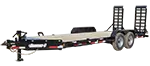
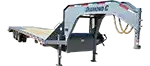
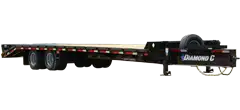
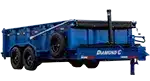
Diamond C’s current LPX, LPT, and HDT families use Lippert axle packages, not Dexter axles. Slipper-spring or Slipper Roller suspension is common on heavy equipment and dump configurations, while torsion is available on selected builds and axle packages. These trailers span multiple GVWR classes, so the correct comparison must be made between two complete configurations rather than assuming that every LPX, LPT, or HDT has the same suspension.
Rubber torsion suspension also has a nonlinear spring response, but that does not support a universal claim that every torsion trailer will be soft when empty and harsh at its rated GVWR. The actual ride depends on the axle’s engineered capacity, rubber specification, starting angle, trailer weight, and load. Both torsion and leaf-spring systems should be operated within the trailer’s certified GVWR, axle ratings, tire ratings, and hitch limits. Overloading either design can eliminate usable suspension travel, create excessive heat, damage components, and produce an unsafe ride.
Maintenance Comparison
Slipper-spring suspensions have external wear points that should be inspected on a regular schedule. Depending on the design, those points can include the spring eye and bushing, rear slipper contact area or roller, equalizer, pivot bolts, hangers, U-bolts, spring seats, tie plates, and the leaves themselves. Look for cracked or shifted leaves, worn bushings, elongated bolt holes, damaged rollers, loose hardware, uneven axle position, corrosion, and evidence that a spring has been contacting the frame.
There is no single re-torque or lubrication interval that applies to every trailer. Follow the trailer and axle manufacturer’s manual for the exact inspection schedule and torque values. Some suspension systems use greasable wet bolts or designated grease fittings, while other wear-resistant bolts and bushings are not intended to be lubricated. Applying grease to a component that was designed to operate dry can attract abrasive dirt or interfere with the intended bushing material. U-bolt torque must also be checked against the specification for the actual bolt diameter, grade, axle, and suspension package rather than a generic number.
Torsion suspension has fewer exposed suspension components. There are no leaf packs, shackles, conventional equalizers, or spring-to-axle U-bolts to inspect. That reduces suspension-related service work, but it does not make the trailer maintenance-free. The axle mounting brackets, mounting bolts or welds, trailing arms, spindle areas, ride height, tire clearance, wheel alignment, brakes, hubs, bearings, seals, wheels, lug nuts, and tires still require inspection and service.
Wheel-bearing and brake maintenance is required regardless of which suspension supports the axle. A torsion trailer with neglected bearings, loose lug nuts, worn brakes, underinflated tires, or damaged mounting brackets is not low-maintenance in any meaningful sense. Trailers used frequently, operated near their ratings, immersed in water, driven on salted roads, or pulled over rough job sites may require more frequent inspection than a lightly used recreational trailer.
Leaf-spring parts are generally more modular. A correctly identified spring, bushing, equalizer, hanger component, or U-bolt can often be replaced without replacing the complete axle beam. That does not mean every repair is a safe driveway job. The trailer must be supported at manufacturer-approved frame locations, the axle must be controlled, replacement parts must match the original capacity and dimensions, and all hardware must be installed and torqued correctly.
The rubber suspension core of a conventional torsion axle is not normally field-serviceable. If the internal rubber suspension has lost its ability to support the trailer, the axle assembly generally has to be replaced. Hubs, bearings, seals, brakes, and other running-gear components may still be serviceable separately, and some specialized torsion products use replaceable spindle designs. Replacement axle cost varies widely because torsion axles are commonly built to order for a specific capacity, hub face, bracket spacing, starting angle, brake package, wheel bolt pattern, and frame installation.
Failure Modes
Leaf-spring problems can develop gradually or occur suddenly. Gradual warning signs include a trailer sitting lower on one side, uneven tire clearance, rust lines around moving fasteners, worn bushings, flattened spring packs, broken secondary leaves, shifting axle alignment, or unusual tire wear. A cracked leaf may be visible during inspection, but it can remain hidden within the spring pack until the assembly is unloaded or disassembled.
A broken main leaf, failed center bolt, damaged equalizer, fractured hanger, or loose or broken U-bolt can allow the axle to move out of position. That can damage a tire, brake wiring, brake line, fender, floor, or adjacent axle. A driver should not assume the trailer can be limped home simply because it has leaf springs. If an axle or suspension component has shifted, the trailer should be stopped in a safe location and inspected before it is moved again.
Torsion suspension problems are diagnosed differently because the rubber cords are enclosed inside the axle tube. There is no external spring pack to inspect. Warning signs can include a change in trailing-arm angle, reduced tire-to-body clearance, one side sitting lower than the other, abnormal wheel position, uneven tire wear, loss of suspension movement, damaged mounting brackets, cracked welds, or a trailer that no longer returns to its normal loaded or unloaded ride height.
The rubber core is protected inside the axle tube, so direct sunlight is not a normal explanation for internal torsion deterioration. Age, repeated overloading, excessive operating temperatures, impact damage, improper mounting, frame distortion, corrosion, or long-term service conditions may contribute to reduced performance. There is no universal rule that a torsion axle automatically expires after a fixed number of years. Dexter, for example, offers a longer limited warranty on Torflex suspension components than on its conventional sprung axles, but a warranty term is not the same as a guaranteed service-life limit.
Either suspension design can suffer a serious failure if it is overloaded, damaged, incorrectly installed, or operated after warning signs appear. A torsion failure does not always cause a wheel arm to drop suddenly, just as a leaf-spring failure does not always develop slowly enough to provide advance notice. Any unexplained change in ride height, wheel angle, tire clearance, axle alignment, or handling should be treated as a reason to stop towing and have the trailer inspected.
Cost at the Point of Sale
Torsion axles usually carry a price premium, but the difference is not consistently limited to a few hundred dollars. The final amount depends on axle capacity, brakes, hub and spindle package, tire and wheel requirements, starting angle, bracket dimensions, trailer construction, and whether torsion is a standard feature or a factory option. On heavier trailers, moving from a sprung axle package to a higher-capacity torsion package can affect more than the axle itself.
Current Diamond C ordering information illustrates why a fixed industry-wide number is misleading. On applicable LPT configurations, torsion is offered as an optional suspension, and displayed factory upcharges can be approximately $995 to $1,490 depending on the selected axle package before final dealer pricing. Available options and prices can change, so the trailer’s current build sheet and dealer quote should control the buying decision.
Enclosed-trailer specifications also vary by product line. Wells Cargo currently lists Dexter torsion axles as standard equipment on several Wagon HD and specialty models, while other Wells Cargo lines use different axle packages. H&H uses torsion suspension as standard on certain enclosed products, including its TOPLINE enclosed car hauler, but its utility, equipment, tilt, dump, and other enclosed families must be checked model by model. Liberty and Darkhorse Cargo specifications should likewise be verified from the current order sheet, VIN, and manufacturer’s label rather than assumed from the brand name.
On open equipment and dump trailers, equalized leaf or slipper-spring suspension remains common because of its capacity, serviceability, and suitability for rough or uneven working conditions. Diamond C offers torsion on selected configurations rather than treating it as a universal upgrade for every model. The appropriate option is the one engineered and approved for that trailer’s GVWR, frame, axle spacing, and intended use.
If you’re buying a 14-foot enclosed cargo trailer in the 7,000-pound GVWR class, compare complete specifications instead of comparing only the suspension name. Confirm the actual GVWR, unloaded vehicle weight, payload capacity, axle manufacturer and ratings, brake equipment, tire ratings, floor and wall construction, roof design, warranty, deck height, and out-the-door price. A torsion-equipped trailer may cost more than a comparable leaf-spring build, but the premium can be included in the base model price or offset by differences elsewhere in the construction.
Which Should You Actually Buy?
Here’s the direct answer: for heavy equipment, dump, construction, landscaping, agriculture, and frequent use on uneven roads or job sites, a properly rated slipper-spring or Slipper Roller suspension is often the practical choice. It provides mechanical load equalization between tandem axles, its working parts are visible, replacement components are widely available, and the suspension can usually be repaired without replacing a custom-built axle assembly. That is why it remains common on high-capacity work trailers.
Torsion axles make real sense when independent wheel action, reduced suspension noise, low deck height, and cargo protection are higher priorities. They are widely used on enclosed cargo trailers, motorcycle trailers, car haulers, and specialty recreational trailers. A correctly selected torsion system can provide a smooth, controlled ride with fewer exposed suspension wear components.
Do not choose torsion because you expect to ignore the trailer between trips. It still needs tire, wheel, brake, bearing, frame, and axle-mount inspections. Likewise, do not choose a leaf-spring trailer solely because individual suspension parts may be easier to obtain. The trailer must still be loaded correctly, maintained on schedule, and operated within every listed rating.
For tandem applications that regularly cross steep transitions or uneven terrain, ask specifically how the suspension shares load between axles. For sensitive cargo and mostly paved-road use, ask about independent wheel action and deck height. For either design, verify that the trailer’s payload capacity is adequate after subtracting the trailer’s empty weight from its GVWR and that the tow vehicle, receiver, hitch, coupler, tires, and brake controller are rated for the complete combination.
| Category | Slipper Spring | Torsion Axle |
|---|---|---|
| Ride quality (light load) | Varies; can be firm when empty | Often smoother and quieter when correctly matched |
| Ride quality (at max GVWR) | Designed for rated load; equalizer can share tandem-axle movement | Designed for rated load; response depends on axle specification and setup |
| Independent wheel travel | No; wheels are connected by a rigid axle beam | Yes; each wheel arm acts independently |
| Load sharing between tandem axles | Normally equalized | Normally not equalized |
| Roadside repairability | Generally higher, with matched parts and proper support | Generally lower if the internal suspension core is damaged |
| Routine maintenance | Periodic inspection of springs, pivots, rollers, equalizer, and U-bolts | Fewer suspension wear points, but mounts and running gear still require inspection |
| Failure visibility | Many components are externally inspectable | Internal core is hidden; condition is checked through ride height and wheel position |
| Typical cost premium | Usually the lower-cost base suspension | Varies by model; often several hundred dollars to more than $1,000 |
A Quick Q&A
Can I convert a leaf spring trailer to torsion axles?
Technically, a qualified fabricator may be able to redesign a trailer for torsion axles, but it is not a bolt-on substitution. The replacement axles must be ordered with the correct capacity, hub face, bracket spacing, starting angle, brake package, wheel bolt pattern, wheel track, and loaded ride height. The frame must also be evaluated for the concentrated loads introduced at the torsion mounting brackets.
Do not weld to a completed rubber torsion axle tube or move its integral brackets unless the axle manufacturer has specifically approved the procedure. Welding heat can damage the internal rubber cords, and changing the bracket position can alter alignment and load capacity. The conversion may also affect the trailer manufacturer’s warranty and certified configuration. In many cases, buying a trailer originally engineered with the preferred suspension is safer and more economical.
Do tandem axle trailers need the same suspension on both axles?
Yes. The axles should be a matched set with compatible suspension type, capacity, starting angle or spring geometry, hub face, bracket spacing, brakes, tires, and loaded ride height. Mixing a torsion front axle with a leaf-spring rear axle would create incompatible suspension movement and unpredictable load distribution. Even two torsion axles with different starting angles or capacities can carry the trailer unevenly.
How do I know which my trailer has?
Look underneath the trailer from a safe position without placing yourself beneath an unsupported unit. A slipper-spring suspension has visible curved steel leaf packs running lengthwise. The front of each spring has an eye and bushing, while the trailing end slides against a hanger, equalizer, or roller. A double-eye leaf spring looks similar but has an eye at both ends, with shackles commonly connecting one end to the hanger or equalizer.
A torsion axle normally has a square or rectangular structural tube mounted directly to the frame, with a trailing arm extending from each end toward the wheel spindle. You will not see external leaf packs, shackles, or a conventional tandem equalizer. The most reliable confirmation is the trailer’s VIN-specific build sheet and the identification label attached to the axle.
Still not sure which direction is right for your next trailer? Browse our current inventory to see exactly how specific models are spec’d, or reach out to us directly at (812) 829-0226. We stock Diamond C, H&H, Liberty, Wells Cargo, Darkhorse Cargo, and more, so available trailers may include both suspension types depending on the model and build. We can compare the axle label, suspension hardware, GVWR, payload, deck height, maintenance needs, and intended use side by side. Seeing the actual components and reviewing the build sheet beats choosing from a suspension name alone.

