



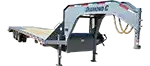


You’ve got a loaded gooseneck sitting in the yard. The coupler is several inches above the ball, the drop legs are pinned, and you still have a fair amount of screw travel left. So you reach for the jack handle, select low gear, start cranking, and your shoulder reminds you that hitching a heavy trailer is not the same as raising a light utility trailer.
That’s the moment most people start wondering whether hydraulic jacks were worth the extra money. It’s a fair question, but the answer depends on more than trailer GVWR. Hitching frequency, actual load carried by the jacks, trailer configuration, available battery power, maintenance habits, and whether the trailer uses one jack or a matched dual-jack system all matter. Here’s a straight breakdown.
What a Drop-Leg Jack Actually Does
A drop-leg jack uses a telescoping lower leg that can be released and pinned close to the ground before the screw mechanism is operated. Dropping the leg first reduces the amount of cranking needed. The terms side-wind and top-wind describe the location and orientation of the crank handle; they are not different names for the drop-leg feature itself. A jack can be top-wind or side-wind and still have a drop leg.
Inside a manual jack, gears turn a threaded screw and nut assembly to raise or lower the front of the trailer. Heavy-duty two-speed jacks add a high-speed gear for quick movement under light load and a low-speed gear for greater mechanical advantage once the jack is carrying substantial weight. The operator should change gears only according to the jack manufacturer’s instructions and should never force a gearbox that is binding.
Capacity labels require careful reading. Some manufacturers publish both a lifting capacity and a higher static or support capacity. Those numbers are not interchangeable. For example, a heavy square jack marketed with a 12,000 lb support rating may have a 10,000 lb lifting rating, while a jack with a much higher static rating may still have a substantially lower lifting limit. The jack data plate, trailer build sheet, mounting structure, and manufacturer’s operating instructions control the usable rating.
Current Diamond C equipment and gooseneck configurations do not all use the same manual jack. Depending on model, GVWR package, tail style, and production configuration, 2026 inventory may include a single 15,000 lb-rated Simol two-speed drop-leg jack, dual 20,000 lb-rated Simol two-speed drop-leg jacks, or another factory-specified matched setup. Current FMAX207 and FMAX210 configurator information, for example, lists dual 20K Simol two-speed drop-leg jacks as the standard selection, with dual 25K two-speed manual jacks and dual Lippert 20K hydraulic jacks available on qualifying configurations. Some hydraulic-dovetail stock builds may be equipped differently, so the VIN-specific build sheet matters more than a general model description.
The front load carried by the jack is also not the same thing as the trailer’s full GVWR. A gooseneck’s axles continue supporting most of the trailer while it is parked. The jack or jack pair supports the front portion of the trailer after it is disconnected from the truck. Gooseneck pin weight commonly falls within roughly 15% to 25% of loaded trailer weight, but the actual percentage depends on trailer geometry and cargo placement. On a 15,500 lb trailer loaded to its rating, that broad range would represent approximately 2,325 to 3,875 lbs at the coupling point. The exact load at the jack location can differ, so weighing the loaded combination is better than estimating.
Manual jack pricing varies too widely to use one universal number. A basic replacement jack can cost a few hundred dollars, while a heavy two-speed assembly, matched dual-jack system, cross-shaft arrangement, mounting hardware, or structural repair can cost considerably more. On current qualifying FMAX configurations, the factory upgrade from the standard dual 20K manual setup to dual 25K two-speed drop-leg jacks is listed at more than $1,200. Aftermarket labor depends on whether the jack is a direct bolt-on replacement or requires welding, reinforcement, relocation, or modification of the storage area.
The Real Effort Problem
Manual cranking is not simply a question of operator strength. Crank effort depends on the jack’s screw pitch, gear ratio, lubrication, load, alignment, handle length, and how much screw travel remains after the drop leg is pinned. A dry screw, bent tube, side-loaded foot, or worn gearbox can make even a correctly rated jack feel much harder to operate than it should.
Two-speed jacks help by letting the operator use high gear while the foot is approaching the ground and low gear once the trailer’s weight comes onto the jack. Even so, a manual system still requires repeated handle rotations. The time can increase substantially when the trailer is heavily loaded, the ground is uneven, or two independent jacks must be adjusted while keeping the gooseneck reasonably level.
Jacks should primarily be used to establish coupling height and support the uncoupled trailer on firm, reasonably level ground. They are not a substitute for choosing a safe parking location, and they should not be used to correct a severely side-sloped trailer. Wheel chocks should be installed before uncoupling, and suitable pads or cribbing should be used when the jack feet could sink into gravel, soil, hot asphalt, or soft job-site surfaces.
For a weekend hauler, the cranking may be an acceptable tradeoff for mechanical simplicity. For a contractor, rancher, hotshot operator, or equipment owner who connects and disconnects several times during a workweek, the cumulative time and fatigue can become a meaningful operating cost. That repeated-use issue is the strongest argument for a hydraulic upgrade.
Hydraulic Jack Basics
A heavy-trailer hydraulic jack system uses one or more hydraulic cylinders connected to a pump, reservoir, valves, hoses, controls, and a 12-volt power source. On an electro-hydraulic system, an electric motor drives the hydraulic pump. The pump sends fluid to extend or retract the cylinder, allowing the operator to raise or lower the front of the trailer without manually turning a screw under load.
Diamond C’s current hydraulic jack option uses single or dual Lippert 20K hydraulic jacks, depending on the trailer and selected configuration. Each jack is rated for 20,000 lbs of lift. The system uses a KTI hydraulic power unit and an onboard Group 27 battery for powered extension and retraction. Diamond C’s dual system incorporates a flow-divider valve to distribute hydraulic flow between the two jacks and includes remote operation on applicable builds.
The Lippert cylinders used by Diamond C have aluminum bodies with an anodized finish and a protective sleeve around the jack assembly. That construction reduces weight and corrosion exposure compared with traditional steel-cased hydraulic landing gear. The internal hose routing also helps protect hydraulic plumbing from road debris while the trailer is in service.
Hydraulic operation is normally much faster and less physically demanding than manual cranking, but a universal cycle time should not be promised. Speed changes with the amount of travel, trailer load, battery condition, pump output, hydraulic-fluid temperature, hose routing, and whether one or two cylinders are moving. Cold fluid, a partially discharged battery, corroded electrical connections, or an overloaded system can slow operation significantly.
The cost difference is substantial because a complete hydraulic conversion involves more than the visible jack cylinder. Current Diamond C online configurator pricing is approximately $840 for a single 20K hydraulic jack on an eligible HDT configuration and about $1,460 for a dual system. On qualifying FMAX builds, dual 20K hydraulic jack pricing is roughly $1,526 when the trailer already has the hydraulic-dovetail system or approximately $2,017 when the jack system requires its own hydraulic package. Factory pricing, compatibility, and included equipment can change, so those figures should be treated as current configuration examples rather than permanent installed-price guarantees.
A retrofit can cost more than the factory option because the shop may need to fabricate mounts, route and protect hoses, install the KTI power unit, add a reservoir and valves, mount a battery and charger, wire controls, verify clearances, and confirm that the trailer’s structure is approved for the jack system. A complete hydraulic upgrade should be evaluated as an engineered system, not as a simple cylinder swap.
Dual Jacks on Gooseneck Trailers
Dual jacks are common on heavy goosenecks because they share the front support load and provide a wider stance while the trailer is uncoupled. They can also reduce twisting at the front of the trailer compared with concentrating the entire support load through one center-mounted jack. That does not mean an unevenly loaded trailer is acceptable; cargo still needs to be positioned and secured according to the trailer and towing-vehicle ratings.
A dual manual setup may use two independently operated jacks or a linked landing-gear arrangement, depending on the manufacturer. With independent jacks, the operator must monitor both sides and avoid allowing one jack to carry most of the load. Excessive height difference can rack the gooseneck structure, side-load the jack tubes, bind the screws, or lift one foot away from its support pad.
Jack ratings should not be added together and then treated as a new trailer capacity. Two jacks with a stated rating may be capable of sharing a substantial load, but the safe system limit is also affected by the mounts, frame, hoses, valves, pump pressure, footing, and how evenly the load is divided. Installing higher-rated jacks does not increase the trailer’s certified GVWR, GAWR, payload capacity, coupler rating, or towing-vehicle capacity.
Current Diamond C FMAX207 and FMAX210 configurations illustrate the range of available systems. Standard configurations can use dual 20K Simol two-speed drop-leg jacks. Qualifying builds may be upgraded to dual 25K two-speed manual jacks or dual Lippert 20K hydraulic jacks. The FMAX210 is offered in lengths from 20 to 40 feet with a 25,000 lb GVWR, while higher-capacity FMAX models can reach 40,000 lb GVWR. The jack selection still depends on the exact model and option package rather than deck length alone.
On the Diamond C dual hydraulic system, the flow divider helps the two cylinders move together. That coordinated operation is useful for solo operators, but it should not be described as automatic self-leveling. The operator must still watch the trailer, use stable footing, stop if one side encounters an obstruction, and avoid trying to use the jacks to compensate for an unsafe parking slope.
Head-to-Head: Key Differences
| Factor | Drop-Leg Manual | Hydraulic (Electric) |
|---|---|---|
| Typical capacity range | Application-specific; current Diamond C heavy-trailer examples include a single 15K jack and dual 20K or 25K two-speed jacks. Verify separate lift and support ratings. | Diamond C’s current Lippert system is rated at 20,000 lbs of lift per hydraulic jack, with single or dual configurations by model. |
| Speed of operation | Depends on drop-leg position, screw travel, gear selection, lubrication, alignment, and load. | Generally faster, but cycle time varies with load, battery charge, pump output, fluid temperature, and cylinder travel. |
| Cost (single jack, installed) | Often included as standard equipment. Replacement and upgrade costs range from hundreds of dollars to more than $1,000 for certain heavy matched systems. | Current Diamond C factory options range from roughly $840 for an eligible single-jack setup to approximately $1,460-$2,017 for qualifying dual systems. Retrofitting may cost more. |
| Maintenance | Inspect and lubricate the screw, gears, handle, drop-leg pin, foot, mounts, and welds according to the jack manual. | Maintain the battery and charger; inspect fluid level, hoses, fittings, cylinder rods, wiring, fuses, controls, mounts, and hydraulic leaks. |
| Failure modes | Dry or damaged screw, worn gears, bent tube, damaged handle, seized pin, misalignment, or overloaded mounting structure. | Low battery, poor electrical connection, blown protection device, pump or solenoid fault, leaking fitting, damaged hose, contaminated fluid, or cylinder-seal failure. |
| Power source | Operator effort through a hand crank; no battery, pump, or hydraulic plumbing required. | Onboard 12-volt battery powering an electro-hydraulic pump. The truck’s charge circuit may help maintain the battery but should not be treated as the primary operating source. |
| Best use case | Owners who value simplicity, field serviceability, lower initial cost, and moderate hitching frequency. | Frequent hitching, heavy commercial use, accessibility needs, solo operation, or trailers already equipped with compatible hydraulic systems. |
Which Trailers Actually Come With What
At Spencer Trailers, current Diamond C jack equipment varies by model and individual build. A blanket statement that every Diamond C gooseneck uses the same 12K manual jack is not accurate. Current FMAX Max Ramps configurations in 2026 inventory may list dual 20K Simol two-speed drop-leg jacks, while certain FMAX hydraulic-dovetail units may use a different matched dual drop-leg arrangement. The trailer’s stock listing, VIN label, build sheet, and jack data plates should always be checked before ordering parts or quoting an upgrade.
Current bumper-pull Diamond C equipment trailers commonly use a single heavy two-speed jack rather than the dual system found on many FMAX goosenecks. Examples include HDT, LPX, and DEC configurations listing a 15K Simol two-speed drop-leg jack. Eligible HDT builds can be configured with a single or dual Lippert 20K hydraulic system. Hydraulic availability on other Diamond C models depends on the selected GVWR, tongue or neck design, powered options, battery package, and factory configuration.
Other brands also vary substantially. Liberty heavy flatbed and dump configurations may offer twin 12K side-wind jacks, twin 12K two-speed manual jacks, or twin Stillwell hydraulic jacks, depending on the model. H&H specifications likewise depend on the trailer series and ordered options. The correct approach is to verify the actual build rather than assuming that every heavy gooseneck is manual-standard or that every dump trailer includes a hydraulic tongue jack simply because it already has a hydraulic hoist.
Delco’s lighter utility trailers demonstrate why jack selection should match the application. A current 7,000 lb GVWR U5 tandem utility configuration uses a 2,000 lb swivel top-wind jack, while heavier Delco dump and gooseneck models use larger drop-leg or dual-jack arrangements. Installing a 20K hydraulic system on a light utility trailer would add cost, battery requirements, weight, and maintenance without providing a practical operating advantage.
A Few Questions Worth Asking Yourself
How many times a week do you hitch and unhitch? There is no universal cutoff at which hydraulic automatically becomes the right answer. Calculate how much time is spent positioning the truck, cranking, switching between dual jacks, and correcting coupling height. For a trailer that stays connected for days at a time, manual jacks may be entirely reasonable. For a trailer dropped at several sites in one day, powered operation can have a clear productivity benefit.
What’s the actual load on the jack system? Do not choose a jack solely from the trailer’s GVWR or an assumed tongue-weight percentage. Consider the trailer’s loaded weight, cargo position, jack location, number of jacks, lift rating, static rating, mounting structure, and required travel. A scale measurement and the manufacturer’s build information provide a better answer than estimating from equipment weight alone.
Are you operating solo? Dual independent manual jacks can be used by one person, but the operator must move between them and keep the front of the trailer from becoming excessively uneven. A properly designed dual hydraulic system with a flow divider and remote control can simplify the process. It still requires visual monitoring and should never be treated as unattended automatic leveling.
Is the trailer’s battery system ready? Diamond C hydraulic jacks operate from an onboard battery and hydraulic power unit. A 7-pin charge circuit may help maintain the battery while towing, but it is not a substitute for a healthy, fully charged battery, secure terminals, adequate cable size, proper circuit protection, and a functioning charger. A discharged battery can leave a hydraulic system moving slowly or not operating at all.
Are you considering a drill adapter? Some manual jack designs can be operated with a manufacturer-approved adapter, but compatibility must be confirmed for that exact jack. Use a torque-limited drill only as directed, keep the jack in the correct gear, and stop before reaching the end of travel. An impact wrench or improvised socket can damage gears, overrun the screw stop, twist the handle shaft, or create an injury hazard.
Where do you normally park? A high-capacity jack is only as stable as the surface beneath it. Soft soil, loose gravel, broken pavement, or a steep slope can make a correctly rated jack unsafe. Use wheel chocks and properly sized pads or cribbing, keep people clear of the trailer while it is moving, and never place any part of your body beneath a trailer supported only by its tongue jack.
The Maintenance Angle
Drop-leg jacks are mechanically simple, but they are not maintenance-free. Follow the jack manufacturer’s lubrication schedule rather than relying on one generic interval. Trailers used daily in rain, mud, road salt, fertilizer, or dusty job-site conditions may need inspection and service more often than trailers stored indoors.
Inspect the crank handle, gearbox, grease fittings, screw mechanism, inner and outer tubes, drop-leg holes, retaining pin, spring mechanism, footplate, mounting bolts, welds, and surrounding frame. A jack that suddenly requires more effort may be dry, bent, side-loaded, contaminated, overloaded, or developing internal damage. Continuing to force it can turn a serviceable problem into a seized screw or broken gearbox.
Hydraulic systems require a different maintenance routine. Check the onboard battery’s state of charge, terminals, cables, charger, fuses or breakers, remote controls, pump motor, reservoir, valve body, hose routing, fittings, cylinder rods, protective sleeves, and mounting structure. Look for damp fittings, damaged hoses, fluid around the cylinder seals, loose wiring, corrosion, abrasion, and unusual pump noise.
Diamond C currently recommends Dexron III-type ATF for its trailer hydraulic systems, but fluid should always be confirmed against the manual for the specific trailer and hydraulic power unit. Do not mix fluids simply because their color looks similar. Keep dirt and water out of the reservoir, clean the area before opening the fill point, and do not overfill a system with the cylinders in the wrong position.
Hydraulic users should have a safe contingency plan for a discharged battery or system fault. That may include a properly rated portable jack, suitable cribbing, wheel chocks, charging equipment, and knowledge of any manufacturer-provided manual override. A bottle jack should only be placed at a structurally approved lifting point, and it should never be used on unstable ground or relied upon as the sole support while anyone works underneath the trailer.
Both manual and hydraulic systems may be repairable, but not every failure should be handled in the field. Manual jacks may have replaceable gears, bearings, pins, handles, or screw assemblies. Hydraulic systems may allow replacement of hoses, fittings, solenoids, pumps, valves, controls, or cylinders. Hydraulic pressure must be safely relieved before opening the system, and structural mounts should be inspected by a qualified trailer technician whenever a jack has bent, shifted, or been overloaded.
Bottom Line Recommendation
For many buyers, a quality two-speed drop-leg jack remains the right choice even on a heavy trailer. Current Diamond C equipment trailers in the 15,500 to 25,000 lb GVWR range regularly use robust manual jack systems as factory equipment. Manual jacks are mechanically straightforward, do not depend on battery power, and can be easier to diagnose or service away from a shop.
The decision should not be reduced to a rule such as “manual below 25K and hydraulic above 25K.” A 25,000 lb FMAX may be well served by its standard dual 20K two-speed manual jacks, while an operator with a lighter trailer may still justify hydraulic power because the trailer is disconnected repeatedly throughout the day. Actual jack load, usage frequency, operator needs, factory compatibility, and maintenance support are more important than GVWR by itself.
If you’re running equipment daily, operating solo, managing a long gooseneck, working around an injury or mobility limitation, or simply losing productive time to repeated cranking, a factory-engineered hydraulic system can be worth the price premium. The best value is usually obtained when hydraulic jacks are ordered with the trailer, especially when another powered feature such as a hydraulic dovetail already provides a compatible pump, battery, charger, and control system.
Not sure which setup fits your trailer configuration? Talk to the Spencer Trailers team directly at (812) 829-0226. We can review your trailer’s VIN, jack data plates, loaded weights, mounting structure, hitching frequency, and available hydraulic equipment before recommending a replacement or upgrade. You can also browse current inventory to compare the jack equipment installed on the goosenecks and equipment haulers currently in stock. Some new and pre-owned trailers are already equipped with factory hydraulic jacks or upgraded two-speed manual systems, which may be more cost-effective than retrofitting a basic trailer later.


