







You’ve got a vehicle to move. Maybe it’s a project car, a weekend race machine, or a collector piece you just bought two states over. The question that stops most people cold is simple: do you put it on an open deck, or do you protect it inside an enclosed trailer? Both options work, but they solve different problems. The wrong choice can leave you paying for capacity you cannot use, exposing a valuable vehicle unnecessarily, or overloading the truck, hitch, trailer, or tires.
Here’s a straight look at what each type actually delivers, using current manufacturer specifications and real trailer models. Prices change with model year, freight, inventory, axle packages, and options, so current dealer quotes are more useful than a fixed online price that may already be outdated.
Open Car Haulers: What You’re Getting
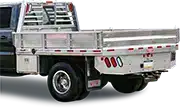
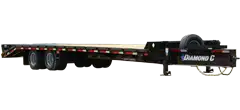
An open car hauler is exactly what it sounds like: a channel-rail or full-deck trailer with no walls and no roof. The vehicle remains exposed to rain, sun, road spray, salt, gravel, insects, and public view. That exposure matters when the car has expensive paint or must cross several states in winter. For routine transportation, however, an open trailer is lighter, easier to inspect, easier to access from the sides, and generally less expensive than an enclosed trailer of comparable capacity.
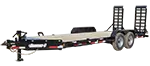
A current H&H 82-inch by 18-foot steel car hauler provides a useful real-world example. The 7,000-pound-GVWR version uses two 3,500-pound axles and has a published curb weight of approximately 2,140 pounds. Subtracting that curb weight from the GVWR produces a nominal cargo capacity of about 4,860 pounds before accounting for installed options, tools, a spare tire, straps, or other cargo. Standard loading equipment includes a 2-foot steel treadplate dovetail and slide-in steel ramps. H&H also offers a 9,900-pound-GVWR version of the same size with 5,200-pound axle ratings and a higher published curb weight, so the correct configuration depends on the vehicle being carried rather than deck length alone.
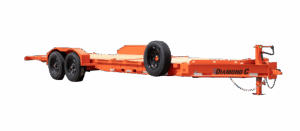
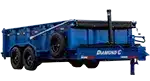
A Diamond C GTF Single Car Hauler is another current open option. The GTF is offered in 14- to 22-foot lengths with an 83-inch bed width and GVWR packages of 7,000 or 9,890 pounds. Diamond C lists an approximate weight range of 1,760 to 3,510 pounds across the available lengths, floors, axle packages, and options. Standard running gear uses two 3,500-pound Lippert drop axles, while the heavier package uses two 6,000-pound Lippert axles with the trailer rated at 9,890 pounds GVWR. The GTF uses a unibody 6-inch I-beam tongue and frame, a formed rub-rail tie-down system, four 360-degree D-rings, a standard winch mounting area, a 24-inch diamond-plate dovetail, and 60-inch rear slide-in punch-plate ramps. Wood and steel flooring choices are available, and the steel receives Diamond C’s DM Difference Maker multi-stage coating system.
Open haulers are normally lighter than enclosed trailers, but the weight advantage needs to be understood correctly. The trailer’s entire curb weight is part of the combination weight; it does not all count against the tow vehicle’s payload rating. Only the load carried by the truck, including passengers, cargo, hitch equipment, and trailer tongue weight, counts against the truck’s payload and GVWR. A lighter trailer can still provide more usable trailer cargo capacity under its GVWR, reduce loaded combination weight, and make it easier to stay within the truck’s GCWR, receiver rating, rear-axle rating, and tire capacities.
When Open Makes Sense
- Hauling a car to a shop, auction, dealership, or storage location where weather and road-debris exposure are acceptable
- Moving vehicles frequently when quick ramp setup, side access, and easy inspection matter
- Working within a tighter purchase budget while still buying enough GVWR and deck length for the vehicle
- Making short or moderate-distance trips during conditions that do not threaten a valuable finish
- Attending track days where the car is loaded and unloaded repeatedly and tools are carried separately
Enclosed Car Haulers: What You’re Getting
An enclosed trailer surrounds the vehicle with a floor, walls, roof, and rear ramp door. That enclosure substantially reduces exposure to rain, direct sunlight, salt spray, insects, gravel, and casual attention. It also gives you lockable doors and space for tools, tires, cabinets, clothing, and race equipment. An enclosed trailer is not automatically waterproof, climate-controlled, or theft-proof, however. Water can enter through damaged seals or roof penetrations, condensation can form inside, and the complete trailer can still be stolen unless the coupler, doors, wheels, and parking location are secured.
The Wells Cargo Road Force RF8528T3 is a current 8.5-foot-wide enclosed auto-hauler configuration. It is built around a tubular steel chassis with bonded .030-inch aluminum exterior skin and a one-piece aluminum roof. The current specification lists a body length of 28 feet 10 inches, an interior length of approximately 28 feet 6 inches, an 8-foot interior width, a 6-foot 6-inch interior height, and 84 inches between the wheel wells. The rear ramp opening is approximately 94 inches wide by 72 inches high, so vehicle height at the door must be measured instead of assuming every lifted truck or SUV will fit. The trailer includes a no-show beavertail, spring-assisted ramp door, ramp extension, side entry door, electric brakes with a breakaway system, sidewall vents, and vehicle tie-down points. A representative 2026 RF8528T3 is rated at 9,990 pounds GVWR with an approximate curb weight of 4,170 pounds and approximate payload capacity of 5,820 pounds. The actual certification label on the trailer controls.
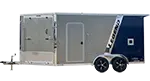
The Legend Thunder V-Nose 8.5 Wide is an all-aluminum enclosed option designed for general cargo and single-vehicle hauling. Current tandem-axle sizes run from 8.5 by 18 feet through 8.5 by 26 feet, with GVWR packages from 7,000 to 9,990 pounds. Published dimensions include a 98-inch interior box width, 83 inches between the fenders, a 78-inch interior height, and a rear ramp opening approximately 90 inches wide by 73 inches high. The standard running gear uses 3,500-pound E-Z Lube torsion axles with electric brakes. It also uses a one-piece aluminum roof, bonded screwless .030-inch aluminum exterior skin, and a 3/4-inch engineered-wood floor. Because tie-down equipment can vary by build, buyers should verify that the exact trailer includes properly rated D-rings, track, or other vehicle-securement hardware before loading a car.
For buyers building a more complete race or transport trailer, Wells Cargo MotorTrac and the Legend Trailmaster Race Series are purpose-oriented choices. The Legend race series is available in 8.5-foot-wide lengths from 20 to 32 feet with GVWR packages reaching 14,000 pounds, depending on length and axle configuration. Escape doors, removable wheel boxes, cabinetry, lighting, finished interiors, and alternative flooring may be available. Hauling two vehicles requires more than simply ordering a longer floor. A true two-car setup may need a purpose-built stacker or lift system, greater interior height, sufficient axle and tire capacity, reinforced structure, correct load placement, and enough tongue-weight adjustment. A 32-foot trailer should not be assumed to carry two cars safely without verifying the complete engineered configuration.
The trade-off is weight, aerodynamic drag, and price. A large enclosed car hauler can weigh 3,500 to 5,000 pounds or more before the vehicle, tools, cabinets, spare tires, generator, winch, or fuel are added. That empty weight does not transfer entirely to the truck, but the loaded trailer’s tongue weight does. Conventional bumper-pull trailers commonly need roughly 10 to 15 percent of their loaded weight on the hitch for stable towing, subject to the trailer and tow-vehicle manufacturers’ instructions. Enclosed trailers also present a larger frontal area and can demand more power in headwinds than an open trailer at the same scale weight. Half-ton owners must check the truck’s payload sticker, receiver limits, rear GAWR, tire ratings, maximum loaded trailer rating, and GCWR rather than relying on an advertised maximum tow rating by itself.
When Enclosed Makes Sense
- Transporting restored classics, race cars with expensive bodywork, specialty vehicles, or other high-value cars
- Making multi-day or long-distance trips through changing weather, construction zones, or winter road conditions
- Using the trailer as temporary event storage while managing ventilation, moisture, battery condition, and security
- Protecting show-quality paint, exposed components, graphics, or other finishes from direct road spray and debris
- Operating a transport or motorsports business where organized equipment storage and a professional appearance matter
Side-by-Side: The Numbers That Matter
| Feature | Open (H&H 82″ x 18′ 7K example) | Enclosed (Wells Cargo RF8528T3 example) |
|---|---|---|
| Current price position | Generally lower; request a quote for the exact GVWR, deck, ramps, freight, and options | Generally higher; request a quote for the shell, axle package, interior, electrical system, and options |
| Empty weight | Approximately 2,140 lbs. | Approximately 4,170 lbs. |
| GVWR and nominal payload | 7,000 lbs. GVWR; approximately 4,860 lbs. before options and extra cargo | 9,990 lbs. GVWR; approximately 5,820 lbs. on a representative current build |
| Weather protection | Vehicle remains exposed; covers and rock shields provide only limited protection | Substantial enclosure from weather and debris, but not automatically watertight or climate-controlled |
| Security | Vehicle remains visible and accessible; locks and immobilizers are strongly recommended | Lockable and concealed, but the doors, coupler, wheels, and complete trailer still need security |
| Loading ease | Open side access, 82-inch deck, dovetail, and separate slide-in ramps | Spring-assisted ramp door with a 94-inch opening and approximately 84 inches between wheel wells |
| Storage use between hauls | Limited weather protection and little secure equipment storage | Useful dry storage when seals, ventilation, floor loading, and theft prevention are managed |
The Weight Question Nobody Asks Until It’s Too Late
Here’s where people get into trouble. They compare trailer prices, choose a length, and never run the complete combination against the truck’s ratings. The payload rating on the tow vehicle covers the driver, passengers, cargo in the cab and bed, aftermarket equipment, the hitch, and the trailer’s loaded tongue weight. It does not include the trailer’s complete curb weight. For example, suppose a truck has 1,800 pounds of available payload, the people and truck cargo total 500 pounds, and the hitch equipment weighs 100 pounds. A 9,000-pound loaded bumper-pull trailer producing 12 percent tongue weight would place about 1,080 pounds on the truck. The combined payload use would be about 1,680 pounds, leaving only 120 pounds of margin before considering measurement error or additional cargo.
The trailer’s own payload calculation is separate. The 7,000-pound-GVWR H&H example has a published curb weight near 2,140 pounds, leaving about 4,860 pounds for the car and everything placed on or in the trailer. A 4,000-pound vehicle would bring the estimated trailer weight to roughly 6,140 pounds before straps, a spare, a winch, tools, or optional equipment. The 9,990-pound-GVWR Wells Cargo example weighs about 4,170 pounds empty and carries approximately 5,820 pounds, so the same 4,000-pound car would produce an estimated trailer weight near 8,170 pounds before additional cargo. The enclosed trailer has a substantially higher GVWR, yet much of that increase is consumed by the enclosure itself.
Check every limiting number: the truck’s GVWR, available payload, rear GAWR, GCWR, receiver rating, maximum trailer rating, tire capacities, and any weight-distribution-hitch requirements. Then check the trailer’s GVWR, certified cargo capacity, axle ratings, tire ratings, coupler rating, ramp capacity, floor capacity, and tie-down ratings. The lowest applicable limit is the working limit. Load the vehicle so the trailer maintains the tongue-weight range specified by its manufacturer, and confirm the finished combination on a scale rather than relying only on brochure estimates.
Both examples are well above Indiana’s 3,000-pound trailer-brake threshold. Indiana law requires qualifying trailers operated on a highway to have brakes adequate to control, stop, and hold the trailer, controllable from the tow vehicle, along with automatic application in an accidental breakaway. Commercial operators also need to evaluate federal and state motor-carrier requirements. A Class A CDL is generally associated with a combination GCWR or actual GCW of at least 26,001 pounds when the towed unit has a GVWR or actual GVW over 10,000 pounds. A trailer rating over 10,000 pounds by itself does not create the Class A threshold when the qualifying combined weight remains below 26,001 pounds, although hazardous-material, passenger, commercial-use, and state-specific rules can change the answer.
So the first question isn’t simply open or enclosed. The first questions are: what does the vehicle weigh in its current condition, what equipment will travel with it, what does the trailer weigh as equipped, and what can the truck and hitch actually support? Answer those questions first, and the better trailer style often becomes obvious.
A Quick Q&A
Can I use an open car hauler for a race car with an aero kit? Yes, when the deck width, ramp angle, breakover angle, and tie-down plan fit the car. Measure the splitter, side skirts, exhaust, diffuser, wheelbase, track width, and door clearance before choosing a trailer. A dovetail, longer ramps, ramp extensions, a tilt deck, removable fenders, or a winch may be necessary. Use properly rated tire nets, wheel straps, soft loops, or manufacturer-approved chassis or axle attachment points. Do not place straps over fragile aero panels or attach them to suspension parts unless the vehicle manufacturer and securement-system instructions specifically allow it.
Is aluminum enclosed better than steel enclosed? An aluminum-frame trailer is often lighter than a similarly sized steel-frame trailer, but construction details, floor material, axle package, interior finish, and options can outweigh the material difference. Aluminum offers strong corrosion resistance and can improve payload efficiency, while steel commonly provides a lower initial cost and straightforward structural repair. Neither material is maintenance-free. Aluminum trailers still require inspection for fatigue, cracked welds, galvanic corrosion around dissimilar metals, loose fasteners, and impact damage. Compare certified empty weight and cargo capacity on the exact trailers rather than assuming a fixed weight advantage.
Do enclosed trailers need more maintenance? They have more components and more places for water to enter. Inspect roof edges, corner caps, vents, lights, windows, side doors, ramp-door seals, hinges, spring hardware, and exterior seams at least annually and after impacts or severe weather. Check the floor around the rear door, wheel boxes, tie-downs, and wall edges for softness, swelling, delamination, or staining. Engineered-wood and plywood floors can deteriorate when water remains trapped. Extruded-aluminum flooring removes the risk of wood rot but still needs inspection for cracks, corrosion, loose attachment points, chemical damage, and wear.
What Spencer Trailers Carries
At our current inventory, you can compare open car haulers and enclosed trailers from manufacturers represented by Spencer Trailers, including Diamond C, H&H, Liberty, Legend, Wells Cargo, United Trailers, and other available brands. Inventory changes, so a particular size or model may be in stock, recently sold, or available by custom order. Diamond C builds its trailers in Mt. Pleasant, Texas, where the company was founded in 1985. Current Diamond C GTF car haulers use Lippert axles and can be configured around the vehicle’s weight, width, clearance, flooring, ramp, and tie-down requirements.
Open haulers cost less in most comparable configurations and handle routine vehicle transport efficiently. Enclosed trailers earn their additional cost and towing demand when protection, equipment storage, privacy, or a finished race-support environment matters. Neither style is automatically the right choice for every customer, and a higher GVWR does not help if the truck, hitch, door opening, ramp angle, or payload capacity is wrong for the job.
If you’re not sure where the line is for your situation, give us a call at (812) 829-0226 or stop by 291 West State Hwy 46 in Spencer. Bring the vehicle’s actual weight, dimensions, ground clearance, tire width, and your truck’s door-jamb payload information. We can compare current stock, review the certification labels, put the loaded-weight estimates on paper, and help you identify the right trailer before you spend money on a configuration that does not fit.
The right trailer isn’t always the most expensive one. But the wrong one gets expensive fast. Start with the vehicle, the complete load, and the tow vehicle’s real ratings, then work backward from there.


