





You finally bought the tractor. Maybe it is a sub-compact machine such as a Kubota BX or John Deere 1025R, a compact utility tractor with a loader and rotary cutter, or a larger farm tractor weighing well over 10,000 pounds once ballast and attachments are included. Either way, the truck is running, the field is waiting, and now you are standing in the driveway wondering exactly how you are going to get that machine from Point A to Point B without overloading the trailer, damaging the tractor, or creating an unstable combination on the highway. The trailer decision matters more than most people realize.
Equipment trailers are not one-size-fits-all. A 7,000-lb GVWR utility trailer that carried a zero-turn mower all summer may have only 4,500 to 5,500 pounds of usable payload after the trailer’s own empty weight is deducted. That can be far too little for a loader-equipped compact tractor, even when the tractor looks small. At the other extreme, a tall deck-over trailer with a steep loading system can make loading a low-clearance sub-compact tractor unnecessarily difficult. Getting this right means knowing the tractor’s actual transport weight, matching that weight to the trailer’s available payload, and selecting the correct deck dimensions, axle package, tires, brakes, ramps, tie-down anchors, hitch, and tow vehicle.
Know What You’re Actually Hauling
The first number to nail down is the tractor’s transport weight with everything that will be on the trailer. Published tractor weights are only a starting point because manufacturers may list base machine weight, shipping weight, operating weight, or an unballasted weight for one specific tire and operator-station configuration. Those numbers may exclude the front loader, bucket, mower deck, rear implement, wheel weights, liquid tire ballast, fuel, tools, and other equipment.
A Kubota BX2380 has a published base tractor weight of approximately 1,455 pounds. Once a loader, bucket, mower deck, fuel, ballast, and other attachments are added, the transport weight can move well past 2,000 pounds and may approach or exceed 2,500 pounds depending on the exact setup. A current John Deere 3025E is approximately 2,600 pounds before a loader, bucket, rear implement, wheel ballast, and other additions are counted. A Case IH Farmall 75C can weigh roughly 5,000 to more than 6,000 pounds before substantial ballast and loader equipment are added. A loader-equipped, ballasted utility tractor can therefore become a 7,000- to 10,000-pound load much faster than its bare specification suggests.
That spread matters enormously. Buyers often look at a tractor, decide that it appears compact, and use whatever trailer is already available. But a compact tractor with a loader, loaded rear tires, a box blade, and an extra attachment can exceed the payload of a light utility trailer even though the trailer’s GVWR number initially appears higher than the tractor’s advertised weight. The trailer’s empty weight counts against GVWR, and every attachment riding on the deck counts as cargo.
Do not select GVWR by adding a percentage to the tractor’s bare weight. Start with the trailer’s actual empty weight as shown on its documentation or a certified scale. Add the tractor’s scale weight, every attached or loose implement, chains, binders, fuel cans, toolboxes, spare parts, and anything else carried by the trailer. The total must remain below the trailer’s GVWR, axle ratings, tire capacities, wheel ratings, coupler rating, safety-chain ratings, and any lower component limit.
For example, a 4,000-pound tractor placed on a 2,200-pound trailer creates a loaded trailer weight of approximately 6,200 pounds before additional tools or implements are counted. A 7,000-pound GVWR trailer would leave less than 800 pounds of remaining capacity. That may be technically within the rating, but it offers little flexibility for a heavier attachment, inaccurate published weight, future equipment changes, or uneven axle loading. In that situation, stepping up to a higher-GVWR equipment trailer may be the more practical long-term choice.
Deck Length and Width: It’s Not Just About Weight
A compact tractor with a front loader can be surprisingly long relative to its weight. Add a rotary cutter, tiller, box blade, backhoe, or other 3-point attachment and the required deck length increases quickly. The machine must fit completely on the load-carrying surface without the tires, bucket, or implement hanging in an unsafe position. There must also be enough fore-and-aft adjustment to establish proper tongue weight without placing an axle, tire, or attachment where it interferes with the trailer’s fenders, toolbox, jack, ramps, or dovetail.
Equipment trailer lengths commonly begin around 16 feet and extend through 18, 20, 22, 24 feet, and longer configurations. A measured 14-foot deck may work for some sub-compact tractors without a long rear attachment, but it should not be treated as a universal sub-compact recommendation. A loader-equipped BX- or 1-Series-size tractor may need a 16-foot or longer deck once a rear implement is installed. Many compact utility tractor combinations are better suited to 18- or 20-foot decks, while utility tractors with larger implements may need 22 feet or more.
Measure the tractor in the exact transport configuration. Lower the loader bucket, place the rear implement in its intended travel position, and measure the total occupied length. Also note where the tractor’s center of gravity falls. A deck may be physically long enough yet still provide too little room to adjust the tractor for correct hitch weight.
Width is also a real concern. Many bumper-pull equipment trailers provide approximately 80 to 82 inches of usable bed width between the fenders, depending on the axle and tire package. That is enough for many compact tractors, but tire width can change with adjustable rear wheels, agricultural tires, turf tires, wheel spacers, chains, or dual-wheel setups. Some utility tractors can be wider than an 82-inch between-the-fenders deck even before duals are installed.
Measure the tractor at its widest point, normally the outside of the rear tires. Do not rely on nominal tractor width or hood width. If the machine is too wide for a between-the-fenders trailer, a 102-inch-wide deck-over configuration or an equipment trailer equipped with a properly engineered drive-over-fender package may be the better solution. Remember that a deck-over normally sits higher, so its loading angle must also be evaluated.
Ramps: The Make-or-Break Feature
More trailers get eliminated from a tractor buyer’s list because of loading geometry than almost any other feature. A tractor’s approach angle, breakover angle, rear departure angle, belly-mower clearance, drawbar height, loader-frame clearance, tire tread, and implement position all interact with the ramp and deck design. A trailer can have ample payload and still be a poor fit if the tractor bottoms out before its rear tires reach the deck.
For tractors, you want ramps that are:
- Wide enough to support the entire tire footprint without forcing the operator to balance an agricultural tire near the ramp edge. The ramp surface should also provide dependable traction when wet, muddy, or covered with loose material.
- Low-angle enough for the tractor’s ground clearance and wheelbase. A steep ramp can contact a belly mower, drawbar, backhoe subframe, 3-point implement, or the center of a long-wheelbase tractor before all four tires are supported.
- Designed for the concentrated load. Trailer payload, axle ratings, and ramp capacity are separate considerations. Confirm that the selected loading system is approved for the tractor’s axle loads and tire configuration rather than assuming that every ramp can accept any machine that fits within the trailer’s GVWR.
A dovetail reduces the transition between the ramps and the main deck, but the complete loading angle still depends on deck height, dovetail length, ramp length, suspension position, and how level the trailer is during loading. Longer ramps generally reduce approach angle, while supportive ramp knees can transfer loading forces into the ground and trailer structure. The tow vehicle and trailer should be aligned on firm, level ground whenever possible.
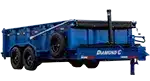
Diamond C offers several legitimate loading systems for different trailer families. MAX Ramps provide a wide, spring-assisted loading surface and can form a usable extension of the deck when stowed in the flat position. XDR Ramps are heavy-duty knee ramps intended for demanding equipment loading on compatible deck-over models. The X-Ramp is a single-piece, full-width loading system used with the appropriate max-width and drive-over-fender equipment package. Availability depends on the trailer model, length, axle package, and build configuration.
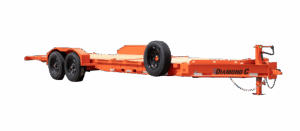
The Diamond C HDT takes a different approach by using a gravity-fed, hydraulically dampened tilt bed. Instead of lifting and positioning conventional loading ramps, the operator releases the tilt mechanism, loads the tractor onto the inclined bed, and allows the deck to return to transport position. A tilt trailer can be an excellent solution, but the tractor’s tire traction, ground clearance, wheelbase, weight distribution, and attachment clearance still need to be checked before ordering.
Diamond C Equipment Trailers Worth Looking At
Diamond C Trailers is a family-owned American manufacturer founded in 1985 and based in Mt. Pleasant, Texas. Its premium equipment and gooseneck lines use Lippert axles, and current builds receive the company’s DM Difference Maker multi-stage coating system. Trailer specifications and available options vary by model, length, axle package, and production availability, so the final build sheet should always be reviewed rather than relying on a generic model description.
For tractor hauling, the most appropriate model depends on whether the buyer needs a low-profile bumper-pull trailer, a tilt-bed loading system, or a 102-inch-wide gooseneck flatbed for larger equipment. These are three of the Diamond C platforms most likely to enter that conversation:
Diamond C HDT (Hydraulically Dampened Tilt)
The HDT is Diamond C’s low-profile hydraulically dampened tilt equipment trailer. Current configurations cover approximately 15,500 to 24,000 pounds GVWR, with available lengths from 16 to 28 feet and bed widths of approximately 80 to 82 inches. The standard axle package uses two 7,000-pound Lippert axles, with heavier tandem and triple-axle configurations available for higher-GVWR builds. Trailer empty weight varies substantially by length and equipment package, so payload must be calculated from the specific trailer’s certification label and documented empty weight.
The HDT’s principal advantage is its gravity-fed tilt bed. There are no loose ramps to pull from storage and no folding ramps to lift into position. That makes it appealing for operators who frequently load wheeled equipment and want a clean, straightforward loading process. The hydraulic system dampens deck movement; it does not power the tractor up the incline or eliminate the need for proper traction and balance.
The HDT can work well for compact and utility tractors when the machine fits within the selected bed width, payload, and loading-angle limits. A buyer should still check whether a low-hanging mower deck, backhoe frame, drawbar, loader mount, or rear implement will clear the transition as the bed tilts. Heavier tractors may require an upgraded HDT axle and GVWR package rather than the standard configuration.
Diamond C FMAX (Flatbed Max Gooseneck)
The FMAX is Diamond C’s premium 102-inch-wide gooseneck flatbed family. It is a deck-over platform rather than a conventional between-the-fenders bumper-pull equipment trailer. Current FMAX models include the FMAX207, FMAX208, FMAX210, FMAX212, FMAX216, FMAX307, FMAX310, and FMAX312, with GVWRs ranging from approximately 15,500 pounds to as much as 40,000 pounds depending on the exact model and package.
Available deck lengths generally begin at 20 feet and extend as long as 44 feet on select models. The series uses Diamond C Engineered Beam frame construction and model-specific Lippert axle packages, including single-wheel, dual-wheel, tandem, and triple-axle arrangements. The FMAX207, for example, occupies the lighter end of the lineup, while the FMAX210 is a 25,000-pound-GVWR tandem-dual-wheel model and the FMAX312 can be configured at the top end of the range.
Compatible loading options vary by FMAX model and length. They can include 44-inch MAX Ramps, XDR Ramps, a hydraulic dovetail, or a straight-deck configuration. A full-width deck-over gives more room for wide tractors and side loading, but it also raises the deck above the tires. Buyers hauling a low-clearance tractor should evaluate the selected ramp or hydraulic-tail angle before assuming that a larger trailer is automatically easier to load.
An FMAX also transfers a meaningful portion of its loaded weight to the truck through the gooseneck ball. The truck must have an approved in-bed hitch, enough payload capacity for pin weight, sufficient rear-axle and tire capacity, and an adequate GCWR. Depending on the truck, trailer, load, and type of operation, the combination may also cross commercial licensing and operating thresholds.
Diamond C LPX (Low Profile Extreme-Duty Equipment)
The LPX is a low-profile, extreme-duty bumper-pull equipment trailer intended for buyers who want substantial capacity without moving to a full deck-over gooseneck. Current LPX configurations range from approximately 15,500 to 24,000 pounds GVWR, with lengths from 16 to 30 feet and bed widths of approximately 80 to 82 inches. The standard package uses two 7,000-pound Lippert axles, while heavier packages can use triple 7,000-pound, tandem 8,000-pound, or tandem 10,000-pound axle configurations.
Because the LPX carries the bed between the fenders, it offers a lower loading surface than a typical deck-over. That can improve loading geometry for compact and utility tractors with mower decks, loader frames, or low-mounted components. The tradeoff is usable width between the fenders, which must be compared with the tractor’s actual outside tire measurement.
LPX loading options can include heavy-duty ramps, MAX Ramps on compatible lengths, and the X-Ramp with the required max-width package and drive-over fenders. The X-Ramp provides a broad loading path for equipment with wider or less predictable tire placement, but the tractor, tire arrangement, and concentrated axle load still have to match the trailer’s approved configuration.
Spencer Trailers carries Diamond C inventory and can order specific configurations. Check the current trailer inventory or reach out directly to ask about HDT, LPX, and FMAX availability. Because axle packages, loading systems, tires, lengths, and accessories can change both empty weight and payload, compare the actual build sheet rather than shopping by model name alone.
Tie-Down Points: Don’t Improvise
Four-corner securement is a sound practice for tractor hauling even when a lighter machine may fall under more general cargo-securement rules. For commercial transportation, federal rules specifically require heavy vehicles, equipment, and machinery weighing more than 10,000 pounds to be restrained with at least four tiedowns, with appropriate restraint at the front and rear. Lighter equipment still has to be secured against forward, rearward, sideways, and vertical movement.
Do not choose every chain or strap by an arbitrary working load limit. The required securement depends on the tractor’s weight, tiedown arrangement, attachment angle, number of devices, anchor ratings, and the applicable regulations. Under federal commercial cargo-securement rules, the aggregate working load limit of the tiedowns used to restrain an article must be at least one-half of the article’s weight. That is a minimum calculation, not a reason to use marginal hardware.
Use transport-rated chain, binders, or web tiedowns with legible working load limit markings. Grade 70 transport chain is commonly used for equipment, but every component in the securement path must be suitable for the load. The effective rating is limited by the weakest chain link, hook, binder, strap, D-ring, stake pocket, rub rail, or attachment point. Replace bent hooks, stretched chain, damaged binders, cut webbing, unreadable tags, and distorted trailer anchors.
Attach to manufacturer-approved securement points or structurally suitable portions of the tractor. Do not wrap chains around steering cylinders, hydraulic hoses, 3-point lift arms, sheet metal, the ROPS, plastic bodywork, or components that can move independently. Axle housings and designated frame points are commonly used, but the tractor operator’s manual should control whenever it identifies transport tie-down locations.
The tie-down anchor points on the trailer matter as much as the chains or straps. A D-ring is not automatically stronger than a stake pocket, and an attractive weld does not establish a working load limit. The anchor must be tied into the trailer structure and rated for the intended direction of pull. Anchor locations should allow the tractor to be restrained without chains rubbing against tires, sharp edges, hydraulic lines, ramps, or fenders. Available anchor layouts vary by trailer model and build, so discuss the intended tractor and securement method before ordering.
Quick checklist before every tractor haul: Park on firm, level ground. Connect the coupler or gooseneck, lock it, raise the jack fully, cross and connect the trailer safety chains where applicable, and attach the breakaway cable independently to the tow vehicle. Load slowly with the trailer aligned behind the truck. Shut off the tractor, set its parking brake, lower the loader and hydraulic attachments, and secure or immobilize attachments as required. Install properly rated tiedowns at approved front and rear points. Confirm that chains, binders, buckets, and implements cannot contact the tires or road. Check hitch engagement, trailer brakes, breakaway battery, lights, tire pressure, wheel condition, lug nuts, ramps, gates, and all latches before pulling out. Stop shortly after departure and recheck the load.
Compact vs. Full-Size: A Practical Comparison
| Tractor Class | Example Models | Loaded Weight (est.) | Recommended Trailer GVWR | Minimum Deck Length |
|---|---|---|---|---|
| Sub-compact | Kubota BX2380, John Deere 1025R | Approximately 1,800 to 3,000 lbs with common attachments | 7,000 lb, subject to verified payload | 14 to 16 ft after measuring the complete setup |
| Compact utility | John Deere 3025E, Kubota L3302 | Approximately 3,000 to 5,500 lbs with loader, ballast, and implement | 10,000 to 15,500 lb, based on trailer empty weight | 16 to 20 ft |
| Mid-size utility | Case IH Farmall 75C, John Deere 5075E | Approximately 6,000 to 10,000+ lbs depending on cab, loader, and ballast | 15,500 to 24,000 lb | 18 to 22 ft |
| Large utility or row-crop | Case IH Farmall 120A, John Deere 6M Series | Approximately 10,000 to 18,000+ lbs before some implements | 24,000 to 40,000 lb gooseneck configuration, as required | 25 ft or longer after full measurement |
These ranges are planning estimates, not substitutes for actual weights. Cab configuration, tire selection, front and rear ballast, liquid-filled tires, loaders, duals, and implements can change the transport weight by thousands of pounds. A certified scale ticket is the best number to use when the combination is close to a trailer, truck, axle, tire, or licensing limit.
What About a Standard Utility Trailer?
A lot of people already own a 16-foot utility trailer or car hauler and want to use it for the tractor. Sometimes that works. Sometimes it does not. The deciding factor is not what the trailer is commonly called; it is whether every relevant rating and dimension fits the actual load.
Start with payload. Subtract the trailer’s verified empty weight from its GVWR, then subtract the weight of anything already mounted or carried on the trailer. A nominal 7,000-pound utility trailer may weigh 1,500 to more than 2,000 pounds depending on construction and options, leaving substantially less than 7,000 pounds for the tractor. Next check the axle, tire, wheel, coupler, jack, safety-chain, ramp, floor, and anchor ratings. A wood floor or light ramp system that is suitable for lawn equipment may not be designed for the concentrated tire loads of a ballasted tractor.
Deck width and loading angle also matter. Utility trailers are often narrower than heavy equipment trailers, and side rails may interfere with a loader frame, mower deck, tire, or implement. A tall square rear edge with short ramps can produce a steep approach angle. Loading a tractor onto an unsuitable utility trailer by stacking loose boards or improvised blocking creates another failure point and should not be treated as a permanent solution.
If a sub-compact tractor weighs less than approximately 3,000 pounds in its actual transport configuration, a properly rated 7,000-pound tandem-axle utility trailer may be workable after the trailer’s payload, ramp capacity, brakes, deck dimensions, and tongue-weight range are verified. A heavier compact tractor may require a 10,000-pound, 14,000-pound, or higher-rated equipment trailer even when it physically fits on the utility trailer’s deck.
Indiana requires a trailer or semitrailer with a gross weight of at least 3,000 pounds on the highway to have brakes capable of controlling, stopping, and holding the trailer, along with a breakaway arrangement that applies the brakes if the trailer separates. Tractor-hauling trailers will normally be above that threshold. Functional brakes on the required wheels, a charged breakaway battery, a correctly adjusted in-cab brake controller, and a properly connected breakaway cable are essential parts of the combination.
Moving to a heavier trailer can also affect licensing. For commercial operation, a Class A CDL is generally required when the combination has a GCWR or actual gross combination weight of 26,001 pounds or more and the towed unit has a GVWR or actual gross weight greater than 10,000 pounds. A trailer rated above 10,000 pounds does not, by itself, create the federal Class A threshold when the entire combination remains below 26,001 pounds. Business use can also bring additional USDOT, insurance, inspection, logbook, and operating requirements, so evaluate the complete use case rather than looking only at the trailer rating.
A correctly configured Diamond C equipment trailer is not an exotic purchase for a working tractor. It is a purpose-built platform with the structure, braking system, loading options, and tie-down provisions needed for repeated equipment use. See what has recently moved off the lot for examples of the lengths, axle packages, loading systems, and equipment-trailer configurations commonly selected in this region. Recently sold units are useful configuration examples, but current pricing and availability should be confirmed directly because model-year equipment and options change.
One More Thing on Tongue Weight
Equipment trailers loaded with tractors can generate substantial hitch weight, especially when the loader or tractor is positioned too far forward. For a bumper-pull trailer, a common starting target is approximately 10 to 15% of the total loaded trailer weight on the hitch, unless the truck, hitch, or trailer manufacturer specifies a different range. A bumper-pull trailer weighing 14,000 pounds when loaded could therefore place approximately 1,400 to 2,100 pounds on the hitch.
That hitch weight counts against the truck’s payload capacity and rear-axle capacity. It must fit within the receiver, ball mount, hitch ball, weight-distribution equipment, truck frame, rear axle, wheels, and tires. A pickup advertised to tow a large trailer may still run out of payload before it reaches the headline tow rating after passengers, tools, fuel, an auxiliary tank, and trailer tongue weight are added.
Too little tongue weight can allow sway and make the combination unstable. Too much tongue weight can overload the receiver and rear axle, cause excessive rear suspension squat, reduce available front-axle load, and affect steering and braking. The correct tractor position cannot be determined reliably by putting an arbitrary percentage of the machine ahead of the trailer axles. Loader tractors are often front-heavy, and rear implements can shift the center of gravity significantly.
Load the tractor, measure the resulting hitch or axle weights, and adjust its position within the usable deck area. A commercial scale, portable wheel scales, or a suitable tongue-weight measurement system is far more reliable than judging the truck’s stance. After the correct position is established, record or mark the tire location so the setup can be repeated. Any change in bucket, implement, ballast, or tractor configuration requires another check.
Gooseneck trailers normally place a larger portion of their loaded weight over the truck’s rear axle than bumper-pull trailers place on a receiver. That can improve stability, but it does not create unlimited capacity. The gooseneck ball, mounting system, truck bed, frame, payload rating, rear GAWR, tire capacity, and GCWR must all support the actual pin load and combination weight.
The driver’s-door certification label normally lists the truck’s GVWR and axle ratings, while a tire-and-loading label provides payload information for that specific vehicle as built. The receiver or gooseneck hardware has its own rating. The truck owner’s manual and manufacturer towing guide provide the applicable towing, hitch, and equipment requirements. Do not expect the door-jamb placard alone to state the complete tongue-weight or trailer-tow limit.
After purchasing a trailer, Indiana residents generally have 45 days from the acquisition date to complete the required title and registration process for a newly acquired, unregistered vehicle. Keep the purchase documents, title paperwork, and any temporary permit information with the trailer until permanent registration is complete.
Questions about which Diamond C model fits your tractor? Call Spencer Trailers at (812) 829-0226 or stop by 291 West State Hwy 46 in Spencer. Bring the tractor’s specification sheet, attachment list, outside tire width, total transport length, and an actual scale weight if available. We can work backward from those numbers to the appropriate payload, deck length, axle package, loading system, hitch type, and trailer configuration.