


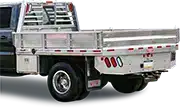
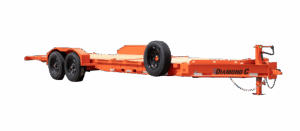





You pull up to pick up a skid steer, a pallet of roofing shingles, or a stack of steel tube. None of it fits cleanly in a dump body, and an enclosed cargo trailer may block the side access or overhead clearance the load requires. What you actually need is an open platform with no permanent walls or roof, enough usable deck area for the cargo, and enough verified payload capacity for the trailer, equipment, attachments, chains, and accessories. That’s the job a flatbed is built to do.
Flatbeds are easy to overlook because the basic idea is simple. But when a load is awkward, palletized, unusually long, wider than a between-fender deck, or best handled by a forklift or crane, an open deck can be the most efficient trailer on the lot. The important part is choosing the correct deck layout, hitch type, GVWR, axle package, loading system, and securement equipment instead of treating every open trailer as interchangeable.
Standard Flatbed vs. Deck-Over: The Real Difference
Open-deck trailers generally fall into two deck-layout categories: a between-fender design and a deck-over design. Those terms describe where the cargo deck sits in relation to the tires. They do not describe the hitch. A between-fender or deck-over trailer may be built as a bumper-pull, pintle-pull, or gooseneck configuration, depending on the model and capacity.
On a between-fender equipment trailer or car hauler, the main deck sits between the fenders. Usable bed width is commonly about 80 to 83 inches, although the exact measurement must come from the current model specifications. The trailer’s overall width can still be close to 102 inches because the tires and fenders are outside the cargo bed. This layout keeps the deck lower, which usually improves the loading angle, but the fenders limit where a wide machine, pallet, or attachment can sit. Removable, drive-over, or extra-wide fender packages can solve some loading problems, but they do not turn every between-fender trailer into a full-width deck-over.
On a deck-over, the deck is positioned above the tires and normally provides a full 102-inch-wide platform. The trade-off is deck height: depending on frame, suspension, tires, axle package, and tail design, a deck-over commonly sits in the low-to-mid 30-inch range or higher. That increases the ramp angle and raises the load’s center of gravity, but it eliminates wheel-well intrusions and gives a forklift or crane much cleaner access along the sides.
Deck-over designs are usually the right call when the cargo itself needs most of the legal 102-inch width, when pallets must be placed from either side, or when long materials need an uninterrupted deck edge. Do not choose by equipment category alone. Compact loaders, skid steers, tractors, and excavators vary substantially in track or tire width, and an attachment may be wider than the carrier. Measure the machine at its widest point in transport position, include the attachment, and compare that number with the trailer’s actual bed width, fender clearance, ramp spacing, and rated payload.
What Loads Belong on a Flatbed
The practical answer is cargo that benefits from open side access, overhead loading, an uninterrupted deck, or a width and shape that will not work inside an enclosed body. A flatbed is also useful when the load must be placed precisely over the trailer axles to achieve safe tongue or pin weight.
- Construction equipment (mini excavators, skid steers, compact track loaders, trench rollers, lifts, and plate compactors)
- Agricultural equipment (compact tractors, cultivators, mowers, hay equipment, attachments, ATVs, and UTVs)
- Lumber and building materials (dimensional lumber, sheet goods, steel tubing, rebar bundles, trusses, and palletized roofing)
- Vehicles (UTVs, golf carts, project cars, motorcycles, and other vehicles that fit the deck, ramps, and ratings)
- Landscaping loads (pallets of sod, stone, block, pavers, bagged mulch, and hardscape materials)
- Industrial goods (HVAC units, generators, tanks, fabricated assemblies, and modular sections)
The common thread is access and geometry. These loads may not fit through a cargo door, may need a forklift from the side, may require crane access from above, or may need to be positioned farther forward or rearward for correct weight distribution. A full-width deck-over removes most side obstructions. A between-fender equipment trailer gives up some width in exchange for a lower deck and easier loading. Neither layout changes the need to stay within GVWR, GAWR, tire capacity, hitch capacity, and the trailer’s actual payload after empty weight and installed options are deducted.
Load Width: Where the Rules Start
On Indiana highways, the general maximum vehicle-and-load width is 8 feet 6 inches, or 102 inches. The same 102-inch standard applies on the federally designated National Network. Width is measured across the widest part of the trailer and load, not merely across the deck. If the combined width exceeds 102 inches, an oversize permit is generally required before travel. In Indiana, oversize and overweight permits are handled through the Indiana Department of Revenue’s Motor Carrier Services program, and local roads or municipalities may impose additional routing or permit requirements.
Practically speaking, a 102-inch deck-over carrying a 102-inch-wide machine is already using the full normal width allowance. A load does not become legal merely because its centerline is aligned with the trailer, and a few inches of side clearance is not a substitute for proper securement. Center the cargo as the loading plan requires, confirm that nothing projects beyond the legal width, and secure it so it cannot shift laterally, forward, rearward, or vertically during normal acceleration, braking, cornering, and road vibration. If the equipment is wider than 102 inches, determine permit, signage, lighting, escort, time-of-travel, and route requirements before loading.
Length matters too. Indiana generally limits a two-vehicle combination, including the load, to 60 feet unless a specific exception or other applicable rule applies. The familiar 53-foot figure applies to a semitrailer unit in a truck-tractor-semitrailer combination; it is not a universal length allowance for every pickup-and-trailer setup. Common 16- to 24-foot bumper-pull trailers are usually well inside the overall limit, while longer tagalong and gooseneck flatbeds require an actual bumper-to-rear measurement of the complete combination. A gooseneck changes hitch placement and weight transfer, but it does not automatically exempt the combination from length, width, axle-weight, licensing, or route rules.
Real Models Worth Knowing
Spencer Trailers carries open-deck, equipment, utility, and deck-over choices from several manufacturers. The examples below show how different these trailers really are. Always verify the VIN-specific build sheet because length, empty weight, axle package, tires, ramps, tail configuration, and final GVWR can change the usable payload.
Diamond C FMAX Flatbed Gooseneck
Diamond C’s FMAX is the company’s Flatbed Max gooseneck family and a true 102-inch-wide deck-over platform. Current model identities include FMAX207, FMAX208, FMAX210, FMAX212, FMAX216, FMAX307, FMAX310, and FMAX312. Depending on model and selected package, GVWR runs from approximately 15,500 pounds to 40,000 pounds, with deck lengths spanning roughly 20 to 44 feet across the family. FMAX models use Diamond C’s Engineered Beam and curved gooseneck architecture, and Lippert axle packages are standard across the premium line. Available tail and loading choices vary by model and can include a straight deck with slide-in ramps, MAX Ramps, or a hydraulic dovetail configuration. The correct FMAX is selected by actual cargo weight, axle distribution, deck length, loading angle, tow-vehicle ratings, and pin-weight capacity, not by the axle count alone. Diamond C builds these trailers in Mt. Pleasant, Texas, and finishes them with the DM Difference Maker multi-stage coating system.
Diamond C LPX
The Diamond C LPX is a low-profile extreme-duty bumper-pull equipment trailer with the working deck between the fenders. Current published configurations cover approximately 15,500 to 24,000 pounds GVWR, while some dealer-stocked or derated packages may be rated at 14,900 pounds. Bed width is generally 80 to 82 inches, lengths run from 16 to 30 feet, and the standard axle package is two 7,000-pound Lippert axles, with available three-axle, 8,000-pound, or 10,000-pound packages depending on configuration. Higher-GVWR packages on longer trailers can use Diamond C Engineered Beam Technology. The LPX is a strong choice for heavy equipment that fits between the fenders and benefits from a lower loading height than a 102-inch deck-over. Its payload is not the number printed in the model name: subtract the trailer’s actual empty weight and installed options from the certified GVWR, then confirm axle, tire, coupler, hitch, and tow-vehicle limits.
Diamond C GTU Utility Trailer
The Diamond C GTU is the General Tandem Axle Utility Trailer, an open-deck utility model rather than a heavy deck-over flatbed. It has a fixed 7,000-pound GVWR, an 83-inch bed, available lengths from 14 to 20 feet, a 4-inch channel frame, and two 3,500-pound Lippert electric-brake axles. That makes it appropriate for mowers, ATVs, UTVs, compact equipment, landscaping supplies, and general property work when the cargo fits between the rails and within the available payload. It is not a 10,000- or 14,000-pound model, and its side rails make it less suitable than a deck-over for unrestricted forklift loading. Manufacturer MSRP and dealer selling prices change with length, options, freight, and market conditions, so use the live inventory listing or a written quote rather than a fixed price estimate from an older article.
H&H Standard Duty Deckover Trailer
H&H’s current Standard Duty Deckover Trailer is a full-width 102-inch platform offered in approximately 14- to 28-foot bed lengths. Published GVWR choices run from 10,000 to 14,000 pounds, with 5,200- to 7,000-pound GAWR per axle depending on the build, and the current design uses a 10-inch I-beam frame. This is the H&H configuration to consider for side-loaded pallets, building materials, farm implements, and equipment that needs a clear deck edge. The deck-over layout does raise the loading surface, so compare ramp or dovetail geometry with the machine’s ground clearance and breakover angle. Confirm the exact deck material, ramp package, brakes, tires, empty weight, and payload on the specific trailer; a 14,000-pound GVWR does not mean 14,000 pounds of cargo capacity.
Liberty Trailers Flatbed Configurations
Liberty’s current flatbed lineup extends well beyond light utility trailers. Its tandem-axle deck-over equipment models use a 102-inch bed and are published at 9,990, 15,400, and 17,500 pounds GVWR, with straight-tail or dovetail choices and lengths that vary by model. Liberty also offers longer 102-inch tagalong and gooseneck flatbeds in single-wheel and tandem-dual configurations, with published GVWRs reaching into the mid-20,000-pound range. That gives contractors and farmers a range from pallet and compact-equipment hauling to heavier machinery and longer materials. As with any configurable flatbed, the model category is only the starting point. Verify the certified GVWR, actual empty weight, axle and brake package, coupler or gooseneck rating, deck length, ramp capacity, and legal overall dimensions before matching it to a load.
When Not to Use a Flatbed
Flatbeds get misapplied more than most people admit. Here’s where an open deck creates more work or less protection than the cargo deserves.
Loose or small materials. Gravel, dirt, sand, loose mulch, demolition debris, and other material that cannot be palletized, bundled, or contained do not belong on an open flatbed. The load can spill, blow, or roll from the deck even when covered casually. A properly rated dump trailer with suitable sides and a compliant tarp or containment system is the better tool.
High-theft loads. Portable tools, boxed equipment, and valuable items left unattended are exposed on an open trailer. An enclosed trailer does not eliminate theft risk, but solid walls, controlled access points, quality locks, and the ability to keep cargo out of sight add useful layers of deterrence. For equipment that must remain on a flatbed, use purpose-built locks, secure parking, removable keys, battery disconnects, GPS recovery tools where appropriate, and a securement plan that is not easy to defeat.
Loads that need weather protection. Electronics, cabinetry, finished materials, packaged goods, and products that degrade with moisture or road spray may be poor flatbed cargo. A correctly fitted tarp can protect some loads, but it must be secured so it does not tear, flap loose, obscure lamps, or become road debris. If the same weather-sensitive cargo moves regularly, an enclosed trailer is usually faster and more consistent.
Fragile or packaged goods at high volume. An enclosed body provides containment, but it does not secure cargo by itself. Pallets, cases, and cartons still need blocking, bracing, straps, E-track fittings, load bars, or other rated equipment appropriate to the load. A flatbed can carry packaged goods safely when they are protected and secured correctly, but repeated high-volume routes may be cleaner and more efficient in an enclosed or purpose-built van trailer.
The flatbed’s strengths are open access, flexible positioning, full-width deck options, and unrestricted overhead clearance. Those advantages only matter when the load needs them. If the cargo needs containment, privacy, weather protection, or frequent unattended storage instead, choose the trailer body that solves those problems rather than forcing a tarp and security routine onto every trip.
Tie-Down Points and Minimum Requirements
For commercial motor vehicles subject to FMCSA cargo-securement rules, the minimum number of tiedowns under 49 CFR 393.110 depends on the article’s length, weight, and whether it is blocked against forward movement. An unblocked article 5 feet or shorter and 1,100 pounds or less generally requires at least one tiedown. An unblocked article 5 feet or shorter and over 1,100 pounds, or longer than 5 feet but not longer than 10 feet, generally requires at least two. An unblocked article longer than 10 feet requires two tiedowns for the first 10 feet and one additional tiedown for every additional 10 feet or fraction. If the article is properly blocked or immobilized against forward movement, the rule generally requires at least one tiedown for each 10 feet of length or fraction. Commodity-specific rules can require more.
The aggregate working load limit of the securement system must be at least one-half the cargo weight, but the calculation is not simply the sum of every label. A tiedown running directly from a vehicle anchor to a cargo anchor contributes one-half of its WLL. A tiedown that starts and ends on the same side after passing through, over, or around the cargo also contributes one-half. A tiedown that passes over or around the cargo and attaches to the opposite side contributes its full WLL. The effective rating of each assembly is limited by its weakest component, including the chain or webbing, hook, binder, connector, cargo attachment point, and trailer anchor.
Heavy equipment and machinery weighing 10,000 pounds or more and operating on wheels or tracks are subject to the specific requirements in 49 CFR 393.130 when the federal rules apply. The machine must be restrained in the forward, rearward, lateral, and vertical directions with at least four tiedowns, attached as close as practicable to the front and rear or to manufacturer-designed securement points. Buckets, booms, blades, and other accessory equipment must be lowered and secured, and articulated machines must be prevented from articulating in transit. Lighter vehicles and equipment have separate or general securement options, but two straps thrown over a machine are not automatically compliant.
Tie-down pockets, rub rails, stake pockets, D-rings, and chain spools vary widely in rating and intended use. Do not assume an anchor is rated by its size or appearance. Use the trailer documentation and component markings, inspect for cracks, elongation, corrosion, bent hardware, damaged webbing, stretched chain, and worn binders, and apply edge protection where webbing can be cut. Wheel chocks and parking brakes can supplement the system, but they do not replace the required tiedowns. Recheck securement after the initial portion of the trip and whenever the load or operating conditions call for another inspection.
The trailer’s GVWR, its available payload, and the working load limits of the securement system are separate numbers. A 14,000-pound GVWR trailer may have substantially less than 14,000 pounds of payload after empty weight is deducted, and that rating does not prove that its anchors, chains, binders, or straps can restrain the cargo. Verify every limit independently.
Matching Trailer to Tow Vehicle
A trailer’s GVWR does not, by itself, tell you which pickup can tow it. Use the tow-vehicle manufacturer’s configuration-specific guide and the certification


