








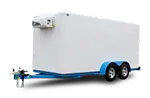

You’ve got a product that needs to stay cold. Maybe it’s artisan ice cream you’re selling at weekend festivals. Maybe it’s fresh-cut flowers for a mobile flower shop. Maybe it’s prepared food, specialty groceries, or farm products that need dependable temperature control between stops. The question isn’t simply whether you need refrigeration. The real question is what type of refrigerated trailer fits your cargo, route, available power, tow vehicle, sanitation requirements, and operating budget when an Indiana summer day climbs into the 90s.
Refrigerated trailers, commonly called reefers, aren’t limited to long-haul trucking. Small all-electric cold-storage trailers, custom refrigerated cargo trailers, medium commercial units, and full-size semitrailers all serve different markets. Those choices are better than they used to be, but they are not interchangeable. Temperature capability, power source, payload, insulation, certification, monitoring, and towing requirements can vary substantially. Here’s how to think through the equipment before putting money into it.
What Mobile Businesses Actually Use Reefers For
The most obvious use is food. Mobile catering operations, BBQ competition teams, craft beverage vendors, restaurants, concession operators, meal-prep services, butchers, and food distributors all use mobile refrigeration to keep products safe and saleable. The FDA’s Sanitary Transportation rule under the Food Safety Modernization Act is relevant to many commercial food shipments, although it is not a one-size-fits-all rule that automatically applies to every farmers-market seller or direct-to-consumer business. Covered shippers, loaders, carriers, and receivers must use suitable equipment, protect food from contamination, maintain adequate temperature control when temperature is necessary for safety, and follow applicable procedures, training, and recordkeeping requirements. Certain operations, including some direct-to-consumer food establishments, may fall under exemptions or waivers.
Federal transportation rules are only part of the picture. Indiana retail food requirements, county health-department rules, supplier contracts, insurance standards, and customer specifications may impose additional obligations. A refrigerated trailer can provide the physical cold-storage capability, but compliance also depends on sanitation, product handling, pre-cooling, temperature monitoring, loading practices, documentation, and a workable response plan for a power or equipment failure.
Food is only part of the picture. Consider:
- Floral businesses transporting arrangements to weddings and events where extended exposure to heat can shorten vase life and damage valuable inventory
- Pharmaceutical and medical supply operations transporting products under a validated, product-specific cold-chain program with appropriate monitoring and backup procedures
- Agricultural producers bringing produce, dairy products, meat, eggs, or other temperature-sensitive goods directly to farmers markets and wholesale customers
- Specialty grocery and butcher shops making home-delivery routes with multiple stops and frequent door openings over several hours
- Brewery and winery operations delivering packaged beverages or other products whose quality benefits from controlled temperatures
- Restaurants and caterers needing temporary cold storage during renovations, large events, equipment failures, or seasonal demand
- Schools, hospitals, and emergency-response organizations requiring temporary refrigerated storage when permanent facilities are unavailable or over capacity
Each use case has different temperature and humidity requirements. Frozen food is generally stored at 0°F or below, while refrigerated perishable food is commonly held at 40°F or below; applicable retail food codes frequently use 41°F or below for cold-held time-and-temperature-control-for-safety food. Ice cream manufacturers may specify a lower temperature to preserve texture and quality. Produce cannot be treated as one temperature category because storage recommendations vary widely by commodity, ripeness, packaging, humidity, and sensitivity to chilling. Temperate cut flowers are often held close to freezing, while tropical flowers may be damaged at those temperatures.
Medical products require an even more careful approach. Many refrigerated vaccines are stored between 36°F and 46°F, but frozen and ultra-cold products use very different ranges, and some products can be permanently damaged by freezing. Transporting vaccines, biologics, lab samples, or pharmaceuticals may require qualified containers, calibrated digital data loggers, mapped temperature performance, alarms, written procedures, documented excursions, and product-specific regulatory oversight. A general-purpose reefer trailer is not automatically a validated pharmaceutical transport system just because it can reach the required setpoint.
How Reefer Trailers Actually Work
A refrigerated trailer combines an insulated cargo enclosure with an active refrigeration system. The enclosure slows heat transfer through the roof, walls, floor, doors, joints, and structural members. The refrigeration system absorbs heat inside the cargo area and rejects it outside. Good performance depends on both parts working together. A powerful refrigeration unit cannot fully compensate for damaged insulation, leaking doors, blocked airflow, frequent openings, warm product, or a poorly planned load.
Air circulation is also part of the system. Cold air must be able to leave the evaporator, travel around the cargo, and return without being blocked. Product stacked tightly against the ceiling, front bulkhead, sidewalls, or air-return path can create warm pockets even when the controller displays the correct setpoint. For regulated or high-value cargo, operators should evaluate temperatures at multiple locations rather than relying only on the unit’s control sensor.
Insulation
Commercial refrigerated bodies commonly use polyurethane or other closed-cell foam incorporated into molded fiberglass, composite panels, or insulated wall assemblies. Construction methods differ by manufacturer. Some enclosures use foamed panels joined together, while others use molded or seamless fiberglass designs intended to reduce joints and water-entry points. Conventional fiberglass batt insulation is common in ordinary cargo trailers but is generally less suitable for demanding refrigerated service because air gaps, thermal bridges, moisture, and compression can reduce its effectiveness.
Wall thickness is important, but thickness alone does not establish thermal performance. The insulation material, density, installation consistency, joints, fasteners, doors, floor design, roof, structural framing, air leakage, moisture condition, and age of the trailer all affect heat gain. A well-built four-inch insulated assembly can reduce refrigeration demand compared with a thinner or poorly sealed enclosure, but buyers should compare the complete body design and published performance rather than choosing solely by wall thickness or a single advertised R-value.
The floor deserves particular attention. It must support the intended cargo while resisting moisture and allowing sanitation. Pallets, rolling racks, kegs, meat-handling equipment, and concentrated wheel loads can require very different floor capacities. Drainage, interior coatings, floor-to-wall transitions, and compatibility with cleaning chemicals also matter. A trailer that works for boxed beverages may not be appropriately equipped for exposed meat, floral water, or wash-down foodservice use.
Refrigeration Units
The refrigeration unit includes a compressor, condenser, evaporator, fans, controls, refrigerant circuit, and power source. Large semitrailer refrigeration units are normally mounted on the front wall and frequently use their own diesel engine, allowing the system to operate independently of the tractor. Thermo King and Carrier Transicold are two major manufacturers in this market, with current platforms offering single-temperature, multi-temperature, telematics, electric-standby, and lower-emission configurations.
Small mobile cold-storage trailers can use a completely different arrangement. Polar King Mobile’s standard compact trailers, for example, use an all-electric GOVI arktik 2000US system rather than a self-contained diesel unit. Those trailers require an appropriate external electrical source. When parked, that can be a suitable shore-power circuit. During mobile or remote operation, it may be a properly sized generator or an engineered inverter and battery system.
Electric standby is useful but should not be described as one universal plug-in standard. Electrical requirements depend on the specific refrigeration unit. Compact systems may operate on 110- or 115-volt single-phase service, while larger commercial standby systems may require 230- or 460-volt three-phase power and professionally installed electrical infrastructure. Before buying a trailer, verify voltage, phase, amperage, connector type, circuit protection, extension-cord limitations, startup demand, and whether the intended site can actually provide the required service.
The setpoint is not the same thing as guaranteed cargo temperature. Actual performance depends on ambient conditions, solar load, insulation, door openings, airflow, product temperature, product mass, defrost cycles, humidity, and refrigeration capacity. Buyers should ask for the manufacturer’s operating range and validation data for the exact body-and-unit combination rather than assuming that any reefer can handle fresh, frozen, and deep-frozen loads equally well.
Polar King: Built for the Small Operator
Polar King Mobile, based in Fort Wayne, Indiana, manufactures compact refrigerated and freezer trailers for commercial mobile and temporary cold-storage applications. Its standard units use a one-piece, seamless fiberglass enclosure intended to reduce the panel seams and moisture-entry points found in many conventionally assembled boxes. Current standard construction includes four-inch insulated roof and walls, reinforced doors, a heavy-duty floor, an antimicrobial interior gel coating, a 2-5/16-inch coupler, and provisions for E-track cargo control.
The standard Polar King Mobile lineup includes 6-by-8-foot, 6-by-12-foot, and 6-by-16-foot trailers. Current published specifications list the 6-by-8 model at 5,000 pounds GVWR, approximately 2,100 pounds empty, and approximately 2,900 pounds of payload capacity. Its published operating range is -10°F to 50°F. The 6-by-12 model is rated at 7,000 pounds GVWR, approximately 2,700 pounds empty, and approximately 4,300 pounds of payload capacity, with a published range of -5°F to 50°F.
The standard 6-by-16 model is rated at 9,990 pounds GVWR, with an approximate trailer weight of 3,300 pounds and a published payload capacity of approximately 6,690 pounds before options and cargo-distribution considerations. Its published operating range is 0°F to 50°F. Current 6-by-16 units in Spencer Trailers inventory use two 5,200-pound torsion axles, but the trailer’s certified GVWR remains 9,990 pounds. Axle ratings do not increase the GVWR printed on the trailer certification label, and payload must still be calculated from the actual empty weight of the finished trailer.
Polar King has also introduced larger and heavier configurations. A current 6-by-20 model uses a GOVI arktik 4000US system, has a published operating range of -5°F to 50°F, and requires 220-volt, 17.5-amp single-phase service. It offers approximately 719 cubic feet of published interior volume and a listed payload capacity of approximately 9,340 pounds. Heavier Avalanche configurations are available for operations that need more chassis capacity than the standard compact lineup. Because specifications can change by year, series, and installed options, buyers should use the certification label and current build sheet for the exact trailer rather than transferring a specification from another size.
The standard compact models use all-electric refrigeration requiring 110-volt, 15-amp service. Polar King recommends a generator rated at a minimum of 6,000 watts for the standard GOVI system. Generator selection must also account for startup demand, operating environment, fuel capacity, noise, weather protection, grounding, and safe exhaust placement. A generator should never be operated inside the trailer, inside a tow vehicle, or near occupied doors, windows, or air intakes because of carbon-monoxide risk.
The refrigeration system is mounted on the front of the insulated enclosure, but that does not make the trailer automatically suitable for a particular pickup. Towability is determined by the completed trailer’s GVWR, actual loaded weight, tongue weight, axle loading, coupler, receiver rating, hitch equipment, brake system, tire ratings, and the tow vehicle’s payload, towing, and GCWR limits. A 9,990-pound trailer can consume a substantial amount of a pickup’s available payload through tongue weight alone. Describing every 6-by-16 refrigerated trailer as a half-ton tow is therefore too broad; the correct vehicle must be selected from the actual ratings and loaded configuration.
Pricing also changes with size, model year, chassis, refrigeration system, doors, shelving, electrical equipment, and accessories. As of July 2026, Spencer Trailers’ advertised inventory included a 2025 6-by-8 Polar King Mobile at $30,750, standard 2026 6-by-16 units at $42,950, and a heavier 2026 6-by-16 Avalanche configuration at $55,900. Those figures are examples of advertised stock-unit pricing at that time, not permanent MSRP. Freight, delivery, taxes, financing, generators, batteries, shelving, ramps, steps, and other accessories can change the final investment.
Standard Reefer Trailers: The Commercial Option
If you need full truckload capacity, a 48-foot or 53-foot refrigerated semitrailer is the commercial benchmark. A current 53-foot Hyundai Translead ThermoTech specification, for example, lists a 68,000-pound trailer GVWR, approximately 3,722 cubic feet of interior volume, and a standard body weight of approximately 11,950 pounds before adding the refrigeration unit. That 68,000-pound figure is the trailer manufacturer’s structural rating, not the amount of cargo that can legally be placed in the trailer.
On the Interstate Highway System, the familiar federal limits generally include 80,000 pounds gross vehicle weight, 20,000 pounds on a single axle, and 34,000 pounds on a tandem axle, with the Federal Bridge Formula and other state or route restrictions potentially requiring a lower weight. Tractor weight, trailer weight, refrigeration-unit weight, fuel, axle spacing, cargo position, and individual component ratings all reduce usable payload. A trailer rated at 68,000 pounds therefore does not mean a tractor-trailer combination may legally operate at a 68,000-pound trailer weight plus the full weight of the tractor.
Current full-size refrigeration platforms can be configured for fresh, frozen, deep-frozen, heated, or multi-temperature work, but there is no universal -20°F-to-70°F capability that applies to every unit. Capacity changes with ambient temperature and box temperature, and a unit designed for produce distribution may not have the same low-temperature performance as a deep-frozen configuration. The body insulation, evaporator arrangement, air chute, bulkheads, telematics, and refrigeration-unit specification must all match the intended load.
Between a compact Polar King and a 53-foot semitrailer is a broad, nonstandard category that can include custom bumper-pull trailers, gooseneck trailers, medium-duty refrigerated truck bodies, and shortened semitrailers. Length alone does not tell you the GVWR or tow-vehicle requirement. A 24-foot unit might be a pickup-towed custom trailer, a heavy gooseneck, or a straight-truck body, each with completely different chassis ratings and licensing implications. Buyers in this size range should request the certification label, empty weight, axle ratings, brake specifications, power requirements, refrigeration capacity, and body-construction details for the exact unit.
| Unit Type | Length | Approx. GVWR | Tow Vehicle Needed | Temp Range |
|---|---|---|---|---|
| Polar King Mobile 6×8 | 8 ft | 5,000 lbs | Properly rated tow vehicle; verify payload, receiver, brakes, GCWR, and loaded tongue weight | -10°F to 50°F |
| Polar King Mobile 6×12 | 12 ft | 7,000 lbs | Properly rated tow vehicle; verify the exact truck and loaded trailer combination | -5°F to 50°F |
| Polar King Mobile 6×16 | 16 ft | 9,990 lbs | Properly rated tow vehicle with adequate payload, hitch, brake controller, and towing capacity | 0°F to 50°F |
| Custom medium commercial reefer | About 20–30 ft | Varies by chassis and manufacturer | Pickup, medium-duty truck, or commercial tractor as specified by the completed unit | System-specific |
| Full commercial semitrailer reefer | 48–53 ft | Commonly up to 68,000 lbs trailer GVWR | Highway tractor matched to axle, combination-weight, and operating requirements | System-specific fresh, frozen, or multi-temperature capability |
The figures in the table are equipment specifications, not promises that every product can safely be carried at every listed temperature. Product requirements, ambient conditions, loading pattern, humidity, refrigeration capacity, door-opening frequency, and validation results must all be considered. Tow-vehicle selection likewise requires more than matching a marketing tow-rating number to the trailer’s GVWR.
Power Options and Running Costs
Dedicated diesel-powered refrigeration units remain common on full-size commercial trailers because they can operate independently from the tractor and continue cooling while the combination is parked. Their fuel consumption is not accurately represented by one universal gallons-per-hour number. Actual use depends on refrigeration-unit model, engine speed, continuous versus start-stop operation, ambient temperature, setpoint, product temperature, insulation condition, door openings, defrost activity, maintenance, and load size.
Instead of building a business plan around a broad estimate, obtain current fuel-consumption data for the exact unit and compare it with the in


