









When a Ball Hitch Is No Longer the Best Fit
If you are towing with a 2-5/16″ ball and regularly operating near the rated limit of the truck, receiver, ball mount, hitch ball, or coupler, the first step is not to assume that movement and noise are normal. A properly matched towing system should not show visible receiver flex, loose mounting hardware, coupler deformation, abnormal wear, or uncontrolled movement. Any of those signs call for an immediate inspection of the complete connection, including the truck frame attachment, receiver, ball mount, ball, coupler, safety chains, trailer tongue, and load distribution.
There are still applications where a pintle hitch trailer is the better tool. Pintle-and-lunette connections are widely used by contractors, utility fleets, municipalities, equipment rental companies, agricultural operations, and other commercial users that need a rugged coupling with generous articulation on uneven terrain. A pintle does not increase the tow vehicle’s capacity or make an overloaded combination legal, but when the trailer, truck, mounting system, and operating environment are suited to it, the connection can be an excellent fit for demanding equipment-hauling work.
What Makes a Pintle Hitch Different
A ball hitch works by securing a properly sized coupler around a hitch ball. Because the ball and coupler fit closely together, the connection generally produces less free play, less chucking, and a quieter ride on pavement. There is no universal 20,000 lb limit for every 2-5/16″ ball system. Commercial hitch balls, mounts, receivers, and couplers are sold with many different gross trailer weight and vertical-load ratings. The legal and safe capacity of the complete setup is always the rating of its lowest-rated component, including the tow vehicle.
A pintle hitch uses a hook mounted on the tow vehicle and a lunette eye mounted on the trailer tongue. The lunette rests in the hook, the upper latch closes over it, and a safety pin or locking device secures the latch. Clearance between the ring and hook gives the connection more vertical and horizontal movement than a close-fitting ball coupler, making it useful when the truck and trailer must cross uneven approaches, construction entrances, farm lanes, drainage areas, and other surfaces where the two units may not remain on the same plane.
That extra clearance also creates more movement inside the connection. Some chucking or clunking can be expected, especially when starting, stopping, or changing direction, but excessive or worsening noise should not simply be ignored. It can indicate an incompatible hook and ring, an incorrect hitch height, poor tongue-weight distribution, loose mounting hardware, or worn coupling surfaces. Approved cushioned, air-compensated, or reduced-slack pintle assemblies can improve ride quality in some applications, but any device used must be compatible with the hook, lunette, mount, truck, and trailer manufacturer requirements.
Weight Ratings: The Real Gap
Pintle hooks are available across a broad capacity range, with commercial products rated as high as 60,000 lb of gross trailer weight. That does not mean every pintle mount, receiver, truck frame, lunette eye, or trailer attached to one can carry 60,000 lb. Pintle hooks also have separate vertical-load ratings, and both ratings matter. The complete towing system is limited by the lowest rating among the tow vehicle, receiver or mounting plate, pintle mount, hook, fasteners, lunette eye, trailer, axles, suspension, tires, wheels, brakes, and safety chains.
Diamond C’s current dedicated pintle-hitch flatbed equipment lineup is the PX series. The PX210 has a 25,000 lb GVWR with two 10,000 lb Lippert axles, while the PX212 has a 25,900 lb GVWR with two 12,000 lb Lippert axles. The PX310 is a 30,000 lb GVWR triple-axle model with three 10,000 lb Lippert axles. The PX312 uses three 12,000 lb Lippert axles and is offered at 30,000 lb GVWR with an available 40,000 lb package. The tandem-axle PX216 uses two 16,000 lb Lippert axles and is also offered at 30,000 lb GVWR with an available 40,000 lb package. GVWR is the maximum allowable weight of the loaded trailer itself, not its cargo capacity. Actual payload equals the trailer’s GVWR minus the trailer’s as-built empty weight and any permanently installed options, tools, spare tires, fuel, or other equipment carried on it.
Heavy-Duty Pintle-Hitch Trailers: What to Look For
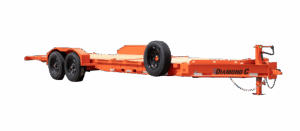
Diamond C’s PX210, PX212, PX216, PX310, and PX312 are purpose-built pintle-hitch equipment trailers rather than converted gooseneck models. Current PX configurations use a 102″ bed width, a 16″ engineered tongue with a 60K pintle eye, and Diamond C’s U.S. patent-protected Engineered Beam design. The PX210 and PX212 use a 16″ low-profile engineered frame, while the higher-capacity PX216, PX310, and PX312 use 16″ to 18″ engineered beams depending on the selected length and configuration. Available deck lengths generally run from 20′ to 40′ on the tandem models and from 25′ to 40′ on the triple-axle models, subject to the selected loading system and current factory availability.
When you are speccing a heavy-duty pintle-hitch equipment trailer, the key variables are:
- Axle count and rating: Do not select a trailer only by counting axles. The tandem PX216 can carry a higher axle rating than a triple-axle PX310, while the PX312 combines three 12,000 lb axles with an available 40,000 lb GVWR package. More axles can distribute weight across additional tire contact points, but they also add tires, hubs, brakes, bearings, maintenance, and tire scrub during tight turns. Choose the model from its complete GVWR, axle, suspension, brake, tire, frame, and payload specifications.
- Pintle eye and hook compatibility: Current PX models use a 60K pintle eye, but the truck-side hook must still have the correct ring compatibility, gross trailer weight rating, vertical-load rating, mounting pattern, fasteners, and supporting structure. A high-capacity hook bolted to an underrated plate or receiver does not create a high-capacity towing system.
- Deck length and loading system: Measure the full footprint, axle locations, attachment points, ground clearance, and concentrated wheel or track loads of the equipment you plan to haul. Depending on model and configuration, Diamond C offers loading arrangements such as MAX Ramps, XDR Ramps, a straight deck with rear slide-in ramps, and a 12′ hydraulic dovetail. Availability and compatibility vary by model, deck length, axle package, and factory build specifications.
The frame design deserves a closer look. Diamond C engineers and builds its own model-specific beams from steel rated at a minimum of 50 ksi rather than relying only on a generic off-the-shelf beam profile. The PX frame incorporates a slight unloaded camber, a channel-iron lace rail with stake pockets and pipe spools, capped deck boards, heavy diamond-plate tire covers, and a low-profile deck layout. The trailer’s DM Difference Maker multi-stage coating system provides the finished surface. Diamond C has built trailers in Mt. Pleasant, Texas since 1985, but the final purchasing decision should still be based on the exact VIN-specific build sheet rather than a generic description of the product line.
Who Actually Buys Pintle Hitch Trailers
Pintle-hitch equipment trailers are primarily commercial and industrial tools. Typical buyers include utility contractors, excavation companies, road and bridge crews, municipalities, equipment rental fleets, agricultural operators, and construction businesses moving machinery between changing job sites. A 25′ to 40′ deck may provide the space needed for large equipment or more than one smaller machine, but available deck space does not guarantee legal payload. Every machine, attachment, bucket, pallet, fuel tank, tool, chain, and spare tire must be included when calculating actual loaded trailer weight and axle distribution.
The articulation advantage matters most in three situations:
- Off-pavement terrain: Rural job sites, construction entrances, farm lanes, gravel yards, and uneven approaches can place the truck and trailer at different vertical or lateral angles. The additional movement available at a properly matched pintle-and-lunette connection reduces the tendency of the coupling to bind. It does not eliminate ground-clearance limits, trailer rollover risk, excessive hitch angles, or the need to travel slowly over severe transitions.
- Frequent coupling and decoupling: A pintle hook can be practical in muddy, dusty, or high-use fleet environments, but it still requires deliberate alignment. The lunette must be fully seated in the correct hook, the latch must close completely, the safety pin must be installed, the jack must be raised and secured, the electrical and brake connections must be tested, and properly rated safety chains must be attached to approved points on the tow vehicle.
- Mixed fleet use: A fleet can standardize around compatible pintle hooks and lunette eyes, reducing confusion over ball sizes. Standardization does not remove the need to verify capacity or hitch height. The trailer should tow level, and the truck-side mounting plate or adjustable mount must place the hook at the correct height. Lunette movement must never be used as a substitute for properly leveling the trailer.
What You Need on the Tow Vehicle
A pintle-hitch trailer requires a compatible pintle hook installed on a receiver-rated pintle mount or on a properly engineered mounting plate attached to the tow vehicle’s chassis. Receiver opening size alone does not establish towing capacity. A 2″, 2-1/2″, or 3″ receiver may have very different ratings depending on the vehicle, hitch design, mounting method, extension length, and whether a weight-carrying or another approved configuration is being used. Plate-mounted pintles on chassis-cab and medium-duty trucks must also be installed on a structure rated by the vehicle manufacturer, body builder, or qualified upfitter for both gross trailer weight and vertical load.
For a PX trailer in the 25,000 to 40,000 lb GVWR range, do not rely on a truck’s advertised maximum gooseneck or fifth-wheel towing figure. Manufacturers commonly publish different limits for conventional receiver towing, gooseneck towing, fifth-wheel towing, and chassis-mounted commercial hitch installations. The selected truck must cover the actual loaded trailer weight under the correct hitch category while remaining within its GCWR, GVWR, rear GAWR, tire ratings, wheel ratings, payload capacity, receiver or pintle-plate rating, and allowable vertical hitch load. For example, a truck weighing 10,000 lb as loaded and a trailer weighing 30,000 lb as loaded create approximately 40,000 lb of gross combined weight. The truck’s GCWR is the manufacturer’s maximum permitted combined rating; it is not the number created by adding those two actual scale weights.
There is no dependable shortcut based on curb weight or truck class. Use the truck’s VIN-specific towing guide or body-builder information, the certification labels for GVWR and GAWR, the installed hitch documentation, the trailer certification label, and actual certified-scale weights. The lowest applicable rating governs the combination.
Pintle vs Ball: When Ball Hitch Still Wins
Pintle hitches are not a universal upgrade. For pavement-focused use, a properly rated ball-coupler setup is normally quieter and has less free play. A Diamond C FMAX is a gooseneck flatbed that connects through a gooseneck ball in the truck bed, while lighter bumper-pull equipment and utility trailers may use an appropriately rated 2-5/16″ ball coupler. These are different towing systems with different vehicle ratings, load paths, handling characteristics, and installation requirements. When the load, terrain, and tow vehicle do not require a pintle connection, a correctly matched ball-coupler trailer from Spencer’s current inventory may provide a smoother and simpler solution.
Noise should be evaluated rather than automatically accepted. A pintle connection normally has more clearance than a ball coupler, so some movement during acceleration, braking, and road transitions is expected. Pronounced impact noise, visible ring wear, a loose mounting plate, an incomplete latch, an ovaled hook or lunette, or a sudden change in handling is not something to dismiss because the trailer is heavy. Follow the hook manufacturer’s wear limits and inspection schedule, confirm that the truck and trailer remain level when loaded, and replace worn components rather than trying to mask movement with an unapproved insert.
Three Questions Before You Buy a Pintle Trailer
Before you spec a heavy-duty pintle-hitch equipment trailer, run through these three:
- Does your tow vehicle cover the trailer under the correct towing category? Confirm the VIN-specific GCWR, maximum conventional or pintle towing capacity, truck GVWR, front and rear GAWR, payload allowance, tire and wheel ratings, and permitted vertical hitch load. The door certification label generally provides GVWR and axle ratings, but GCWR and hitch-specific towing limits are normally found in the manufacturer’s towing guide, owner’s documentation, body-builder information, or dealer system. Include passengers, fuel, service bodies, tools, auxiliary tanks, and trailer tongue weight in the calculation.
- Is every component in the pintle connection compatible and adequately rated? Check the hook’s gross trailer weight and vertical-load ratings, accepted lunette dimensions, mounting orientation, bolt grade and torque, pintle plate or receiver rating, hitch-pin rating, safety-chain capacity, and truck-frame attachment. The PX trailer’s 60K pintle eye does not raise the rating of a 30K hook, an underrated receiver, or an inadequately supported mounting plate. The trailer must also sit level at its normal loaded tongue height.
- What rules apply to your operation on public roads? A trailer’s GVWR by itself is not the federal Class A CDL trigger. A Class A CDL is generally required when the combination has a GCWR of 26,001 lb or more and the towed vehicle has a GVWR over 10,000 lb, subject to applicable exemptions and the nature of the operation. Because every current PX model is rated above 10,000 lb, the tow vehicle’s rating will usually place a working PX combination above the Class A threshold. Indiana also requires a trailer or semitrailer with a gross weight of at least 3,000 lb to have brakes that the driver can apply from the cab and an automatic breakaway function. Indiana residents must title and register a newly acquired, unregistered trailer within the state’s 45-day window. CDL status is not the only compliance issue, so commercial operators should also confirm insurance, USDOT, inspection, hours-of-service, load-securement, axle-weight, and route requirements that apply to their operation.
Where to Go From Here
If your work involves heavy equipment, frequent commercial use, or uneven terrain where the additional movement of a pintle-and-lunette connection is valuable, Diamond C’s PX lineup is the right place to begin the discussion. The PX210 and PX212 are tandem dual-wheel models at 25,000 and 25,900 lb GVWR. The PX310 is a 30,000 lb triple dual-wheel model. The PX216 and PX312 are available in 30,000 lb configurations with optional 40,000 lb GVWR packages, using tandem 16K or triple 12K Lippert axle layouts respectively. The best layout depends on payload, concentrated equipment loads, deck length, turning environment, maintenance needs, braking system, hitch capacity, and the ratings of the tow vehicle. A third axle should not be selected solely because the trailer will encounter soft ground or because it is assumed to track better.
Call Spencer Trailers at (812) 829-0226 or stop in at 291 West State Hwy 46 in Spencer to review the trailer’s current factory specifications, estimated empty weight, available payload, loading system, brake package, hitch requirements, and compatibility with your tow vehicle. You can also browse current inventory or send us a question online if you want to compare options before making the drive.


