










You need a trailer that hauls a riding mower, a few pallets of landscaping material, or a side-by-side. You do not want to pay for more trailer than you will ever use. And you do not want to buy something too light and spend a Saturday on the shoulder of State Road 46 with an overloaded tire, overheated hub, damaged suspension, or bent axle. Before you sign anything, here is what actually matters when you are picking a utility trailer.
Start With the Load, Not the Trailer
The single biggest mistake buyers make is shopping by price before they know their payload requirement. Flip that process. Determine the heaviest load you realistically expect to haul, including fuel, fluids, attachments, pallets, batteries, tie-down equipment, a spare tire, a toolbox, and any accessories added to the trailer. Then add the trailer’s actual unloaded weight and leave a sensible operating margin. GVWR, or Gross Vehicle Weight Rating, is the maximum allowable loaded weight of the complete trailer, not the amount of cargo it can carry. A trailer with a 7,000 lb GVWR and an actual unloaded weight of 1,500 lbs would have a theoretical payload of about 5,500 lbs before accounting for accessories or other changes to the finished trailer.
Use the unloaded weight shown for the exact trailer configuration rather than relying on a generic brochure estimate, because length, flooring, gates, spare tires, side panels, storage boxes, and other options all affect payload. The usable capacity is also limited by the lowest-rated applicable component, including the trailer’s GVWR, axle ratings, tires, wheels, coupler, cargo securement points, and tow vehicle. Getting that calculation wrong can mean paying for capacity you never use, or operating overloaded and causing premature tire, bearing, suspension, brake, or frame damage. Overloading can also result in denial of warranty coverage for related damage.
Single Axle vs. Tandem Axle: The Real Trade-Off
Single-axle utility trailers are generally lighter, easier to maneuver by hand, and simpler to maintain because they have fewer tires, hubs, bearings, brakes, and suspension components. A 2,990 lb GVWR single-axle utility trailer is a common choice for lawn equipment, golf carts, ATVs, light building supplies, and property-maintenance work. Registration may also cost less in Indiana when the trailer is registered in a lower declared-weight category, although the fee is based on weight classification rather than axle count by itself.
There is not a universal 3,500 lb GVWR ceiling for single-axle utility trailers. Current offerings include 5,000 lb and 6,000 lb single-axle configurations with heavier axles, tires, frames, and braking equipment. Even so, a tandem-axle trailer is often the better choice when heavier loads will be hauled regularly. Two axles distribute weight across more tires and suspension points, usually provide more braking capacity, and can deliver a more settled ride over uneven pavement. A tandem trailer may remain more controllable during a tire failure, but the second axle is not permission to continue driving on a damaged tire; the driver should slow down, stop safely, and inspect the trailer immediately.
Tandem utility trailers commonly begin at 7,000 lb GVWR and extend into substantially heavier configurations. A Diamond C GTU tandem has a 7,000 lb GVWR, an 83-inch-wide bed, and two 3,500 lb Lippert electric-brake axles. Depending on the finished trailer’s unloaded weight, cargo dimensions, and weight distribution, it can be a strong fit for side-by-sides, zero-turn mowers, landscaping equipment, palletized materials, and lighter compact equipment. Full-size skid steers and many compact tractors can exceed the GTU’s practical payload or loading geometry, so heavier equipment should be matched to a purpose-built equipment trailer such as a Diamond C LPX or HDT.
A Quick Comparison
| Feature | Single Axle | Tandem Axle |
|---|---|---|
| Typical current utility GVWR range | About 2,990–6,000 lb | About 7,000–14,000 lb and higher |
| Maneuverability | Excellent, especially in tight yards and storage areas | Stable under load but harder to turn or move by hand |
| Tire and load distribution | One axle supports the trailer load | More tires and suspension points share the load, but failures still require an immediate stop |
| Registration cost (Indiana) | Often lower when registered at a lower declared gross weight | Often higher as the declared gross-weight category increases |
| Best use | Lawn equipment, recreational vehicles, light cargo, and occasional hauling | Frequent hauling, heavier equipment, bulk supplies, and longer-distance work |
Mesh Sides vs. Solid Sides vs. No Sides
The deck and side configuration change how the trailer works day to day. Side height does not increase GVWR or payload, so choose the configuration for cargo control and loading access rather than treating taller sides as additional carrying capacity. Here is the breakdown.
- Flat deck (no sides): Maximum access for loading from the rear or side. A flat deck is useful for wide, irregularly shaped, or palletized cargo, provided the load fits the legal width limits and can be secured to properly rated tie-down points. With no perimeter rails to contain cargo, careful placement and securement become even more important.
- Mesh or expanded metal sides: Expanded metal can help contain brush, bagged material, tools, and smaller equipment while maintaining visibility and airflow. It is available on many utility-trailer configurations rather than being universal standard equipment. The Diamond C GTU has 13-inch open sides as standard and offers expanded metal sides as an available configuration. Mesh sides do not replace straps, chains, or a tarp when loose material could escape onto the roadway.
- Solid tube or board sides: Removable boards or approved solid panels can be useful for bulky, lightweight material that needs more containment. They must be properly supported and secured, and their weight reduces available payload. Gravel, stone, soil, demolition debris, and similar dense loose material are generally better suited to a dump trailer designed with a steel floor, retaining sides, and unloading system for that job.
And then there is the ramp question. Utility trailers may use a one-piece ramp gate, a bi-fold gate, separate ramps, or a tractor-style gate. Ramp angle is controlled mainly by deck height, dovetail length, ramp length, and the transition between the ramp and deck; overall trailer length by itself does not determine the angle. The current Diamond C GTU uses a 24-inch Laser Grip dovetail with an EZ Bi-Fold Gate as its standard loading arrangement, with tractor-gate alternatives available. Before buying, check the ground clearance, wheelbase, approach angle, and breakover point of the mower, ATV, or tractor you plan to load. A machine can clear the initial ramp angle and still contact the trailer at the ramp-to-deck transition.
Real Models Worth Knowing
Spencer Trailers carries both Diamond C and Liberty utility trailers, and the differences are worth understanding before you pick one. Compare the actual VIN-specific build, standard equipment, options, unloaded weight, and warranty rather than assuming that every trailer within a brand is equipped the same way.
Diamond C GTU
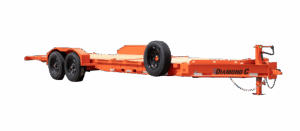
The GTU is Diamond C’s premium tandem-axle utility trailer. Current configurations have a 7,000 lb GVWR, an 83-inch bed width, lengths from 14 to 20 feet, and two 3,500 lb Lippert electric-brake axles. The standard structure includes a 4-inch channel frame, 2-inch engineered-channel crossmembers on 24-inch centers, 13-inch open sides, and a 2-3/8-inch pipe top rail. Standard loading equipment includes a 24-inch Laser Grip dovetail and EZ Bi-Fold Gate. The standard floor is treated lumber, while Diamond C’s AlumaTrax aluminum flooring is an available alternative on qualifying builds.
Other current GTU equipment includes a 2-inch, 10,000 lb-rated Demco EZ-Latch adjustable coupler, a 7,000 lb drop-leg jack, all-LED lighting, integrated upright tie-downs, five stake pockets, an under-frame spare mount, and a lockable steel tongue box. A 2-5/16-inch Demco coupler, expanded metal sides, tractor gates, upgraded wheels, all-terrain tires, and additional equipment may be available depending on the build. The trailer receives Diamond C’s DM Difference Maker multi-stage coating system. Actual unloaded weight and payload change with length and options, so the VIN label and final build information should be used for capacity calculations.
The GTU remains a 7,000 lb GVWR utility platform rather than a catch-all equipment hauler. Buyers who need substantially more payload, a heavier frame, a tilt deck, or a lower equipment-loading profile should compare Diamond C equipment lines such as the LPX and hydraulically dampened HDT. Diamond C was founded in 1985 and builds its trailers in Mt. Pleasant, Texas.
Liberty Trailers
Liberty offers utility trailers across the light- and medium-duty range. The LU3K single-axle utility trailer has a 2,990 lb GVWR, a 3,500 lb Dexter idler axle, a 4-inch channel frame and wrapped tongue, treated pine flooring, LED lighting, and a fold-flat mesh gate with spring assistance. Liberty also offers a 5,000 lb GVWR single-axle utility configuration with a 5,200 lb electric-brake axle for buyers who need more capacity without moving to two axles.
The Liberty LU7K tandem-axle utility trailer has a 7,000 lb GVWR, two 3,500 lb Dexter electric-brake axles, an 83-inch bed width, and available lengths from 14 to 20 feet. Current standard equipment includes a 4-inch channel frame, treated pine flooring, a 2-5/16-inch Demco EZ-Latch adjustable coupler, a 7,000 lb drop-leg jack, radial tires, LED lighting, and a fold-flat mesh gate. Liberty prepares the steel through multiple cleaning stages and applies a Sherwin-Williams Powdura protective finish. Exact equipment can change by model year, width, length, and dealer order, so compare the individual trailer rather than relying only on the brand name.
If you want to see what is on the lot right now, check the current inventory at Spencer Trailers. Stock rotates, options vary, and trailers shown in a manufacturer’s promotional material may include equipment that is not standard on the unit currently available.
Hitch and Tow Vehicle Requirements
GVWR is the trailer’s maximum allowable loaded weight, not necessarily what the trailer weighs during every trip. A 9,990 lb GVWR trailer does not automatically weigh 9,990 lbs, but it cannot be loaded beyond a tow vehicle rated for only 7,700 lbs. Check the truck’s owner manual, door-jamb labels, factory towing guide, payload rating, rear Gross Axle Weight Rating, Gross Combined Weight Rating, maximum trailer weight, maximum tongue weight, and any configuration-specific restrictions. Cab style, bed length, axle ratio, engine, drivetrain, wheelbase, factory tow package, passengers, cargo, and aftermarket accessories can all change the available towing capacity. The lowest applicable rating controls the combination.
Do not select a hitch by receiver opening alone. A 2-inch receiver may be used on several hitch classes with very different gross-trailer-weight and tongue-weight ratings. Read the labels on the receiver, ball mount, hitch ball, coupler, and tow vehicle, and stay within the lowest rating in the system. Weight-distribution equipment should be used only when the tow vehicle, receiver, trailer, and hitch manufacturer approve it for that configuration; trailer length alone does not determine whether it is required. The Diamond C GTU uses a 2-inch, 10,000 lb-rated Demco EZ-Latch coupler as standard, with a 2-5/16-inch option available. Many heavier equipment trailers use a 2-5/16-inch coupler. The ball diameter, ball rating, shank size, ball mount, hitch pin, safety chains, electrical connector, and breakaway equipment all need to match the trailer.
For commercial operation, a trailer over 10,000 lb GVWR does not trigger a Class A CDL by itself. A Class A CDL generally applies when the combination’s GCWR or actual gross combination weight is 26,001 lbs or more, whichever is greater, and the towed unit’s GVWR or actual gross weight is more than 10,000 lbs, subject to applicable exemptions and operating circumstances. A combination below 26,001 lbs does not meet that Class A weight threshold merely because the trailer is rated above 10,000 lbs.
Q&A: Things People Ask at the Lot
Do I need brakes on a utility trailer?
Indiana Code 9-19-3-3 requires a trailer or semitrailer with a gross weight of at least 3,000 lbs, when operated on a highway, to have brakes adequate to control, stop, and hold the trailer. The brakes must be controllable from the tow vehicle’s cab and must apply automatically if the trailer breaks away. For buying and sizing purposes, a utility trailer rated to operate at or above that threshold should be equipped with a compliant braking and breakaway system. Electric brakes require a compatible brake controller and properly wired connector in the tow vehicle. The Diamond C GTU has electric brakes on both standard 3,500 lb Lippert axles.
What’s the difference between payload and GVWR?
GVWR is the maximum allowable loaded weight of the complete trailer. Payload is the amount that can be added after subtracting the trailer’s actual unloaded weight, including installed options and permanent accessories. A 7,000 lb GVWR trailer that actually weighs 1,750 lbs would have a theoretical payload of 5,250 lbs, but the precise capacity must be confirmed from the finished trailer’s specifications and must not exceed axle, tire, wheel, coupler, hitch, or cargo-concentration limits.
Can I add a tool box or side panels later?
Often, but the accessory must be compatible with the specific frame and mounting provisions. The current Diamond C GTU includes five stake pockets, which can support suitable removable-side applications, while Liberty equipment varies by model. Do not assume that every tube rail is approved for drilling, welding, or supporting a heavy toolbox. Use manufacturer-approved or properly engineered mounting hardware, protect the coating after installation, and remember that every added accessory increases unloaded weight and reduces remaining payload.
What to Inspect Before You Buy
- Check the coupler for damage, excessive wear, correct adjustment, and complete latch engagement on the correct ball size. Coupler looseness can cause clunking and unsafe connection, while trailer sway is more commonly associated with poor weight distribution, insufficient tongue weight, excessive speed, underinflated tires, or an improperly matched tow vehicle.
- Inspect welds and structural connections at the tongue, main frame, crossmembers, suspension hangers, gate hinges, tie-downs, and jack mount. Look for cracks, incomplete welds, distortion, impact damage, or unprotected bare metal.
- Check tire size, load range, inflation pressure, age, sidewall condition, tread, lug-nut torque, hub play, bearing seals, and lubrication requirements. A trailer that has been parked for an extended period should still be inspected before highway use rather than assumed ready because the tread looks new.
- Verify that the VIN on the certification label matches the manufacturer’s statement of origin, title, registration paperwork, and sales documents as applicable. Indiana residents generally must title and register vehicles unless a specific exemption applies. Complete the required title and registration process within the 45-day window after purchase to avoid an administrative penalty.
- Test the connector appropriate to the trailer. That may be a four-way connector on a light unbraked trailer or a seven-way connector on a braked trailer. Confirm running lights, turn signals, brake lights, reverse lights when equipped, electric-brake output, breakaway operation, battery condition, and ground connections before leaving the lot.
Spencer Trailers does a pre-delivery inspection on every trailer before pickup. But it is still worth knowing what to look for yourself, confirming that the tow vehicle is correctly equipped, and walking around the combination again after the first few miles to check the coupler, chains, plug, straps, tires, hubs, and load.
Where Pricing Lands
Utility-trailer pricing changes with model year, steel and component costs, length, axle package, flooring, gates, tires, wheels, spare equipment, coating options, and dealer freight. Generic price ranges become outdated quickly. At the time of writing, Diamond C’s current configurator lists a base MSRP of approximately $3,736 for the PSA single-axle utility trailer and approximately $6,791 for the GTU tandem-axle utility trailer. Those are manufacturer base MSRPs rather than guaranteed dealer selling prices, and they exclude options, taxes, title, license, registration, and other applicable charges. Liberty pricing should likewise be compared by the exact width, length, GVWR, axle, gate, and option package rather than by a broad single- versus tandem-axle label.
Ask for an itemized out-the-door quote that identifies the trailer, installed options, freight, sales tax, title and registration charges, and any document-preparation fee. Indiana limits dealer document-preparation fees under state law, with the permitted amount adjusted periodically, so use the current cap rather than an old estimate. You can also browse recently sold trailers to see which sizes and configurations have moved through the dealership. The page is useful for comparing real builds, although a listing may not display the final negotiated transaction price.
The Right Trailer for the Right Job
A 7,000 lb GVWR tandem utility trailer is a versatile choice for many homeowners, landscapers, and small contractors, but it is not automatically the right trailer for every buyer. It works well when its actual payload, deck dimensions, gate capacity, tie-down arrangement, and the tow vehicle’s ratings match the equipment being hauled. A 2,990 lb GVWR single-axle trailer may be the better choice for lighter lawn equipment and recreational vehicles, while current 5,000 lb and 6,000 lb single-axle configurations provide additional capacity for buyers who still value compact size and maneuverability. Base the decision on measured cargo weight and the finished trailer’s actual payload rather than a blanket cargo-weight rule.
If you are still not sure which configuration fits your situation, reach out to Spencer Trailers at (812) 829-0226 or stop by the lot at 291 West State Hwy 46 in Spencer. Bring your tow vehicle’s year, make, model, drivetrain, axle ratio, payload label, hitch rating, and towing specifications, along with a realistic description of your heaviest load. That is all it takes to get pointed toward a trailer that fits both the job and the truck.


