










You bought the side-by-side. You made the trail plans. Then you pulled out the tape measure and realized your buddy’s 6-foot-wide trailer may not work. A current Polaris RZR XP 4 1000 is approximately 64 inches wide and nearly 12.5 feet long. Can-Am Maverick X3 models are offered in both 64-inch and 72-inch configurations, including four-seat MAX versions, while some other high-performance four-seat machines reach approximately 74 inches wide and more than 13.5 feet long. Those published dimensions may not include every accessory you have added, such as side mirrors, wider-offset wheels, aftermarket tires, rock sliders, fender extensions, a spare-tire carrier, or a rear cargo box. Roofs and cages can also turn interior height and ramp-door clearance into problems on an enclosed trailer.
Getting the trailer wrong can mean more than a tight squeeze. It can leave too little room to attach restraints correctly, place the machine’s tires against side rails or wheel boxes, overload a light trailer, create poor tongue-weight distribution, or prevent the rear gate from closing. Before you hitch anything up, here is what you actually need to know about matching a trailer to your ATV or UTV.
Width Is the Number That Matters Most
Most traditional ATVs, including many Honda FourTrax, Yamaha Grizzly, and Kawasaki Brute Force models, are approximately 46 to 50 inches wide. A trailer with a genuinely usable 60-inch deck can carry one of these machines, although a 72-inch deck gives you considerably more room to walk beside it and connect straps. Always check the exact model rather than relying on the brand name because tire packages, power steering configurations, and factory trim levels can change the published dimensions.
UTVs changed the math completely. Many trail-width and utility side-by-sides are approximately 60 to 65 inches wide, while wide-track sport machines commonly measure 72 or 74 inches. Work-oriented machines in the Kubota RTV, John Deere Gator, Polaris Ranger, and Can-Am Defender families also vary by cab, suspension, wheel, and tire package. A nominal 7-foot trailer body does not automatically provide 84 inches of clear loading space. Fenders, side rails, rear-gate posts, ramp cables, door hardware, and interior wheel boxes may reduce the narrowest usable opening substantially.
For a 64-inch UTV, a trailer with a 77-inch to 82-inch clear deck or rear opening is often workable, provided the tires, mirrors, and accessories remain inside that measurement. An 82-inch opening leaves only five inches per side around a 72-inch machine and four inches per side around a 74-inch machine, so loading and tie-down access can become tight. A wider deck-over platform or an enclosed trailer with approximately 96 to 97 inches of wall-to-wall interior width provides more working room, but you still need to measure the rear-door opening and the distance between wheel boxes.
A useful planning target is roughly 8 to 12 inches of total clearance beyond the machine’s widest actual point, but that is a convenience guideline, not a legal requirement. Measure the machine with its accessories installed, then compare that number with the trailer’s narrowest loading point. Also compare overall length, wheelbase, tire position, and turning clearance. A four-seat UTV may technically fit on the deck while leaving its rear tires too close to the dovetail or preventing you from achieving safe tongue weight.
Open Utility Trailers: The Working Choice
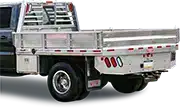
For many ATV and UTV owners, an open utility, car-hauler, or equipment trailer is the practical choice. Open trailers generally weigh less than comparable enclosed trailers, create less aerodynamic drag, are easier to inspect during a trip, and provide access to the machine from both sides. Mud and debris are easier to remove after a ride, although wheel bearings, electrical connections, wood decking, brakes, and painted components should not be blasted carelessly with a pressure washer.
The H&H Speed Loader Car Hauler Tilt is one current option in this category. H&H offers the Speed Loader with an approximately 82-inch-wide bed, multiple deck lengths, and GVWR configurations ranging from lighter 7,000-pound builds to substantially heavier versions. The tilting deck eliminates separate loading ramps and can work well for a 64-inch UTV. A 72-inch machine may also fit on an 82-inch bed, but the actual tire width, sidewall bulge, tie-down access, and any removable fenders or side rails still need to be checked. Do not assume the trailer can carry a UTV and a second ATV merely because its GVWR is 7,000 pounds. Available payload is the trailer’s GVWR minus its actual empty weight and installed options, and the machines must also fit in positions that produce proper tongue weight.
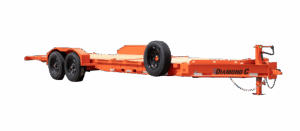
The Diamond C HDT (Low Profile Hydraulically Dampened Tilt) is the heavier-duty step for owners who want a commercial-grade equipment trailer rather than a basic utility trailer. Current HDT configurations are generally offered with approximately 80-inch to 82-inch bed widths, lengths from roughly 16 to 28 feet, and GVWR packages from 15,500 to 24,000 pounds. Standard axle equipment on the premium HDT line uses LIPPERT axles, with axle quantity and rating changing by configuration. Frame construction also varies with the selected length and capacity, including heavy I-beam and Diamond C Engineered Beam designs where specified. Its hydraulic dampening controls the gravity-tilt movement without requiring a separate powered hydraulic pump for ordinary loading. The HDT is built by Diamond C in Mt. Pleasant, Texas, and receives the company’s DM Difference Maker multi-stage coating process. It offers far more capacity than most recreational UTV owners need, but it is appropriate when the trailer will also move tractors, skid steers, compact construction equipment, or multiple machines. The tow vehicle, receiver, hitch, ball mount, tires, brake controller, and driver’s licensing requirements must all match the heavier combination.
For a single ATV and occasional property work, a compact Delco utility trailer may be a better fit than a heavy equipment trailer. Delco’s current utility offerings include narrow single-axle configurations with approximately 60-inch decks and 2,000-pound GVWRs, as well as wider models around 83 inches with 3,500-pound GVWRs. The smaller configuration can suit one conventional ATV, lawn equipment, or light cargo. The wider 3,500-pound model may accommodate a small side-by-side, but only after subtracting the trailer’s empty weight and confirming the machine’s fully equipped transport weight. A light single-axle utility trailer should not automatically be treated as a two-ATV trailer simply because both machines can be positioned on the deck.
Ramps: What Works, What Doesn’t
Ramp angle is one of the measurements people ignore until the front bumper, skid plate, hitch receiver, or center of the machine contacts the trailer. Standard slide-in or stand-up ramps in the 60-inch to 72-inch range can work well for ATVs and higher-clearance utility machines. A long-wheelbase sport UTV, lowered machine, or four-seat model may need a longer ramp, a dovetail, or a tilt deck. There is no universal maximum angle that guarantees every UTV will load safely because the result depends on the machine’s approach angle, breakover angle, wheelbase, tire diameter, ground slope, trailer height, and the transition at the top of the ramp.
For a simple comparison, a 20-inch vertical rise with a straight 72-inch ramp produces a ramp angle of approximately 16 degrees. Increasing the ramp length to 90 inches reduces the theoretical angle to approximately 13 degrees. Real-world loading can be steeper or smoother depending on whether the ground slopes, the trailer settles under load, or the trailer has a dovetail. Use the calculation as a starting point, then compare the trailer with the UTV manufacturer’s ground-clearance, wheelbase, approach-angle, and breakover information.
Ramp capacity must exceed the machine’s actual transport weight, not merely its advertised dry weight. Check whether the stated rating applies to each ramp or to the pair, and confirm the rating at the intended loading angle. The machine’s fuel, winch, roof, windshield, doors, cab enclosure, spare tire, tools, and cargo all count. Ramps also need positive attachment to the trailer so they cannot slide away when the tires begin climbing. Expanded metal, punched steel, serrated bars, or other traction surfaces can help, but mud, snow, and wet grass can still make both the ramps and the trailer deck slippery.
Tilt-deck trailers reduce the need to handle loose ramps and often provide a smoother loading path, but they do not eliminate every clearance issue. The tilted angle and hinge transition vary by trailer, and the deck must be on stable ground with the coupler secured to a properly rated tow vehicle. Hydraulic dampening or a controlled tilt mechanism should be allowed to work as designed; operators should not stand beneath a raised deck or attempt to alter its movement with improvised blocks.
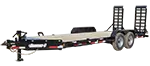
Dovetail designs provide a middle ground. The current H&H Car Hauler Trailer, for example, is available with an integrated rear dovetail and slide-in ramps in appropriate configurations. The sloped rear section lowers the initial transition compared with a completely flat deck. The usable flat-deck length, however, is shorter than the trailer’s total deck length, so confirm that the UTV’s tires will sit on the intended structural portions of the deck rather than on the ramp edge or too far back on the dovetail.
Tie-Down Points and Strap Strategy
An ATV or UTV that shifts in transit can damage the machine, alter tongue weight, interfere with neighboring cargo, and destabilize the trailer. Four independent restraints, two controlling forward movement and two controlling rearward movement, are a sound starting point for most machines. The exact securement method should follow the ATV or UTV manufacturer’s transport instructions and the restraint manufacturer’s directions. Every strap, chain, hook, anchor, ratchet, and connecting fitting must be marked or otherwise verified for an adequate working load limit, and the lowest-rated component controls the capacity of that connection.
A fixed formula such as assigning one-quarter of the machine’s weight to each strap is not a substitute for proper securement design. Direct and indirect tiedowns are evaluated differently, and commercial cargo-securement regulations are not identical to the rules governing every private recreational trip. The safest practical approach is to use designated attachment points, rated hardware with a substantial capacity margin, and a layout that prevents movement forward, rearward, and sideways. Inspect the system after the first few miles, then check it again at fuel and rest stops.
What to look for in a trailer’s tie-down ring placement:
- Recessed D-rings or properly installed track systems should sit where they can be reached without placing straps against tires, sharp deck edges, exhaust components, or bodywork
- Anchor points should be structurally connected to the trailer frame or reinforced crossmembers; a properly engineered bolted anchor can be suitable, while an unreinforced ring attached only to decking may not be
- There should be usable anchors ahead of and behind every planned machine position, with enough flexibility to secure different wheelbases without pulling straps at extreme or damaging angles
Wheel nets, over-the-tire straps, axle-style restraints, and chassis straps can all be appropriate when they are compatible with the machine and trailer. Wheel-based systems allow the suspension to move without repeatedly changing strap tension, but the net must fit the tire and remain clear of brake lines, steering parts, and sharp edges. Chassis restraints should connect only to manufacturer-approved structural points. Avoid plastic bumpers, body panels, thin suspension tabs, brake hoses, steering links, and components that were not designed to carry transport loads. Do not compress the suspension until it bottoms out, and do not use a winch cable as the primary tiedown.
Enclosed Trailers: When They Make Sense
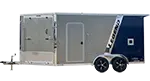
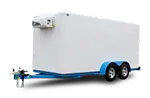
If you take a machine to competitive events, store expensive riding equipment, travel long distances, or want protection from road salt, rain, sun, and flying debris, an enclosed trailer can justify the additional cost and tow-vehicle demand. It can also provide lockable storage, a changing area, organized tool space, and a controlled place to work. The tradeoffs are greater empty weight, more aerodynamic drag, reduced side visibility while loading, and more sensitivity to crosswinds. Condensation and fuel-vapor management also matter, so ventilation should be planned rather than treated as an afterthought.
The Darkhorse Cargo DHW 7×16 is a practical example for one appropriately sized UTV. A typical 7×16 tandem-axle DHW configuration has approximately 80 inches of interior width, but the rear ramp-door opening may be closer to 76 inches. Tandem 3,500-pound axles produce a 7,000-pound GVWR in that configuration, with electric brakes as part of the running gear. The wedge nose is approximately 18 inches rather than a full additional two feet of rectangular floor space, and some of that area is shaped rather than square. A 64-inch UTV generally leaves reasonable clearance through a 76-inch opening. A 72-inch machine would have only about two inches per side before accounting for tire bulge, mirrors, ramp cables, and loading alignment, so an in-person measurement is essential.
The Wells Cargo FastTrac 8.5×20 provides substantially more interior width and capacity when correctly configured. Current 8.5-foot-wide FastTrac builds can provide approximately 96 to 97 inches of wall-to-wall interior width, while GVWR may be 7,000 or 9,990 pounds depending on the axle package and ordered specifications. The wheel boxes and rear-door opening can be narrower than the upper wall-to-wall measurement. A 72-inch or 74-inch UTV may fit through the opening but still leave limited walking and strapping room alongside the tires at the wheel wells.
A 20-foot enclosed trailer should not automatically be described as a two-UTV trailer. One four-seat UTV can be nearly 12.5 to 14 feet long before a spare tire, rear bumper, or cargo rack is added. Two full-size UTVs commonly require a longer trailer, a specific staggered arrangement, or a different loading plan. Add the machines’ actual overall lengths, allow space between them, preserve tongue-weight balance, and account for cabinets, the wedge nose, rear-door hardware, and any interior beavertail. An 8.5×20 is often better suited to one long UTV plus tools, tires, riding equipment, or a smaller ATV than to two full-size four-seat machines.
FastTrac framing and crossmember spacing vary by model and option package. Even when wall posts are placed 16 inches on center, heavy shelving, spare tires, batteries, fuel containers, and tool cabinets should not be attached casually to thin interior wall panels. Locate the structural framing, use reinforcement recommended by the trailer manufacturer, and keep added equipment within the trailer’s payload and balance limits. Fuel and other hazardous materials should be stored and ventilated according to applicable safety requirements rather than mounted wherever space is available.
One honest tradeoff with enclosed trailers is visibility. When the machine is inside the box, the operator cannot watch both sides directly. Adequate interior LED lighting, ramp-area lighting, reflective edge markings, and a spotter make night loading safer. Confirm interior height at the rear opening as well as inside the box because a tall roof, light bar, whip mount, or cage can clear the ceiling but contact the ramp-door header. Provide ventilation whenever a fueled machine is stored, and never run the engine inside a closed trailer longer than necessary for loading or unloading.
Quick Comparison: Open vs. Enclosed for ATVs and UTVs
| Factor | Open Utility / Tilt | Enclosed Cargo |
|---|---|---|
| Typical GVWR range | Approximately 2,000 to 24,000+ lbs., depending on utility, car-hauler, or equipment configuration | Approximately 2,990 to 14,000+ lbs., depending on body size, axle package, and intended use |
| Deck width options | Approximately 60″ to 102″; usable width may be reduced by fenders, rails, and gate posts | Approximately 56″ to 97″ wall-to-wall; rear openings and wheel-well spacing are often narrower |
| Machine protection | Exposed to road spray, weather, salt, and debris | Protected from direct road spray and weather; ventilation, condensation, and security still require attention |
| Post-ride washdown | Easier to clean in the open, while protecting wiring, brakes, bearings, finish, and wood decking | Sweeping and controlled cleaning are preferred unless the floor, seams, and drainage were designed for washdown |
| Storage between trips | Machine can remain on the trailer, but weather and theft protection are limited | Lockable, weather-protected storage with room for organized gear when payload and ventilation allow |
| Starting cost (approx.) | Roughly $3,000 for basic single-axle models to $20,000+ for heavy tilt and equipment builds | Roughly $4,500 for smaller single-axle models to $20,000+ for larger, taller, or heavier 8.5-wide builds |
Those price ranges are broad 2026 shopping references rather than fixed quotes. Axle upgrades, extra height, premium wheels and tires, interior finish, electrical packages, cabinets, winches, spare tires, doors, ramps, and freight can change the total substantially. Compare live inventory and written specifications rather than assuming two trailers with the same nominal dimensions are equivalent.
What People Get Wrong at the Dealer
The most common mistake is buying a trailer around the ATV owned today without considering the UTV that may replace it later. A trailer that comfortably handles a 48-inch ATV may not have the rear-opening width, deck length, payload, ramp capacity, or brake equipment needed for a four-seat side-by-side. Moving to an approximately 77-inch or 82-inch usable deck can provide room for many 64-inch machines, but buyers considering a 72-inch or 74-inch sport UTV should measure even more carefully. Future-proofing does not always mean buying the heaviest trailer available; it means choosing dimensions and capacity that match a realistic next machine while remaining compatible with the tow vehicle.
The second mistake is looking only at axle labels. Trailer payload is not the sum of the axle ratings. It is determined by the certified GVWR minus the trailer’s actual empty weight, including permanently installed options. Tires, wheels, suspension, frame, coupler, safety chains, brakes, jack, and other components can each limit the trailer. Tongue weight is part of the trailer’s gross weight and also consumes payload capacity on the tow vehicle. For many bumper-pull trailers, a properly loaded tongue weight in the general range of 10% to 15% of gross trailer weight is a common target, but the trailer and tow-vehicle manufacturers’ instructions control.
A current Can-Am Defender MAX can weigh from roughly the upper 1,700-pound range to well over 2,000 pounds dry depending on engine, trim, cab, and equipment package. Fuel, windshield, roof, doors, heater, winch, larger tires, spare tire, tools, and cargo can add several hundred pounds. That can place a well-equipped machine close to the usable payload of some 2,990-pound or 3,500-pound single-axle trailers once the trailer’s own weight is subtracted. Passengers do not count as transported UTV cargo because no one should ride in an ATV or UTV while it is being hauled on a trailer. Select capacity from the machine’s transport-ready weight and verify it on a scale when practical.
A Few Questions Worth Asking Before You Buy
Does the trailer have brakes? Indiana law requires a trailer with a gross weight of at least 3,000 pounds to have brakes adequate to control, stop, and hold it. The braking system must be operable from the towing vehicle, and the trailer must have an automatic breakaway function. Indiana’s requirements for new trailers above the under-3,000-pound exception generally call for service brakes on all wheels. A 7,000-pound tandem-axle trailer should therefore have functioning brakes on both axles, not merely one braked axle. Confirm that the tow vehicle has a compatible brake controller, test the breakaway battery and switch, and service the brakes according to the axle and brake manufacturer’s schedule.
What’s the deck height? Lower platforms usually improve the loading angle and reduce the machine’s center of gravity, but the exact number varies with axle placement, tire size, suspension, frame style, and load. Many low-profile car haulers, tilts, and enclosed trailers fall somewhere in the high-teens to low-20-inch range, while other utility trailers sit higher. Measure from level ground to the deck, then evaluate the ramp length, dovetail, hinge transition, and the machine’s wheelbase. A difference of only a few inches can materially change whether a long UTV clears the top of the ramp.
What’s the lumber or steel decking rated for? Pressure-treated wood is widely used and can serve ATVs and UTVs well when it is properly supported and maintained. Steel decking offers durability but can become slick when wet or muddy. Ask about overall payload, crossmember spacing, deck thickness, fastener condition, and any published concentrated-load restrictions. A trailer may have enough total payload while still being unsuitable for a narrow tire or wheel load placed between widely spaced crossmembers. Pay special attention to the rear transition, where the machine’s weight is concentrated while climbing the ramps.
What is the narrowest opening? Do not stop at the advertised trailer width. Measure between rear-door posts, gate hinges, ramp cables, side rails, fenders, interior wheel boxes, cabinets, and any spare tire. For an enclosed trailer, measure vertical clearance at the ramp-door header and the transition where the roof or roll cage enters. Confirm that the door can close with the UTV positioned for proper tongue weight and that you can still reach the tiedown points after loading.
If you are not sure which setup fits your machine, bring the manufacturer’s specification sheet and your own measurements to the dealer. Record the actual accessory-to-accessory width, overall length, wheelbase, overall height, dry or curb weight, expected fuel and cargo weight, and tire locations. Also bring the tow vehicle’s receiver rating, payload label, maximum trailer rating, and GCWR information. Those numbers will narrow the decision quickly and help prevent a trailer from being matched to a truck that cannot safely control it. Browse the current trailer inventory at Spencer Trailers or reach out directly and someone can walk you through the available dimensions, payloads, ramp systems, axle packages, and brake equipment without the upsell pressure. We carry H&H, Diamond C, Delco, Darkhorse Cargo, and Wells Cargo, so if one brand does not offer the right usable width, opening height, deck length, or GVWR for your machine, another likely will.


