





You spent real money on that bike. Maybe it is a touring Harley you have owned for a decade, a sport bike you take to track days, an adventure bike that travels farther by road than by trailer, or a vintage restoration that does not see rain on purpose. Whatever you ride, choosing the wrong trailer or attaching straps to the wrong part of the motorcycle can lead to damaged paint, bent components, leaking fork seals, or a bike that shifts in transit. Getting the trailer, wheel chock, anchor layout, and towing setup right matters before the first strap ever touches the motorcycle.
Motorcycle-hauling trailers break down into two broad categories: open and enclosed. Both can transport a motorcycle safely when they have enough payload capacity, suitable loading equipment, properly reinforced tie-down points, and a tow vehicle rated for the completed combination. They work best for different riders, different motorcycles, and different kinds of trips. Here is how to think through the decision.
Open Motorcycle Trailers
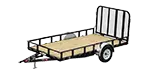
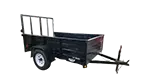
Open motorcycle trailers include purpose-built motorcycle haulers and conventional utility trailers equipped with an appropriately sized wheel chock and rated tie-down anchors. Current single-axle utility models from manufacturers such as H&H and Liberty Trailers are commonly available in lengths from 8 to 14 feet and at a 2,990-pound GVWR. As one current example, an H&H 78-inch-by-10-foot aluminum utility trailer has a listed curb weight of approximately 720 pounds and a 2,990-pound GVWR. Actual payload is the trailer’s GVWR minus its completed unloaded weight, including optional ramps, spare tires, toolboxes, chocks, batteries, and other installed equipment. Never calculate payload by subtracting the empty weight from the axle rating alone; the trailer’s certified GVWR on the VIN label is the controlling limit. :contentReference[oaicite:0]{index=0}
The upside is simplicity. An open trailer is generally lighter than an enclosed trailer of similar deck length, presents less frontal area to the wind, and gives you access to the motorcycle from either side while loading and securing it. Open utility trailers also tend to cost less than comparably sized enclosed trailers, although the actual difference depends on steel versus aluminum construction, axle capacity, brakes, ramp design, wheel chocks, tie-down hardware, and current dealer inventory. Compare completed specifications and out-the-door pricing instead of relying on a fixed price gap.
The downside is exposure. Rain, dust, road salt, highway bugs, gravel, and debris thrown by the tow vehicle can all reach the motorcycle. A stone guard on the trailer can reduce direct debris impact, but it does not provide the protection of an enclosed body. An open trailer can still make sense for a frequently ridden motorcycle, short local trips, or a rider who prioritizes low weight and easy storage. For a show bike, a high-value restoration, or a motorcycle with delicate paint and polished finishes, an enclosed trailer usually offers better protection.
Chocks and Tie-Down Points on Open Trailers
A properly configured open motorcycle trailer should have a wheel chock or wheel-retention system that is compatible with the motorcycle’s actual front tire width and wheel diameter. Motorcycle chocks are not one-size-fits-all, and the relevant measurement is the front wheel entering the chock, not the width of the rear tire. The chock should be attached according to its manufacturer’s instructions and secured to structural framing or adequate reinforcement beneath the deck. Bolting a chock only through thin sheet metal or an unsupported section of wood flooring can allow the fasteners to pull through during a hard stop. A conventional chock helps keep the front wheel centered while you attach the straps, but it should not be treated as the motorcycle’s only restraint unless the specific restraint system is engineered and approved for that method.
For a conventional four-point tie-down arrangement, look for at least four properly rated D-rings, recessed anchors, or track-mounted fittings positioned to pull the motorcycle forward, outward, and rearward without allowing the straps to contact bodywork. Anchor placement matters as much as anchor quantity. Each anchor and strap should have a stated working load limit, and the anchors should be fastened into the trailer structure rather than only the finished floor. Bolt-in and removable chock systems from established manufacturers such as Condor can make loading easier, but the chock, anchors, straps, and attachment points on the motorcycle still have to be used as a complete system. Specialized wheel-locking systems may use a different strap arrangement, so follow that system’s instructions instead of automatically applying a generic four-strap method.
Enclosed Motorcycle Trailers
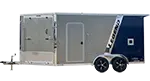
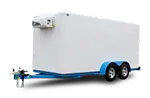
Enclosed trailers protect motorcycles from most weather and road debris while keeping the load out of casual view. A single-bike enclosed trailer is commonly built in a 6-foot-wide, 10- or 12-foot-long configuration, although smaller and larger options are available. Current H&H 6-by-10 and 6-by-12 single-axle enclosed cargo configurations are offered with a 2,990-pound GVWR; the listed curb weight of one 6-by-10 configuration is approximately 1,320 pounds, while a 6-by-12 configuration is approximately 1,375 pounds before additional options. That leaves enough theoretical payload for many individual motorcycles and normal riding gear, but the exact available payload must be calculated from the completed trailer’s actual empty weight. For two large motorcycles, a tandem-axle 7-by-14, 7-by-16, or larger trailer with a 7,000-pound or higher GVWR is usually the more practical starting point. :contentReference[oaicite:1]{index=1}
The enclosed format also gives you lockable doors and hides the motorcycle from view. That is useful during overnight stops, but an enclosed trailer is not automatically theft-proof. Use a quality coupler lock, locked door hasps, and, where practical, an additional wheel or chain lock. Parking with the rear ramp close to a wall or another obstruction can make unauthorized unloading more difficult. High-value motorcycles may justify a trailer alarm, hidden location tracker, or separate lock through a structural part of the bike. Do not rely on a single inexpensive padlock as the entire security plan.
Interior height is only one part of the clearance calculation. You also need the rear ramp-door opening height and width, because the door opening is often smaller than the interior box. For example, a current Legend 6-by-10 enclosed model lists a 78-inch interior height but a 73-inch rear-door opening. A tall adventure motorcycle may fit once it is inside yet contact the upper door frame while entering because of its windscreen, mirrors, hand guards, luggage, or raised handlebars. Measure the motorcycle at its tallest and widest points in the exact transport configuration, then compare those measurements with the usable door opening as well as the interior dimensions. :contentReference[oaicite:2]{index=2}
Multi-Bike Enclosed Setups
A tandem-axle 7-by-14 or 7-by-16 enclosed trailer from Darkhorse Cargo, Legend Trailers, Wells Cargo, or another established cargo-trailer manufacturer can be configured for two motorcycles, but a 7-foot exterior width does not provide a full 84 inches of unobstructed interior space. Current Legend 7-wide enclosed models list approximately 79 inches of interior box width. Two full-size touring motorcycles may fit when their front wheels are staggered or the bikes are loaded at an angle, but a straight side-by-side layout should never be assumed. Measure both motorcycles across their widest points, including handlebars, mirrors, engine guards, saddlebags, and exhaust components. An 8.5-foot-wide trailer can provide substantially more wall-to-wall room, although the floor narrows between the interior wheel boxes on many models. :contentReference[oaicite:3]{index=3}
GVWR on tandem enclosed trailers of this size commonly starts around 7,000 pounds, with 8,500- and 9,990-pound configurations available on some models. Empty weight cannot be estimated reliably from exterior dimensions alone. Aluminum construction may reduce curb weight, while added height, cabinets, finished walls, air conditioning, awnings, generators, additional doors, reinforced flooring, and workbenches can add hundreds of pounds. Read the completed trailer’s VIN label, obtain its actual empty or scale weight, and subtract that figure from GVWR before allocating payload to motorcycles, fuel, tools, spare wheels, riding equipment, and accessories.
Multi-bike loading requires planning the layout before you buy. Bikes loaded straight in consume more length but can simplify unloading. Staggering the front wheels or using angled chocks can improve handlebar clearance, but it changes where the load sits relative to the axles and tongue. Mark the proposed tire positions on the floor, verify that every chock can be bolted into reinforcement, and confirm that straps will not cross, rub against another motorcycle, or block the side door. Leave enough room to reach each ratchet, remove straps in a controlled order, and walk between the motorcycles without damaging mirrors or paint.
A 14-foot trailer can be adequate for two motorcycles when the layout is carefully planned, while a 16-foot trailer provides more room for gear, cabinets, and safer access around the bikes. The shorter trailer is not automatically easier or safer for a particular tow vehicle. What matters is the completed trailer’s actual loaded weight, tongue weight, frontal area, brake equipment, tire ratings, and the tow vehicle’s payload, rear-axle, receiver, and gross combination limits. A vehicle advertised with a 5,000-pound maximum tow rating does not automatically have enough payload or hitch capacity for every enclosed trailer loaded close to 5,000 pounds.
Single-Bike vs. Multi-Bike: How to Decide
| Factor | Single-Bike Trailer | Multi-Bike Trailer |
|---|---|---|
| Typical length | 8 to 12 ft | 12 to 20 ft |
| GVWR range | About 2,200 to 5,000 lbs | About 5,000 to 14,000+ lbs |
| Tow vehicle needed | Depends on loaded weight, tongue weight, payload, and hitch ratings | Often a properly equipped truck or full-size SUV; verify every rating |
| Best use | Solo trips, club rides, service visits, and track days | Families, riding schools, race teams, dealers, and group trips |
| Storage footprint | Easier to store; verify garage-door width and height | May require a larger bay, driveway space, or dedicated storage |
If you ride solo most of the time but occasionally help another rider, a single-bike trailer is often the more practical answer. It is usually less expensive to purchase, easier to maneuver by hand, and easier to fit beside a garage or in a smaller storage area. Registration and insurance costs vary by state, trailer weight class, and use, so they should not be assumed from the number of motorcycles alone. For an occasional two-bike trip, renting or borrowing a properly rated trailer may cost less than owning and storing capacity you rarely use.
But if you run a riding school, manage a household with two or three motorcycles, support a race team, or transport bikes as part of a business, a larger tandem-axle trailer can earn back its additional cost through flexibility. Build in room for future motorcycles, but do not fill every available foot with cabinets and equipment without recalculating payload and tongue weight. A longer trailer that is loaded poorly can tow worse than a shorter trailer that is balanced correctly.
Tie-Down Strategy: The Part Most People Get Wrong
The trailer itself is only half the equation. The wheel chock, tie-down anchors, straps, motorcycle attachment points, and loading sequence determine whether the bike remains stable. Always review the motorcycle owner’s manual for model-specific transport instructions, because suitable tie-down points vary among touring bikes, sport bikes, cruisers, adventure motorcycles, and motorcycles with carbon-fiber or aluminum components. A few things that are frequently overlooked:
- Ratchet straps vs. cam buckle straps: Either type can work when it is in good condition, properly rated, and used correctly. Cam buckle straps are simple and make it harder to apply extreme force, but they still need enough working load capacity and must be checked for slippage. Ratchet straps provide greater mechanical advantage and are often preferred for heavy touring motorcycles, but they can damage components or over-compress the suspension when overtightened. Use the strap’s working load limit, not its higher break-strength number, and make sure the combined working load limit is appropriate for the motorcycle and tie-down arrangement. :contentReference[oaicite:4]{index=4}
- Soft loops at approved attachment points: Do not place hooks directly against painted surfaces, polished metal, brake lines, wiring, grips, levers, or fragile fairing brackets. Soft loops can create a protected attachment point around a suitable structural member, but the correct location depends on the motorcycle. The lower triple-clamp area or manufacturer-provided tie-down brackets are commonly preferred over pulling on handlebars that may rotate, flex, or use rubber-mounted bushings. Harley-Davidson, for example, offers model-specific brackets that move the attachment point toward the triple-tree area. :contentReference[oaicite:5]{index=5}
- Four points for a conventional strap setup: Use two independent front straps pulling forward and outward and two rear stabilizing straps attached to approved structural points. Rear attachment points may include suitable passenger-peg brackets, frame members, or the swingarm, depending on the motorcycle manufacturer’s instructions. Avoid assuming that every subframe, luggage rack, exhaust bracket, or crash bar is strong enough. Apply enough suspension compression to keep the straps seated through bumps, but do not pull the forks to the bottom of their travel. Specialized wheel-restraint systems may require fewer straps, and their instructions take priority over a generic four-point method. :contentReference[oaicite:6]{index=6}
- Check tension after the first few miles: Stop after approximately 10 to 25 miles, inspect the wheel chock, anchors, hooks, soft loops, and strap tension, and make sure nothing has shifted or begun rubbing. Check again at fuel and rest stops. Straps can settle as the tires move into the chock and the suspension cycles. Also inspect the trailer coupler, safety chains, breakaway cable, lights, tires, and wheel hubs during the trip.
Flooring and Ramp Considerations
Smooth painted metal, wet aluminum, and some finished flooring materials can become slippery under motorcycle tires and riding boots. Treated or engineered wood decking provides a practical surface in many trailers, while rubber coin flooring or another durable non-slip finish can improve grip and protect the floor. Rubber flooring is not automatically slip-proof when contaminated with water, oil, or fuel, so keep the loading path clean. Wheel chocks and D-rings should be attached through suitable backing plates or structural members rather than relying only on the finished floor panel.
Ramp angle depends on several measurements: deck height, ramp-door length, any built-in beavertail, ramp extensions, tire position at the hinge, and the slope of the ground where the trailer is parked. A longer ramp and lower deck generally produce a shallower approach, but no single door length guarantees safe clearance for every motorcycle. Check the motorcycle’s ground clearance and wheelbase, especially on lowered cruisers, long-wheelbase customs, sport bikes with low fairings, and touring motorcycles with exhaust components near the centerline. When loading solo, consider a secure wheel chock, a spotter, a remote winch, or another controlled loading method instead of relying on momentum.
Some enclosed models can be ordered with an additional front or side ramp door, depending on the manufacturer, trailer width, axle placement, and structural package. An additional ramp can make staggered loading easier and may allow one motorcycle to be unloaded without removing every bike behind it. Before paying for the option, confirm the clear opening dimensions, door load rating, support-cable arrangement, exterior clearance, and whether the opening conflicts with cabinets, wheel boxes, chocks, or tie-down straps.
What to Ask at the Dealership
When you walk the lot at Spencer Trailers, a few specific questions cut through the noise fast:
- What are the usable interior width and height, the width between wheel boxes, and the clear rear-door opening?
- What are the deck height, ramp-door length, ramp capacity, and approximate loading angle on level ground?
- How many rated tie-down anchors are included, what is their working load limit, and how are they reinforced beneath the floor?
- What flooring material is installed, how is it supported, and does it provide adequate grip when wet?
- What axle brand, GAWR, brake configuration, tire rating, breakaway system, and completed trailer GVWR are shown on the VIN label?
These are not trick questions. The answers may vary by model, option package, and production date, so the salesperson should verify the exact trailer rather than quoting a general brochure from memory. Ask to see the VIN and certification label, inspect the underside of the anchor locations, and confirm which features are standard versus optional. Spencer Trailers currently carries open utility and enclosed cargo trailers from several manufacturers, including Liberty, Darkhorse Cargo, H&H, Legend, United, and others, so there is no reason to force one configuration to fit every motorcycle-hauling job. :contentReference[oaicite:7]{index=7}
Not sure whether your tow vehicle can handle the trailer you are considering? The team at Spencer Trailers can compare the trailer’s GVWR and expected loaded weight with your vehicle’s tow rating, payload rating, GCWR, rear-axle rating, receiver rating, ball-mount rating, and tire capacity. For a bumper-pull trailer, the manufacturer’s recommended tongue-weight range is commonly around 10 to 15 percent of loaded trailer weight, and that tongue weight counts against the tow vehicle’s available payload. Indiana law requires a trailer with a gross weight of at least 3,000 pounds, when operated on a highway, to have adequate brakes that the driver can apply from the cab, along with automatic brake application if the trailer breaks away. For operations subject to CDL rules, the standard Class A threshold involves a combination at 26,001 pounds or more with a towed unit over 10,000 pounds; a trailer exceeding 10,000 pounds by itself does not create that threshold when the combination remains below 26,001 pounds. Applicable exemptions and commercial-use rules should still be checked for the specific operation. :contentReference[oaicite:8]{index=8} And if you want to browse what is in stock right now, the full inventory is online.
The question worth sitting with is this: are you buying a trailer for the motorcycle you own today, or for the motorcycles, trips, and equipment you realistically expect to haul during the next several years? That answer changes the math on open versus enclosed, single versus tandem axle, interior dimensions, payload, storage, and tow-vehicle requirements more than anything else.


