


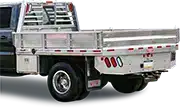
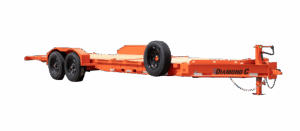



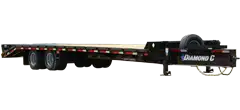

You pull up to a job site with a tall excavator or another machine that measures about 10 feet 6 inches from the bottom of the tracks to its highest point in the secured transport position. Put that machine on a conventional highway flatbed with a deck roughly 60 inches above the pavement, and the combination measures approximately 15 feet 6 inches tall. Indiana’s normal legal vehicle-and-load height limit is 13 feet 6 inches, so that setup cannot travel legally without an oversize permit, an approved route, and adequate overhead clearance.
That is the problem drop-deck trailers are designed to address. By lowering the cargo floor, a step-deck or lowboy can reduce the overall loaded height by two feet or more compared with a conventional semi-trailer flatbed. For contractors, equipment dealers, agricultural operators, and commercial haulers, choosing the correct deck configuration can prevent permit problems, route restrictions, bridge strikes, loading difficulties, and violations. The legal height limit is only the starting point: posted bridge clearances, axle weights, trailer ratings, ground clearance, and the equipment’s actual transport dimensions must also be checked.
What Makes a Drop-Deck Different
“Drop-deck” is a general description for a trailer whose primary cargo floor sits below an elevated front deck or gooseneck area. On a gooseneck step-deck such as a Diamond C SDX, the trailer has an upper deck over the gooseneck and a lower main deck behind it. A commercial semi-trailer step-deck follows a similar single-step layout. A double-drop lowboy goes farther by placing a very low well between the front neck and the rear axle group. These configurations should not be confused with ordinary low-profile equipment trailers, which may have a relatively low loading deck but do not necessarily have the same stepped freight-trailer architecture.
The key measurement is the loaded deck height: the distance from the road surface to the cargo floor with the trailer coupled, properly inflated, and sitting at its designed travel height. A conventional highway semi-trailer flatbed is commonly about 58 to 60 inches high. Commercial step-deck lower decks are often approximately 34 to 42 inches high, depending on the manufacturer, suspension, tires, axle arrangement, and intended capacity. Current Diamond C SDX configurations place the lower main deck in roughly the mid-30-inch range, while purpose-built double-drop and lowboy well decks may sit approximately 18 to 30 inches above the road.
Every inch matters. A load that measures 10 feet 6 inches tall produces an overall height of about 15 feet 6 inches on a 60-inch deck. Place the same load on a 35.5-inch lower deck, and the theoretical total falls to approximately 13 feet 5.5 inches. A 22-inch lowboy well would reduce it to approximately 12 feet 4 inches. Those calculations are useful for planning, but the final determination must come from measuring the fully loaded combination. Exhaust stacks, folded booms, hydraulic lines, cab guards, beacons, attachments, blocking, tire deflection, and suspension height can all change the result.
Step-Deck vs. Double-Drop: Not the Same Thing
These trailer types are often grouped together because both lower the cargo floor, but their construction, loading methods, weight capacities, and intended uses are substantially different. A buyer should specify whether the load needs a single-step platform, an extremely low well, a detachable gooseneck, or simply a low-profile equipment trailer.
A step-deck trailer, also called a single-drop trailer, has one main transition from an elevated front deck to a lower cargo deck. It is useful for machinery, building materials, fabricated components, and other freight that is too tall for a conventional flatbed but does not require a true lowboy. Diamond C’s current SDX step-deck family includes the SDX212, SDX216, and SDX312. Depending on the model and configuration, these trailers cover GVWR classes from 25,900 pounds through 40,000 pounds, use 102-inch-wide decks, include a 10-foot upper deck, and use Lippert axle packages matched to the selected rating. Exact deck length, suspension, brake system, axle configuration, loading system, and empty weight vary by build.
A double-drop trailer, commonly described as a lowboy in heavy-equipment applications, has a low central well between the front neck and the rear axle group. The well provides substantially more vertical clearance than a conventional flatbed or most step-decks. Fixed-neck lowboys may load over the rear with ramps, while removable or hydraulic detachable gooseneck designs allow the front of the trailer to be lowered so equipment can drive directly into the well. Heavy-haul lowboys are frequently specified by tonnage, concentrated-load capacity, deck length, axle arrangement, and permit configuration rather than by one simple GVWR number.
| Trailer Type | Typical Deck Height | Approximate Cargo Height at 13 ft 6 in Overall | Best For |
|---|---|---|---|
| Conventional Highway Flatbed | About 58–60 inches | About 8 ft 6 in–8 ft 8 in | Lumber, pipe, steel, palletized freight, and loads that are not unusually tall |
| Step-Deck (Single Drop) | About 34–42 inches on the lower deck | About 10 ft–10 ft 8 in | Tall machinery, fabricated components, forklifts, compact equipment, and hotshot freight |
| Double-Drop (Lowboy) | About 18–30 inches in the well | About 11–12 ft | Excavators, dozers, cranes, agricultural machinery, and industrial equipment requiring maximum height reduction |
The figures in the table are planning ranges, not universal specifications. Tire diameter, suspension design, axle placement, frame depth, deck material, loaded weight, and manufacturer-required ride height all affect the measurement. Air-ride suspension can improve ride quality and axle control, but it should not be treated as a way to travel below the manufacturer’s specified operating height. The only reliable clearance number is the measured overall height of the completed, secured load.
The Real Clearance Math
Indiana’s normal legal maximum vehicle-and-load height is 13 feet 6 inches. That is an Indiana dimensional limit, not a federal nationwide vehicle-height standard. Federal highway design and clearance criteria influence the Interstate system, but states establish their own legal vehicle-height limits. A legal-height vehicle is also not guaranteed to clear every structure. Older bridges, railroad overpasses, utility lines, work zones, parking entrances, local roads, and private job-site approaches may have lower posted clearances that must be obeyed.
The basic calculation is deck height plus the equipment’s transport height, but both values must be measured correctly. Deck height is measured from the road surface to the exact portion of the deck supporting the load. Equipment height is measured from that deck surface to the highest point after the boom, cab guard, exhaust, attachment, and other movable components have been placed in their proper transport positions. The legal measurement is the total distance from the road to the highest point of the loaded combination. Measuring an unloaded trailer in a yard or relying on a brochure’s nominal dimension can leave too little margin.
For example, a compact machine that stands 6 feet 8 inches tall would produce an overall height of approximately 9 feet 7.5 inches on a 35.5-inch step-deck. The same machine on a 60-inch highway flatbed would measure about 11 feet 8 inches. Both examples remain below Indiana’s 13-foot-6-inch limit, but the step-deck preserves more than two additional feet of clearance for taller attachments or machinery. Before departure, measure the load at its highest point and compare the result with both the legal limit and the lowest verified clearance along the route.
Weight Ratings and GVWR
Height receives most of the attention, but the trailer’s weight ratings are equally important. GVWR is the maximum permitted weight of the loaded trailer; it is not the trailer’s cargo capacity. Available payload is generally determined by subtracting the trailer’s actual as-built empty weight from its GVWR, and the result may be further limited by the axle ratings, tires, wheels, brakes, coupler, frame, suspension, loading system, concentrated-load limits, and tow vehicle. Tongue or pin weight also transfers part of the load to the truck, so both the truck’s axle ratings and the trailer’s axle ratings must remain within their limits.
For buyers who need a true gooseneck step-deck, Diamond C Trailers currently offers the SDX212 at 25,900 pounds GVWR, while SDX216 and SDX312 configurations extend into 30,000- to 40,000-pound classes. These USA-built trailers use Lippert axles and are designed around a 102-inch-wide deck and a 10-foot upper step. Buyers moving compact equipment rather than long step-deck freight may be better served by Diamond C LPX low-profile equipment trailers or HDT hydraulically dampened tilt trailers, which cover approximately 15,500- to 24,000-pound GVWR classes. H&H Trailers offers equipment, industrial, tilt, and low-profile deckover models in several ratings, including configurations in roughly the 14,000- to 22,000-pound range, but those trailer styles should be evaluated by their actual deck layout rather than assumed to be interchangeable with a true step-deck.
Current compact-equipment weights illustrate why payload calculations matter. A John Deere 317 P-Tier compact track loader has an operating weight of approximately 8,423 pounds, while a Kubota SVL75-3 is roughly in the 9,000- to 9,300-pound range depending on cab and configuration. A skid steer may weigh approximately 6,500 to 7,500 pounds before a bucket, grapple, breaker, forks, fuel, spare components, and securement equipment are added. A trailer rated at 15,500 pounds does not provide 15,500 pounds of payload. The trailer’s certification label, actual empty weight, equipment operating weight, attachment weight, and tongue or pin loading must all be included. Trailers in these classes also exceed Indiana’s 3,000-pound brake threshold, so the truck, brake controller, breakaway system, and trailer brake package must be compatible and fully operational.
Loading: Where Drop-Decks Get Complicated
The lower deck provides a clearance advantage, but the trailer still needs a loading system suitable for the machine. A step-deck’s vertical transition matters only when cargo must move between the lower and upper decks. Equipment staying on the lower deck can usually be loaded from the rear, side-loaded with a forklift, or placed by crane, depending on the trailer’s design. Operators must evaluate ramp angle, breakover angle, ground clearance, machine track width, tire position, tail support, and whether the trailer is designed to accept concentrated loading from tracks or narrow wheels.
Lowboys introduce different considerations. A removable or hydraulic detachable gooseneck can lower the front of the trailer so a dozer, excavator, or other low-clearance machine can drive into the well without climbing over a high rear axle section. Fixed-neck models generally depend on rear ramps or loading equipment. The very low deck that makes a lowboy useful can also create ground-clearance problems at railroad crossings, driveway crowns, steep job-site entrances, and abrupt grade changes. Route planning therefore has to account for both overhead clearance and the trailer’s ability to pass over changes in pavement elevation without contacting the ground.
On current Diamond C SDX step-decks, the upper 10-foot deck uses dedicated slide-in ramps for moving equipment between deck levels. Rear loading configurations may include MAX Ramps, XDR Ramps, a 12-foot hydraulic dovetail, or a straight-deck arrangement selected for the intended work. These systems are not interchangeable in capacity, loading angle, or convenience. Check the exact build sheet and capacity labeling for the selected ramp or tail system, and confirm that it is approved for the machine’s total weight, axle or track concentration, width, and loading direction. The trailer’s GVWR alone does not establish how much weight a ramp, dovetail, upper deck, or individual section of flooring can safely support.
When a Step-Deck Is the Right Call (And When It Isn’t)
A step-deck is the right choice when loads repeatedly exceed the practical height available on a conventional highway flatbed and can be carried safely on a lower platform in the mid-30- to low-40-inch range. It is especially useful for long commercial freight, fabricated machinery, agricultural components, building materials, forklifts, and equipment that benefits from both a lower main deck and usable cargo space on the upper deck. Diamond C SDX models are substantial gooseneck trailers with overall deck lengths beginning around 35 feet and extending to approximately 53 feet, including the upper deck, so they are generally aimed at hotshot, commercial, and heavy-duty users rather than occasional residential hauling.
A step-deck is not a substitute for a purpose-built lowboy when the equipment requires an ultra-low well, a detachable neck, specialized axle distribution, or heavy-haul permits. Large excavators, bulldozers, cranes, and industrial machines weighing tens of thousands or even more than 100,000 pounds require trailers engineered for their concentrated loads and transport dimensions. A permit does not increase the structural capacity of the trailer or truck. The equipment must fit the trailer’s deck, frame, axles, tires, brakes, coupling system, and loading method before permit planning even begins.
There is also an important middle category. Contractors carrying compact track loaders, skid steers, mini excavators, and similar equipment may not need a full-length commercial step-deck. A low-profile Diamond C LPX equipment trailer or HDT hydraulically dampened tilt trailer, available in approximately 15,500- to 24,000-pound GVWR configurations, may provide the required payload and manageable loading angle in a shorter package. Air-ride suspension is available on some heavier step-deck configurations for ride quality and axle-management purposes, but it should not be selected as a substitute for the correct fixed deck height. The best solution comes from matching the equipment’s measured height, weight, wheelbase, ground clearance, and attachment package to the trailer’s certified specifications.
A Quick Q&A on Common Confusion Points
Is a step-deck the same as a lowboy? No. A step-deck has one primary transition from an elevated upper deck to a lower main deck. A double-drop lowboy has a much lower well between the front neck and rear axle group. Both reduce cargo height, but a lowboy is generally intended for equipment that needs more vertical clearance, heavier concentrated-load capability, or a detachable-neck loading system.
Do I need a CDL to pull a step-deck? For commercial operation, a Class A CDL is generally required when the truck-and-trailer combination has a gross combination weight rating of 26,001 pounds or more and the trailer has a GVWR greater than 10,000 pounds. The 26,001-pound threshold applies to the rated combination, not to the trailer by itself. A trailer rated over 10,000 pounds does not automatically trigger a Class A CDL when the combination remains below 26,001 pounds, although other commercial motor vehicle requirements may still apply. Many 25,900- to 40,000-pound step-decks will place the combination above the Class A threshold when paired with an appropriately rated truck. Personal-use and other statutory exemptions can differ, so the intended operation should be reviewed before purchase.
Can I haul equipment without permits on a step-deck? A dimensional oversize permit is generally not required in Indiana when the complete combination remains within the applicable limits, including 13 feet 6 inches in height and 102 inches in width. That does not automatically make the trip legal. Length, gross weight, axle weight, equipment overhang, securement, bridge limits, and route restrictions also apply. Any load exceeding a legal dimension or weight limit may require a permit and an approved route, and posted clearances must be observed even when the vehicle is below the statewide legal-height maximum.
What to Look at When Buying
Before committing to a step-deck, lowboy, tilt trailer, or low-profile equipment trailer, get build-specific answers rather than relying on a category name or an advertised GVWR. Review the certification label, manufacturer’s build sheet, loading instructions, and the dimensions of the actual trailer being purchased.
- Measure the lower deck, upper deck, wheel or axle area, and any dovetail from the pavement while the trailer is properly coupled and sitting at its specified travel height. Confirm whether published deck-height figures are loaded, unloaded, or nominal dimensions.
- Verify GVWR, actual empty weight, calculated payload, individual GAWRs, tire and wheel ratings, coupling capacity, tongue or pin-weight requirements, and the tow vehicle’s GCWR, rear-axle rating, payload, hitch, and braking limits.
- Confirm the selected loading system, ramp or hydraulic-tail capacity, loading angle, track or tire width, concentrated-load limits, stabilizer requirements, breakover clearance, and whether the machine can load without contacting the frame, tail, or pavement.
- Review the number, placement, and working load limits of chains, D-rings, stake pockets, rub rail, winches, and other securement points. Tie-down capacity must be evaluated by working load limit and applicable cargo-securement rules, not simply by counting attachment points.
- Identify the axle manufacturer and rating, brake type, breakaway system, suspension type, required brake controller, tire specification, and whether options such as air ride, hydraulic disc brakes, ABS, lift axles, or additional axles are standard or optional on the exact configuration.
Spencer Trailers stocks and orders true Diamond C step-decks as well as low-profile equipment, tilt, deckover, and heavy-duty trailers from Diamond C, H&H, Liberty, and other established manufacturers. Diamond C has built trailers in Mt. Pleasant, Texas, since 1985. Its current premium lines, including the SDX step-decks and the FMAX, HDT, LPT, LPX, WDT, and DEC families, use Lippert axle systems and the DM Difference Maker multi-stage coating process. Because specifications can change by model, length, axle package, suspension, brake system, and optional equipment, the trailer should be matched to the heaviest and tallest complete load you reasonably expect to carry.
Check out our current trailer inventory to see what is available now, or reach out to the team at (812) 829-0226 to discuss your equipment’s actual operating weight, transport height, attachments, wheelbase, and loading requirements before you buy. The clearance problem is usually solvable, but the answer must be based on measured dimensions, certified ratings, a legal tow combination, and a route that can safely accommodate the completed load.


