








You’re standing at the lot looking at two trailers that seem nearly identical. Same deck length, same general profile. But one uses tandem 7,000 lb axles and the other uses tandem 10,000 lb axles. The price gap is real. So is the difference in payload, running gear, tow-vehicle requirements, and what you can legally and safely haul. Picking the wrong one can leave you paying for capacity you never use or, much worse, operating overloaded and exposed to equipment damage, citations, denied claims, and serious liability.
Here’s how tandem 7K and tandem 10K axle packages actually differ, why axle capacity and trailer GVWR are not always identical numbers, and when each setup makes sense.
What “7K” and “10K” Actually Mean
Axle rating refers to the maximum load the axle manufacturer assigns to one axle when it is installed with the correct suspension, hubs, brakes, wheels, and tires. A 7,000 lb axle, commonly called a 7K axle, has a 7,000 lb gross axle weight rating. Two 7K axles provide 14,000 lbs of total axle capacity. Two 10K axles provide 20,000 lbs of total axle capacity.
That does not automatically mean every tandem-7K trailer has a 14,000 lb GVWR or every tandem-10K trailer has a 20,000 lb GVWR. The completed trailer’s GVWR is established by its manufacturer after accounting for the frame, suspension, tires, wheels, coupler, safety chains, brakes, and expected tongue or pin load. Some heavy-duty trailers with tandem 7K axles carry a GVWR above 14,000 lbs because part of the loaded trailer weight is transferred to the tow vehicle through the hitch. Diamond C, for example, offers its 207 axle package with two 7,000 lb Lippert axles and a 15,500 lb GVWR on applicable models. Its 210 package uses two 10,000 lb Lippert axles and is rated at 20,000 lbs on applicable models.
GVWR, or Gross Vehicle Weight Rating, is the maximum permitted weight of the loaded trailer, including the trailer itself, cargo, attachments, fluids, chains, spare parts, and anything else carried on it. The manufacturer lists that rating on the trailer’s certification label. Gross axle weight ratings must also be observed: a trailer can be under its overall GVWR and still overload one axle because the machine was positioned incorrectly.
Payload capacity is not simply the axle rating. It is the trailer’s GVWR minus its actual empty or curb weight as equipped. A nominal 14,000 lb trailer weighing 3,800 lbs would have about 10,200 lbs of theoretical payload. A 20,000 lb trailer weighing 4,500 lbs would have about 15,500 lbs. Options such as hydraulic ramps, additional toolboxes, a spare tire, upgraded decking, winches, and heavier jacks increase empty weight and reduce available payload pound for pound. Always use the certification label, current scale weight, and the manufacturer’s weight information for the exact trailer rather than relying on a generic example.
That difference is not marginal. Depending on the trailer’s actual empty weight and the machine’s operating configuration, it can be the difference between legally carrying a compact excavator with attachments and exceeding the trailer’s rated capacity.
Tire and Wheel Differences
Axle capacity is only one part of the running-gear system. Tires, wheels, hubs, suspension components, and brakes must all be suitable for the completed trailer’s ratings. Installing higher-capacity tires does not increase an axle’s rating or the trailer’s certified GVWR, and 7K running gear cannot be treated as 10K equipment simply because stronger-looking wheels or tires were installed.
Tandem-7K equipment trailers commonly use 16-inch special-trailer tires, but the exact size and load range vary by manufacturer and configuration. Many current heavy-duty Diamond C models equipped with the 207 package use 14-ply all-steel radial tires with their standard two 7,000 lb Lippert axles. The correct tire capacity must be verified from the sidewall and trailer certification label, and the combined capacity of the tires supporting each axle must meet or exceed the load placed on that axle.
Tandem-10K packages generally use heavier hubs, wheels, and commercial-grade tires. On current Diamond C LPX and HDT configurations, the 210 package is available with two 10,000 lb Lippert axles, while 215/75R17.5 16-ply tires are an available upgrade on applicable builds. Exact wheel-end and tire specifications can change with the selected suspension, brake package, model year, and factory options, so tire size alone should never be used to identify axle capacity.
Replacement tires and wheels for a 10K-axle trailer usually cost more than common 16-inch trailer tires, and 17.5-inch commercial sizes may not be stocked by every local tire shop. They may also require higher inflation pressure and appropriately rated valve stems and wheels. That is a real operating and downtime cost worth considering before you buy, particularly if the trailer routinely travels far from commercial tire service.
Brake Requirements
This is where the rules and the equipment both matter. Under Indiana Code 9-19-3-3, a trailer or semitrailer with a gross weight of at least 3,000 lbs must be equipped with brakes adequate to control, stop, and hold the vehicle. That covers loaded tandem-axle equipment trailers in both categories. The tow vehicle also needs a compatible brake controller when the trailer uses electric brakes, and every brake-equipped axle and wheel-end must remain properly adjusted and functional.
A typical 7K electric-brake axle uses 12-by-2-inch drum brakes. A 10K axle uses larger-capacity wheel-end equipment, but the exact brake dimensions and actuation system depend on the axle and trailer specification. Heavy-duty configurations may use larger electric drum brakes or electric-over-hydraulic disc brakes. Do not assume a particular drum size from the advertised GVWR alone; confirm the build sheet, axle identification, and brake manufacturer’s service information for the exact trailer.
Current Diamond C heavy-duty equipment trailers use Lippert axles as standard. Diamond C has also begun introducing Lippert anti-lock brake systems on selected heavy-duty packages for 2026-model-year production. Availability is package-specific: ABS is standard on certain axle packages, optional on some 207 builds, and the rollout for applicable 210 configurations may depend on production timing. Buyers should confirm the exact brake and ABS equipment shown on the factory order or VIN-specific build rather than assuming every trailer has the same system.
A brake controller does not add towing capacity, and an improperly adjusted controller can produce weak braking, wheel lockup, or unstable stops. Loaded braking performance also depends on tire condition, brake adjustment, hitch setup, cargo placement, road surface, grade, and the tow vehicle’s brakes. The axle upgrade is only useful when the entire trailer and tow vehicle combination is properly matched and maintained.
Frame and Coupler Specs
Axle capacity does not exist in isolation. A legitimate 10K-axle package must be engineered as a complete trailer. It commonly brings heavier suspension components, wheels, tires, brakes, and structural capacity, but frame dimensions cannot be reduced to a universal “7K frame” and “10K frame.” Main-beam depth, flange size, web thickness, crossmember spacing, tongue design, neck structure, and steel grade all affect capacity. Two trailers with beams of the same nominal depth can have substantially different structural strength.
The hitch hardware must also be rated for the trailer’s certified capacity and intended tongue load. Heavy bumper-pull equipment trailers may use an appropriately rated 2-5/16-inch adjustable ball coupler or a pintle-eye configuration. Gooseneck trailers use properly rated gooseneck couplers and require a correctly installed bed-mounted hitch. Never assume that every 2-5/16-inch coupler is rated for 14,000 or 25,000 lbs; the coupler’s own stamped rating must meet or exceed the applicable load.
This matters for your truck too. A half-ton pickup with a 9,500 lb maximum trailer rating is not an acceptable match for a loaded trailer that exceeds that rating. Even when a 20,000 lb GVWR trailer is being used below its maximum, the truck must have adequate conventional or gooseneck towing capacity, payload capacity, rear-axle capacity, tire capacity, hitch rating, and gross combination weight rating for the trailer’s actual loaded weight and tongue or pin weight.
Many tandem-10K trailers require a properly configured one-ton pickup or heavier truck when loaded near capacity. A three-quarter-ton badge by itself does not establish suitability, and neither does a weight-distributing hitch. Weight distribution can improve load distribution and stability on compatible bumper-pull combinations, but it cannot raise the truck, receiver, coupler, axle, tire, or trailer ratings. Follow the truck manufacturer’s towing guide for the exact cab, engine, drivetrain, axle ratio, wheelbase, and hitch configuration.
Which Trailer Fits Which Job
The tandem-7K class covers a wide range of common work when the trailer’s certified payload and the loaded axle weights are sufficient:
- Compact tractors such as John Deere 2 Series, Kubota BX models, and Mahindra compact tractors, provided the combined weight of the tractor, loader, backhoe, implements, ballast, fuel, and securement equipment remains within the trailer’s ratings
- Many compact and mid-size skid-steer loaders, after accounting for the exact operating weight, bucket, forks, tires or tracks, counterweights, and other attachments
- Landscaping equipment, zero-turn mowers, compact loaders, and multiple ATVs or UTVs when the cargo can be positioned without exceeding GVWR, axle ratings, or tongue-weight limits
- Small construction machines whose fully equipped transport weight fits the trailer’s actual payload capacity with a sensible operating margin
The tandem-10K class becomes appropriate when individual machines or combined loads routinely push beyond the practical payload of a tandem-7K trailer:
- Large skid-steer and compact track loaders whose transport weight can approach or exceed 10,000 lbs once buckets, forks, counterweights, tracks, fuel, and accessories are included
- Compact excavators in roughly the 6,000-12,000 lb class, including attachments and buckets that may add hundreds or thousands of pounds to the base machine weight
- Loaded flatbed hauls carrying multiple pallets, masonry products, steel, lumber, or other dense materials whose weight can rise faster than their visible volume suggests
- Farm equipment, seed, fertilizer, feed, hay, and combinations of implements where the completed load needs more payload and stronger running gear
Published machine weights require careful reading. Equipment manufacturers may list operating weight, transport weight, shipping weight, or a range that changes with cab, tracks, tires, bucket, counterweights, and options. A Caterpillar 262D3, for example, is not automatically a 10K-trailer load merely because it is a full-size skid steer; its exact configuration and every carried attachment must be added to the trailer’s actual empty weight. Conversely, a compact excavator with a coupler, multiple buckets, hydraulic thumb, blade, fuel, and loose tools may weigh considerably more than a stripped base specification suggests.
The honest answer for many contractors and serious farm users is that they can outgrow tandem 7K capacity sooner than expected. If the complete transport weight of your regular machine is already near the practical payload limit of the smaller trailer, moving to the 10K package can provide valuable capacity and flexibility. That does not mean choosing the largest trailer automatically: the heavier trailer costs more, weighs more empty, reduces the tow vehicle’s available payload and combination capacity, and may change licensing or regulatory requirements.
Specific Models Worth Looking At
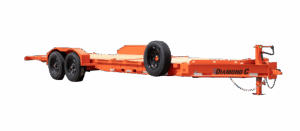
At Spencer Trailers, the Diamond C LPX shows how these axle packages work on a current heavy-duty equipment trailer. The LPX is a low-profile extreme-duty bumper-pull equipment trailer offered in lengths from 16 to 30 feet and with GVWR options from approximately 15,500 to 24,000 lbs, depending on configuration. Its standard running gear uses two 7,000 lb Lippert axles, while available upgrade packages include tandem 8K, tandem 10K, and triple-7K configurations.
For a direct comparison, an applicable Diamond C 207 configuration combines two 7K Lippert axles with a 15,500 lb GVWR, while the 210 configuration uses two 10K Lippert axles with a 20,000 lb GVWR. Because trailer weight changes with deck length and installed options, payload must be calculated from the VIN-specific empty weight and GVWR. Diamond C’s HDT hydraulically dampened tilt equipment trailer offers a comparable heavy-duty range, including available tandem-10K configurations on applicable builds.
Diamond C designs and builds its trailers in Mt. Pleasant, Texas, and has been manufacturing trailers since 1985. Its heavy-duty lines use the DM Difference Maker multi-stage coating process, while loading options vary by model and can include correctly named systems such as MAX Ramps, XDR Ramps, or X-Ramp configurations. Not every ramp system, axle package, brake package, or deck width is available on every model, so the final factory specification should be matched to the intended cargo.
H&H and Liberty also offer equipment and flatbed trailers across multiple axle and GVWR classes. Their exact model names, standard equipment, axle suppliers, frame specifications, and available ratings can vary by model year and individual build. Compare certification labels and factory build sheets rather than assuming two trailers with the same length or axle description have equal payload or structural capacity.
If you’re moving into the 20,000 lb range regularly, a heavy bumper-pull, pintle, or gooseneck configuration may be appropriate depending on the truck, application, hitch ratings, and cargo. Browse current inventory at Spencer Trailers to compare actual trailers across both weight classes and verify the specifications of each unit in stock.
The CDL Question
One thing buyers often overlook is the driver’s-license and commercial-operation threshold. For a Class A CDL, the relevant federal threshold is a gross combination weight rating or actual gross combination weight of 26,001 lbs or more, whichever is greater, when the towed unit has a GVWR or actual gross vehicle weight over 10,000 lbs, whichever is greater. The 26,001 lb figure applies to the combination, not to the trailer by itself.
For example, a truck with a 14,000 lb GVWR and a trailer with a 14,000 lb GVWR produce a 28,000 lb combined rating. Because the trailer is rated above 10,000 lbs, that combination falls within the Class A weight definition when the CDL rules apply. A 20,000 lb GVWR trailer paired with a heavy-duty pickup can cross the threshold even more easily. Using a three-quarter-ton truck does not automatically keep a combination below CDL territory; you must add the actual ratings shown for the specific truck and trailer and consider the applicable gross-combination rating.
CDL applicability also depends on how the vehicle is used and whether a valid federal or Indiana exemption applies. Strictly personal, non-business transportation and qualifying farm operations can be treated differently from commercial hauling, while interstate and intrastate operations may carry additional requirements involving USDOT registration, medical qualification, inspections, hours of service, and commercial insurance. A “not for hire” label does not by itself exempt a business vehicle from safety or licensing rules.
Do not downrate a trailer informally or rely on the load being light that day to avoid a rating-based requirement. Use the manufacturer’s ratings, the truck’s certification label and towing guide, actual scale weights where relevant, and guidance from the Indiana Bureau of Motor Vehicles or an appropriate compliance professional. Talk to us at Spencer Trailers and we’ll help identify the trailer and truck ratings involved, although final licensing and regulatory determinations belong to the appropriate government agency.
A Quick Comparison
| Spec | Tandem 7K Setup | Tandem 10K Setup |
|---|---|---|
| Combined axle capacity | 14,000 lbs | 20,000 lbs |
| Typical completed-trailer GVWR | Manufacturer-specific; approximately 14,000-15,500 lbs on many heavy-duty builds | Often 20,000 lbs; verify the certification label |
| Typical payload | GVWR minus the exact trailer weight; often roughly 9,000-12,000 lbs depending on build | GVWR minus the exact trailer weight; often roughly 14,000-16,000 lbs depending on build |
| Common tire class | Often 16-inch heavy-duty ST or all-steel radial tires; verify sidewall capacity | Often commercial-grade 16-inch or 17.5-inch tires; specification varies by axle package |
| Common brake equipment | Electric brakes on both axles, commonly 12-by-2-inch drums on 7K axles | Higher-capacity drums or electric-over-hydraulic discs, depending on the build |
| Tow vehicle | Must meet actual trailer weight, tongue weight, hitch, axle, tire, payload, and GCWR limits | Often a properly configured one-ton or heavier truck when loaded near capacity |
| Frame specification | Manufacturer- and model-specific; beam depth alone does not establish capacity | Heavier complete structure and running gear required for the certified rating |
What It Comes Down To
The 7K-versus-10K decision is really a question about your heaviest regular transport configuration, not your lightest machine. Add the machine, fuel, attachments, buckets, implements, pallets, chains, binders, tools, and every other carried item. Then subtract the exact trailer’s empty weight from its GVWR and verify that the planned placement will keep each axle, tire, hitch, and tow-vehicle rating within its limit.
Building in useful capacity is sensible, but unused GVWR is not the same as permission to exceed another component’s limit. A 20,000 lb GVWR trailer carrying 14,000 lbs gross may have more capacity in reserve than a 14,000 lb trailer operating at 13,800 lbs, but both must still have correct tongue weight, balanced axle loads, properly inflated tires, working brakes, rated securement, and a capable tow vehicle.
Both setups have their place. Tandem 7K axles can provide an efficient and economical platform for compact equipment and moderate payloads. Tandem 10K axles add capacity for heavier machines and commercial work, but they also bring greater empty weight, higher tire and maintenance costs, stronger tow-vehicle requirements, and a greater likelihood that the combination will enter CDL or commercial-regulation territory.
If your equipment already pushes the practical payload limit of a tandem-7K trailer, the tandem-10K package may be worth the premium. The decision should come from verified weights and ratings, not the machine’s appearance, the pickup’s badge, or an advertised axle number viewed in isolation.
Not sure which axle rating matches your equipment list? Call Spencer Trailers at (812) 829-0226 and we’ll spec the right trailer for what you’re actually hauling, including the machine, attachments, trailer weight, hitch requirements, and available payload.


