








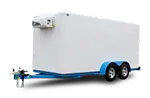


Your buddy’s Corvette may have only about 4 inches of clearance beneath its front splitter. The car runs fine, but when its long front overhang meets a steep ramp, the splitter can touch the pavement before the front tires reach the trailer. That is not necessarily a tow-vehicle problem. It is a loading-geometry problem, and a properly selected tilt trailer can provide a much gentler path onto the deck.
Tilt-deck trailers are popular for sports cars, lowered muscle cars, track-day builds, and other vehicles with limited approach or breakover clearance. Ground clearance alone does not determine whether a car will load safely: front overhang, wheelbase, splitter shape, deck height, tail profile, and the actual loading angle all matter. If you have been fighting ramp transitions whenever you move a car, this post explains how a tilt deck can improve the geometry, how to load correctly, and what securement equipment belongs on a car trailer.
Why the Tilt Deck Wins on Low Cars
A conventional car hauler with separate ramps creates at least two important transitions: the pavement-to-ramp transition and the ramp-to-deck transition. The actual angles vary considerably with deck height, ramp length, dovetail design, suspension loading, and the slope of the parking surface. A trailer with short ramps and a high deck can be difficult for a low car even when the trailer is otherwise large enough.
A tilt-deck trailer pivots so the rear edge of the deck approaches the ground. This creates a longer, more continuous loading path and can eliminate the abrupt ramp-to-deck hinge found on some conventional trailers. Certain low-profile car-hauler tilts achieve very shallow loading angles, but the exact angle is specific to the trailer configuration. Always obtain the manufacturer’s published angle or measure the actual trailer rather than assuming every tilt deck is 7 degrees or less.
The H&H Speed Loader Car Hauler Tilt Trailer is a current example of a purpose-built tilt car hauler. H&H offers the steel Speed Loader in an 82-inch bed width, multiple bed lengths from 18 to 30 feet, and GVWR configurations ranging from 7,000 to 16,000 pounds. It uses a hydraulic tilt cylinder and a reverse taper-cut rear profile to simplify vehicle loading. The specific deck length, axle package, empty weight, payload, and loading geometry must be confirmed on the trailer’s VIN certification label and current build sheet.
There is a secondary benefit too: efficiency. Loading with an integrated tilt deck avoids carrying, positioning, and storing separate ramps. For repair shops, track-day drivers, and transporters that load frequently, reducing those steps can save time. The operator must still park on firm, level ground, follow the trailer manufacturer’s tilt procedure, and verify that the deck is fully secured before towing.
Ground Clearance Numbers That Actually Matter
Loading clearance cannot be calculated reliably from deck height and ground clearance alone. For a simple straight incline, the approximate ramp angle is based on the vertical rise and horizontal run. A 24-inch rise spread across a true 16-foot horizontal run would be approximately 7.1 degrees, not 8.6 degrees. A real tilt trailer’s pivot geometry, rear taper, tire compression, suspension movement, and stationary deck section can change that figure.
A 24-inch rise over a 5-foot horizontal ramp run would produce an angle of approximately 21.8 degrees before accounting for a dovetail or the terrain. That is much steeper than the long incline in the previous example, but it still does not establish a universal clearance requirement. Whether the nose touches depends primarily on the car’s approach angle, which is determined by the lowest point at the front and the horizontal distance from that point to the front-tire contact patch. Breakover angle determines whether the vehicle’s center can clear the transition as the axles pass over it.
That is why a tilt is more than a convenience feature for many low cars, but it is not an automatic guarantee against contact. Measure the car’s front overhang and clearance, check its wheelbase and lowest underbody points, and compare those dimensions with the trailer’s actual loading profile. Race ramps, approach extensions, boards designed for vehicle loading, or a lower dedicated car-hauler tilt may still be necessary. Never improvise with loose blocks or unstable materials.
Using the Winch Right
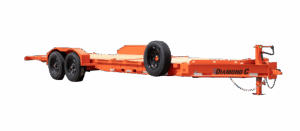
Many tilt trailers can be ordered with a winch mount or fitted with a properly engineered winch installation. A Diamond C HDT hydraulically dampened tilt equipment trailer, for example, is currently offered in 16- to 28-foot lengths with GVWR packages from 15,500 to 24,000 pounds. Standard configurations use two 7,000-pound Lippert axles, with higher-capacity packages available. Winch compatibility and winch capacity depend on the selected build, mount, electrical system, cable or rope, and the weight and rolling condition of the vehicle.
Non-runners, cars disabled at the racetrack, and vehicles that cannot be driven safely can be loaded with a correctly rated winch. A vehicle that rolls freely on level pavement requires less line pull than one with locked wheels, flat tires, damaged suspension, or an uphill approach. Select the winch and every attachment component for the actual recovery conditions, not merely the car’s curb weight. Here is how to reduce the chance of damaging the car or trailer:
- Park the tow vehicle and trailer in line on firm, level ground, apply the tow vehicle’s parking brake, and follow the trailer manufacturer’s loading instructions. Chock as directed. Release, tilt, dampen, or power the deck only through the procedure specified for that trailer; do not add an improvised lock or defeat an automatic latch.
- Connect only to a recovery or loading point approved by the vehicle manufacturer. A removable factory tow eye may be suitable when the owner’s manual authorizes it, but not every shipping tie-down slot or tow eye is rated for every recovery angle. Never attach to a bumper cover, steering linkage, control arm, brake line, or another unapproved component.
- Use a winch line, hook, soft shackle, strap, pulley block, and anchor system with compatible ratings. A pulley block may change line direction or increase pulling advantage, but it also changes the forces applied to the mounting points. Keep everyone out of the line’s path and away from the danger zone beside a tensioned cable or synthetic rope.
- Watch the front fascia, wheels, rocker panels, exhaust, and underbody as the vehicle moves. As the vehicle’s weight crosses the pivot, a gravity or hydraulically dampened deck may begin returning toward level. Maintain slow, controlled line speed and follow the trailer’s operating instructions throughout that transition.
- Winch in short, controlled movements. Stop to check tire alignment and clearance. Do not stand on the moving deck, straddle the winch line, or attempt to steer from beside a rolling vehicle where you could become trapped.
For cars that can be driven onto the trailer, use a spotter whenever practical and proceed at idle or the lowest controllable speed. Keep the wheels aligned, avoid sudden throttle or braking, and stop at a position that produces the required tongue weight without exceeding any rating. There is no universal rule requiring the front axle to stop 12 inches from the front of the deck; the correct position depends on the car, axle location, trailer design, hitch, and tow vehicle.
Wheel Straps Over Hook-and-Chain, Every Time
Purpose-built wheel nets or wheel straps are often the best securement choice for an undamaged passenger car because they restrain the tires without placing hooks on painted wheels or loading unapproved suspension components. Frame securement can also be appropriate when the vehicle manufacturer provides designated tie-down points and the trailer and tiedowns are configured for that method. Never hook through a wheel spoke, around a brake line, or onto an unapproved suspension part.
Wheel nets wrap over or around the tire and must restrain movement laterally, longitudinally, and vertically. Choose complete assemblies whose straps, hooks, ratchets, connectors, and trailer anchors are compatible and properly rated. A 2-inch strap may have a working load limit around 3,333 pounds, but width alone does not establish its rating. The labeled working load limit of the weakest component controls. Four independently anchored wheel assemblies, one at each wheel, are a sound professional setup for passenger vehicles when the system is designed for that arrangement.
Here is the positioning that actually works:
- Center each wheel net on the tire according to the securement manufacturer’s instructions. Make sure the webbing cannot migrate onto the wheel, valve stem, brake components, or a sharp edge. The arrangement must resist forward, rearward, sideways, and upward movement.
- Connect only to rated trailer anchors positioned for the selected system. Recessed D-rings, deck-mounted track, and other anchor systems have different ratings and fitting requirements. Liberty’s current LC7K car hauler, for example, lists four tie-down D-rings as an available feature, while other configurations may use different anchor layouts. Never assume a particular spacing or anchor capacity without checking the build sheet and labels.
- Remove slack and tension each assembly firmly in accordance with the strap manufacturer’s directions. Do not use an arbitrary tire-compression measurement. Excessive tension can damage tires, track fittings, ratchets, anchors, or trailer structure, while inadequate tension allows the vehicle to move.
- Check that every strap runs cleanly and that hooks are seated in the intended direction. The correct angle depends on the wheel-net design and anchor placement; a universal 45-degree rule does not apply to every over-the-tire system. Protect webbing from deck edges, hot exhaust parts, and other abrasion points.
For commercial motor-vehicle operations subject to the Federal Motor Carrier Safety Regulations, 49 CFR 393.128 requires automobiles, light trucks, and vans weighing 10,000 pounds or less to be restrained at both the front and rear against lateral, forward, rearward, and vertical movement using at least two tiedowns. Wheel-based tiedowns must provide restraint in all those directions. Four wheel assemblies provide redundancy and straightforward four-corner control, but operators must still satisfy the applicable aggregate working-load-limit rules, system instructions, state requirements, and any stricter company policy. Private towing may fall outside federal motor-carrier rules, but the same securement principles remain prudent.
Tilt Trailers Worth Knowing
| Model | GVWR | Deck Length | Best For |
|---|---|---|---|
| H&H Speed Loader Car Hauler Tilt | 7,000-16,000 lb, by configuration | 18-30 ft | Passenger cars and frequent vehicle loading |
| Diamond C HDT | 15,500-24,000 lb | 16-28 ft | Heavy vehicles and equipment within the selected build’s ratings |
| Liberty LT7K Tilt Car Hauler | 7,000 lb | 18 or 20 ft | Cars that fit its payload, width, and loading profile |
| Delco 83-inch Full-Tilt Equipment Trailer | 14,000 lb standard published configuration | 16-24 ft | Full-size vehicles and equipment within rated capacity |
GVWR matters because it is the maximum allowable weight of the loaded trailer, not its payload rating. Available payload is generally the trailer’s GVWR minus its actual empty weight and any permanently or temporarily installed equipment, subject to axle, tire, wheel, coupler, hitch, and other component ratings. A 9,990-pound-GVWR trailer weighing 2,800 pounds would have a theoretical 7,190-pound payload before accounting for added accessories, not 7,100 pounds. Use the trailer’s certification label, an actual scale weight, and the car’s actual loaded weight rather than relying on internet curb-weight estimates.
A Few Things People Get Wrong
Forgetting to secure the tilt deck before driving. A deck that has not returned fully to its transport position or has not engaged its specified retention system can move while towing. Depending on the model, the system may use a latch, hold-down, hydraulic mechanism, or another manufacturer-designed arrangement. Complete the published loading sequence, confirm that the deck is fully down and secured, and inspect it again before entering traffic.
Loading the car too far back. Too little tongue weight can contribute to unstable towing and trailer sway, while too much can overload the tow vehicle’s rear axle, receiver, hitch, coupler, or trailer tongue. Pivot and axle locations vary, so rules such as placing the front axle at 40 percent of deck length are unreliable. Position the car to achieve the tongue-weight range specified by the trailer, hitch, and tow-vehicle manufacturers, then verify it with a suitable scale rather than guessing from appearance.
Running undersized or unrated wheel straps. Strap color or width does not prove capacity. Use purpose-built vehicle tiedowns with legible working-load-limit labels and compatible hooks, ratchets, track fittings, and anchors. Federal commercial securement rules generally require the aggregate working load limit to equal at least one-half the cargo’s weight, calculated according to how each tiedown is attached. The weakest component, including the trailer anchor, limits the assembly. Use WLL, not breaking strength, for securement calculations.
Skipping tire inspections. Check the car’s tires before loading, but also inspect the trailer tires. Verify cold inflation pressure against the tire and trailer information, examine tread and sidewalls, confirm that wheel straps will not bear on a damaged area, and check trailer wheel fasteners according to the manufacturer’s schedule. A visibly damaged, underinflated, or flat car tire may require a different loading and securement method rather than simply applying more ratchet tension.
What to Ask About Before You Buy
If you are shopping for a tilt trailer to haul a specific car, begin with measurable questions. What is the loaded deck height and published loading angle? Is the rear edge taper-cut, and is there a stationary front deck? What are the usable deck width, inside-fender clearance, fender height, and door-opening clearance? A low loading angle is valuable, but the car must also fit between or over the fenders, and the driver may need enough room to exit after loading.
Ask whether the trailer uses gravity tilt, hydraulic dampening, or powered hydraulic tilt, because those systems operate differently. Confirm the deck’s loading procedure, retention system, winch-mount availability, battery requirements, and service needs. Inspect the location and rating of every D-ring or track section. Four correctly located and rated wheel-securement positions may be sufficient for a four-wheel system; asking for “at least four per side” is unnecessary unless a particular operation needs that flexibility.
For many people moving one passenger car, an 18- or 20-foot purpose-built car-hauler tilt provides adequate deck length, but GVWR must be selected from real weights rather than a broad rule. Confirm the trailer’s actual payload, the car’s loaded weight, and any winch, toolbox, spare tire, fuel, parts, or track equipment carried on the trailer. A 22-foot trailer can provide useful positioning room or stationary-deck space, but it does not automatically have the payload or usable length for two vehicles.
The tow vehicle must be rated for the trailer’s loaded weight, tongue weight, hitch type, receiver, ball or gooseneck components, rear-axle load, tire load, and gross combined weight. The trailer must also have functional brakes, a compatible brake controller where required, safety chains or cables, a breakaway system where applicable, and correctly functioning lamps. In Indiana, trailers with a declared gross weight above 3,000 pounds must be equipped with brakes that comply with IC 9-19-3-3.
We keep tilt-deck trailers in stock from H&H, Liberty, Diamond C, and Delco at our Spencer location. Inventory specifications change with each build, so bring the car’s measurements and actual weight along with the tow vehicle’s door-jamb, owner’s-manual, hitch, and receiver ratings. We can compare those figures with the trailer’s VIN label and equipment list. Browse current tilt trailer inventory here, or call us at (812) 829-0226 and we will check what is available today.
The right trailer for a low car is not simply the least expensive one or the shortest deck the tires will fit on. It is the trailer with suitable loading geometry, deck dimensions, payload, anchors, brakes, and towing compatibility for the complete combination. A properly selected tilt deck makes loading easier, but careful measurement, correct weight distribution, rated four-corner securement, and a complete pre-trip inspection are what get the car there without unwanted surprises.


