








You’ve got a Bobcat T76 to move. Depending on model year, market, undercarriage, tracks, bucket, options, fuel level, and installed attachments, the machine may weigh substantially more than the number shown in a basic specification table. Before loading it on a 22-foot equipment trailer, confirm the actual configuration and do the payload, axle, hitch, and securement math. Equipment is damaged, tow vehicles are overloaded, and loads become unstable when operators rely on a model name instead of verified weights. Get the trailer capacity, load balance, and securement right before the trip, and the rest of the job becomes much more straightforward.
Know the Machine Before You Load It
The Bobcat T76 is a full-size compact track loader. Bobcat’s current North American specifications list an operating weight of approximately 9,592 lbs for the T76 and T76-2 in the published standard configuration. Some earlier or market-specific T76 literature lists operating weights near 10,250 lbs, so do not assume that every machine carrying the T76 badge weighs exactly the same. Operating weight normally includes the machine with standard equipment and operating fluids, but the exact definition and configuration can vary. Check the machine identification plate, operator’s manual, attachment specifications, and, when practical, a certified scale ticket.
An auger, grapple, hydraulic breaker, mulcher, trencher, pallet forks, counterweights, optional tracks, accumulated mud, tools, and other equipment can add hundreds or even thousands of pounds. A bucket is also part of the transported load, whether it remains mounted or is carried separately. Record the weight of every attachment and accessory before selecting the trailer. The figure that matters is the total transported cargo weight, not simply the loader’s advertised operating weight.
Bobcat’s current North American specifications list the T76 at approximately 142.3 inches long with a standard bucket, 114 inches without an attachment, 73.5 inches wide in the listed standard configuration, and 81.9 inches high. Track and attachment choices can change the machine’s width, while a wide bucket, grapple, mower, or other attachment may be wider than the loader itself. Measure the actual machine and attachment before leaving for the job site. You need those dimensions to confirm deck fit, legal loaded width, clearance, and securement-point access.
Choosing the Right 22-Foot Trailer
Not every 22-foot trailer is rated for this job. Deck length does not establish payload capacity. Start with the trailer’s certification label and subtract the trailer’s actual empty weight from its GVWR. The result is the maximum available payload only when the trailer is otherwise empty, correctly equipped, and operated within every component rating. Spare tires, ramps, winches, toolboxes, chains, binders, stored attachments, and aftermarket accessories consume payload too.
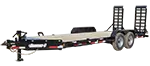
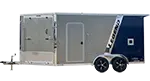
A Diamond C 22-foot equipment trailer must be identified by its exact model, GVWR package, curb weight, axle configuration, tire rating, coupler rating, and payload shown for that specific unit. Diamond C offers several equipment-trailer families and capacity packages, so it is inaccurate to describe every 22-foot Diamond C equipment trailer as a 14,000-lb trailer. The current bumper-pull Diamond C LPX is a low-profile, extreme-duty equipment trailer offered in lengths that include 22 feet. Current LPX configurations span approximately 15,500 to 24,000 lbs GVWR, with tandem 7,000-lb Lippert axles standard and higher-capacity Lippert axle packages available. Published package terminology and rated GVWR can vary with configuration, so the VIN certification label and build documentation govern.
The LPX’s published empty-weight range begins around 2,730 lbs, but a 22-foot trailer’s actual empty weight changes with axle package, frame construction, ramps, winch equipment, spare tires, decking, toolbox options, and other equipment. For example, a trailer with a 15,500-lb GVWR and a 3,200-lb as-equipped empty weight has approximately 12,300 lbs of theoretical payload before chains, binders, tools, or loose attachments are added. That can accommodate a standard T76 configuration, but the calculation must be completed with the actual numbers for the trailer and machine.
If you’re running a H&H Equipment Trailer in the 22-foot range, verify the model, GVWR, gross axle weight ratings, unloaded vehicle weight, payload, tire capacities, coupler rating, and ramp ratings on that specific trailer. H&H offers multiple equipment and tilt-trailer configurations, and specifications can differ by model year and option package. Never infer the trailer’s legal payload simply by adding the nominal axle ratings. The manufacturer’s assigned GVWR may be limited by the frame, coupler, tires, wheels, suspension, brakes, or another component.
There is no universal rule that GVWR minus machine weight should equal at least 2,000 lbs. The correct calculation is trailer GVWR minus the trailer’s actual loaded weight, including the trailer itself and everything carried on or in it. Tongue weight is part of the trailer’s total weight; it is not an extra allowance that can be added to GVWR. Build a written weight budget and retain a reasonable reserve for attachments, securement equipment, tools, mud, fuel, and configuration differences. A certified public scale is the best way to verify the loaded trailer’s total weight, axle-group weight, and tow-vehicle axle weights.
The Balance Problem on a 22-Foot Deck
A 22-foot deck gives you useful room to position the loader, but there is no safe universal stopping point based only on deck length. A compact track loader placed too far forward can overload the hitch, receiver, tow vehicle’s rear axle, or trailer tongue. Positioned too far rearward, it can reduce tongue weight enough to cause sway and poor steering or braking control. The trailer can still be overloaded even when the loader physically fits and the truck appears level.
The machine’s center of gravity is not necessarily at the geometric center of its tracks, and it moves when the bucket or attachment is raised, lowered, curled, removed, or replaced. Instead of trying to place a fixed percentage of cargo over a particular part of the axle group, position the loader so the completed combination produces the trailer manufacturer’s recommended loaded tongue weight while staying within the trailer GVWR, each trailer GAWR, the hitch and ball ratings, the tow vehicle’s GVWR and rear GAWR, and its permitted gross combination weight.
For many conventional bumper-pull equipment trailers, a starting target near 10 to 15 percent of the loaded trailer weight is commonly used, subject to the trailer and tow-vehicle manufacturers’ instructions. A 15,000-lb loaded bumper-pull trailer could therefore impose roughly 1,500 to 2,250 lbs at the hitch. That is only an initial range, not a substitute for measurement. Use a suitable tongue-weight scale or weigh the combination by axle group on a certified scale. A weight-distributing hitch should be used only if the tow vehicle, receiver, trailer, and hitch manufacturer all approve it for the combination and it is adjusted correctly.
Do not rely on a rule stating that the T76’s center of gravity must be 10 to 12 feet from the coupler. Coupler-to-axle dimensions, deck geometry, dovetail length, ramp weight, toolbox location, frame design, and axle placement differ among 22-foot trailers. Even two trailers with the same nominal deck length can require different loader positions. Mark the verified position on the deck only after obtaining satisfactory scale weights.
On a tilt-deck trailer, the pivot location and stationary-deck length are model-specific. Follow the trailer manufacturer’s loading instructions and keep the loader centered laterally as the deck moves. Do not assume that the pivot is 16 feet from the coupler or that the loader must stop at a predetermined deck mark. The correct final position is the one that produces compliant weights after the deck has returned fully to its transport position and the tilt mechanism has been locked or secured as designed.
Ramp Angle and Drive-On Approach
Do not use a claimed maximum grade capability as permission to climb a steep, wet, damaged, or undersized trailer ramp. A machine’s ability to travel on a slope is not the same as its ability to transition safely from the ground to a narrow trailer deck. Ramp angle depends on deck height, dovetail design, ramp length, suspension deflection, ground elevation, and how level the towing combination is. Confirm that the ramps are rated for the loader’s axle or track loading and are properly seated, pinned, or locked before driving onto them.
A few things to confirm before you throttle forward:
- Park on firm, level ground whenever possible. Avoid side slopes, soft shoulders, mud, loose gravel, holes, and overhead hazards. Chock the trailer tires with appropriately sized chocks before loading, following the trailer manufacturer’s instructions.
- Keep the trailer coupled to a correctly rated tow vehicle unless the trailer manufacturer expressly authorizes another loading procedure. Fully seat and lock the coupler, install its safety pin or lock, connect the safety chains and breakaway cable correctly, set the tow vehicle’s parking brake, place the transmission in park or the appropriate gear, and shut off the engine when directed.
- Inspect the deck, ramps, hinges, pins, hydraulic tilt components, tires, wheels, and surrounding area. Remove oil, ice, mud, loose boards, tools, chains, and other material that could reduce traction or interfere with the tracks.
- Keep the bucket or attachment as low as practical while maintaining adequate clearance through the ramp-to-deck transition. Avoid raising it unnecessarily because that raises or shifts the machine’s center of gravity. Follow the Bobcat operator’s manual for travel posture and slope operation.
- Use a trained spotter positioned where the operator can see the spotter without placing anyone in front of, behind, beneath, or alongside the machine’s travel path. Agree on hand signals before loading and stop immediately if visual contact is lost.
- Drive slowly and straight up the center of ramps that provide full, stable track support. Avoid abrupt steering, braking, or acceleration on the ramps. Verify that the bucket or attachment clears the deck and that the loader remains centered between the trailer’s fenders.
Once the machine is on the deck, move it cautiously to the preliminary balance position. Place the tracks fully on the main deck rather than leaving them on ramps or an unsecured dovetail. Lower the bucket or attachment to the deck in accordance with Bobcat’s transport instructions, place the controls in neutral, engage the parking brake, stop the engine, remove the key, and relieve stored hydraulic pressure if directed by the operator’s manual. Ensure the tilt deck has returned completely to its travel position and that every transport lock is engaged before applying tiedowns.
Chain and Binder Setup
For commercial interstate transportation, a T76 weighing more than 10,000 lbs in its transported configuration falls under the FMCSA requirements for heavy vehicles, equipment, and machinery in 49 CFR 393.126. It must be restrained against movement in the lateral, forward, rearward, and vertical directions using at least four tiedowns. Those tiedowns must be attached as close as practicable to the front and rear of the machine or to manufacturer-designated securement points. State rules and noncommercial requirements may also apply, and using the federal heavy-equipment standard is a sound baseline for a machine near this threshold.
Use properly marked transport chain and compatible binders, hooks, trailer anchors, and machine securement points. Grade 70 transport chain is common for this work. Typical working load limits include 4,700 lbs for 5/16-inch Grade 70 chain and 6,600 lbs for 3/8-inch Grade 70 chain, but the legible grade and size markings on the actual chain and the manufacturer’s rating govern. The complete tiedown assembly is limited by its lowest-rated component, which may be the chain, hook, binder, D-ring, stake pocket, or machine attachment point.
FMCSA’s general rule requires the aggregate working load limit of the cargo-securement system to equal at least one-half the weight of the secured cargo. The method used to calculate aggregate WLL matters. Under 49 CFR 393.106, only 50 percent of the WLL is credited for each tiedown that connects an anchor point on the vehicle to an attachment point on the cargo. A tiedown attached to the vehicle at both ends and passed through, over, or around the cargo may receive its full WLL. Consequently, four separate 3/8-inch Grade 70 direct tiedowns do not automatically contribute 26,400 lbs to the regulatory aggregate calculation; when each is attached between the trailer and the machine, the credited aggregate is normally 13,200 lbs. That still exceeds one-half of a 10,250-lb machine’s weight, provided every component is appropriately rated and the installation complies with the rule.
The minimum WLL calculation is not permission to use fewer than four tiedowns on heavy equipment covered by 49 CFR 393.126. Four appropriately located restraints are required even when one or two chains would appear to provide enough mathematical capacity. Additional securement may be necessary for a heavy attachment, an unusual machine configuration, a long trip over rough roads, or anchor geometry that does not provide effective restraint.
Chain placement on a compact track loader:
- Front two chains: Use Bobcat-designated front transport tie-down points, not unapproved lift points, hydraulic cylinders, hoses, steps, handles, track components, or the quick-attach mechanism. Run one tiedown toward each side of the trailer so the arrangement restrains forward, lateral, and vertical movement without allowing hooks to side-load or chains to contact sharp edges.
- Rear two chains: Use the designated rear transport points and connect them to adequately rated trailer anchors near the rear of the machine. Arrange the chains to oppose rearward and lateral movement while maintaining useful downward restraint. Keep the assemblies clear of tires, tracks, lights, brake wiring, hydraulic components, and sharp edges.
Any articulated or hydraulic component that could move during transport must be prevented from moving. Lower the bucket or attachment to the deck, use the machine’s approved locks where provided, and apply separate restraint when required by 49 CFR 393.126, the Bobcat manual, the attachment manufacturer, or the securement arrangement. If an attachment is removed and transported separately, secure it as its own article of cargo with enough tiedowns and aggregate WLL for its weight and dimensions.
Ratchet binders are commonly chosen because they allow controlled tensioning and avoid the handle-release behavior associated with lever binders, but either style must be rated, maintained, and used exactly as its manufacturer directs. Never use a cheater bar unless the binder manufacturer specifically authorizes it. Remove twists, protect chains from damaging edges, secure excess chain, close hooks correctly, and prevent binder handles from loosening during travel.
Tighten the system evenly so the machine cannot roll, slide, tip, or bounce, without applying forces that damage the loader or trailer. Inspect the securement before departure and again shortly after beginning the trip. Commercial drivers must also comply with the cargo-inspection requirements in 49 CFR 392.9, including reexamination within the first 50 miles and subsequent checks when required. A five-mile courtesy check can be useful, but it does not replace the federal inspection schedule. Recheck after hard braking, rough roads, or any event that could loosen the load.
Tongue Weight and Tow Vehicle Requirements
Do not assume that a T76 on a 22-foot bumper-pull trailer will always create 1,800 to 2,500 lbs of tongue weight. Actual tongue weight depends on the trailer’s empty balance, axle location, loader position, attachment, deck equipment, and total loaded weight. Measure it or verify it through axle-scale readings. The hitch load must remain within the lowest applicable rating among the truck, receiver, drawbar or ball mount, hitch ball, coupler, trailer tongue, and any weight-distribution equipment.
A 2-1/2-inch receiver and 2-5/16-inch ball are common on heavy bumper-pull equipment combinations, but dimensions alone do not establish capacity. Components of the same size can carry very different ratings, and some heavy configurations may require a 3-inch receiver or another manufacturer-approved hitch arrangement. Verify the stamped or labeled rating of every component and determine whether that rating applies in weight-carrying or weight-distributing mode.
No pickup class or engine option is automatically adequate for every T76-and-trailer combination. Some properly configured three-quarter-ton trucks may have sufficient tow, hitch, axle, tire, payload, and GCWR capacity, while other versions may not. Cab style, bed length, four-wheel drive, passengers, aftermarket equipment, cargo, and the truck’s original configuration all affect capacity. A one-ton single-rear-wheel or dual-rear-wheel truck may provide additional payload and rear-axle capacity, but its certification label and towing guide must still be checked.
Before towing, verify the tow vehicle’s GVWR, front and rear GAWR, payload allowance, receiver rating, maximum trailer rating, GCWR, tire and wheel ratings, and any manufacturer limits on frontal area or hitch loading. Count passengers, tools, fuel, bed cargo, auxiliary tanks, and hitch equipment against the truck’s available payload. A truck’s advertised maximum towing number usually applies only to a particular configuration and does not override the ratings on the actual vehicle.
Confirm that the trailer’s service brakes operate on every required braked wheel and that the in-cab brake controller is compatible and properly adjusted for the loaded trailer. Indiana law generally requires brakes on a trailer with a declared gross weight over 3,000 lbs under IC 9-19-3-3. Inspect the seven-way connector, brake wiring, breakaway switch, breakaway battery, safety chains, and brake operation before departure. Attach the breakaway cable to an independent point on the tow vehicle as instructed, not merely around a removable drawbar.
License requirements depend on ratings and use, not simply on the machine’s weight. In Indiana, a Class A CDL is generally required when the combination has a GCWR of 26,001 lbs or more and the towed vehicle has a GVWR over 10,000 lbs, subject to applicable exemptions. For example, pairing a trailer over 10,000 lbs GVWR with a truck can cross the Class A threshold even when the actual trip weight is below the trailer’s GVWR. Commercial use may also trigger USDOT registration, medical qualification, hours-of-service, inspection, marking, and other requirements at lower weight thresholds. Confirm the rules that apply to the operator, vehicle ratings, business use, and route before traveling.
A Quick Pre-Trip Checklist
| Item | What to Verify |
|---|---|
| Trailer capacity | Specific trailer GVWR minus actual as-equipped empty weight exceeds the total loader, attachment, securement, tool, and accessory weight with a sensible reserve |
| Axles and components | Certification-label GAWR, tires, wheels, suspension, brakes, frame, coupler, jack, ramps, and anchors are all appropriately rated and undamaged |
| Machine weight | Correct weight for the actual T76, tracks, fuel, bucket, counterweights, options, mud, and every installed or separately carried attachment |
| Machine position | Centered laterally and positioned by measured tongue and axle weights, not by a universal distance from the coupler |
| Truck ratings | Loaded truck remains within GVWR, front and rear GAWR, payload, hitch rating, trailer rating, tire ratings, and GCWR |
| Chain count | At least four properly marked and rated tiedowns for equipment over 10,000 lbs, using designated front and rear securement points |
| Aggregate WLL | At least one-half of cargo weight after applying the correct regulatory WLL credit to each tiedown; every assembly limited by its weakest component |
| Attachment restraint | Bucket or hydraulic attachment lowered and restrained as required; removable attachments carried separately are independently secured |
| Binders and hooks | Correctly seated, adequately rated, free of damage, tensioned evenly, protected from sharp edges, and secured against loosening |
| Brakes and breakaway | Brakes operate correctly, controller is adjusted, breakaway battery is charged, and cable is connected independently as instructed |
| Trailer lights | Tail, stop, turn, clearance, identification, marker, and license-plate lamps and reflectors function as required for the trailer |
| Tires and wheels | Cold inflation follows the trailer/tire manufacturer’s requirements; tires have adequate load capacity and no damage, and wheel fasteners are properly torqued |
| Ramps or tilt deck | Rated for the load, fully stowed, pinned, latched, or hydraulically locked in the transport position |
| Loaded dimensions | Actual width, height, length, and projection of the machine and attachments are measured before travel |
| Permits | Indiana generally limits vehicle-and-load width to 8 feet 6 inches; obtain required permits and follow route restrictions for a non-divisible overwidth load |
| License and registration | Driver license class, trailer registration, insurance, USDOT obligations, and commercial operating requirements match the rated combination and intended use |
| Inspection schedule | Inspect before departure, shortly after starting, within the first 50 miles when federal commercial rules apply, and thereafter as required |
What Trailer Should You Buy for This Job?
If you’re hauling a T76 regularly, choose the trailer by verified payload and configuration rather than deck length or nominal axle size alone. A 22-foot trailer can provide useful positioning room for the loader and an attachment, but a 14,000-lb GVWR trailer may offer less payload margin than expected after its empty weight and equipment are deducted. It should be considered only when the actual trailer payload, machine weight, attachment weight, axle loads, hitch weight, and tow-vehicle ratings have all been verified.
A current 22-foot Diamond C equipment trailer in the Diamond C LPX family can be configured at substantially more than 14,000 lbs GVWR. The LPX currently spans approximately 15,500 to 24,000 lbs GVWR, uses Lippert axles, and offers tandem 7,000-lb, tandem 8,000-lb, tandem 10,000-lb, and triple 7,000-lb axle configurations as applicable. The appropriate package depends on the T76’s actual transported weight, attachments, desired payload reserve, tow vehicle, licensing implications, and operating conditions.
The LPX’s low-profile design reduces deck height and can improve the approach and breakover geometry compared with a taller deck-over design. That does not make side-slope or muddy-site loading automatically safe. The trailer should still be placed on firm, level ground whenever possible, with properly rated ramps or the loading system fully deployed and the tow vehicle secured.
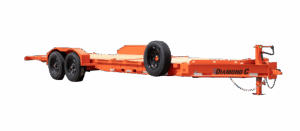
A stationary-deck tilt trailer such as the Diamond C HDT may also suit operators who want to load without handling conventional stand-up ramps. Current HDT models are offered in 22-foot-compatible lengths and approximately 15,500 to 24,000 lbs GVWR, with Lippert axles and multiple capacity packages. Tilt-deck geometry, stationary-deck space, loading procedure, payload, and final balance should be reviewed for the particular loader and attachment combination.
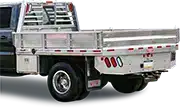
An H&H 22′ Equipment Trailer may also be suitable when ordered in an adequate heavy-duty configuration, but compare actual payload, GVWR, GAWR, empty weight, ramp capacity, frame design, brakes, tires, coupler, warranty, and available securement points rather than shopping by price or axle description alone. Obtain the manufacturer’s current specification sheet and inspect the certification label on the exact unit being considered.
Spencer Trailers keeps equipment trailers in stock at our Spencer, Indiana inventory, and the team can help you match GVWR, payload, deck length, axle package, hitch type, and ramp or tilt configuration to the exact machine you’re moving. Call us at (812) 829-0226 or reach out through the contact page with the loader’s model year, operating weight, track configuration, bucket or attachment specifications, and tow-vehicle information.
One more thing: if you’re unsure whether a trailer can handle your T76, review the entire certification label and as-built specification, not only the axle rating or headline GVWR. Axle ratings are important, but they do not replace the trailer’s assigned GVWR, and they do not establish the capacity of the frame, tongue, coupler, tires, wheels, suspension, brakes, ramps, or tiedown anchors. The controlling limit is always the lowest applicable rating, and scale weights are the most reliable way to confirm the finished combination. Want to see what’s currently available? Check our trailer inventory and filter by equipment trailers.


