







You’re heading down a long mountain grade with a loaded trailer when the combination begins gaining speed faster than expected. The trailer feels as though it is pushing the truck, the brakes smell hot, or stopping performance begins to change. Those are warnings that the truck and trailer brakes may be absorbing more heat than they can safely dissipate. Once braking performance begins to deteriorate, pressing the pedal harder may add still more heat without restoring normal stopping power. The safest strategy is to control speed before the descent and prevent the brakes from overheating in the first place.
Towing on a steep descent is one of the most demanding situations a truck-and-trailer combination can face. Gravity continuously accelerates the combination downhill, while every friction brake converts the vehicle’s motion into heat. Truck brakes, trailer brakes, tires, axle ratings, hitch limits, vehicle weight ratings, road speed, grade length, and driver technique all affect the result. Mechanical defects can cause brake failures, but correctly functioning brakes can also fade when they are asked to control too much speed for too long. Engine braking, proper gear selection, a correctly adjusted brake controller, and conservative speed must work together.
Engine Braking: Your First Line of Defense
Engine braking is the resistance the powertrain creates when the vehicle remains in gear and the driver releases the accelerator. Gasoline engines produce useful braking through pumping losses and transmission downshifts. Many diesel pickups add an exhaust brake or another engine-braking strategy. This assistance reduces, but does not eliminate, the work performed by the truck and trailer friction brakes.
Select tow/haul mode and an appropriate gear before the descent becomes steep. Waiting until the truck is already moving too fast can force the transmission to make an abrupt downshift or require heavy service-brake application just to return to a manageable speed. The appropriate gear cannot be predicted from trailer weight alone. It depends on the truck’s engine, transmission, axle ratio, tire size, combined weight, road grade, speed limit, and the instructions in the vehicle owner’s manual.
Diesel exhaust brakes can provide substantial retarding force, particularly when the transmission maintains enough engine speed for the system to work effectively. Their performance still varies by truck, operating mode, engine speed, grade, and combined weight. An exhaust brake should never be treated as a guarantee that a particular truck can hold a specified weight on a particular grade without service-brake input. Stay within the truck manufacturer’s towing, GCWR, GVWR, GAWR, hitch, and operating limits.
The familiar advice to descend in the same gear used to climb the hill came from older manual-transmission vehicles and can be a useful reminder to slow down early. It is not a precise rule for modern multi-speed automatics. Traffic, curves, road surface, transmission programming, load, and grade direction can all be different on the descent. Follow the owner’s manual, observe posted truck-grade warnings, and choose a gear and speed that prevent uncontrolled acceleration.
What “Tow/Haul Mode” Actually Does
Tow/haul programming varies by manufacturer and model. It commonly changes transmission shift scheduling, reduces unnecessary gear hunting, holds lower gears longer, and commands downshifts during deceleration. On properly equipped diesel trucks, tow/haul and the exhaust-brake controls may work together to help maintain the selected speed. Some vehicles also use grade-braking logic that recognizes a descent after the driver applies the brake pedal.
Tow/haul mode does not universally change brake-pedal sensitivity, and it does not increase the truck’s published towing or weight ratings. It also cannot compensate for excessive speed, an overloaded combination, poorly adjusted trailer brakes, an incompatible brake controller, or overheated friction brakes. Read the owner’s manual for the exact truck because the available modes and their behavior differ even among trucks from the same manufacturer.
On a long or steep grade, activate the appropriate towing and engine-braking modes before descending. Slow to a conservative entry speed while the brakes are cool, select the gear recommended for the conditions, and monitor speed continuously. If the combination continues accelerating despite appropriate engine braking and intermittent service-brake applications, reduce speed further at the first safe opportunity or stop at a designated turnout and reassess the conditions.
Trailer Brake Gain: The Setting Most People Get Wrong
Indiana law requires brakes on trailers with a gross vehicle weight rating above 3,000 pounds under IC 9-19-3-3. Many trailers use electric drum brakes controlled through the tow vehicle’s integrated or aftermarket brake controller. Other heavy trailers may use electric-over-hydraulic systems, hydraulic disc brakes, or another approved configuration. The controller must be compatible with the trailer’s brake system.
Brake-controller gain determines the maximum or relative amount of trailer-brake output requested by the controller. Some controllers also have separate boost, aggressiveness, effort, or trailer-profile settings. The numbers are not standardized. A setting of 5 on one controller is not necessarily equivalent to 5 on another, so universal gain recommendations based only on trailer GVWR are unreliable.
Gain that is too low can leave the tow vehicle doing an excessive share of the braking. Gain that is too high may cause harsh braking, wheel lockup, reduced directional control, or rapid trailer-brake heating. The correct setting changes with trailer loading, brake condition, road surface, tire traction, brake temperature, controller design, and whether the trailer uses electric or electric-over-hydraulic brakes.
Set the controller by following the truck and brake-controller manufacturers’ procedures. A typical procedure begins on a level, dry, traffic-free paved area with the trailer coupled and loaded as it will be used. After warming and burnishing the brakes as directed by the brake manufacturer, make the specified low-speed test and adjust the gain until the trailer provides firm, smooth assistance without wheel lockup. Some integrated controllers prescribe a manual-control test at approximately 20 to 25 mph, but the required speed and procedure vary. Do not use a passenger leaning outside the vehicle to watch the wheels, and do not perform adjustment stops in traffic.
Repeat the check whenever the load changes substantially, after brake service, after connecting a different trailer, or when road traction changes. Save the correct trailer profile if the truck supports that feature, but still confirm operation before each trip. If maximum controller output does not produce meaningful trailer braking during the prescribed test, adjustment alone is not the solution. Inspect the connector, wiring, grounds, magnets or hydraulic actuator, brake adjustment, linings, drums or rotors, and controller compatibility.
Manual Override: Use It on the Grade
The manual control on an electric-brake controller applies the trailer brakes independently of the truck’s service brakes. It is useful for the controller manufacturer’s setup test and may help control a developing sway event when used exactly as directed. It should not be treated as the routine braking method for a long descent.
Applying only the trailer brakes for repeated or extended periods can overheat them while leaving the truck brakes comparatively cool. Trailer electric drum brakes are also friction brakes and can fade. Continuously holding the manual control, or repeatedly cycling it without allowing adequate cooling, can reduce trailer-brake effectiveness and damage components.
For normal grade braking, keep the combination straight, use engine braking, and make controlled service-brake applications so the integrated system can proportion braking between the truck and trailer. If the trailer begins swaying, avoid accelerating or making an abrupt steering input. Follow the truck and brake-controller manuals; many systems instruct the driver to release the accelerator and apply the trailer-brake manual control gradually without applying the tow vehicle brakes unless needed for an emergency.
Downshifting: Timing Is Everything
Modern automatic transmissions can manage many ordinary descents, especially when tow/haul or grade-braking mode is active. A loaded equipment trailer, car hauler, dump trailer, or enclosed cargo trailer can nevertheless require earlier driver intervention. Select the appropriate towing mode before the grade and use the manual gear-range control when the owner’s manual recommends it.
There is no dependable table that assigns a specific gear to a particular percentage grade or trailer weight. Current pickups may have six, eight, or ten forward ratios, and “third gear” represents very different road speeds and engine speeds among them. Gear selection must keep the engine within the manufacturer’s permitted operating range while holding a safe road speed. Never force a downshift that would over-speed the engine or exceed the safe traction available on wet, icy, gravel, or otherwise slippery pavement.
Medium-duty trucks and vehicles with manual or automated manual transmissions require the same advance planning. Enter the descent slowly enough to select the needed gear before speed builds. Obey posted truck speed limits and grade warnings, and use lower speeds for curves, poor visibility, road work, wind, reduced traction, or an unfamiliar route. Mountain grades in the United States vary considerably, and a technique that works on one descent may not be appropriate on the next.
The goal is to reach the bottom with the brakes still capable of making a full stop. Smoke, a sharp burning odor, changing pedal feel, visible heat damage, a brake warning, or reduced deceleration indicates a serious problem. Do not touch a wheel, hub, drum, rotor, or brake component to judge its temperature; these parts can cause severe burns. If overheating is suspected, stop at a safe turnout or designated brake-check area and allow the complete system to cool naturally. Do not apply water to hot brakes.
Brake Fade: What It Is and How to Avoid It
Brake fade is a reduction in braking effectiveness caused by excessive heat, but not every form feels the same. Friction-material fade occurs when overheated pads or linings produce less friction and may be accompanied by a relatively firm pedal that produces less deceleration. Fluid fade occurs when moisture-contaminated or overheated hydraulic fluid boils and creates compressible vapor, often causing a soft, long, or sinking pedal. Heat can also expand drums, glaze linings, damage seals, degrade magnets, overheat an electric-over-hydraulic actuator, or trigger protective behavior in vehicle systems.
A spongy or unusually long truck brake pedal can indicate overheated fluid, air in the hydraulic system, a leak, or another defect. It should never be assumed to be ordinary pad fade. Any unexpected change in pedal feel or braking response requires immediate attention at the first safe stopping location and professional inspection before the vehicle returns to service.
Avoiding fade means controlling speed early and limiting continuous heat input. Engine braking and exhaust braking reduce demand on the friction brakes, but trailer brakes do not make heat disappear. They distribute braking work to additional friction surfaces. Every part of the system must remain within its thermal and mechanical limits.
- Do not rest a foot on the brake pedal or drag the brakes continuously down a long grade. Enter slowly, use an appropriate lower gear, and use controlled brake applications as directed by the vehicle manufacturer.
- A commonly taught heavy-vehicle technique is snub braking: apply the brakes firmly enough to reduce speed by a defined amount, then release them fully while the lower gear helps prevent rapid acceleration. Light, continuous pressure can generate heat without providing a cooling interval. Follow the truck manufacturer’s instructions because passenger pickups and commercial air-brake vehicles are not identical.
- If braking performance changes, use a runaway-truck ramp if control cannot otherwise be maintained. If a safe turnout is available and the combination remains controllable, stop and allow the brakes to cool. There is no universal 10- or 15-minute recovery time; cooling can take much longer depending on temperature, mass, airflow, weather, and damage.
- Use only the brake-fluid specification printed in the truck’s owner’s manual or on the reservoir cap. Federal minimum dry boiling points are 401 degrees F for DOT 3 and 446 degrees F for DOT 4, but actual products vary. Higher classification alone does not make a fluid correct for a particular system. Never substitute silicone DOT 5 fluid into a system designed for glycol-based DOT 3, DOT 4, or DOT 5.1.
- Replace hydraulic brake fluid at the interval and with the procedure specified by the manufacturer. Brake fluid absorbs moisture over time, lowering its boiling point. A high dry boiling-point number does not protect a neglected system containing moisture.
- Inspect and adjust trailer brakes at the manufacturer’s interval and before severe mountain service. Some electric drum assemblies require periodic manual adjustment, while self-adjusting assemblies still require inspection and correct initial setup. Worn, contaminated, disconnected, or misadjusted brakes may provide little useful stopping force.
A Quick Reference by Load and Grade
| Combined Weight | Grade | Recommended Gear | Trailer Brake Gain Range |
|---|---|---|---|
| Any legal combination | Up to 5% | Use tow/haul or grade-braking mode; select a lower range if speed builds | Set by the controller manufacturer’s loaded-road test |
| Any legal combination | 5 to 7% | Enter below the posted limit and select a range that provides sustained engine braking | Confirm firm trailer assistance without wheel lockup |
| Heavy equipment or commercial combination | 5 to 7% | Follow the truck manual, posted truck warnings, and any required brake-check procedure | Verify controller and brake-system compatibility before departure |
| Any legal combination | Over 7% | Use the manufacturer’s recommended low range and exhaust brake, if equipped; reduce entry speed substantially | Do not increase gain blindly on the descent; test before the grade |
These entries are planning guidance, not universal gear or gain settings. The same combined weight can behave very differently behind different trucks and on grades of different length. Confirm the actual truck-and-trailer ratings, consult both owner’s manuals, inspect the brakes, and test the loaded combination on a controlled route before committing to a mountain pass.
What Your Trailer Setup Tells You
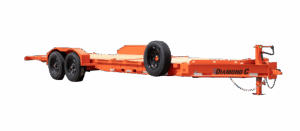
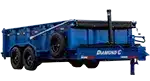
Not all trailers make the same braking contribution. The current Diamond C LPX Low Profile Extreme Duty Equipment Trailer is offered in configurations from approximately 15,500 to 24,000 pounds GVWR. Its standard configuration uses two 7,000-pound Lippert axles, with heavier tandem and triple-axle packages available. The brake system, GVWR package, tire package, coupler rating, and other equipment must be verified on the specific trailer’s certification label and build documentation rather than inferred from its model name.
Diamond C’s premium FMAX, HDT, LPT, LPX, WDT, and DEC lines use Lippert axles as standard. Current heavy-duty configurations can vary widely. For example, an FMAX212 is rated at 25,900 pounds GVWR and uses two 12,000-pound Lippert axles, while an FMAX312 can be configured from 30,000 to 40,000 pounds GVWR with three 12,000-pound Lippert axles. Axle capacity is only one part of the trailer rating, and the sum of the axle ratings does not automatically determine legal payload or GVWR. Use the certification label, actual empty weight, loaded tongue or pin weight, tire ratings, coupler rating, and every applicable truck rating.
Heavy axle capacity does not guarantee adequate braking on a descent. Braking performance depends on the installed brake type, its condition and adjustment, tire traction, controller compatibility, electrical voltage, wiring integrity, and load distribution. Some high-capacity packages use equipment that differs from conventional electric drum brakes. Confirm whether the specific trailer has electric drum or electric-over-hydraulic brakes and configure the tow vehicle controller accordingly.
Annual inspection may be too infrequent for a commercial trailer or one regularly used at high weights. Follow the axle, brake, and trailer manufacturers’ mileage and time-based maintenance schedules, and shorten the interval for severe service. Inspect the brakes immediately if performance changes, a seal leaks, a wheel runs unusually hot, wiring is damaged, or the trailer has been submerged or stored for an extended period.
Bumper-pull and gooseneck trailers load the tow vehicle differently, but a properly set up bumper-pull does not simply lift the front wheels whenever it travels downhill. Tongue weight, hitch height, suspension geometry, braking forces, load distribution, and weight-distribution equipment all affect axle loading. Excessive or insufficient tongue weight, an unlevel trailer, or an improperly adjusted weight-distribution hitch can reduce stability and steering response. Measure loaded axle weights on a certified scale and set up the hitch according to the truck, hitch, and trailer manufacturers’ instructions.
A Note on Breakaway Systems
Indiana’s braking requirements for trailers above 3,000 pounds include an automatic means of applying the required trailer brakes if the trailer separates from the tow vehicle. On an electric-brake trailer, this is normally a breakaway switch, a dedicated battery or approved onboard power source, and properly connected brake wiring.
The breakaway cable must be attached to a suitable point on the tow vehicle independently of the safety chains and routed so it will pull the switch if separation occurs without dragging, binding, or activating during a normal turn. It should not be looped loosely around a safety chain. Follow the breakaway-system and hitch manufacturers’ instructions for attachment and cable length.
Battery voltage alone does not prove that the system can operate the brakes. A fully charged resting 12-volt lead-acid battery may measure approximately 12.6 to 12.8 volts, but battery chemistry, surface charge, temperature, condition, wiring resistance, and load all affect the reading. Test the battery and breakaway operation using the procedure specified by the trailer or breakaway-system manufacturer. Do not tow with the breakaway pin intentionally pulled, and reinstall it immediately after a brief functional test to avoid overheating the brake magnets or discharging the battery.
Before the Trip, Not During
The best time to find a brake problem is before the combination reaches a grade. With the trailer correctly coupled, check the hitch or gooseneck latch, safety chains, breakaway cable, electrical connector, jack, tires, wheels, and cargo securement. Confirm that the controller recognizes the trailer and does not display a fault. Conduct the manufacturer’s low-speed brake test in a safe location and verify that the trailer brakes respond smoothly.
Brake lamps and trailer-brake operation are separate checks. Working brake lights do not prove that the electric brakes are receiving proper current. Test all required lamps, then test the brakes through the controller’s prescribed procedure. Inspect the seven-way connector for corrosion, looseness, heat damage, and pulled wires. Poor grounds and undersized, damaged, or corroded wiring can reduce braking voltage even when the controller display appears normal.
Inspect electric-brake wiring where it passes through or along the axles. Check drums, linings, magnets, adjusters, springs, bearings, seals, and mounting hardware at the required service interval. Grease or gear oil on a brake lining can seriously reduce braking and normally requires correction of the leak plus replacement of contaminated friction components. Do not assume that wiping the lining clean restores safe performance.
Confirm cold tire pressure from the truck and trailer labels, not from the maximum number on the tire sidewall unless that is the pressure specified for the application. Inspect tread, sidewalls, valve stems, wheel condition, lug-nut torque, tire age, load range, and speed rating. Underinflation, overloading, and excessive speed generate heat and can contribute to tire failure and instability on a descent.
Weigh the loaded combination when practical. Compare the scale readings with the truck’s GVWR and front and rear GAWR, the trailer’s GVWR and GAWR, the truck’s GCWR, tire and wheel ratings, receiver or gooseneck ratings, and the manufacturer’s towing limit. Payload includes passengers, fuel, tools, hitch equipment, and the trailer’s loaded tongue or pin weight. Staying below the advertised tow rating does not guarantee that every other rating is satisfied.
If you are purchasing a trailer for hilly or mountain use, discuss the complete brake configuration before ordering. Ask which axles have brakes, whether the system is electric drum or electric-over-hydraulic, which controller mode it requires, how the brakes are adjusted, and what maintenance schedule applies. A tandem-axle trailer may have brakes on every axle, but that should be confirmed from the build sheet and by physical inspection rather than assumed from trailer size.
Also confirm that the truck is legally and mechanically appropriate for the loaded combination. For interstate commercial operation, a Class A CDL is generally implicated when the combination has a GCWR or gross combination weight of 26,001 pounds or more and the towed vehicle has a GVWR or gross vehicle weight above 10,000 pounds, subject to federal definitions, state licensing rules, exemptions, and the actual use of the vehicle. A trailer exceeding 10,000 pounds does not by itself establish that the combination meets the Class A threshold.
Questions about brake configurations on a specific trailer model or which brake controller is compatible with your truck? Reach out to the Spencer Trailers team or stop by 291 West State Hwy 46 in Spencer. Bring the truck’s year, make, model, powertrain, hitch information, and the trailer VIN or build sheet. We can help you identify the actual equipment and prepare the combination before you head somewhere steep.


