









You back the truck up, dump your load of crushed limestone, lower and secure the bed, and pull away. Simple enough, right? Not quite. A loaded dump trailer can be more demanding than an open utility or equipment trailer because its cargo is often dense, loose, and carried higher above the road. The load can settle or shift, the raised dump body creates a separate set of stability and overhead-clearance hazards, and an overloaded trailer can exceed several ratings at once.
Safe operation begins before the trailer leaves the yard. You must know the trailer’s actual empty weight, payload capacity, loaded tongue or pin weight, axle and tire ratings, the tow vehicle’s ratings, and whether the entire combination is legal for the driver and route.
Weight Distribution Changes Everything
A 14-foot dump trailer carrying 10,000 lbs of soil does not necessarily handle like a flatbed carrying the same gross trailer weight. Soil, gravel, demolition debris, and similar materials are usually carried in a pile above the floor. That raises the combined center of gravity, especially when the load is heaped or concentrated near one side. A higher center of gravity increases body roll and reduces the margin available during abrupt steering, sharp curves, shoulder drop-offs, and uneven job-site travel.
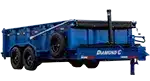
The current Diamond C LPT Heavy Duty Telescopic Dump is offered in 12-, 14-, and 16-foot lengths, with an 81- or 82-inch bed width depending on configuration. Its available GVWR range is approximately 15,500 to 24,000 lbs. Standard configurations use tandem 7,000-lb LIPPERT axles, while higher-capacity packages can use three 7,000-lb axles or tandem 8,000- or 10,000-lb axles. Because specifications and options affect empty weight and payload, always use the certification label and measured scale weight for the individual trailer.
Bulk-material weight can vary dramatically with composition, particle size, compaction, and moisture. A cubic-yard estimate is useful for planning, but it is not a substitute for a scale ticket. Wet soil or aggregate may be hundreds of pounds heavier per cubic yard than expected. Payload equals the trailer’s GVWR minus its actual empty weight, including installed options, ramps, tarp equipment, spare tires, tools, and anything else carried on the trailer. Never assume that a trailer with a 15,500-lb GVWR can carry 15,500 lbs of material.
Tongue weight matters too. For a bumper-pull trailer, a commonly used starting range is approximately 10-15% of loaded trailer weight, but the correct target must remain within the trailer, coupler, hitch, receiver, tow vehicle, and axle ratings. Gooseneck trailers generally impose a larger percentage of their weight on the truck. Do not automatically move material forward to correct sway: excessive forward loading can overload the hitch, truck rear axle, suspension, or tires. Load the material evenly from side to side and in the manufacturer-designated cargo area, then verify the finished combination on a certified scale whenever possible.
Braking: You Need More Distance Than You Think
Dump trailers in these weight classes normally have brakes on the applicable axles, but the exact brake system depends on the model and selected package. Diamond C’s current LPT configurations use LIPPERT axles, with electric-brake and higher-capacity brake packages available according to axle configuration. In Indiana, a trailer or semitrailer with an actual gross weight of at least 3,000 lbs must have brakes adequate to control, stop, and hold the vehicle. Those brakes must be controllable from the tow vehicle’s cab and must apply automatically if the trailer breaks away.
Functioning trailer brakes do not make the combination stop like an unloaded truck. Gross combination weight, speed, grade, pavement, tire condition, brake temperature, and brake-controller adjustment all affect stopping distance. Loose gravel, mud, rain, snow, and downhill grades can reduce available traction substantially. No advertised maximum tow rating guarantees short or drama-free stops, and a high tow rating does not override the truck’s payload, rear-axle, tire, hitch, or gross combination ratings.
Set and test the brake controller according to the controller, tow vehicle, and trailer manufacturers’ instructions. Perform the adjustment in a safe, open area at low speed. The trailer should contribute firm, proportional braking without locking its wheels during an ordinary test stop. Recheck the setting when trailer weight changes significantly. A gain setting that worked with an empty trailer may be inadequate when the dump body is carrying several tons of material.
Inspect the breakaway switch, cable, and dedicated battery before travel. Attach the breakaway cable to a secure point on the tow vehicle that is independent of the hitch ball or removable drawbar, following the component manufacturer’s instructions. Do not use the breakaway system as a parking brake, and never tow with the breakaway pin intentionally removed.
Downhill Grades
Going downhill with a loaded dump trailer is where poor speed control and overheated brakes become serious hazards. Select an appropriate lower gear before starting down a sustained grade and use the tow vehicle’s approved engine-braking or exhaust-braking system when equipped. Begin the descent at a conservative speed rather than trying to slow an already accelerating combination halfway down the hill.
Avoid riding the service brakes continuously. If braking performance changes, smoke appears, or you smell overheated brakes, move to a safe stopping location as soon as conditions allow. Do not touch hot drums, rotors, hubs, or wheels, and do not resume travel until the cause has been evaluated and the system has cooled sufficiently. If braking ability is impaired, the combination should be inspected or serviced before continuing.
The Tip-Over Risk Nobody Talks About Enough
Dump-trailer rollovers can occur during unloading and during travel. During unloading, the center of gravity rises as the body lifts and the material moves rearward. During travel, excessive speed, an uneven load, abrupt steering, soft shoulders, or a wheel dropping into a rut can create enough lateral force to overturn the trailer.
Dump only on firm, level ground. Keep the trailer aligned with the tow vehicle, apply the parking brake, follow the manufacturer’s instructions for remaining coupled, and use wheel chocks when directed. Never attempt to compensate for a side slope by positioning more material on the uphill side. If the site is not sufficiently level and stable, relocate before raising the body.
Watch the load from a safe position while raising the body. Stop immediately if the trailer leans, the tires or stabilizing components sink, the load hangs on one side, or the body moves abnormally. Sticky clay, frozen material, wet soil, and demolition debris can bridge or remain attached to the floor and then release suddenly. Never climb onto, strike, or enter a raised body to free a load.
Before you activate the dump mechanism, check for three things:
- Is the ground firm and laterally level? Walk the unloading area and look for crowns, ruts, uncompacted fill, soft shoulders, buried voids, or a downhill edge. If there is any doubt, do not raise the body there.
- Is there adequate overhead clearance? Check for power lines, tree limbs, roofs, doors, conveyors, and other obstructions. Required clearance depends on the trailer’s body length, dump angle, and configuration, so use the manufacturer’s dimensions or measure the individual trailer rather than relying on a generic height estimate. Treat every overhead electrical line as energized and maintain the clearance required by the utility and applicable safety rules.
- Is the load centered and free to discharge? Material packed harder on one side can unload unevenly and pull the raised body sideways. Confirm that the tailgate is configured and released correctly before raising the body, keep everyone out of the discharge area, and never stand beneath or directly behind the raised body.
Keep control of the dump function throughout the cycle and lower the body completely before moving the trailer. Do not drive with the body raised. If anyone must enter the space beneath a dump body for authorized maintenance, the trailer must be unloaded and the manufacturer-provided mechanical body support must be correctly engaged. Hydraulic pressure alone is never an acceptable support.
In transit, avoid abrupt steering and aggressive braking. If sway begins, hold the steering wheel steadily, stay calm, and reduce speed gradually. Do not accelerate to “pull out” of sway, make sharp counter-steering inputs, or repeatedly stab the tow vehicle’s brakes. Where conditions and the controller manufacturer’s instructions permit, gentle manual application of the trailer brakes can help bring the trailer back in line. Pull over safely and correct the underlying cause before continuing.
Electronic trailer-sway mitigation can assist by applying selected vehicle brakes or reducing engine torque, but it cannot correct an overloaded trailer, inadequate tongue weight, excessive speed, or an improperly matched combination. Use a weight-distribution hitch only when the trailer, receiver, hitch, and tow vehicle manufacturers approve it for that exact application, and have it sized and adjusted for the actual loaded weights.
Matching Trailer to Truck to Load
Running a dump trailer above its GVWR is one of the fastest ways to combine poor braking, excess tire heat, reduced stability, and accelerated component wear. You must remain within every applicable rating, including trailer GVWR, axle ratings, tire and wheel capacities, coupler or gooseneck rating, safety-chain capacity, hitch and receiver limits, truck GVWR, front and rear GAWR, tire ratings, payload capacity, and GCWR.
Axle ratings should not be confused with payload or GVWR. Part of a properly loaded trailer’s weight is carried by the tow vehicle through the tongue or gooseneck, so the sum of the axle ratings does not by itself establish trailer GVWR or cargo capacity. Conversely, strong axles do not permit the frame, tires, hitch, or complete trailer to exceed the GVWR shown on its federal certification label.
Do not select a tow vehicle by labels such as “half-ton,” “three-quarter-ton,” or “one-ton” alone. Trucks within the same marketing class can have very different ratings depending on cab, wheelbase, drivetrain, engine, axle ratio, bed, tire, hitch, and option package. Compare the truck’s door labels, owner’s manual, towing guide, and hitch label with actual scale weights. A dually may provide additional rear-tire capacity and lateral stability, but it is still subject to its published ratings.
For commercial operation, driver-licensing requirements must also be checked before selecting a heavy trailer. A Class A CDL generally applies when the combination has a GCWR or actual gross combination weight of at least 26,001 lbs, whichever criterion controls under the applicable rule, and the towed unit has a GVWR or actual gross weight over 10,000 lbs. A trailer over 10,000 lbs does not by itself trigger that combination threshold when the total remains below 26,001 lbs. Commercial-use, medical-card, USDOT, operating-authority, inspection, and hours-of-service requirements are separate questions and can apply at lower weights, especially in interstate commerce.
| Trailer | GVWR | Axle Rating | Recommended Tow Vehicle |
|---|---|---|---|
| Diamond C GDT General Duty Telescopic Dump | 7,000 lbs | Two 3,500-lb LIPPERT axles | Vehicle rated for the trailer’s actual loaded weight and tongue weight |
| Diamond C MDT Medium Duty Telescopic Dump | 9,890 lbs | Two 6,000-lb LIPPERT drop axles | Properly equipped truck within GVWR, GAWR, hitch, payload, and GCWR limits |
| Diamond C LPT Heavy Duty Telescopic Dump | 15,500-24,000 lbs, by package | Two 7,000-lb LIPPERT axles standard; higher-capacity configurations available | Heavy-duty truck specifically rated for the complete loaded combination |
Pre-Trip Checks Specific to Dump Trailers
A standard pre-trip covers the coupler or gooseneck connection, safety chains, breakaway cable, electrical plug, lights, reflectors, tires, wheels, lug nuts, suspension, brakes, load securement, license plate, and required documents. For dump trailers, add these items:
- Tailgate, spreader chains, and latches. Confirm that the gate is in the correct operating mode and that every latch, pin, and retaining device is secured for travel. A gate that opens on the highway can release material into traffic.
- Hydraulic system. With the body fully lowered and the trailer positioned as the manufacturer directs, check the reservoir level, hoses, fittings, cylinder, pump, and battery compartment for leaks, damage, corrosion, or loose connections. Use only the specified hydraulic fluid. Never search for a leak with your hand because pressurized fluid can penetrate skin.
- Body support. Verify that the mechanical safety prop or body support is present, undamaged, and secured in its travel position. Use it exactly as instructed before authorized work beneath an unloaded raised body. Never use improvised lumber, a jack, or hydraulic pressure as the sole support.
- Tires and wheels. Check cold inflation pressure against the trailer placard and tire manufacturer’s requirements. Do not lower pressure merely because the trailer is empty or exceed the tire sidewall limit when loaded. Inspect tread, sidewalls, valve stems, wheel condition, and lug-nut torque according to the maintenance schedule.
- Hydraulic power supply and controls. Most bumper-pull dump trailers use an onboard battery and electric-hydraulic pump. Confirm that the battery is charged, terminals are secure, the charging circuit is functioning as designed, and wired or wireless controls operate correctly. If a particular commercial unit uses a different power source, follow its manufacturer’s procedure.
Before each loaded trip, make sure the dump body is completely lowered and seated, the hydraulic control is secured, ramps are pinned in their storage position, tarp components are locked, stabilizer jacks are retracted, and no loose material can escape. Indiana law requires a load to be secured so it does not leak, sift, blow, spill, or otherwise escape onto the highway. A tarp does not make an overloaded or poorly distributed load safe.
On the Road: Habits That Prevent Incidents
Once you are moving, consistent driving habits help preserve the stability and braking margin available to the combination.
Increase following distance. Use at least a four-second interval under favorable conditions and substantially more when heavily loaded, descending a grade, traveling at night, or driving in rain, snow, loose gravel, or traffic with limited escape space. Space is more valuable than attempting to recover from a stop that began too late.
Slow down before curves and lane changes. Enter turns at a speed that does not require abrupt braking or steering. Posted curve speeds are not trailer-specific guarantees, and a high or shifting load may require a much lower speed.
Watch the mirrors and instruments. Look for early sway, tire smoke, loose tarp components, an unlatched gate, material loss, or a body that is not fully seated. Also monitor brake-controller warnings and tow-vehicle temperature or transmission alerts. Stop safely if anything changes.
Respect tire speed ratings. Trailer tires have load and speed limits. Heat increases rapidly when tires are underinflated, overloaded, damaged, or driven too fast. A roadside tire failure can destabilize a loaded dump trailer, so inspect the other tire and the trailer for collateral damage before proceeding.
Know your route and unloading site. Confirm road restrictions, construction zones, bridge limits, steep grades, narrow entrances, soft shoulders, and available turning space. With the dump body lowered, use the actual trailer’s measured overall height rather than a generic estimate. At the destination, separately confirm that the fully raised body will clear power lines, structures, trees, and equipment.
Buying the Right Trailer from the Start
Many dump-trailer safety problems begin with equipment that is too small for the intended material and hauling frequency. If routine loads leave little or no payload margin, the correct answer is a properly rated trailer and tow vehicle, not estimating each bucket more optimistically. Remember that additional side extensions increase volume but do not increase GVWR, axle capacity, tire capacity, or legal payload.
We carry Diamond C, H&H, and Delco dump trailers at Spencer Trailers, with configurations suited to property maintenance, farm work, landscaping, construction, and heavier commercial hauling. Current Diamond C choices include the GDT General Duty Telescopic Dump, MDT Medium Duty Telescopic Dump, LPT Heavy Duty Telescopic Dump, LPT-GN gooseneck version, DOD Deck Over Dump, and WDT Workhorse Dual Tandem gooseneck dump. Diamond C trailers are built in Mt. Pleasant, Texas, and its premium lines use LIPPERT axles as standard. Browse current dump trailer inventory to see what is on the lot, or call us at (812) 829-0226 to discuss the GVWR, payload, axle package, brake system, hitch type, and body size that fit the way you work.
Buying the right trailer once costs far less than operating an overloaded combination. The best selection is based on weighed loads, not only advertised bed volume or truck marketing. Allow for the trailer’s empty weight, installed accessories, changing moisture content, tongue or pin weight, and enough reserve capacity to avoid treating the maximum rating as an everyday target.
What is the heaviest load you regularly haul, and does your current trailer’s payload capacity cover it after the trailer, options, tools, and accessories are weighed? If you are not sure, let’s talk through the numbers.


