





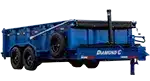

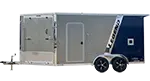
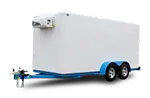
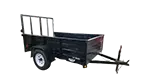

You’ve picked out your trailer, the hitch is on order, and you’re ready to roll. Then someone asks: “Do you have the right license for that?” And you realize you never thought about it.
Most Indiana drivers pulling a trailer for personal, nonbusiness use are completely fine with a standard driver’s license. In other states, the ordinary passenger credential may be called a Class D, Class C, or operator’s license. The name matters less than the privileges your state attaches to it.
The important questions are what the truck and trailer are rated to carry, what they actually weigh, whether the trip is connected to a business, and whether a state-specific license or endorsement applies. Get those details wrong and you could face citations, an out-of-service order, insurance problems, or liability after a crash.
Here’s what you need to know before you pull out of the lot.
The Federal Starting Point: GCWR 26,001 Pounds
The federal Class A commercial driver’s license threshold applies when a combination vehicle is used in commerce and has a Gross Combination Weight Rating or actual Gross Combination Weight of 26,001 pounds or more, and the towed unit has a GVWR or actual gross weight of more than 10,000 pounds. Both parts of that test matter.
That means 26,001 pounds is the combined threshold. It is not a rule saying that every trailer over 26,000 pounds requires a CDL by itself, and it is not a rule saying that every trailer over 10,000 pounds automatically requires a CDL. A commercial combination with a 12,000-lb trailer and a 10,000-lb tow-vehicle rating totals 22,000 pounds based on those ratings, so it does not reach the Class A weight threshold. The same trailer behind a heavier truck may produce a different result.
GCWR is also not simply the weight of whatever happens to be loaded on the truck and trailer that day. It is a rating used to classify the combination. Under the federal CDL definitions, the calculation can involve the manufacturer-specified combination rating displayed for the power unit and the truck and trailer GVWRs or actual gross weights, using the values that produce the highest applicable result. Actual Gross Combination Weight can also matter if the rig is loaded beyond its ratings, although operating over a vehicle’s ratings creates additional safety and enforcement problems.
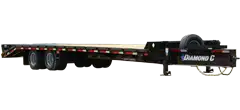
For a practical example, consider a pickup with an 11,500-lb GVWR towing a current Diamond C FMAX210 gooseneck flatbed rated at 25,000 lbs GVWR. Adding the two vehicle ratings produces a 36,500-lb preliminary combination figure, and the trailer is rated above 10,000 pounds. If that rig is being operated in commerce and no exemption applies, it falls into Class A CDL territory. The vehicles do not have to be loaded to their maximum ratings before the rating-based threshold becomes relevant.
Class B is different. It generally covers a single commercial vehicle with a GVWR or actual gross weight of 26,001 pounds or more, including such a vehicle towing a trailer rated at 10,000 pounds or less. Class C applies to certain passenger-carrying and placarded hazardous-material vehicles that do not meet the Class A or Class B weight definitions.
But here’s the part many people miss. The federal CDL rules apply to commercial motor vehicles used in commerce. Strictly personal transportation of personal property is generally outside the federal CDL rules, although a driver’s home state can impose additional requirements on heavy nonbusiness combinations. Farmers, emergency operators, military personnel, recreational-vehicle users, and other groups may also qualify for specific exceptions, but those exceptions have conditions. The rules are not one-size-fits-all.
What “Commercial” Actually Means
The CDL regulations use “commercial motor vehicle” as the key term, but “commercial” does not mean only a semi-truck hauling freight across state lines. Commerce can include trade, traffic, or transportation performed entirely within one state as well as interstate activity. A trip may be commercial when it furthers a business, even if the driver does not charge a separate hauling fee.
For example, a private citizen towing a 7×14 enclosed cargo trailer to move household furniture is normally engaged in personal, nonbusiness transportation. A landscaping company using a similar trailer to carry mowers and tools to customer properties is transporting property in furtherance of a business. The landscaping trip may count as commerce even when every job and every mile stays inside Indiana.
The same distinction can affect contractors, mobile service businesses, construction companies, equipment-rental operations, delivery businesses, racing operations with business sponsorship, and owners who occasionally haul property for compensation. Crossing a state line is important for determining whether interstate rules apply, but staying inside Indiana does not automatically turn a business trip into personal use.
There is another threshold worth knowing. A business combination can become subject to commercial motor-carrier safety rules at 10,001 pounds GVWR, GCWR, GVW, or GCW even though a CDL is not required until the higher Class A, B, or C conditions are met. In other words, “no CDL required” does not necessarily mean “no commercial vehicle regulations apply.” Depending on the operation, requirements involving a USDOT number, medical qualification, inspections, vehicle markings, hours of service, cargo securement, and records may still need to be reviewed.
Agricultural use also needs a careful reading. A covered farm vehicle exemption is not created merely because a person owns farmland or is hauling something agricultural. The vehicle generally must be operated by a farmer, rancher, employee, or family member; properly identified as a farm vehicle under applicable state requirements; and used to transport agricultural products, livestock, machinery, or supplies to or from a farm or ranch. It cannot be used in a disqualifying for-hire operation or carry hazardous materials in quantities requiring placards. The geographic scope depends on the vehicle’s weight and whether it is operating inside or outside its state of registration, with a 150-air-mile limitation applying in some heavier interstate situations.
This distinction matters a lot for small-business owners, contractors, and farm operators. If you use your trailer for work, even occasionally, consult the Indiana BMV, Indiana State Police Commercial Vehicle Enforcement Division, or a qualified transportation professional before assuming personal-use rules apply to you.
State Rules: Where It Gets Complicated
States administer driver’s licenses and can impose requirements on vehicles or drivers that federal law would otherwise exempt. Some states issue special noncommercial licenses for heavy recreational combinations, while others address the same situations through endorsements or vehicle-specific exceptions. A few examples of the variation you’ll encounter:
- Indiana: A standard Indiana driver’s license covers most personal, nonbusiness trailer towing. For a combination used in commerce, a Class A CDL is generally required when the GCWR or actual GCW is 26,001 pounds or more and the towed unit’s GVWR or actual weight is more than 10,000 pounds. A T endorsement is required for a CDL holder operating qualifying double or triple trailer combinations. Indiana also has a non-CDL for-hire endorsement that can apply to a motor vehicle with a GVWR of at least 16,000 pounds but not more than 26,000 pounds when it is used to transport property. That endorsement does not authorize operation of a vehicle that meets the CDL definition. The Indiana BMV is the authoritative licensing source; commercial operators should also verify motor-carrier requirements with the appropriate enforcement agency.
- Some states require a noncommercial Class A or similar credential for heavier personal combinations. California, for example, uses a noncommercial Class A license for certain travel trailers over 10,000 lbs GVWR and fifth-wheel travel trailers over 15,000 lbs GVWR when they are not being towed for compensation. California also has a separate endorsement path for some fifth-wheel travel trailers between 10,000 and 15,000 lbs GVWR. Those California rules do not automatically apply to an Indiana resident, but they illustrate why drivers must check the licensing law of their home state and any state in which they will operate.
- Agricultural exemptions exist under federal and state law, but they are conditional. Vehicle identification, ownership or control, cargo, farm connection, for-hire status, hazardous-material status, vehicle weight, distance from the farm, and state lines can all affect eligibility. A farm plate or agricultural load should never be treated as an unlimited exemption from CDL and motor-carrier rules.
What counts: always verify your specific situation with your state’s licensing and motor-carrier authorities. What applies to an Indiana-licensed driver may not match the noncommercial license categories used in another state, and a commercial trip may be regulated differently from a personal trip made with the same truck and trailer. This post gives you a framework, not a legal opinion.
License Classes at a Glance
| License Type | Typical Requirement | Example Scenario |
|---|---|---|
| Standard Driver’s License | Personal, nonbusiness towing permitted by state law, or an operation that does not meet a CDL classification; another state or Indiana endorsement may still apply | Pickup + utility trailer for a personal home or recreational project |
| Noncommercial Class A or Similar Credential (some states) | Heavy personal combinations that exceed a state’s ordinary-license limits but are not being operated in commerce | Heavy-duty pickup + large fifth-wheel or travel trailer in a state with a noncommercial heavy-trailer license category |
| Commercial Class A CDL | GCWR or actual GCW of 26,001+ lbs, with the towed unit’s GVWR or actual weight over 10,000 lbs, when used in commerce and no exemption applies | Commercial pickup + heavy Diamond C gooseneck flatbed or equipment trailer |
| Commercial Class B CDL | Single vehicle with GVWR or actual weight of 26,001+ lbs, or such a vehicle towing a unit rated at 10,000 lbs or less | Straight dump truck towing a 9,990-lb GVWR tag-along trailer |
Again, these are general categories. A Class C CDL can be required for certain passenger or hazardous-material operations even when the vehicle does not meet Class A or Class B weight thresholds. Indiana’s for-hire endorsement is another separate category: it is added to a standard driver’s license and does not replace a CDL when the vehicle meets the federal and state CDL definition. Your state may also use different class labels, restrictions, or exemptions.
Trailer GVWR vs. GCWR: Know the Difference
A lot of confusion comes from mixing up vehicle ratings, actual weights, payload capacity, and towing capacity. They are related, but they are not interchangeable.
GVWR (Gross Vehicle Weight Rating) is the maximum rated weight of one vehicle when loaded. For a trailer, that includes the trailer itself, installed equipment, fluids where applicable, and cargo. For a tow vehicle, it includes the truck, driver, passengers, fuel, accessories, cargo, and the portion of trailer weight carried by the hitch. GVWR appears on the truck’s certification label and the trailer’s VIN or certification tag.
For example, the Diamond C GTU premium tandem-axle utility trailer has a 7,000-lb GVWR. If it is paired with a pickup carrying an 8,800-lb GVWR, adding the two ratings gives a preliminary combination figure of 15,800 pounds. That is below the 26,001-lb Class A threshold. The driver must still stay within the pickup’s towing, payload, axle, tire, hitch, and Gross Combination Weight limits, and commercial-use rules may still apply at the lower CMV threshold.
GVW (Gross Vehicle Weight) is what one vehicle actually weighs at a particular time. GCW (Gross Combination Weight) is what the complete truck-and-trailer combination actually weighs. The most reliable way to determine actual axle and combination weights is to use a certified scale with the rig loaded as it will travel.
GCWR (Gross Combination Weight Rating) is the applicable rated value for the truck-and-trailer combination. For a preliminary CDL check, owners commonly add the tow vehicle’s GVWR and the trailer’s GVWR. They should then compare that result with any applicable manufacturer-displayed GCWR and with actual loaded weights, because federal definitions use the applicable values that produce the higher classification result.
Now consider a current Diamond C FMAX216 gooseneck flatbed in its 25,900-lb GVWR configuration paired with a heavy-duty pickup carrying an 11,500-lb GVWR. Adding those two ratings produces 37,400 pounds, and the trailer is well over the 10,000-lb towed-unit threshold. That is a Class A combination when it is used in commerce and no qualifying exemption applies. The FMAX216 is also available in higher-GVWR configurations, so the certification tag on the exact trailer being purchased must control the discussion.
A lighter example shows why the truck matters. A 15,500-lb GVWR Diamond C FMAX207 paired with a 10,000-lb GVWR pickup produces a 25,500-lb preliminary total, just below 26,001 pounds. Pair the same trailer with an 11,500-lb GVWR truck and the total becomes 27,000 pounds. Because the trailer is also rated over 10,000 pounds, that second combination meets the Class A weight test when used in commerce.
Always record both vehicle ratings, check the tow vehicle manufacturer’s GCWR and towing limits, and obtain actual scale weights when the combination is close to a legal or equipment threshold. Never use payload capacity, empty trailer weight, axle capacity, or advertised maximum towing capacity as a substitute for the applicable GVWR, GCWR, GVW, and GCW figures.
What About Endorsements?
Beyond the base CDL class, certain operations require added endorsements. Endorsements describe the type of vehicle or cargo the driver is qualified to handle; they do not increase the truck’s towing capacity or allow an overloaded combination.
- T endorsement (Double/Triple Trailers): Required for a CDL holder operating double or triple trailer combinations. The endorsement does not override state restrictions on where a particular multiple-trailer configuration may be operated.
- N endorsement (Tank Vehicle): Required for a CDL holder operating a qualifying tank vehicle that meets the federal tank-capacity definition. The rule can apply to certain tanks attached permanently or temporarily to a vehicle, so contractors and agricultural operators should verify the tank configuration rather than relying on the trailer’s body style.
- H endorsement (Hazardous Materials): Required when transporting hazardous materials in quantities that require placarding. Obtaining and maintaining this endorsement involves additional testing and a Transportation Security Administration security threat assessment.
A CDL driver who needs both tank and hazardous-material privileges generally receives the combined X endorsement. Passenger and school-bus operations have their own endorsements as well.
For most Spencer Trailers customers pulling ordinary cargo trailers, utility trailers, equipment trailers, dumps, or flatbeds without qualifying tanks or placarded hazardous materials, these endorsements are not part of the transaction. But if you’re hauling fuel, chemicals, compressed gases, placarded materials, or more than one trailer, confirm the exact endorsement and operating rules before you move.
A Few Practical Checkpoints
Before you hitch up anything heavier than a basic utility trailer, run through this quick list:
- Document every applicable weight. Record the tow vehicle’s GVWR, the trailer’s GVWR, the manufacturer’s GCWR, and the loaded truck, trailer, axle, and combination weights when available. The truck’s certification label, owner’s manual or manufacturer towing guide, trailer VIN tag, and a certified scale are the proper places to look. Do not base a license decision only on the trailer’s empty weight.
- Determine your use. Is the trip strictly personal, or is it connected to a business, customer, paid service, farm, sponsored activity, or commercial delivery? Is the movement intrastate or interstate? Who owns the property, who benefits from the trip, and whether compensation is involved can all matter.
- Check your state authorities. Indiana drivers: in.gov/bmv. Commercial operators may also need guidance from Indiana State Police Commercial Vehicle Enforcement or Indiana Department of Revenue Motor Carrier Services. Out-of-state customers should review both the ordinary license privileges and any noncommercial Class A, for-hire, recreational, or farm endorsements used by their state.
- Call your insurance company. A personal auto policy may exclude business use, paid hauling, certain cargo, or trailers above specified values or weights. Commercial vehicle, trailer, cargo, and general-liability coverage are separate questions. Describe the actual truck, trailer, cargo, operating radius, and business use to the insurer rather than asking only whether “trailers are covered.”
- Check the trailer-brake system. This is separate from licensing, but it is essential. Indiana Code 9-19-3-3 requires a trailer or semitrailer with a gross weight of at least 3,000 pounds, when operated on a highway, to have brakes adequate to control, stop, and hold the trailer. The brakes must be controllable as required from the tow vehicle and must apply automatically if the trailer breaks away. An electric-brake trailer therefore needs a compatible, correctly adjusted brake controller and a functioning breakaway battery and switch.
A legal driver’s license does not make an unsafe combination legal. The truck’s tow rating, payload capacity, front and rear axle ratings, tires, wheels, hitch, coupler, safety chains, breakaway system, lighting, cargo securement, trailer registration, and actual loaded weight must all be appropriate for the job.
What Spencer Trailers Customers Usually Run Into
The vast majority of people buying from us in Spencer, Indiana, are towing for personal use or operating combinations that remain comfortably below the Class A CDL threshold. Common examples include a 7,000-lb tandem utility trailer for an ATV or compact tractor, an enclosed cargo trailer for household projects, or a car hauler rated below 10,001 pounds. Paired with an appropriately rated half-ton or three-quarter-ton pickup, many of these combinations remain well below 26,001 pounds.
In those straightforward personal-use situations, a standard Indiana driver’s license is usually sufficient. But the responsible answer is not simply “standard license, no CDL, go.” You still need to verify the truck-and-trailer ratings, the actual load, the tow vehicle’s limits, the brake requirements, and the laws of every state in which the combination will be operated.
Questions arise more often when customers move into heavy equipment trailers, dump trailers, and gooseneck flatbeds. Current Diamond C LPX and HDT equipment trailers are available in configurations ranging from approximately 15,500 to 24,000 lbs GVWR. A 15,500-lb trailer may stay below the Class A threshold behind one pickup and cross it behind another. The truck’s rating cannot be left out of the calculation.
The same is true for Diamond C FMAX gooseneck flatbeds. An FMAX207 is rated at 15,500 lbs GVWR, an FMAX210 is rated at 25,000 lbs GVWR, and an FMAX216 starts at 25,900 lbs GVWR with higher-rated configurations available. These current Diamond C premium trailers use Lippert axles, with axle sizes and brake systems matched to the particular model and GVWR package. The trailer’s VIN tag and build specifications, not a generic online listing or another unit’s description, are the controlling references for the trailer being purchased.
A contractor using an 11,500-lb GVWR pickup with a 15,500-lb FMAX207 reaches a 27,000-lb preliminary combination rating. Because the trailer is rated above 10,000 pounds, that commercial combination meets the Class A weight test. An FMAX210 or FMAX216 paired with a heavy-duty pickup moves even farther into Class A territory. Paid hauling is an obvious commercial use, but carrying your own skid steer, building materials, tools, or products to perform paid work can also be commerce.
Personal, nonbusiness use may produce a different licensing answer, but it does not change the physical limits of the truck or trailer. A personal-use exemption cannot increase towing capacity, cure an overloaded axle, eliminate required brakes, or make an inadequately rated hitch safe. Heavy personal combinations must also be checked against the license privileges of the driver’s home state and the laws of the states being visited.
Not sure where to start? Reach out to us at (812) 829-0226 and we can walk you through the GVWR, empty weight, axle configuration, brakes, coupler, and other specifications on any trailer in our inventory. Knowing the exact ratings of the trailer you’re buying is the first step toward determining what license, endorsement, tow vehicle, and equipment you actually need.


