













You’ve probably seen it on the highway. A trailer begins moving from side to side behind a pickup, the driver makes a sudden steering correction, and the combination becomes unstable in a hurry. Trailer sway can contribute to loss-of-control crashes, and poor cargo placement is one of the most preventable causes.
Get the weight distribution right and a properly matched, maintained trailer should track predictably behind the tow vehicle. Get it wrong and even good tires, working brakes, and a sway-control hitch may not compensate for a trailer that is tail-heavy, overloaded, or unevenly loaded.
Why Trailer Sway Happens
A trailer pivots at the hitch, so any sideways disturbance can start an oscillation. Crosswinds, passing trucks, abrupt steering, uneven pavement, excessive speed, low tire pressure, worn suspension components, or a sudden maneuver may initiate the movement. When the trailer’s center of mass is too far rearward and hitch weight is too low, the oscillation may grow instead of settling.
The basic loading correction is straightforward: place the heaviest cargo low, near the trailer’s longitudinal centerline, and far enough forward of the axle or axle group to produce the hitch weight specified by the trailer and tow-vehicle manufacturers. Do not rely on cargo position alone. Confirm the finished setup by weighing it, and stay within the trailer GVWR, axle ratings, tire ratings, coupler rating, hitch rating, and the tow vehicle’s towing, payload, rear-axle, and gross combined weight limits.
The 60/40 Rule Explained
The familiar 60/40 rule is a useful starting point for many conventional bumper-pull trailers: begin with roughly 60 percent of the cargo weight in the front half of the usable deck and 40 percent in the rear half. It is a loading guideline, not a substitute for measuring hitch weight. Axle location, trailer length, empty-trailer balance, cargo shape, and the position of each item’s center of gravity all affect the final result.
For most conventional bumper-pull trailers, manufacturers commonly call for tongue weight of approximately 10 to 15 percent of the trailer’s actual loaded weight. Gooseneck and fifth-wheel trailers generally place a higher percentage on the truck, often approximately 15 to 25 percent, but the correct figure is the range specified for that particular trailer, hitch, and tow vehicle.
Here’s what that looks like with real numbers. Say you’re carrying 2,000 lbs of landscaping material on a 7×14 utility trailer. As an initial layout, approximately 1,200 lbs of cargo can be placed in the forward portion and 800 lbs in the rear portion, with the material centered from left to right. The final tongue-weight target must be calculated from the entire loaded trailer weight, not the cargo alone. If the empty trailer weighs 1,850 lbs, the loaded trailer weighs approximately 3,850 lbs, and a 10-to-15-percent target would be approximately 385 to 578 lbs.
That number is not automatically acceptable merely because a pickup is described as a 3/4-ton. The truck’s certification label, owner’s manual, receiver label, ball mount, hitch ball, and any weight-distribution equipment determine the actual limits. Passengers, tools, fuel, accessories, and cargo in the bed consume payload, while trailer tongue weight adds load to the truck and usually increases the load carried by its rear axle.
Too little tongue weight can make a conventional trailer more susceptible to sway. Excessive tongue weight can overload the receiver, rear axle, tires, suspension, or truck GVWR and may reduce weight on the steering axle. The correct goal is not simply to hit a universal percentage; it is to stay within the manufacturer’s recommended hitch-weight range while meeting every applicable weight rating.
Checking Tongue Weight Without a Scale
A bathroom scale can sometimes be used for a light trailer if the expected tongue weight is safely within the scale’s capacity. Place the scale on a firm, level surface and support the coupler at approximately its normal towing height. Do not assume that putting the tongue jack directly on an ordinary household scale is safe: many utility and equipment trailers can apply more force than the scale is designed to carry. A properly constructed lever arrangement can divide the load for measurement, but its distances and supports must be set up accurately.
A better option is a purpose-built tongue-weight scale with adequate capacity, a hitch-mounted measuring device, or a certified public scale. Tongue-weight scales are available in several capacities and price ranges, so choose one rated above the expected load rather than shopping by price alone. For a public-scale measurement, weigh the loaded truck and trailer in the configurations needed to determine axle loads and the weight transferred through the hitch.
Always measure the trailer as it will travel: full fuel cans or water tanks, attachments, spare tires, batteries, tools, and all cargo aboard. Keep the trailer level or at the towing attitude specified by its manufacturer, because an incorrectly adjusted hitch height can change load sharing between tandem axles.
Cargo Types and How to Stack Them
Different loads require different planning, but every load should remain within the trailer’s payload capacity. Payload is not the same as GVWR. A trailer’s available payload is generally its GVWR minus its actual empty weight and installed equipment, subject to axle, tire, deck, concentrated-load, and hitch limitations.
Dense, heavy items
Gravel bags, engine blocks, steel plate, masonry, and palletized material belong low in the trailer and centered from side to side. Position the heaviest pieces to produce the required hitch weight without concentrating more load on the deck, axle group, tires, or tow vehicle than those components can carry. Do not place a dense item in the rear third merely because it will be easier to unload. A 500-lb engine block can materially change tongue weight when it is moved several feet, and a weight-distribution hitch cannot correct a fundamentally tail-heavy load.
Bulk materials also need containment. Loose gravel, soil, or debris must not be allowed to escape, and the load should be distributed so one axle or one side is not carrying a disproportionate share. When practical, confirm individual axle weights at a scale after loading.
Long items: lumber, pipe, ladders
Long stock may span both sides of the axle group, but that does not guarantee correct balance. Determine where the material’s center of gravity falls, keep the load supported along the deck or approved rack system, and secure it against forward, rearward, lateral, and vertical movement. Use enough tie-down points to prevent individual pieces from sliding out of the bundle.
If material extends beyond the trailer, comply with applicable overhang, marking, lighting, and securement requirements. Do not try to correct excessive rear overhang by adding unrelated ballast at the front; that raises total weight without eliminating the overhang hazard. Reposition the material, use a longer trailer, or use an approved support system.
Furniture, appliances, boxes
In an enclosed trailer such as a Wells Cargo FastTrac or a Darkhorse Cargo trailer, heavy appliances and furniture generally belong low and toward the front, but not automatically pressed against the front wall. Their exact position should produce the specified tongue weight, and each item must be restrained using structurally suitable anchors. Interior wall panels and thin floor sheathing are not automatically rated tie-down points.
Secure refrigerators, washers, dryers, cabinets, and tall furniture independently so they cannot tip, slide, or strike the trailer walls. Lighter boxes can fill remaining spaces without being used as the primary restraint for heavy cargo. Moving blankets and nonslip mats help protect surfaces and reduce movement, but they do not replace properly rated tie-downs.
Equipment trailers: ATVs, mowers, skid steers
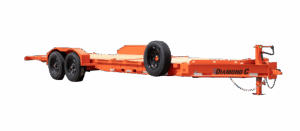
Equipment positioning is especially important because moving a machine only a few inches can noticeably change hitch and axle loads. On a Diamond C LPX, HDT, DEC, FMAX, or another properly rated equipment trailer, position the machine’s center of gravity to achieve the trailer manufacturer’s recommended hitch load. The machine’s center of gravity is not necessarily at the midpoint between its axles or tracks, especially when it carries a loader, bucket, attachment, counterweight, or fluid-filled tires.
Before hauling a skid steer listed at 6,600 lbs, verify its actual operating weight with the installed bucket, forks, fuel, counterweights, and accessories. Select a trailer whose available payload, deck rating, axle package, tires, hitch, and GVWR accommodate the complete load. Diamond C’s current LPX and HDT lines are offered in multiple configurations from 15,500 through 24,000 lbs GVWR and use LIPPERT axles; the certification label on the individual trailer controls.
Load ATVs and mowers according to their actual weights, not their physical sizes. If two machines are carried, arranging the heavier one forward may be a reasonable starting point, but measure the completed setup. Secure movable attachments, lower buckets and implements when directed by the equipment manufacturer, set parking brakes, and use manufacturer-approved securement locations.
Real Scenarios Where Cargo Distribution Goes Wrong
Scenario one: a contractor loads most of his landscaping material near the rear of an open utility trailer because it will be faster to unload at the job site. The cargo weighs 1,400 lbs, but approximately 900 lbs is behind the axle group. At highway speed, a steering correction or passing truck starts a sway event. Reducing speed may lessen the instability, but continuing with a known tail-heavy load is unsafe. The correct response is to stop in a safe location, inspect the trailer, reposition and resecure the load, and verify the resulting tongue weight.
Scenario two: a family moves a refrigerator, washer, and dryer in a 6×12 enclosed cargo trailer. They place the refrigerator near the rear doors so it can be unloaded first. The completed trailer has only 7 percent tongue weight. On a freeway on-ramp, an abrupt steering input starts an oscillation. The appliances should be repositioned and individually secured so the trailer reaches its specified tongue-weight range without exceeding any truck or trailer rating.
Scenario three: a farmer hauls a 5,500-lb tractor on a properly rated H&H gooseneck equipment trailer. To make room for a pallet, he changes the tractor’s usual position without reweighing the combination. The pallet, tractor, and attachments alter both the gooseneck load and axle loading. The truck may feel different even though the cargo appears secure. Before traveling at road speed, he should verify the truck’s steer- and drive-axle loads, the trailer axle load, total combination weight, and the gooseneck load against all ratings.
These are common, preventable mistakes. Familiarity with a trailer does not make a changed load safe, and a setup that towed correctly on a previous trip may handle differently after equipment, attachments, cargo, or hitch height changes.
If sway begins, keep the steering wheel steady, avoid abrupt steering and hard tow-vehicle braking, and gradually reduce speed. If the trailer has independently controllable electric brakes, carefully applying the manual trailer-brake control may help pull the combination straight. Follow the tow vehicle and brake-controller manufacturers’ instructions. Do not accelerate in an attempt to outrun the sway, and do not resume normal speed until the cause has been identified and corrected.
Securing the Load So It Stays Put
Cargo that starts in the right position has to stay there. An unsecured load can shift during acceleration, braking, cornering, or travel over rough pavement. That movement can change hitch weight and side-to-side balance in the middle of a trip while also damaging the cargo or trailer.
- Select straps, chains, binders, anchors, and attachment hardware by their labeled working load limits, not merely by strap width or appearance. One-inch and 2-inch straps are sold with different ratings, so a generic width does not guarantee an 833-lb or 3,300-lb working load limit. Never use breaking strength as the allowable working load.
- Make sure the combined working load limit and number of tie-downs are adequate for the cargo and the applicable securement rules. Commercial carriers must follow the commodity-specific and general cargo-securement requirements in the Federal Motor Carrier Safety Regulations; private haulers should use equally conservative practices.
- Attach tie-downs only to structurally suitable, properly rated points. Frame-connected D-rings, stake pockets, rubrails, and equipment tie-down points may be appropriate when the trailer manufacturer permits their use. Do not attach to light sheet metal, an unrated wall fitting, a ramp component, or deck boards alone.
- Restrain heavy equipment in every direction. Crossing two straps can improve lateral control in some arrangements, but an X-pattern by itself does not automatically provide adequate forward, rearward, lateral, and vertical restraint. Follow the equipment and tie-down manufacturers’ instructions.
- Protect webbing from sharp edges, heat, abrasion, and chemicals. Do not use a strap that is cut, melted, badly abraded, knotted, or missing a readable rating label. Use edge protectors where the load could damage the webbing.
- Stop soon after departure in a safe location to inspect the hitch, coupler, safety chains, breakaway cable, doors, ramps, tires, and load securement. Recheck periodically and after hard braking, a sharp maneuver, rough road, or any suspected cargo movement. Some loads settle and can reduce tie-down tension.
- Use moving blankets, chocks, blocking, cradles, or rubber mats where appropriate, but treat them as supporting measures. A refrigerator on a smooth floor still requires positive restraint against sliding and tipping.
Weight-Distribution Hitches: What They Do and Don’t Do
A weight-distribution hitch uses spring bars or another leverage system to restore some of the load removed from the tow vehicle’s front axle when trailer tongue weight is applied. Properly selected and adjusted equipment can improve ride attitude and steering response, but it must be approved by the tow-vehicle, receiver, and trailer manufacturers.
Choose a system such as an Equal-i-zer, Andersen, Reese, or another compatible product according to actual loaded tongue weight, trailer weight, receiver rating, coupler design, and vehicle requirements. Do not choose one solely because the trailer falls within a broad GVWR category. The weight of cargo carried behind the tow vehicle’s rear axle can also affect setup, and the hitch must be adjusted using the manufacturer’s measurements and torque specifications.
A weight-distribution hitch does not increase the truck’s GVWR, rear gross axle weight rating, tire capacity, receiver rating, trailer GVWR, or legal towing capacity. It also cannot make a tail-heavy or overloaded trailer safe. Some systems include integrated sway resistance, while friction sway-control devices may be separate. These products can help resist disturbances, but they cannot replace correct cargo placement, adequate tongue weight, proper tire pressure, suitable speed, and sound suspension and hitch components.
Some trailers and tow vehicles prohibit or limit certain weight-distribution or friction-control systems, particularly with surge brakes, specialized couplers, or particular frame designs. Follow the written instructions for the exact combination rather than assuming every bumper-pull trailer needs or accepts the same hardware.
Trailer Specs to Know Before You Load
Different trailers are available with different lengths, axle packages, GVWRs, door styles, ramps, and optional equipment. A model-family name or deck size alone does not establish capacity. Check the federal certification/VIN label and the manufacturer’s documentation for the individual trailer before loading it.
| Trailer | GVWR | Axle Rating | Notes |
|---|---|---|---|
| Diamond C LPX Equipment Trailer | 15,500-24,000 lbs, by configuration | Standard tandem 7,000-lb LIPPERT axles; higher-capacity packages available | 80-82 in. bed widths and 16-30 ft lengths; certification label controls |
| H&H Rail Side Utility Trailer | 2,990-7,000 lbs, by size and configuration | 3,500-lb GAWR per axle on current listed configurations | Available in multiple widths and lengths; confirm curb weight and payload for the exact unit |
| Wells Cargo FastTrac 6×12 Cargo | 2,990 lbs | Single-axle configuration; verify the axle and tire labels on the unit | Approximate curb weight and payload vary by model configuration and installed options |
| Darkhorse Cargo 7×16 V-Nose | Configuration-specific | Configuration-specific | Axles, brakes, doors, tie-downs, and GVWR must be verified from the unit’s certification label and build sheet |
| Liberty 5×10 Single-Axle Utility | Configuration-specific | Configuration-specific | Deck, gate, axle, tire, and payload specifications can vary; use the individual trailer label |
Stay below the trailer GVWR, gross axle weight ratings, tire capacities, wheel ratings, coupler rating, safety-chain rating, jack rating, and any stated deck or concentrated-load limit. A 3,500-lb axle rating is the maximum permitted load on that axle, not 3,500 lbs per tire. Two 3,500-lb axles also do not automatically create a 7,000-lb payload; the trailer’s own weight and all installed equipment consume part of the GVWR.
The combined axle ratings may differ from the trailer GVWR because some loaded weight is carried through the tongue or gooseneck. Never calculate an unofficial capacity by adding component ratings. The GVWR assigned by the manufacturer and the ratings of the lowest-capacity components govern.
Indiana requires brakes on a trailer or semitrailer with a gross weight of at least 3,000 lbs under IC 9-19-3-3. Brakes must be maintained and correctly adjusted, and the tow vehicle must have a compatible controller when electric trailer brakes are used. A breakaway system is an emergency device, not a parking brake or substitute for the service brakes.
Indiana residents generally must title and register a newly acquired, unregistered trailer within 45 days of purchase or acquisition to avoid the applicable administrative penalty. That 45-day requirement is not blanket permission to operate an unregistered trailer on public roads for the entire period; temporary-permit, plate, title, insurance, and operating rules still apply.
For CDL classification, the trailer’s GVWR alone is not the complete test. A Class A CDL is generally implicated when the combination has a GCWR or qualifying actual gross combination weight of at least 26,001 lbs and the towed unit has a GVWR or qualifying actual gross weight over 10,000 lbs, subject to the federal definitions, the nature of the operation, exemptions, and Indiana licensing rules. Commercial operations may also be subject to USDOT registration, medical qualification, hours-of-service, inspection, and cargo-securement requirements at lower weight thresholds.
A Quick Pre-Trip Mental Checklist
- Is the heaviest cargo low, centered from side to side, and positioned to produce the manufacturer’s required hitch weight?
- Are the trailer GVWR, axle loads, tire loads, tow-vehicle GVWR, rear-axle load, payload, receiver rating, and GCWR all within their limits?
- Has tongue or gooseneck weight been measured for the trailer in its actual loaded condition rather than estimated from cargo placement alone?
- Are all tie-downs undamaged, properly rated, adequately tensioned, and attached to suitable structural points?
- Are cargo, attachments, doors, ramps, jacks, spare tires, and loose equipment prevented from shifting or opening during acceleration, braking, cornering, and rough-road travel?
Also check the coupler or gooseneck latch, hitch pin, safety chains, breakaway cable and battery, electrical connector, lights, brake operation, wheel-lug torque, tire pressure, tread condition, and visible suspension components. Set the hitch height so the trailer rides as specified by its manufacturer, and perform a low-speed brake and handling check before entering traffic.
Five cargo questions plus a complete equipment inspection take only a few minutes. That short check can reveal a tail-heavy load, an overloaded axle, a loose tie-down, or a hitch problem before it develops into a sway incident on the highway.
If you’re not sure whether your current trailer is set up for the type of hauling you’re doing, or if you’re looking at a model with better axle capacity, loading equipment, and tie-down options for your work, browse what we have in stock at Spencer Trailers. We carry Diamond C, H&H, Wells Cargo, Darkhorse Cargo, Liberty, and more, and we can help you compare the individual trailer’s GVWR, empty weight, payload, axle package, brakes, hitch requirements, and loading features. You can also call or stop in at 291 West State Hwy 46 in Spencer, Indiana. The number is (812) 829-0226. Tell us what you haul, what it weighs with attachments, and what tow vehicle you use, and we’ll give you a straight answer about the safest suitable configuration.


