


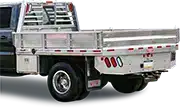
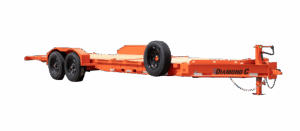



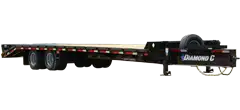
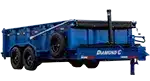



You’re standing on a lot comparing two trailers. Their GVWR and advertised payload look similar, and the prices are close. One frame has a smoother surface, while the other has the darker, slightly textured appearance commonly associated with hot-rolled structural steel. A salesperson describes one as “hot-rolled” and the other as “cold-rolled.” That distinction can tell you something about how the steel was finished at the mill, but it does not, by itself, tell you which trailer is stronger or better built. Steel grade, section geometry, thickness, weld design, surface preparation, coating quality, and the manufacturer’s load calculations matter far more than a single hot-rolled or cold-rolled label.
Here’s what actually separates the two processes, how each may appear in trailer construction, and what you should examine when you’re buying a trailer meant to work for a living.
How Steel Gets Made: Two Very Different Processes
Hot-rolled and cold-rolled products generally begin with steel that has been cast and then processed into slabs, blooms, billets, or coils. From there, the manufacturing path depends on the final product. Plate, structural channel, angle, and wide-flange shapes are commonly rolled while hot. Sheet and coil may be hot-rolled, pickled and oiled, cold-reduced, annealed, or temper-rolled. Trailer tubing is frequently formed from coil and welded along a longitudinal seam. That means a trailer frame can contain several steel products made through different processes, even when the completed trailer is marketed under one broad description.
Hot-rolled steel is shaped while the material is above its recrystallization temperature, often at temperatures near 1,700 degrees Fahrenheit for carbon steel. At that temperature, the steel can be rolled efficiently into plate, sheet, I-beams, channel, angle, and other structural sections. As the material cools, normal thermal contraction can produce less precise dimensions than a comparable cold-finished product. Exposure to oxygen at elevated temperature also creates mill scale, the dark iron-oxide layer commonly visible on unfinished hot-rolled steel. Hot-rolled products are widely used in load-bearing structures because they are available in substantial thicknesses and large structural shapes, not because they are limited to low-strength applications.
Cold-rolled steel generally begins as hot-rolled sheet or coil that is cleaned and reduced to a final thickness at or near room temperature. Depending on the specification, the material may then be annealed and temper-rolled to obtain the required combination of strength, ductility, flatness, finish, and formability. Cold reduction can increase strength through work hardening, but the amount of strength increase depends on the grade and subsequent processing. The most consistent differences are usually a smoother surface, more precise thickness, sharper dimensional control, and improved suitability for parts that must be formed or fitted closely.
A common mistake is comparing ASTM A36 structural steel with cold-finished 1018 bar and concluding that cold-rolled steel is automatically about 50 percent stronger. ASTM A36 is a structural specification with a minimum yield strength of approximately 36,000 PSI for common thicknesses, while 1018 identifies a low-carbon chemistry that may be supplied in hot-rolled or cold-finished conditions. That is not a controlled comparison of the rolling processes. Hot-rolled structural and high-strength low-alloy steels are available with yield strengths of 50,000 PSI, 80,000 PSI, 100,000 PSI, or more, while some cold-rolled commercial sheet grades have much lower minimum strengths. Steel grade and condition determine the material properties. The rolling label alone does not. It is also important to remember that ordinary carbon and high-strength steels have nearly the same elastic modulus, so a higher yield strength does not automatically make an identically shaped beam noticeably stiffer under normal elastic loading. Beam depth, flange size, web thickness, bracing, span, and section geometry largely control frame deflection.
What This Means on a Real Trailer Frame
Trailer manufacturers use hot-rolled plate and structural shapes, cold-rolled sheet, cold-formed tubing, and fabricated members in different locations. The appropriate choice depends on the trailer’s GVWR, expected load distribution, deck height, frame length, hitch configuration, fatigue demands, manufacturing method, and target empty weight. A properly engineered hot-rolled frame can outperform a poorly designed frame made from smoother or nominally higher-strength material.
Hot-rolled steel is practical for main rails, tongues, cross members, gussets, dump bodies, and other heavily loaded components because it is readily available as plate, structural channel, angle, and I-beam. Heavy equipment and flatbed trailers do not carry purely static loads. Braking, acceleration, road impacts, uneven jobsite surfaces, concentrated machinery weight, and cargo movement create repeated dynamic stresses. A responsible manufacturer accounts for those loads through material grade, beam section, cross-member spacing, reinforcement, suspension placement, hitch loading, and fatigue-resistant joint design rather than simply adding steel until the trailer looks heavy.
Cold-rolled sheet is useful where surface quality, thickness consistency, or precise forming matters, including panels, boxes, brackets, fenders, and smaller fabricated components. Square and rectangular trailer tubing is often cold-formed, but that does not necessarily mean it was made from cold-rolled steel. Many structural tubes are formed and welded from hot-rolled coil. The words cold-formed and cold-rolled describe different parts of the manufacturing process and should not be treated as interchangeable. A smooth tube can provide consistent fit-up, but its structural performance still depends on the steel specification, wall thickness, corner radius, weld seam, unsupported length, and how it is connected to the rest of the frame.
This is where brand and engineering discipline matter. A manufacturer should select a documented steel grade and section for each load path, control how parts fit before welding, and verify the completed frame against the intended GVWR and loading conditions. The meaningful question is not whether every component is hot-rolled or cold-rolled. It is whether the material, geometry, welds, suspension, coupler, axles, tires, and coating system work together as a properly rated trailer.
Diamond C’s Engineered Beam: Why This Is Different
Diamond C Trailers, one of the brands we carry at Spencer Trailers, takes a different approach on compatible heavy-duty models by designing and fabricating its own Engineered Beam sections. Diamond C has built trailers in Mt. Pleasant, Texas, since 1985. Instead of relying only on a standard mill-produced I-beam for every configuration, the company changes the beam dimensions and construction to suit the trailer model, length, axle package, and intended capacity.
The Diamond C Engineered Beam is a fabricated I-beam, not simply a generic cold-rolled tube. The web is cut and shaped before continuous one-piece flanges are welded to the top and bottom. That allows Diamond C to control beam height, flange size, web profile, reinforcement, and weight for a particular trailer configuration. Current Fleetneck 2.0 FMAX gooseneck frames use Grade 100 material in the main beam webs, along with full-height cross members and configuration-specific reinforcement. Depending on the model, Diamond C’s engineered gooseneck beams are approximately 14 to 18 inches tall, while compatible equipment and dump-trailer beams generally use different dimensions appropriate to those platforms.
On the current Diamond C LPX Low Profile Extreme-Duty Equipment lineup, GVWR packages range from 15,500 to 24,000 pounds. Frame construction depends on the selected package and length. Some LPX configurations use conventional 8-inch I-beam members, while current higher-GVWR 208, 210, and 307 packages list Engineered Beam Technology on trailers 22 feet and longer. The FMAX gooseneck family uses taller engineered main-frame beams across its heavy flatbed configurations. For example, the current FMAX210 is rated at 25,000 pounds GVWR and uses a 16-inch low-profile Engineered Beam frame with two 10,000-pound Lippert axles. Those specifications are substantially different from a 14,000-pound bumper-pull equipment trailer and should not be blended together when comparing models.
Why does an efficient strength-to-weight ratio matter? A trailer’s empty weight is subtracted from its GVWR to determine its theoretical payload before options, cargo placement, and individual component limits are considered. A lighter but properly engineered frame can therefore leave more of the trailer’s rating available for cargo. On the tow vehicle, only the portion of trailer weight carried at the ball or gooseneck hitch counts directly against truck payload, but the truck must also remain within its receiver, rear-axle, tire, payload, towing, and gross-combination ratings. Reducing trailer weight does not create unlimited capacity, and one pound removed from the frame does not automatically equal one extra pound of legal cargo in every configuration. It does, however, improve the available capacity calculation when all other ratings remain adequate.
Surface Finish and Corrosion: The Practical Reality
Mill scale on hot-rolled steel deserves attention, but its presence does not make hot-rolled steel unsuitable for a trailer. Mill scale is a hard iron-oxide layer created during high-temperature processing. It can crack, loosen, or separate from the base steel, especially around welds, cut edges, bends, and areas exposed to road impacts. A coating applied over inadequately prepared scale may eventually lose adhesion with the scale beneath it, allowing moisture and road salt to reach the steel. The real problem is poor preparation before primer or powder coat, not the fact that the underlying member was hot-rolled.
Cold-rolled steel normally has little or no heavy mill scale and offers a smoother starting surface, but it still requires cleaning and pretreatment. Rolling oils, shop contamination, laser scale, welding residue, fingerprints, and an overly smooth surface can all interfere with coating adhesion. A cold-rolled component that is merely wiped down and painted is not automatically better protected than a hot-rolled member that has been thoroughly blasted, washed, chemically pretreated, primed, top-coated, and fully cured. Finish life depends on the entire coating system, edge coverage, film thickness, cure, drainage, stone-chip exposure, maintenance, and operating environment.
Diamond C addresses surface preparation through its DM Difference Maker multi-stage powder-coating system. Completed frames are steel-shot blasted to remove mill scale and create an anchor profile. They then pass through a five-stage wash using reverse-osmosis-purified water, followed by force drying at approximately 300 degrees to limit flash rust. A zinc-rich epoxy powder primer and high-gloss topcoat are electrostatically applied before the coating is fully cured in the final oven. That preparation is far more informative than judging the uncoated steel by whether it originally looked smooth or rough.
Weld Quality: Where Steel Choice Shows Up in Failure Points
Fatigue cracks in trailer frames commonly begin at stress concentrations such as weld toes, abrupt changes in section, poorly terminated reinforcement, damaged members, undersized brackets, or joints subjected to repeated flexing. That does not mean every visible weld is a likely failure point. A properly designed and executed weld transfers load predictably. Problems arise when joint geometry, penetration, heat input, fit-up, contamination, undercut, porosity, incomplete fusion, or weld placement falls outside the design requirements.
Cold-rolled parts may offer tighter dimensional fit and a cleaner initial surface, which can make production setup more consistent. Properly prepared hot-rolled structural steel also welds extremely well and is used in bridges, buildings, heavy equipment, truck bodies, and trailers every day. Weldability is determined by the steel’s chemistry and carbon equivalent, material thickness, joint design, cleaning, preheat requirements, welding procedure, filler metal, welder skill, and inspection. A smooth surface cannot compensate for poor penetration or a badly designed load path, and visible mill scale should be removed from critical weld areas before welding.
On a Diamond C LPX207, the current 15,500-pound GVWR package uses two 7,000-pound Lippert axles. The fact that the GVWR is higher than the combined axle ratings is not automatically an error because part of the loaded trailer weight is carried by the tow vehicle through the coupler. The same principle applies to the 25,000-pound GVWR FMAX210, which uses two 10,000-pound Lippert axles while transferring a substantial portion of loaded weight through the gooseneck. In both cases, the frame, tongue or neck, coupler, suspension, tires, wheels, brakes, axles, and hitch load must function as a complete rated system. Clean welds are important, but weld appearance alone cannot confirm whether the trailer has been correctly engineered.
Side-by-Side: What Matters at Purchase Time
| Factor | Hot-Rolled Steel | Cold-Rolled Steel |
|---|---|---|
| Yield Strength (typical) | Grade-dependent; ASTM A36 is commonly 36,000 PSI minimum, while hot-rolled HSLA and engineered grades can be substantially higher | Grade- and processing-dependent; cold reduction may increase yield strength, but cold-rolled steel is not automatically stronger |
| Dimensional Tolerance | Generally looser after hot rolling and cooling, especially in sheet and basic structural products | Generally tighter thickness, flatness, and dimensional control |
| Surface Finish | May be darker and textured, with mill scale unless pickled, blasted, or otherwise cleaned | Usually smoother and more uniform, but oils and contaminants still require removal |
| Weld Prep Required | Scale, rust, coatings, and contamination should be removed from critical weld areas | Cleaning is still required; weldability depends on grade, thickness, joint design, and procedure |
| Cost of Raw Material | Usually lower for comparable basic products and readily available in large structural sections | Usually higher because of additional processing and tighter surface or dimensional requirements |
| Best Applications | Plate, structural channel, I-beams, angle, gussets, dump bodies, and heavy load-bearing members | Precision sheet, panels, formed brackets, boxes, fenders, and components requiring controlled dimensions or finish |
H&H and Other Brands in the Mix
It’s not only Diamond C matching material and construction to the intended job. H&H Trailers, another brand we carry, offers both steel and aluminum trailer families rather than treating one material as the answer for every buyer. Its current steel car hauler lineup uses channel-frame construction and is offered in 82-inch-wide configurations from 16 to 24 feet, with GVWR packages of 7,000 or 9,900 pounds depending on length. H&H also offers aluminum car haulers in multiple 7,000- to 14,000-pound configurations. The correct comparison therefore includes actual model, curb weight, deck dimensions, axle package, frame design, payload, and intended use, not a blanket assumption that steel or aluminum is always superior.
Liberty Trailers likewise changes frame and running-gear specifications as capacity increases. Its current LU7K tandem-axle utility trailer is rated at 7,000 pounds GVWR, is available in 83-inch widths and lengths from 14 to 20 feet, and uses a 4-inch channel steel frame, a 4-inch channel wrapped tongue, and two 3,500-pound electric-brake axles. Liberty’s lighter single-axle utility line is rated at 2,990 pounds GVWR rather than 3,500 pounds. Those differences matter because a 2,990-pound single-axle utility trailer and a 7,000-pound tandem-axle model have different braking, frame, suspension, payload, and towing requirements even when both appear under the same general utility-trailer category.
The better manufacturers do not choose material by appearance alone. They document the steel section and grade, match the frame to the selected GVWR and length, provide adequate cross-member support, control weld fit-up, prepare the surface before coating, and select running gear appropriate to the completed trailer. Extra weight can sometimes add strength, but unnecessary weight can also reduce payload and increase demand on the tow vehicle. Efficient engineering means placing the right material in the right location rather than assuming that the heaviest frame or smoothest surface must be the best one.
Questions Worth Asking Before You Buy
- What steel grade, yield-strength specification, thickness, and section are used in the main tongue, neck, and frame rails?
- What surface preparation happens before primer or powder coat, and are mill scale, weld residue, oils, and contamination removed?
- How are the cross members attached, where are gussets or reinforcements used, and how are abrupt stress concentrations controlled?
- Is the beam geometry engineered for this exact model, length, GVWR, and axle package, or is the same section used across several configurations?
A knowledgeable dealer should be able to identify the model, GVWR, axle package, frame type, empty weight, and major options, while confirming configuration-specific details with the manufacturer’s current build sheet when necessary. Checking a spec sheet is not a weakness because trailer specifications can change by model year, length, package, and selected options. The warning sign is a confident answer that relies only on how thick, smooth, or heavy the steel looks without addressing the complete rated system.
If you want to compare a Diamond C with an engineered beam to other options in our inventory, come look at what’s on the lot at Spencer Trailers in Spencer, Indiana. Or call us at (812) 829-0226 and we’ll walk you through the current frame construction, GVWR, Lippert axle package, trailer weight, loading system, and available payload before you drive out. The right trailer isn’t always the heaviest one or the one with the smoothest raw-steel finish. It is the trailer whose frame, running gear, hitch, brakes, tires, welds, and coating system are properly matched to the work you need it to do.


