


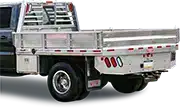









You’ve got a plow on the truck, a skid loader in the yard, and a blower or two that need to move from job to job without becoming a maintenance problem. The trailer behind your operation is either protecting your winter revenue or quietly consuming it through corrosion, electrical failures, tire trouble, brake repairs, and lost time. Road salt, brine, packed snow, moisture, repeated freeze-thaw cycles, and rapidly changing payloads make snow removal severe-duty trailer work.
This guide breaks down what holds up in winter service, what to look for in enclosed versus open configurations, and which trailer lines make practical sense when you’re running a commercial snow operation. The right choice starts with verified equipment weights, actual trailer payload capacity, the tow vehicle’s ratings, and how the load will be protected and secured.
Why Snow Removal Is Hard on Trailers
Salt is the main corrosion threat. Sodium chloride residue holds moisture against steel, electrical terminals, brake components, fasteners, and damaged coating. Calcium chloride is especially hygroscopic, meaning it readily attracts moisture from the air. Brine can migrate into seams, wiring connections, spring hangers, couplers, brake assemblies, and areas where coating has been chipped by gravel. Aluminum does not develop red rust like carbon steel, but chloride exposure can still cause pitting and galvanic corrosion around dissimilar metals.
Add the weight and the numbers rise quickly. A current Bobcat S76-2 skid-steer loader has an operating weight of about 8,014 lbs, while a Bobcat S450 is approximately 5,370 lbs. Loader-mounted snow blowers vary substantially by width and design, with Bobcat models ranging from roughly 620 lbs to more than 1,450 lbs. Rock salt is commonly estimated at approximately 2,160 lbs per cubic yard, so 1.5 cubic yards can weigh about 3,240 lbs before adding the empty weight of a hopper, attachment, pallet, container, or other equipment.
That means a loader, snow attachment, tools, fuel cans, chains, and contained deicing material can create 11,000 to 14,000 lbs of cargo surprisingly quickly. A spreader should not automatically be transported while loaded; follow the spreader manufacturer’s instructions and account separately for the spreader’s empty weight and the actual material inside it.
The trailer has to carry the load without exceeding its GVWR, axle ratings, tire capacities, coupler rating, or payload capacity. It also has to resist corrosion, provide safe loading angles, maintain reliable brakes and lighting, and keep operating when a breakdown would interrupt an entire route.
Enclosed Trailers for Blowers and Salt
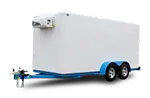
An enclosed cargo trailer is a strong choice for bagged ice melt, walk-behind blowers, push spreaders, hand tools, spare parts, and smaller power equipment. It keeps precipitation and direct road spray away from the cargo, provides lockable overnight storage, and gives crews a controlled place to organize equipment between stops.
Loose bulk salt should not be dumped directly into a conventional cargo trailer unless the trailer was specifically engineered for that use. Most enclosed trailers use either steel or aluminum framing with engineered-wood decking and interior wall panels. Salt can enter panel joints, retain moisture under mats, attack fasteners, and overload a floor if material is concentrated in one area. Bagged salt should remain sealed and be carried on plastic or otherwise moisture-resistant pallets, in rated bins, or inside removable containment that spreads the load across the floor.
A removable polyethylene liner can protect the floor, but it should not trap brine underneath. Remove it periodically, inspect the floor, clean spilled material immediately, and dry the trailer before storage. Rubber mats can improve grip but also conceal moisture, damaged bags, and floor deterioration. Always verify the trailer’s payload, floor rating, tiedown capacity, axle ratings, and rear-door rating before loading commercial equipment.
For a single crew handling several commercial accounts, a 7×16 or 7×18 tandem-axle enclosed trailer is often a practical starting point. A current Wells Cargo Road Force 7×16 is commonly configured at 7,000 lbs GVWR with two 3,500-lb axles, rather than automatically carrying a 9,990-lb rating. A 6’6″ interior height is common in the Road Force range, while taller builds may be ordered or stocked. Confirm the exact GVWR, empty weight, interior height, brake arrangement, payload, and option list from the trailer’s VIN plate and build sheet because specifications vary by configuration.
A full pallet of bagged deicer can consume a large portion of an enclosed trailer’s payload before blowers, shelving, spare parts, and hand tools are added. Distribute the weight so that the trailer maintains proper tongue weight and does not overload one axle, one side, or a small section of floor. Shelving and storage cabinets must also be included in the empty or installed-equipment weight.
If you need more width for a compact machine, wide attachment, or larger mobile workshop, consider a properly configured Legend aluminum enclosed trailer. The Legend Trailmaster Race Series is available in an 8.5×24 size and in GVWR configurations ranging from 7,000 to 14,000 lbs. Current specifications list a 78-inch interior height, an 89-inch-wide rear-door opening, and bonded .040-inch aluminum exterior skin. Its all-aluminum construction eliminates most carbon-steel frame rust, but the trailer still needs regular washing and inspection for chloride pitting, fastener corrosion, and galvanic reaction around steel components. Verify the ramp-door capacity before attempting to load a tractor, loader, or other concentrated equipment load.
Open Trailers for Skid Loaders and Plows
For a skid steer, compact track loader, tractor, pusher, or loader-mounted plow, an open equipment trailer is usually the practical working choice. It avoids enclosed-trailer door and roof restrictions, makes inspection and securement easier, and can provide a lower deck height and better loading angle.
The non-negotiables for winter use include enough verified payload for the machine and attachment, protected wiring, correctly rated tiedown points, brakes on the required wheels, a functioning breakaway system, suitable tires and wheels, and a deck that provides usable traction. Axle service should follow the actual axle manufacturer’s schedule rather than an arbitrary weekly grease routine. Lippert’s current maintenance guidance generally calls for bearing inspection or lubrication at the specified annual or mileage interval, with more frequent attention under heavy-load, high-mileage, or water-exposure conditions. Overgreasing can damage seals and contaminate brakes.
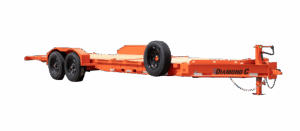
Diamond C’s HDT is the Low Profile Hydraulically Dampened Tilt Trailer, with current GVWR packages from 15,500 to 24,000 lbs and available lengths from 16 to 28 feet. The standard 207 package uses two 7,000-lb Lippert axles. Higher-capacity configurations include 8,000-lb, 10,000-lb, and triple-axle packages, with equipment varying by package. Diamond C’s premium trailer lines use Lippert axles as standard equipment.
The standard HDT uses a gravity-fed, hydraulically dampened tilt system: unlatch the deck, allow it to tilt, load the machine, and return the deck to transport position. It is not automatically a full-power hydraulic tilt. Diamond C’s optional Pro Tilt system allows the operator to switch between gravity and powered tilt, which can be useful for off-balance loads, multiple machines, or locations where snow and ice make deck control more difficult. Full-bed tilt is available on certain 16- to 20-foot configurations, while longer trailers may use a stationary front deck with a tilting rear section.
For crews that prefer ramps, the Diamond C LPX is the Low Profile Extreme Duty Equipment Trailer. It is offered from 15,500 to 24,000 lbs GVWR in lengths from 16 to 30 feet. The 207 package includes two 7,000-lb Lippert axles and 14-ply all-steel radial tires. MAX Ramps are available on qualifying 18-foot-and-longer LPX builds, and higher-GVWR packages can be configured with upgraded axles, tires, brakes, frames, and suspension.
An 18-foot LPX 207 package can be a practical match for a Bobcat S450, current S76-2, or similarly sized loader when the trailer’s actual empty weight leaves sufficient payload for the machine, bucket or blower, chains, tools, and any installed options. Do not assume that a 15,500-lb GVWR means 15,500 lbs of cargo capacity. Subtract the trailer’s actual empty weight and then verify that the axles, tires, wheels, coupler, hitch, and tow vehicle support the planned load.
H&H’s current Industrial Equipment Trailer line is another winter-capable option. These trailers are available in 14,000- and 16,000-lb GVWR configurations, depending on length and axle package. Standard features include pressure-treated pine decking, slipper-spring suspension, an industrial-grade polymer finish, and a fully sealed wiring harness. Current 14K models use two 7,000-lb axles, while 16K configurations use two 8,000-lb axles. Confirm the exact curb weight because payload changes with length, ramps, full-width packages, toolboxes, winches, and other options.
Securement is just as important as trailer capacity. Under federal cargo-securement rules applicable to commercial motor vehicles, wheeled or tracked equipment weighing 10,000 lbs or more must be restrained against forward, rearward, lateral, and vertical movement with a minimum of four tiedowns attached near the front and rear or to manufacturer-approved mounting points. Lighter equipment must still comply with the applicable general securement requirements and may also be secured using the heavy-equipment method. Buckets, blades, blowers, booms, and other accessories must be lowered, restrained, or secured as required so they cannot move during transport.
What GVWR Do You Actually Need?
| Equipment | Approx. Cargo Weight | Recommended Trailer GVWR |
|---|---|---|
| Walk-behind blowers, push spreader, tools, and bagged product | 500-1,500 lbs | 7,000 lb enclosed for commercial use and growth capacity |
| One pallet of bagged deicer plus walk-behind equipment | 2,500-4,000 lbs | 7,000-9,990 lb enclosed, subject to actual trailer payload |
| Compact skid steer such as a Bobcat S450 with attachment | 6,000-7,000 lbs | 10,000-12,000 lb open, if verified payload is sufficient |
| Current Bobcat S76-2 with bucket, blade, or blower | 8,600-9,500 lbs | 15,500 lb-class open equipment or tilt trailer |
| Kubota SVL75-3 with winter attachment | 8,700-10,100 lbs | 15,500 lb or higher open equipment trailer |
| Loader, heavy attachment, tools, and contained deicer | 11,000-14,000 lbs | 18,000-24,000 lb equipment trailer, depending on trailer tare |
The figures above are planning ranges, not substitutes for scale tickets or manufacturer specifications. The current Kubota SVL75-3 is listed at approximately 8,135 lbs with an open cab and 8,631 lbs with a closed cab before adding a bucket, blower, counterweight, tracks packed with snow, tools, or other cargo. Equipment options can change operating weight significantly.
GVWR is the maximum permitted weight of the loaded trailer, including the trailer itself. Payload capacity is calculated by subtracting the trailer’s actual empty weight from GVWR, but the usable limit can be lower if an axle, tire, wheel, coupler, jack, hitch, or tow-vehicle rating is reached first. Installed winches, toolboxes, spare tires, hydraulic systems, upgraded flooring, ramps, and permanent storage all reduce remaining payload.
Build in a working margin rather than planning to operate at the maximum on every route. Snow and ice stuck to a machine, chains, fuel, spare parts, and last-minute bags of salt add weight. A larger trailer may provide more margin, but it also increases empty weight, tongue weight, purchase cost, and tow-vehicle requirements. The correct choice is the combination that safely carries the real load without exceeding any component rating.
Winter Durability: What to Check Before You Buy
Not all coatings, wiring systems, floors, and brake packages perform the same way around salt. Look beyond a general claim that a trailer is painted, coated, aluminum, or heavy duty. Ask how the surface is prepared, how wiring connections are protected, what components are serviceable, and which specifications apply to the exact VIN you are buying.
- Frame coating. Surface preparation and primer matter as much as the visible topcoat. Diamond C’s DM Difference Maker system uses steel-shot blasting, a five-stage wash with reverse-osmosis water, forced drying, a zinc-rich epoxy primer, and a powder topcoat. A properly applied multi-stage system offers substantially better protection than a simple one-step paint finish, but chips should still be repaired before salt reaches bare steel. Hot-dip galvanizing provides sacrificial corrosion protection, while aluminum avoids red rust; neither eliminates the need for cleaning and inspection.
- Wiring. Look for a sealed harness, protected junction box, grommets where wiring passes through steel, weather-resistant connectors, secure grounds, and routing that keeps the harness away from moving suspension and sharp edges. Exposed crimp connectors, household-style wire nuts, unsupported wiring, and quick-splice taps are poor choices for repeated salt and water exposure.
- Decking material. Aluminum is corrosion-resistant and easy to wash, but a smooth or treadplate aluminum deck can become extremely slick under snow and ice. Pressure-treated pine is replaceable and often provides better equipment traction, although it must be inspected for splitting, trapped salt, loose fasteners, and decay. Blackwood and other upgraded lumber products may improve grip and durability. Choose the floor for the machine, loading method, and maintenance routine rather than assuming one material is always best.
- Fenders and light mounts. Inspect weld edges, bolt holes, steps, stake pockets, marker-light brackets, and areas where gravel strikes the coating. Bolt-on fenders can be easier to repair after contact with a loader or snowbank. Stainless or appropriately coated fasteners help, but dissimilar-metal contact should be monitored on aluminum trailers.
- Brake type. Electric drum brakes are standard on many equipment and enclosed trailers and work well when properly adjusted and paired with a compatible proportional brake controller. Electric-over-hydraulic disc brakes can provide stronger, smoother braking on appropriately equipped high-capacity trailers, but they require a compatible controller, hydraulic actuator, maintained fluid system, and charged breakaway battery. Cold-weather reliability depends more on maintenance, adjustment, corrosion control, wiring, grounds, battery condition, and controller compatibility than on a blanket claim that one actuation type always performs better in freezing weather.
- Wash and inspection access. A winter-work trailer should be easy to rinse underneath. Wash salt from the frame, axles, suspension, brakes, coupler, jack, wheels, fenders, ramps, and wiring after storms whenever temperatures permit. Do not aim high-pressure water directly into bearings, seals, electrical connectors, or brake assemblies. Inspect coating damage, brake wiring, breakaway operation, tire pressure, lug torque, and securement hardware throughout the season.
A Practical Setup for a Mid-Size Snow Crew
Running three to five commercial accounts with a skid steer or compact track loader, two walk-behind blowers, tools, and bagged deicer? A two-trailer setup usually works better than forcing heavy equipment, corrosive product, and small tools into one trailer. It also allows one crew to continue sidewalk and deicing work while the loader is operating elsewhere.
Trailer one: a Diamond C LPX 18′ 207 package with a 15,500 lb GVWR for the loader and winter attachment. It uses two 7,000-lb Lippert axles and can be configured with MAX Ramps on qualifying builds. If ramp-free loading is a priority, compare it with an HDT in the appropriate length and GVWR package, remembering that the standard HDT is hydraulically dampened gravity tilt and Pro Tilt is an optional powered system. Verify the actual payload against the loader’s serial-number-specific operating weight and every attachment that will travel on the deck.
Trailer two: a Wells Cargo 7×16 tandem-axle enclosed trailer, or a comparable commercial enclosed model, for walk-behind blowers, tools, spare parts, and sealed bagged deicer. A 7,000-lb configuration may be sufficient for many crews, but a higher-capacity build may be appropriate when carrying full pallets, shelving, generators, or multiple machines. The GVWR shown on the VIN plate, not a model name or online advertisement, controls the calculation.
Do not rely on a fixed combined-price estimate for this setup. Current manufacturer MSRPs, dealer selling prices, freight, ramps, flooring, spare tires, winches, brake upgrades, height options, shelving, taxes, title fees, and delivery can move the total by many thousands of dollars. Get itemized quotes for the exact trailer configurations and compare payload, not simply purchase price.
Single-trailer operators can use a 16- or 18-foot open equipment trailer with a lockable toolbox and weatherproof containers for limited bagged product. Keep salt separated from chains, straps, electrical tools, and exposed steel. Do not carry loose bulk salt on an open flatbed under an ordinary tarp, and do not place containers where they prevent proper machine securement or create excessive rearward weight.
Quick Q&A
Can I store bagged salt in an enclosed trailer all winter? It can be done when the trailer has enough payload, the bags remain sealed, the floor is protected, and moisture is actively managed. Keep product on plastic or moisture-resistant pallets, repair or remove torn bags immediately, and clean all spilled material. Ventilation alone is not a complete solution because humid outdoor air may add moisture. Follow the product manufacturer’s storage instructions and inspect beneath pallets and mats throughout the season.
What tire rating do I need for winter? Do not select trailer tires by load-range letter alone. The combined load capacity of the tires at the specified cold inflation pressure must support the applicable axle rating, and the wheels and valve stems must also be rated for the pressure and load. Many 14,000-lb trailers use Load Range E tires, but higher-GVWR equipment trailers frequently use Load Range G or higher all-steel radials. Diamond C’s current LPX and HDT base packages specify 14-ply-rated all-steel radial tires. A ply rating is a load-strength designation, not necessarily the actual number of fabric plies in the tire. Check pressure when the tires are cold and never reduce pressure simply to soften the ride.
Do I need brakes on a trailer for snow removal use? Indiana Code 9-19-3-3 requires a trailer or semitrailer with a gross weight of at least 3,000 lbs, when operated on a highway, to have brakes adequate to control, stop, and hold the trailer. The driver must be able to apply the brakes from the tow vehicle’s cab, and the brakes must apply automatically if the trailer accidentally breaks away. In practical buying terms, a trailer rated above 3,000 lbs should be purchased with a compliant brake and breakaway system and maintained accordingly.
Does a trailer over 10,000 lbs automatically require a CDL? No. For the usual Class A threshold, the combination must have a GCWR or qualifying gross combination weight of 26,001 lbs or more and include a towed unit with a GVWR or qualifying gross weight of more than 10,000 lbs. A trailer’s rating by itself does not trigger a Class A CDL when the entire combination remains below 26,001 lbs, although commercial operations may be subject to other state or federal motor-carrier rules at lower weight thresholds. Verify the truck’s GVWR, trailer’s GVWR, manufacturer’s GCWR, actual weights, operating area, and business use before dispatching the combination.
How soon should an Indiana buyer complete the paperwork? Indiana buyers should submit the title application promptly. The Indiana BMV states that an administrative penalty applies when the certificate-of-title application is made more than 45 days after purchase. A temporary permit has its own validity period and should not be confused with the title-application deadline.
What We Carry for Snow Work
At Spencer Trailers, we carry and sell trailers from Diamond C, H&H, Wells Cargo, Liberty, Legend, and other manufacturers suited to commercial equipment and enclosed-cargo work, with exact inventory changing throughout the year. Diamond C has built trailers in Mt. Pleasant, Texas, since 1985, and its current premium equipment lines use Lippert axles as standard. We can help match the trailer to the actual machine, attachment, cargo, tow vehicle, and route rather than selling solely from a model name or advertised GVWR.
Come out to browse current inventory, or call us at (812) 829-0226 to talk through your setup before the next season hits. Inventory specifications and pricing can change, so confirm the VIN plate, build sheet, empty weight, axle package, tire ratings, brake equipment, ramp or tilt system, and payload before purchase.
If you’re not sure what you need, bring the equipment make and model, attachment specifications, planned salt quantity, tow-vehicle door-sticker ratings, receiver or gooseneck rating, and your typical load list. We’ll work backward from the real weights and identify the trailer that carries the load without leaving you undersized or exceeding the truck’s limits. You can also check our recently sold trailers to see the equipment, enclosed, utility, and tilt configurations other commercial buyers have selected.


