


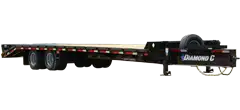
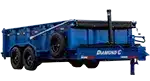

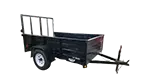

You’ve got the mower, a truck, and a handful of clients lined up. The one thing standing between you and your first paid day on the road is a trailer. Get this decision wrong and you may outgrow the trailer in one season, overload a light-duty axle, or tow more trailer than your half-ton pickup is properly configured to handle. The right choice starts with the actual weight and overall dimensions of every mower, attachment, fuel can, rack, blower, trimmer, and tool you plan to carry.
Here’s the honest breakdown: most lawn care startups need a roughly 6×12 or 7×14 open utility trailer. In current utility-trailer sizing, that may mean an actual bed width of 76, 77, 78, 82, or 83 inches rather than an exact 72 or 84 inches. For a new operator, an open deck, a properly rated ramp gate, secure tie-down points, and enough usable payload are usually more valuable than an enclosed body or an oversized equipment trailer.
Why Open Utility Over Enclosed for a Startup
Enclosed trailers look professional, provide a large surface for business graphics, and make it easier to secure tools overnight. They also cost more, weigh more before any equipment is loaded, create more aerodynamic drag, and can reduce the payload available for mowers and accessories. Heat can build inside an enclosed trailer during an Indiana summer, so ventilation and safe fuel-storage practices also need to be considered.
Open utility trailers are easier to inspect while loading, allow quick access from the sides, and generally give a startup more usable payload for the purchase price. A current H&H Rail Side Utility Trailer in a 76×12 configuration, for example, has a 2,990 lb GVWR, a 3,500 lb axle rating, and a published curb weight of approximately 1,050 lbs. The 82×12 version carries the same 2,990 lb GVWR and has a published curb weight of approximately 1,110 lbs. That leaves roughly 1,940 lbs or 1,880 lbs of theoretical payload before optional equipment is added. Whether that is enough depends on the actual mower and accessory weights, not simply the number of machines on the deck.
When your business grows and you want permanent exterior branding, enclosed storage, built-in shelving, or better overnight security, you can move to an enclosed trailer. Until the revenue and workload justify that upgrade, an open utility trailer keeps the initial investment, empty weight, and maintenance requirements more manageable. Lockable trimmer racks, blower holders, fuel-can racks, tongue boxes, and removable signs can still make an open trailer organized and professional.
The 6×12: Right Size for One-Crew Solo Ops
A nominal 6×12 trailer gives you approximately 12 feet of deck length, but the actual width varies by manufacturer. Current steel utility models commonly measure 76, 77, or 78 inches wide, while wider versions may measure 82 or 83 inches. That difference matters. A mower advertised with a 52-inch cutting deck can be several inches wider at the tires, frame, anti-scalp wheels, or discharge chute. A 12-foot deck generally works best for one zero-turn or stand-on mower, a push mower, and handheld equipment rather than two large commercial machines.
The H&H 82×14 Rail Side Utility Trailer is a useful example of why buyers need to read the certification label rather than shop by dimensions alone. The single-axle version has a 2,990 lb GVWR, one 3,500 lb-rated axle, and a published curb weight of approximately 1,210 lbs, leaving about 1,780 lbs of theoretical payload before options. H&H also offers an 82×14 tandem-axle configuration with a 7,000 lb GVWR, two 3,500 lb-rated axles, and a published curb weight of approximately 1,610 lbs. Both configurations use treated wood flooring and a full-width, spring-assisted fold-flat rear ramp gate, but their legal carrying capacities are very different.
What to Look for in a Ramp Gate
A correctly designed full-width gate makes loading a mower a one-person job. A bi-fold gate can also be full width; the term means the gate folds across its height to reduce wind resistance and lifting effort, not that it creates a narrow opening. Separate loading ramps are useful for some equipment trailers, but a landscape crew normally benefits from a continuous surface that supports both mower tires throughout the loading process. Look for:
- A clear gate opening wider than the mower’s widest fixed point, including tires, deck hardware, and any chute that cannot be folded
- Expanded metal, traction mesh, or formed steel surfaces that provide tire grip without leaving openings large enough to catch small caster wheels
- A published gate or ramp capacity that safely exceeds the weight of the mower, including concentrated loads at the rear tires and caster wheels
- Spring assistance, gas-spring assistance, secure transport latches, and stabilizing provisions that allow the gate to be raised and lowered under control
The current H&H Rail Side Utility Trailer uses a full-width, spring-assisted gate that can fold flat into the bed. The Diamond C GTU uses an EZ Bi-Fold Gate with gas-spring assistance, an automatic latch when unfolded, and a folded position designed to improve rearward visibility and reduce wind drag. For a trailer that will be opened and closed at multiple properties every day, an assisted gate and dependable latch system are working equipment, not cosmetic upgrades.
The 7×14: Two-Crew or Two-Mower Setups
Moving from a 76- or 78-inch-wide 12-foot trailer to an 82- or 83-inch-wide 14-foot trailer adds roughly four to seven inches of usable width and two feet of deck length. That extra space can be more valuable than it sounds. It gives you more flexibility to position a zero-turn mower, walk-behind, aerator, spreader, and front-mounted racks while maintaining proper tongue weight. Two commercial mowers will often need to be loaded nose-to-tail or in a carefully measured staggered arrangement rather than simply placed side by side.
A Diamond C GTU tandem-axle utility trailer in an 83×14 configuration is the correct Diamond C model for this class. The GTU has a 7,000 lb GVWR, two 3,500 lb Lippert electric-brake axles, a 4-inch channel frame, engineered channel crossmembers, a 24-inch Laser Grip dovetail, 2-inch treated lumber flooring, integrated tie-downs, and an EZ Bi-Fold Gate. A 2-inch adjustable Demco EZ-Latch coupler is the standard current configuration, with a 2 5/16-inch coupler available depending on the build. The GTU is offered in 14-, 16-, 18-, and 20-foot lengths, all with an 83-inch bed width.
Current pricing is substantially higher than older entry-level estimates found in many online articles. Diamond C lists a base MSRP of approximately $6,791 for the GTU before dealer-specific pricing, freight, taxes, registration, accessories, color upgrades, spare tires, mesh sides, or other options. Final pricing can vary, so compare the exact stock unit or custom build rather than relying on a generic 7×14 price. The additional capacity of a tandem trailer becomes useful when the business adds a ride-on spreader, aerator, heavier stand-on mower, compact utility attachment, or landscaping equipment, but every machine must still be compatible with the gate rating, deck construction, payload capacity, and tow vehicle.
Mower Fit: Know Your Deck Width Before You Buy
This is where buyers get burned. The advertised cutting width is not the mower’s transportation width. A 52-inch mower may be wider at the rear tires or discharge chute, while the wheel wells, side rails, gate latches, toolbox, and front rack can reduce the usable trailer space. Measure the mower at its widest fixed point with the chute in the transport position. Also record its overall length, operating weight, attachment weight, and the position of its heaviest axle.
Here’s a practical starting point for common commercial mower sizes. These are planning guidelines, not guaranteed fit dimensions:
| Mower Deck Width | Recommended Usable Trailer Width | Notes |
|---|---|---|
| 36 inch walk-behind | 72-76 inches minimum | Usually easy to load individually; two machines require measurement of their true overall widths and handle positions |
| 48 inch zero-turn | 76-78 inches minimum; 82-83 preferred | Check the discharge chute, tire width, side-rail clearance, and gate-latch opening |
| 52 inch zero-turn | 78 inches minimum; 82-83 preferred | A wider trailer gives more room for tie-down access and reduces contact with rails or fenders |
| 60 inch zero-turn | 82-83 inches preferred | Measure the mower’s true transport width; a 12-foot trailer may not leave enough length for a second commercial mower |
| 72 inch commercial mower | Verify an 83-inch clear deck or consider a wider equipment-style deck | Many 72-inch machines are too wide once tires and chute hardware are included; confirm every clearance before purchase |
Many startup operators use a 48- or 52-inch zero-turn plus a 32- or 36-inch walk-behind. That combination may fit on a 12-foot trailer, but it is not automatic. Machine length, rack placement, gate clearance, payload, and tongue-weight balance all matter. A 14-foot tandem trailer usually offers a better growth margin, especially when fuel, blowers, trimmers, spare blades, spreaders, and cleanup tools are carried on the same unit.
Brands Worth Buying New vs. Skipping
Not all utility trailers with the same listed dimensions have the same usable payload, frame design, ramp rating, electrical protection, finish quality, or warranty. Compare the certification label, GVWR, GAWR, actual empty weight, frame and crossmember construction, axle and brake configuration, coupler rating, floor material, tie-down locations, tire load range, wiring protection, and gate capacity.
H&H Trailers builds current Rail Side Utility Trailers in widths from 60 to 82 inches and lengths from 8 to 24 feet, with GVWR choices from 2,990 to 7,000 lbs. Standard features include treated wood flooring, LED lighting, a sealed wiring harness, tie-down points, easy-lube hubs, a set-back tongue jack, and a full-width spring-assisted fold-flat gate. For lawn care, the 76×12, 82×12, and 82×14 configurations are worth comparing, but the single-axle and tandem versions should never be treated as interchangeable simply because their deck dimensions match.
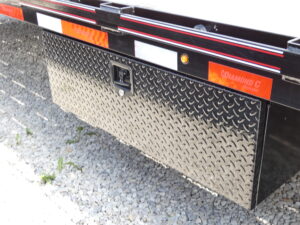
Diamond C offers the PSA for single-axle utility work and the GTU for the 7,000 lb tandem-axle class. The current GTU uses Lippert brake axles, a 4-inch channel frame, treated lumber flooring, integrated tie-downs, a lockable tongue box, and the DM Difference Maker multi-stage coating system. Diamond C has built trailers in Mt. Pleasant, Texas, since 1985. For a lawn care company carrying mowers and everyday property-maintenance equipment, the PSA and GTU are the relevant utility models. The LPX belongs to a much heavier 15,500- to 24,000-lb GVWR equipment-trailer class and becomes relevant only when the business has moved into compact construction equipment and has an appropriately rated tow vehicle.
Liberty Trailers also offers straightforward utility configurations for startup budgets. A current Liberty LU 78×12 single-axle unit, for example, is listed with a 2,990 lb GVWR, one 3,500 lb axle, a 4-inch channel steel frame, treated wood decking, a 48-inch rear gate, tie-down pockets, radial tires, and LED lights. As with any 2,990 lb trailer, calculate the actual payload remaining after the trailer, spare tire, racks, toolbox, and other installed equipment are weighed.
What to avoid: trailers without a readable VIN and federal certification label, a transferable title where required, documented GVWR and GAWR ratings, properly rated tires, or verifiable axle and coupler information. Also be cautious with repaired frames, bent tongues, badly corroded crossmembers, mismatched wheels, homemade ramp extensions, and altered safety chains. A low purchase price does not compensate for a trailer that cannot be registered, safely loaded, insured, or matched to the tow vehicle.
The Upgrade Path: Plan It Now
Here’s a realistic business growth sequence for most lawn care operators. The timing depends on revenue, route density, equipment size, and crew count rather than a fixed calendar:
- Startup and solo operation: A 76- to 83-inch-wide, 12- to 14-foot open utility trailer. A lighter single-axle model can work for one mower and limited gear if the payload calculation supports it. A tandem 7,000 lb model is the better starting point for two machines or near-term growth. A realistic planning range is roughly $3,000 to $7,000-plus, depending on brand, axle configuration, gate, spare tire, racks, freight, and dealer-installed options.
- Growing route or second operator: Add another tandem utility trailer or move to an 82- or 83-inch-wide 16- to 18-foot model with commercial trimmer racks, blower storage, secure fuel-can holders, a tongue box, spare tire, and properly positioned tie-downs. Plan on approximately $4,500 to $8,000-plus for an open trailer and accessories, with premium configurations potentially costing more.
- Multiple crews or expanded landscaping: Consider a 7×16 or 8.5×20 enclosed cargo trailer when secure tool storage, interior shelving, weather protection, and exterior branding justify the additional weight and cost. Current tandem enclosed units commonly begin around the upper-$7,000 to $8,000 range and can exceed $15,000 with heavier construction, extra height, finished interiors, electrical packages, or premium materials.
The mistake is buying an enclosed trailer only for appearance before the business has the revenue, tow vehicle, and operational need to support it. The other mistake is choosing a 2,990 lb single-axle trailer without adding the weight of the trailer itself, the mower, fuel, racks, tools, spare tire, and accessories. A properly configured 7,000 lb tandem trailer in the first year costs more, but it can prevent an early replacement when a second mower or heavier service equipment is added.
Quick Answers: Startup Trailer FAQ
Do I need brakes on a 6×12? Indiana law uses the trailer’s rating, not an estimate of what it happens to weigh on a particular day. Under IC 9-19-3-3, a trailer with a GVWR over 3,000 lbs must be equipped with brakes. Many entry single-axle utility trailers are rated at 2,990 lbs even though they use a 3,500 lb axle. A 2,990 lb model is below that statutory threshold, but an available electric-brake package can still improve control when properly installed and used with a compatible in-cab brake controller. A 7,000 lb tandem trailer requires brakes, and the Diamond C GTU is equipped with two 3,500 lb Lippert electric-brake axles.
What ball size does my truck need? Utility trailers in this category commonly use either a 2-inch or 2 5/16-inch coupler. Do not choose the ball by trailer length or appearance. Read the size and rating stamped on the coupler, use the matching ball diameter, and make sure the ball, mount, receiver, pin, safety chains, and tow vehicle are all rated for the loaded trailer. The current Diamond C GTU can be configured with a 2-inch adjustable Demco EZ-Latch coupler or an available 2 5/16-inch version, so two trailers of the same model may not use the same ball.
Can a half-ton truck pull a loaded 7×14? Many properly equipped half-ton pickups can tow a 7,000 lb GVWR utility trailer, but the answer depends on the exact truck configuration. Check the truck’s door-jamb payload label, receiver rating, maximum trailer rating, GCWR, axle ratings, tire ratings, brake-controller requirements, and the weight of passengers and cargo in the truck. Use the trailer’s actual scale weight and maintain the tongue-weight range specified by the truck and trailer manufacturers. A 7,000 lb trailer does not by itself trigger a Class A CDL. That threshold generally requires a combination GCWR of at least 26,001 lbs and a towed unit with a GVWR over 10,000 lbs, although other commercial-carrier rules can apply separately.
Should I buy new or used for year one? New gives you a known configuration, manufacturer documentation, and warranty coverage, but it still must be matched to your equipment and truck. A used trailer can be a good business purchase when the VIN, title, certification label, GVWR, axle ratings, and maintenance history are verified. Inspect the frame, tongue, welds, coupler, safety chains, suspension, bearings, tires, brakes, breakaway system, wiring, lights, deck, gate hinges, latches, and ramp structure. Indiana residents generally have 45 days after acquiring an unregistered vehicle or trailer to complete the required title and registration process without the applicable late administrative penalties.
Ready to Pick Your Trailer
The best starter trailer for a lawn care business is the open utility that fits the mower’s measured transport dimensions, carries the full equipment list without exceeding GVWR, provides a properly rated loading gate and tie-down system, and stays within every towing limit of the truck. A lighter 76- to 78-inch-wide 12-foot single-axle trailer can serve a solo operator with one appropriately sized mower. For a second mower, heavier commercial equipment, or planned growth, an 82- or 83-inch-wide 14-foot tandem trailer is usually the stronger long-term choice. Compare an H&H Rail Side tandem configuration with the Diamond C GTU and evaluate the exact payload, gate, coupler, brake, and accessory specifications of the unit in front of you.
Browse current inventory at Spencer Trailers’ full inventory or check out recently sold trailers to get a feel for real pricing in this market. If you want to talk through your specific mower setup and crew size before buying, reach out to the team directly. Call (812) 829-0226 or stop by 291 West State Hwy 46 in Spencer, IN. Bring the manufacturer weights and overall dimensions for every mower you plan to haul, along with the tow vehicle’s ratings, and leave with a trailer that actually fits your business.