








Palletized hardscape material does not care about your schedule. A bundle of 60 mm concrete pavers often weighs around 2,000 lbs, while pallets of flagstone, bluestone, granite, and other natural stone can range from under 2,000 lbs to well over 3,000 lbs depending on thickness, coverage, moisture, and how the supplier packages the material. Put three pallets on a trailer with an 8,000- to 10,000-lb compact track loader, bucket, forks, compactor, and jobsite tools, and the cargo alone can reach 14,000 to 18,000 lbs before the empty trailer is counted.
The wrong trailer does more than slow the crew down. Overloading can exceed the trailer’s GVWR, axle ratings, tire or wheel capacities, coupler rating, hitch rating, or the tow vehicle’s limits. It can also create poor tongue or pin weight, unstable handling, premature frame and suspension wear, overheated brakes, tire failures, and an out-of-service roadside inspection. So here is the honest answer to what hardscape contractors should be pulling.
Why Hardscape Loads Are Harder Than They Look
General contractors often underestimate the density of hardscape material because a pallet does not occupy much floor space. Many 2-3/8-inch concrete pavers weigh roughly 27 to 30 lbs per square foot, but pallet coverage varies considerably by manufacturer, shape, and pattern. One pallet may weigh 1,500 lbs, while another may exceed 2,000 lbs. Natural stone is even less predictable because thickness, stone type, irregular shapes, moisture, and crate construction all change the final weight. The pallet tag, supplier ticket, or certified scale weight should always take priority over a rule-of-thumb estimate.
Equipment changes the calculation just as quickly. A small skid-steer loader may weigh around 3,000 lbs, but current compact track loaders used by larger hardscape crews are much heavier. A Bobcat T66-2 has an operating weight of approximately 8,560 lbs, while a T76-2 is approximately 9,592 lbs. A heavier bucket, pallet forks, hydraulic attachment, breaker, or grading attachment can add hundreds or even thousands of pounds. You also have to count fuel cans, compaction equipment, hand tools, straps, chains, spare tires, and anything carried in the trailer’s storage areas.
That is why a 7,000 lb GVWR dump trailer is rarely enough for commercial hardscape material. GVWR is the maximum allowable weight of the loaded trailer, not the amount of cargo it can carry. The trailer’s empty weight must be subtracted from its GVWR to estimate payload, and installed options can reduce that payload further. A 14,000 lb GVWR trailer may work for one machine or a moderate material load, but it is not automatically suitable for a compact track loader plus several pallets. Contractors combining equipment and material commonly need trailers in the 15,500- to 20,000-lb range, while larger consolidated loads may justify a 24,000- to 25,900-lb gooseneck. The correct minimum is determined by actual weights, not by the size of the job or the number printed in the trailer’s model name.
The Right Trailer Types for This Work
Heavy-Duty Equipment Trailers (Flatbed/Tilt)
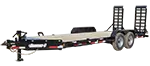
For moving a skid steer or compact track loader from site to site, a low-profile equipment trailer or tilt trailer is the workhorse of the trade. Diamond C’s LPX Low Profile Extreme Duty Equipment Trailer is available in lengths from 16 to 30 feet and in GVWR configurations from 15,500 to 24,000 lbs. The standard 207 Package uses two 7,000 lb LIPPERT axles and carries a 15,500 lb GVWR. Higher packages include an 18,000 lb configuration with two 8,000 lb oil-bath axles, a 20,000 lb configuration with two 10,000 lb oil-bath torsion axles, and a 24,000 lb triple-axle configuration with three 7,000 lb LIPPERT axles.
A 20-foot LPX can therefore be ordered at several different ratings. That distinction matters: “20-foot LPX” describes the deck length, not the GVWR or payload. Diamond C’s low-profile geometry helps reduce the loading approach compared with a tall deckover, while available MAX Ramps provide two 37-inch-wide spring-assisted loading surfaces. An available X-Ramp system works with the max-width configuration and drive-over fenders when a wider loading path is needed. Actual deck height, approach angle, ramp capacity, axle package, empty weight, and payload should be confirmed on the build sheet for the exact trailer.
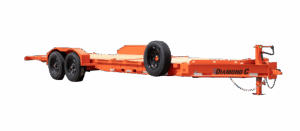
Contractors who load tracked equipment repeatedly may also consider the Diamond C HDT Hydraulically Dampened Tilt Trailer. The HDT is offered in 16- to 28-foot lengths with GVWR configurations from 15,500 to 24,000 lbs. It starts with two 7,000 lb LIPPERT axles and can be configured with heavier tandem or triple-axle packages. Its tilt deck eliminates the need to deploy conventional ramps, while hydraulic dampening controls the deck’s movement during loading and unloading. An available Pro Tilt system adds powered tilt capability on compatible configurations. The HDT can be especially useful when a crew loads and unloads several times a day, but deck balance, attachment clearance, breakover angle, and the machine manufacturer’s loading instructions still matter.
For heavier equipment, longer decks, or equipment combined with pallets, the Diamond C FMAX212 Flatbed Max Gooseneck is the correct step up. The FMAX212 carries a 25,900 lb GVWR and is available in lengths from 20 to 44 feet. It uses two 12,000 lb LIPPERT axles, a 102-inch-wide deck, a 16-inch low-profile Engineered Beam main frame, and a 12-inch curved engineered gooseneck. Depending on length and options, published empty weights range from approximately 6,250 to more than 12,000 lbs, so payload must be calculated from the exact completed trailer. The FMAX212 can provide substantially more usable capacity than a bumper-pull equipment trailer, but only when the truck, gooseneck hitch, tires, rear axle, and driver qualifications are also appropriate for the loaded combination.
Heavy Dump Trailers
When the job calls for delivering crusher run, decomposed granite, sand, soil, or demolition debris, a dump trailer turns unloading into a controlled hydraulic operation. The H&H Industrial Dump Trailer is available in 83-inch-wide beds from 12 to 16 feet and with 14,000 or 16,000 lb GVWR configurations. It uses a hydraulic scissor hoist, a 10-gauge one-piece steel floor, a combination barn-door and spreader gate, slipper-spring suspension, an integrated tarp system, and equipment-loading ramps.
The 83-by-16-foot, 14,000 lb GVWR bumper-pull model has a published curb weight of approximately 4,550 lbs, leaving about 9,450 lbs of theoretical payload before optional equipment or carried accessories are added. The corresponding 16,000 lb model has a published curb weight of approximately 4,700 lbs, producing about 11,300 lbs of theoretical payload. Crusher run commonly weighs around 2,400 to 2,700 lbs per cubic yard, with moisture and stone type affecting the total. That means the 14,000 lb model may reach its weight limit at roughly 3.5 to 4 cubic yards even if the body has room for more. Trailer body volume is not the same as legal payload, so aggregate should be purchased by verified tonnage and checked on a scale whenever possible.
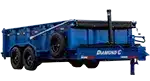
For contractors who need more capacity, Diamond C’s LPT Heavy Duty Telescopic Dump Trailer is offered in 12- to 16-foot lengths and heavy-duty GVWR configurations from approximately 15,500 to 24,000 lbs. It uses LIPPERT axles, beginning with tandem 7,000 lb axles and progressing to heavier tandem or triple-axle packages. A front-mounted telescopic hydraulic cylinder provides strong lifting leverage and a full 45-degree dump angle. The standard dump body is intended for commercial service, while a 7-gauge body upgrade is available for operations that regularly handle broken concrete, rock, and demolition debris.
The LPT can also be configured with loading ramps, tarp equipment, side extensions, higher-capacity tires, upgraded brakes, and different rear-gate arrangements. Those options make it possible to move a machine on one trip and aggregate on the next, but carrying equipment inside a dump body requires attention to ramp rating, floor loading, equipment clearance, tie-down locations, and the trailer’s reduced payload after options. The body may look large enough for the load while the trailer is already at its GVWR.
Deckover and Gooseneck Trailers
The real power move for a full-scale hardscape crew is a properly matched gooseneck. Diamond C’s FMAX Flatbed Max family covers single-wheel, tandem-dual, triple-axle, and higher-capacity configurations from approximately 15,500 to 40,000 lbs GVWR depending on the exact model. For many hardscape businesses, a 25- to 30-foot FMAX212 at 25,900 lbs GVWR provides enough deck area to position a compact track loader, pallet forks, a plate compactor, and palletized material while maintaining workable weight distribution.
That does not mean every machine-and-material combination will fit legally. Add the exact machine operating weight, every attachment, the pallet-ticket weights, tools, fuel, and trailer empty weight before loading. The gooseneck connection places pin weight over or near the truck’s rear axle, which generally improves stability and maneuverability compared with a similarly loaded bumper-pull. It also puts a substantial share of the trailer’s weight directly on the truck, so rear-axle rating, payload, tire capacity, bed-mounted hitch rating, and truck GVWR can become the limiting factors before maximum advertised tow capacity is reached.
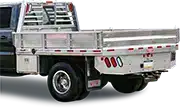
For contractors who need a full-width deck without installing a gooseneck hitch, the Liberty LOA16K Deckover Equipment Trailer is a bumper-pull option with a 17,500 lb GVWR, a 102-inch-wide deck, and several available lengths up to 25 feet. Straight-deck and dovetail loading arrangements are available depending on the build. Because the deck sits above the tires, pallets can be placed across the full width without working around fenders. That is useful for stone and paver loads, but a deckover normally has a higher loading surface than a low-profile equipment trailer. Ramp length, breakover angle, equipment width, deck height, and trailer payload should all be checked before deciding that a flush deck is the best fit.
Key Specs to Compare Before You Buy
| Trailer | GVWR | Deck Length | Best Use |
|---|---|---|---|
| Diamond C LPX | 15,500-24,000 lb | 16-30 ft | Low-profile compact track loader and skid-steer transport |
| Diamond C HDT | 15,500-24,000 lb | 16-28 ft | Frequent equipment loading with a hydraulically dampened tilt deck |
| H&H Industrial Dump | 14,000-16,000 lb | 12-16 ft | Base material, soil, debris, and occasional equipment hauling |
| Diamond C LPT | 15,500-24,000 lb | 12-16 ft | Heavy aggregate, demolition debris, and commercial dump work |
| Liberty LOA16K Deckover | 17,500 lb | Up to 25 ft | Full-width pallet placement and bumper-pull equipment hauling |
| Diamond C FMAX212 | 25,900 lb | 20-44 ft | Gooseneck equipment, attachments, and consolidated material loads |
What People Get Wrong When Spec’ing These Trailers
The most common mistake is buying on GVWR alone while ignoring actual payload. Payload is generally the trailer’s GVWR minus its completed empty weight, but the trailer must also remain within every axle, tire, wheel, coupler, jack, ramp, floor, hitch, and structural limitation. A 20,000 lb GVWR trailer that weighs 5,000 lbs empty does not have room for 20,000 lbs of cargo. Its theoretical payload starts around 15,000 lbs and can be reduced by spare tires, toolboxes, hydraulic accessories, heavier ramps, side extensions, and other options.
Hardscape loads also create concentrated pressure instead of evenly distributed weight. A pallet containing 2,500 lbs of stone occupies a relatively small area, and placing it too far forward can overload the truck, hitch, coupler, or trailer tongue. Placing it too far rearward can remove necessary tongue weight and create sway. Equipment should be positioned according to the trailer manufacturer’s loading guidance, and the finished combination should be checked on a certified scale. Ideally, weigh the truck by itself and then obtain steer-axle, drive-axle, trailer-axle, and total combination weights after loading.
Tire ratings matter, but tire size alone does not tell you capacity. Two tires carrying the same nominal size can have different load ranges, load indexes, maximum pressures, and speed ratings. Read the tire sidewall, wheel rating, trailer certification label, and axle tags. The sum of a trailer’s axle ratings may be lower than its GVWR because part of the loaded weight is intended to be carried by the tow vehicle through the tongue or gooseneck pin. That design does not permit an axle, tire, wheel, hitch, or truck rating to be exceeded.
Before every heavy haul, inspect inflation pressure when the tires are cold, tread condition, age, cracking, cuts, valve stems, wheel damage, and lug-nut torque. Underinflation, excess speed, heat, age, road damage, and overloading can all contribute to tire failure. A larger load-range letter is not permission to increase the trailer’s GVWR, and installing higher-capacity tires does not upgrade the axles, wheels, frame, coupler, or certification rating.
A Quick Note on Truck Compatibility
Pulling a trailer in this class means the truck must be selected by its exact configuration, not by the badge on the fender. For 2026, the Ram 2500 advertises maximum towing of up to 20,000 lbs in a properly configured diesel model, while certain GMC Sierra 2500HD configurations advertise maximum towing of up to 22,390 lbs. Those are best-case ratings. Engine, cab, bed length, drivetrain, axle ratio, wheels, trim, installed options, passengers, bed cargo, hitch equipment, and accessories can reduce the rating of an individual truck substantially.
A loaded 25,900 lb GVWR FMAX212 will generally require an appropriately configured one-ton truck, often a dual-rear-wheel model when high pin weight and commercial-duty stability are considered. Even then, verify the truck’s VIN-specific tow rating, GCWR, GVWR, rear GAWR, payload label, tire capacities, and gooseneck hitch rating. A truck can remain below its maximum trailer rating and still exceed its payload or rear-axle rating because the gooseneck pin transfers weight into the bed.
The trailer rating and the truck rating are separate limits, and the lower applicable limit controls. Do not use empty trailer weight when checking towing capacity. Use the trailer’s actual loaded weight, including equipment, pallets, attachments, chains, tools, and any material left in the body. The truck’s own weight must include the driver, passengers, fuel, toolboxes, fuel tanks, bed cargo, and hitch hardware.
Driver licensing must also be considered. A trailer with a GVWR above 10,000 lbs does not automatically require a CDL by itself. For a commercial combination, a Class A CDL generally applies when the combination’s GCWR or actual gross combination weight, whichever is greater, is 26,001 lbs or more and the towed unit’s GVWR or actual gross weight, whichever is greater, exceeds 10,000 lbs. Business use, interstate or intrastate operation, vehicle configuration, and any applicable exemptions can affect the final determination, so contractors should verify their specific operation with the Indiana BMV and FMCSA rather than relying on a trailer salesperson’s shorthand.
Electric Brakes vs. Hydraulic Brakes on Heavy Trailers
Electric drum brakes remain standard on many equipment and dump trailer configurations from approximately 14,000 through 24,000 lbs GVWR. They are controlled by an in-cab brake controller and can perform well when correctly adjusted, burnished, maintained, and matched to the load. Regular service should include the shoes, magnets, drums, wiring, grounds, connectors, bearings, seals, and breakaway system. A controller that is set too low will make the truck perform too much of the stopping work, while an aggressive setting can lock the trailer tires on loose gravel or wet pavement.
Diamond C offers electric-over-hydraulic disc brakes on compatible LPX, HDT, LPT, DEC, and other heavy-duty configurations. Electric-over-hydraulic systems still take their command from an in-cab controller, but an electric actuator generates hydraulic pressure at the trailer. Disc brakes can provide strong, consistent braking and improved performance during repeated stops, making them worth considering for frequent heavy hauling in the hills of Owen County and surrounding areas. They cost more initially, and the truck’s factory brake controller must be compatible with electric-over-hydraulic operation. If it is not, a compatible aftermarket controller may be required. Electric-drum ABS is also available on certain current Diamond C axle and brake configurations, but it should be verified for the exact package rather than assumed to be standard.
Indiana law requires a trailer or semitrailer with an actual gross weight of at least 3,000 lbs, when operated on a highway, to have brakes adequate to control, stop, and hold it. The brakes must be operable by the driver from the towing vehicle’s cab and must apply automatically if the trailer accidentally separates. Every high-GVWR trailer discussed here therefore needs functioning service brakes and a properly maintained breakaway system. Before towing, confirm that the breakaway battery is charged, the switch and cable are undamaged, the seven-way connection is secure, and all braked wheels are operating.
Buying New vs. Buying Used for This Work
Hardscape equipment and concentrated aggregate loads are demanding on trailers. A used 14,000 lb dump trailer that hauled gravel or demolition debris for several years may have a distorted floor, bowed sides, worn hinge pins, cracked welds, damaged crossmembers, tired suspension components, contaminated hydraulic fluid, a weak battery, or a cylinder that leaks only when the body is heavily loaded. A freshly painted trailer can still have serious structural or mechanical wear underneath.
Inspect a used dump trailer with the body both lowered and raised using the manufacturer’s safety support procedure. Cycle the hydraulic system several times, listen for pump strain, inspect the cylinder and hoses for leakage, and check the hoist mounting points. Examine the frame around the tongue or gooseneck, spring hangers, equalizers, axle seats, rear hinge, coupler, jack mounts, and crossmembers. Inspect brake wiring, breakaway equipment, drums or rotors, bearings, seals, tires, wheels, ramps, tie-downs, lights, tarp hardware, and charging system. Confirm that the VIN on the frame and certification label matches the title and that the label still shows readable GVWR and GAWR information.
New trailers provide known component history, current build specifications, and written manufacturer warranty coverage, although warranty periods, commercial-use terms, maintenance requirements, and exclusions vary. Diamond C has built trailers in Mt. Pleasant, Texas, since 1985. Its current premium FMAX, HDT, LPT, LPX, WDT, and DEC lines use LIPPERT axles as standard, with axle rating and suspension type determined by the selected package. Current Diamond C trailers also use the multi-stage DM Difference Maker coating system, which includes surface preparation, primer, and powder-coat finishing. Coating durability still depends on normal cleaning, chip repair, and protection from corrosive material.
A new trailer also lets the buyer select the correct axle package, brakes, tires, ramps, deck length, side height, tarp, hydraulic equipment, coupler, and tie-down layout before taking delivery. That is often more economical than buying an underspecified trailer and attempting to modify it later. Factory and dealer-installed options add weight, however, so ask for the completed trailer’s estimated or certified empty weight rather than calculating payload from a stripped base model.
Spencer Trailers carries Diamond C, H&H, and Liberty trailers in stock and can order configurations to match a contractor’s machine and material requirements. Browse what is available now at our current inventory, and check the recently sold page to see the deck lengths, GVWR packages, ramp systems, and dump configurations contractors are actually purchasing.
Indiana residents must register a newly acquired, unregistered trailer within 45 days of purchase or acquisition, and the application for title is also generally due within 45 days to avoid an administrative penalty. Do not confuse that window with permission to operate indefinitely without a valid plate or temporary permit. Make sure the dealer or seller provides the title, manufacturer’s certificate of origin when applicable, purchase documents, and any information needed for registration.
For tax planning, qualifying business equipment acquired and placed in service after January 19, 2025, may be eligible for 100% bonus depreciation under the current federal rules restored by the One Big Beautiful Bill Act. Eligibility depends on qualified-property rules, acquisition timing, business-use percentage, placed-in-service date, prior ownership, elections, and the contractor’s tax situation. Purchasing a trailer does not automatically guarantee a full deduction, so have a qualified tax professional review the transaction before relying on depreciation to justify the purchase.
What’s the Right Call for Your Operation?
If your crew primarily installs pavers and rents a skid steer that the rental company delivers, a 14,000 or 16,000 lb dump trailer may handle material and debris without forcing you into an unnecessarily long equipment trailer. Run the payload calculation first. An 83-by-16 H&H Industrial Dump at 14,000 lbs GVWR has approximately 9,450 lbs of theoretical payload before options, which may be enough for a moderate aggregate load but not a body filled to the top with dense stone. Contractors routinely carrying heavier aggregate should compare the 16,000 lb H&H configuration with a higher-GVWR Diamond C LPT.
If you own a compact track loader and haul it daily, an LPX or HDT is usually the core of the operation. Select the GVWR package by adding the machine’s actual operating weight, attachment weight, trailer empty weight, tools, chains, and planned reserve capacity. Confirm usable deck length, machine width, ramp or tilt capacity, approach angle, tie-down locations, and truck compatibility. Install and correctly set up a quality brake controller before the first loaded trip, and verify braking performance in a controlled area after the trailer is connected.
If the crew needs to move machines, attachments, and palletized material together, a properly configured FMAX gooseneck may reduce the number of trips. The FMAX212 provides a 25,900 lb GVWR, two 12,000 lb LIPPERT axles, a 102-inch deck, and lengths from 20 to 44 feet. A heavier FMAX model is available when the operation genuinely needs more capacity, but buying a larger trailer also affects truck requirements, licensing, insurance, operating cost, tire cost, route planning, and maneuverability. Trip consolidation only saves money when the combined load remains within every trailer, truck, hitch, axle, tire, and legal limit.
Questions about which trailer fits your specific machine and load? Call the Spencer Trailers team at (812) 829-0226 and provide the exact skid steer or compact track loader model, attachment list, pallet weights, typical aggregate tonnage, preferred pull type, and tow vehicle information. We will help you compare the right GVWR, deck length, axle package, braking system, and loading arrangement without overselling the trailer you do not need.


