









You pull up to a customer’s house with three buckets of shock, a telescoping pole, a submersible pump, and a cordless drill. Where does it all live? If the answer is “the back seat and the truck bed,” you’re doing your route harder than it needs to be. The right trailer turns a pool service truck into a rolling work station. The wrong one creates chemical-exposure, cargo-securement, payload, and theft risks that can follow you to every stop.
This guide covers what pool service companies actually need: secure and properly segregated chemical storage, ventilation designed for the products being carried, enough payload to haul off a dead pump or an empty filter tank, and a trailer that holds up to daily loading and unloading. Pool chemicals should never ride loose in a passenger compartment, and ordinary cargo-trailer features should not be mistaken for a purpose-built chemical-storage system.
Why Pool Service Is Harder on Trailers Than Most Trades
Chlorine products and muriatic acid do not care about your trailer’s warranty. Sodium hypochlorite, calcium hypochlorite, trichlor, dichlor, and hydrochloric acid can damage metals, coatings, fasteners, wiring, wood, and other materials when containers leak, products spill, or corrosive vapors accumulate. Mixing chlorine products with acids can release dangerous chlorine gas, while mixing different types of chlorinating products can also cause heat, fire, or a violent reaction. A trailer that works fine for a landscaper or plumber can deteriorate quickly in pool service if chemicals share an unprotected cargo space.
There is also the haul-off factor. Residential and commercial pool work may involve removing leaves and debris, failed pumps, heaters, empty filter tanks, old plumbing, broken skimmer components, or renovation material. These loads are bulky, awkward, and sometimes much heavier than they look. Sand, water, filter media, concrete coping, and demolition debris should be weighed or reasonably calculated before loading because a trailer’s usable payload is its GVWR minus the trailer’s actual empty weight and any permanently installed shelving, boxes, tanks, or equipment.
Enclosed Trailers: The Core Setup for Most Pool Companies
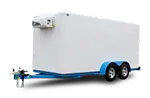
For tool security, weather protection, parts inventory, and mobile organization, an enclosed cargo trailer remains a strong choice for a full-service pool company. Chemicals require a more careful decision. The trailer’s general cargo area should not become one shared chemical room simply because it has wall vents. A better enclosed setup keeps tools and replacement equipment in the main cargo area while chlorine products and acids ride in separate, noncommunicating, chemical-compatible compartments that are secured, independently contained, and ventilated according to the product labels and Safety Data Sheets.
Size: Start at 6×12, Think About 7×16
A nominal 6×12 enclosed trailer is manageable in tight residential neighborhoods and can handle a solo technician’s tools, hoses, cleaners, replacement parts, and portable equipment. Actual exterior width, interior width, wall height, rear-door opening, and usable floor length vary by manufacturer and model, so measure the equipment you intend to roll through the door instead of relying only on the advertised size. A 7×16 provides more room for fixed shelving, a clear center aisle, hose storage, service carts, and a rear loading zone for an empty filter tank or replacement pump.
Many single-axle 6×12 cargo trailers are rated at 2,990 pounds GVWR. Current 2026 Darkhorse 6×12 examples at Spencer Trailers use a 3,500-pound axle but are certified at 2,990 pounds GVWR, with listed empty weights around 1,575 to 1,675 pounds. That leaves roughly 1,315 to 1,415 pounds of payload before adding shelves, containment, spare tires, chemicals, or tools. A typical 7×16 tandem-axle cargo trailer is rated at 7,000 pounds GVWR. A current Darkhorse 7×16 example lists two 3,500-pound axles, electric brakes, an empty weight of about 2,825 pounds, and approximately 4,175 pounds of payload. For a growing pool company, that additional payload and axle capacity can be more valuable than the extra floor space alone.
Darkhorse Cargo and Wells Cargo
Spencer Trailers carries Darkhorse Cargo and Wells Cargo enclosed trailers. Wells Cargo has built enclosed trailers since 1954 and offers single- and tandem-axle configurations for commercial users. Darkhorse Cargo provides practical cargo models at competitive prices, including 2,990-pound single-axle and 7,000-pound tandem-axle configurations. Build details vary by model, so compare the frame, crossmember spacing, axle configuration, brakes, coupler, door opening, roof height, floor material, wall material, tie-downs, and listed empty weight rather than choosing by exterior size alone.
Many standard cargo trailers, including current Darkhorse configurations, use an engineered-wood or plywood floor and wood-based interior wall panels. Those materials are appropriate for ordinary dry cargo but need protection in a chemical-service build. A smooth interior liner can make routine cleaning easier, but bare aluminum should not automatically be treated as chemical-proof. Hypochlorite solutions and muriatic acid can attack common metals, including aluminum and carbon steel. Chemical areas should use removable or seamless secondary containment made from a material verified as compatible with the exact products and concentrations listed on their Safety Data Sheets.
Ventilation: Non-Negotiable
Standard enclosed trailers usually include only basic cargo ventilation. For example, current Darkhorse cargo-trailer listings commonly show two flow-through wall vents. Those vents help ordinary cargo spaces breathe, but they are not proof that the trailer is suitable for transporting acids or oxidizers. A pool-service chemical compartment should be designed so vapors do not enter the technician’s work area, the tow vehicle, or a neighboring compartment. The location and type of intake, exhaust, compartment seals, and any mechanical ventilation should be selected by a qualified upfitter familiar with the products being carried.
Do not rely on an unapproved household or battery-powered fan placed beside chemical containers. Electrical components used around corrosive vapors must be suitable for that environment, and airflow should discharge away from people, doors, windows, ignition sources, and the tow vehicle. The compartment also needs protection from direct sun and excessive heat. Pool-chemical guidance emphasizes cool, dry, well-ventilated storage, with each product kept in its original labeled container. Because the inside of a closed trailer can become extremely hot in summer, route operators should monitor storage conditions and follow each manufacturer’s temperature limits.
Utility Trailers: The Haul-Off Workhorse
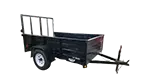
Not every pool company needs a fully enclosed trailer for every job. Some operations use a split setup: an enclosed trailer or service body for tools and replacement parts, plus an open utility trailer for haul-off and larger equipment moves. Others use one open utility trailer with separate, lockable chemical compartments. Open-air transport can reduce the chance of vapors accumulating in a large common cargo box, but it does not eliminate the need for compatible containers, segregation, secondary containment, weather protection, load securement, and compliance with hazardous-material transportation rules.
A utility trailer is especially useful for empty filter tanks, pumps, plumbing, hose reels, compact service equipment, bagged material, and renovation debris. Loose leaves, broken plastic, pipe, or demolition material must still be contained with appropriate sides, covers, tarps, and tie-downs. Chemicals should never be placed loose among scrap or haul-off material, and an ordinary metal toolbox should not be assumed compatible with chlorine or acid simply because it can be locked.
H&H and Diamond C for Open Utility
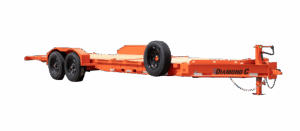
H&H Trailers and Diamond C are two brands Spencer Trailers stocks for utility and equipment-hauling applications. The current Diamond C GTU premium tandem-axle utility is available in an 83-inch bed width and lengths from 14 to 20 feet. It is rated at 7,000 pounds GVWR and uses two 3,500-pound Lippert brake axles, a 4-inch channel frame, engineered channel crossmembers, a treated-wood floor, and integrated tie-down points. Diamond C manufactures its trailers in Mt. Pleasant, Texas, where the company has operated since 1985.
The GTU’s DM Difference Maker coating system uses a multi-stage preparation, primer, top-coat, and curing process that provides a durable general-purpose finish. It still does not replace prompt spill cleanup, secondary containment, or product-specific chemical protection. Chlorine and acid contamination should be removed according to the chemical manufacturer’s instructions before it remains trapped around boards, fasteners, wiring, brakes, or frame components.
H&H offers utility configurations from lighter 2,990- and 7,000-pound models through 9,900-pound heavy-duty rail-side trailers, along with 14,000-pound heavy-duty utility and equipment configurations. A 7,000-pound tandem utility may be appropriate for pumps, empty filters, tools, and moderate haul-off work, but concrete coping, wet debris, or renovation material can use its payload quickly. For heavier work, compare the certified empty weight and available payload of a 9,900- or 14,000-pound configuration, then confirm that the truck, receiver, hitch, ball or pintle, tires, and brake controller are rated for the combination.
The Chemical Storage Question
Whether you use an enclosed trailer, utility trailer, service body, or truck bed, chemical transport needs a written plan. OSHA’s Hazard Communication Standard applies to workplace labeling, Safety Data Sheets, employee information, and training. Highway transportation is regulated separately by the U.S. Department of Transportation and the Pipeline and Hazardous Materials Safety Administration. Pool-service chemicals may qualify for the federal “materials of trade” exception when every condition is met, but eligibility depends on the exact product classification, concentration, package size, packing group, total quantity, packaging, and business use.
- Physically separate incompatible products. Acids must be isolated from chlorine products, and incompatible types of chlorinating products should not share a spill area. Use separate, noncommunicating compartments or boxes rather than placing chlorine on one shelf and acid on the opposite wall of the same enclosed space.
- Keep products in proper packages. Use original, labeled containers or packaging of equal or greater integrity. Keep every cap, lid, and manufacturer-provided venting feature in its intended condition. Containers should remain upright, protected from impact, and secured against sliding, tipping, puncture, or crushing.
- Use separate compatible containment. Each chemical group needs its own secondary-containment tray or compartment made from a material confirmed compatible with that product. Do not use one common pan for acids and oxidizers, and do not install a drain that can release a spill onto the roadway or ground.
- Control heat, moisture, access, and exposure. Keep products dry, shaded, ventilated, locked away from unauthorized access, and separated from fuels, oils, organic material, metal debris, and ignition sources. Carry current Safety Data Sheets, train every driver on the products aboard, and maintain product-specific spill and emergency procedures.
For many Packing Group II or III Class 8 or Division 5.1 materials carried under the materials-of-trade exception, the federal package limit is generally 30 liters or 30 kilograms per package, which is approximately 8 gallons or 66 pounds, and the combined gross weight of all materials of trade on one motor vehicle generally may not exceed 200 kilograms, or 440 pounds. Different limits apply to certain Packing Group I materials, gases, and other classifications. Those numbers are not a blanket allowance for every pool product. Check the shipping description and transportation information in each product’s Safety Data Sheet, and obtain qualified compliance assistance when quantities exceed the exception or when placarding, shipping papers, hazmat registration, or driver endorsements may apply.
Comparing Your Options: A Quick Reference
| Trailer Type | Best For | Typical GVWR | Key Brands at Spencer |
|---|---|---|---|
| Enclosed 6×12 single axle | Solo technician, tools, parts, and compact residential routes | Usually 2,990 lbs; verify listed empty weight and payload | Darkhorse Cargo, Wells Cargo |
| Enclosed 7×16 tandem axle | Full-service routes, shelving, mobile equipment, and growing companies | Commonly 7,000 lbs with electric brakes | Wells Cargo, Darkhorse Cargo |
| Open utility 83×14-16 | Equipment moves, empty filters, haul-off, and service accessories | About 2,990 or 7,000 lbs by model | Diamond C, H&H |
| Flatbed/equipment 82×18-20+ | Renovation work, compact equipment, and heavier material | About 7,000-14,900+ lbs by configuration | Diamond C, H&H |
What to Ask Before You Buy
A few questions will sort out the right trailer faster than comparing brochure headlines:
- How many stops per day? More stops mean more door, ramp, latch, and loading cycles. A rear ramp door can make rolling carts, pumps, vacuums, and empty filter tanks easier, but verify the ramp’s distributed and point-load ratings, rear opening dimensions, transition angle, and floor capacity. Barn doors preserve a flat rear threshold and may be preferable when most equipment is hand-carried. Choose the door around the actual workflow rather than assuming one style is automatically better.
- Which chemicals and quantities do you carry? Liquid chlorine, muriatic acid, shock, tablets, algaecides, and specialty treatments have different hazards and packaging requirements. Neither tablets nor dry shock should be treated as harmless cargo. List the maximum quantity of every product carried on the busiest day, obtain the Safety Data Sheets, and design separate storage zones before ordering shelves, boxes, vents, or interior liners.
- What is the heaviest load you will tow? Weigh or calculate the trailer, permanent equipment, chemicals, tools, spare tire, shelving, tanks, and haul-off cargo. A 2,990-pound single axle may provide little more than 1,300 to 1,400 pounds of real payload after the trailer’s empty weight is deducted. Indiana requires brakes on trailers over 3,000 pounds GVWR, and a 7,000-pound tandem cargo or utility trailer normally includes electric brakes that require a compatible brake controller and 7-way connection. A commercial Class A CDL is generally triggered when the combination is rated at 26,001 pounds or more and the towed unit is rated over 10,000 pounds; a trailer does not trigger that rule merely because it exceeds 10,000 pounds by itself.
- Where do you park it overnight? An enclosed trailer with a quality coupler lock, door lock, wheel restraint, alarm, and inventory system helps protect tools and parts. Chemical security also requires controlling access, temperature, sunlight, water intrusion, and proximity to buildings or ignition sources. If the trailer will be parked at an employee’s home, in an HOA, on a public street, or inside a building, verify local fire-code, zoning, parking, insurance, and private-covenant requirements before building the route around that location.
A Note on Fleet Buyers
Pool service companies that run multiple crews often outfit each truck with its own trailer. At that scale, standardizing the floorplan, shelving, tie-down locations, chemical compartments, spare wheels, couplers, electrical connectors, locks, and brake components can simplify training and maintenance. The payload sticker and equipment record should still be maintained for each individual VIN because empty weight can change with options. Spencer Trailers works with commercial buyers and can discuss multi-unit orders. Call (812) 829-0226 or stop by at 291 West State Hwy 46 in Spencer, Indiana. Indiana buyers generally have 45 days after acquisition to complete title and registration without the late-title penalty. Qualifying business equipment placed in service after January 19, 2025, may also be eligible for restored 100% federal bonus depreciation, but eligibility, business-use requirements, and the interaction with Section 179 should be reviewed with a qualified tax professional.
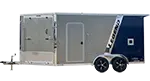
Legend Trailers is another brand worth considering for fleet applications. Legend offers all-aluminum enclosed-trailer structures in single- and tandem-axle configurations, including 7×16 tandem models rated around 7,000 pounds GVWR. Aluminum construction can reduce empty weight compared with some similarly sized steel-frame trailers, but the actual advantage must be confirmed from the certified trailer weight and payload label. Current Legend models may still use engineered-wood flooring and interior wall material, and aluminum construction does not make the cargo area resistant to chlorine or acid. Chemical compartments, containment, and ventilation remain separate upfit requirements.
Don’t Overlook the Truck Bed Side
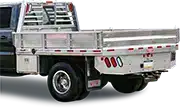
Some pool service operations skip a trailer for the primary route and use a service body, flatbed, or truck bed with dedicated exterior compartments. Zimmerman and Martin truck-bed products are available through Spencer Trailers. A service body can provide enclosed side compartments for tools and parts, while a flatbed creates an open work platform that can be fitted with compatible boxes, racks, hose storage, and tie-downs. Paired with a utility trailer for occasional haul-off, this can be an efficient setup for smaller operations working in tight neighborhoods. Chemical boxes still need independent segregation, ventilation, containment, weather protection, and material compatibility; an ordinary underbody or aluminum toolbox is not automatically suitable for acids or oxidizers.
Where to Start
For a tool-focused residential route, a 7×16 enclosed tandem with electric brakes, a rear ramp or barn-door configuration matched to the workflow, a clear center aisle, properly anchored shelving, and a documented payload plan is a practical starting point. Chemical-heavy routes may be better served by exterior-access compartments, an open service-body arrangement, or a professionally designed chemical-storage upfit rather than carrying every product in the main enclosed cargo area. As a mid-2026 pricing reference, current Darkhorse 6×12 single-axle units at Spencer Trailers have been listed around $5,000 to $5,300, while a stocked 7×16 tandem example has been listed around $8,300. Taxes, title, registration, freight, spare equipment, shelving, containment, ventilation, security, and chemical-specific fabrication add to the completed route price, and inventory pricing can change.
Check Spencer Trailers’ current inventory to see what is on the lot and compare each trailer’s GVWR, empty weight, payload, axle configuration, brakes, floor, doors, and dimensions. Stock changes regularly, and inspecting a trailer in person can reveal doorway clearances, ramp angles, tie-down locations, and service access that are difficult to judge from a specification sheet. If you have a specific configuration in mind, the team at Spencer Trailers’ contact page can help determine whether it is in stock, what options are available, and what lead time applies.
What’s your current setup? If you are already running a trailer on a pool route and something is not working, identify whether the friction comes from organization, payload, loading height, chemical segregation, heat, ventilation, security, braking, or tow-vehicle capacity. That specific problem usually points directly to the next upgrade worth making.


