









You’ve found a trailer. The salesperson says it’ll haul “plenty.” But plenty isn’t a number, and an enforcement officer, scale ticket, tire, axle, hitch, or tow-vehicle rating does not care about a vague estimate. What matters is whether the math works before you hitch up.
This is that math. Using real trailer models and realistic examples, we’ll work through the calculations that determine whether a load stays within the trailer’s ratings, the tow vehicle’s ratings, and the capacity of the complete combination.
The Core Formula: GVWR Minus Tare Equals Payload
Every trailer has a Gross Vehicle Weight Rating (GVWR), which is the maximum allowable loaded weight assigned to that trailer by its manufacturer. It includes the trailer itself, installed options, cargo, equipment fuel, tools, chains, binders, spare tires, and anything else carried on or in the trailer.
Subtract the trailer’s actual empty weight, commonly called tare weight, curb weight, or unloaded vehicle weight, and you get its available payload capacity.
Payload = GVWR − Actual Empty Trailer Weight
The calculation is simple, but finding the correct numbers takes care. GVWR should come from the certification label or VIN data plate on the specific trailer, not an advertisement for a similar model. Empty weight can change with trailer length, axle package, ramps, deck material, spare tires, toolboxes, hydraulic equipment, winches, batteries, upgraded couplers, and other factory or dealer-installed options.
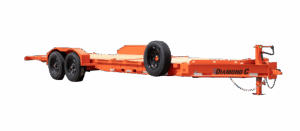
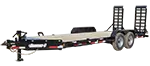
Consider a current Diamond C LPX low-profile extreme-duty equipment trailer. The LPX is a bumper-pull model offered in multiple lengths, axle packages, and GVWR configurations. Its current range begins at 15,500 lbs and extends through higher-capacity configurations. Standard 15,500 lb versions use two 7,000 lb Lippert axles, while upgraded configurations may use different axle packages.
Suppose the certification label on a particular LPX shows a 15,500 lb GVWR and a certified scale shows that the fully equipped but empty trailer weighs 3,540 lbs. The calculation for that specific unit would be:
15,500 − 3,540 = 11,960 lbs maximum theoretical payload
That 11,960 lbs must include the complete transported load: the machine, fuel in its tank, buckets or attachments, loose tools, chains, binders, straps, cribbing, and anything stored in a trailer-mounted toolbox. It is not an additional allowance beyond those items.
Even when this subtraction produces an 11,960 lb payload figure, the load still must be positioned so the trailer’s axle ratings, tire capacities, hitch rating, and tow vehicle limits are not exceeded. GVWR-minus-tare is the starting point, not the only calculation.
A Smaller Trailer, Worked Through
Not every load needs an extreme-duty equipment hauler. For mowers, a side-by-side, building supplies, or a single ATV, a properly sized utility trailer may be enough. The Diamond C PSA is a real premium single-axle utility model offered in 10- to 14-foot lengths and 77- or 83-inch bed widths. Its standard configuration has a 2,990 lb GVWR and a 3,500 lb axle, with higher-capacity configurations available on selected builds.
Assume a particular 12-foot PSA has a 2,990 lb GVWR on its VIN label and weighs 1,050 lbs on a certified scale with its spare tire and installed options:
2,990 − 1,050 = 1,940 lbs payload
One mid-size ATV weighing 700 lbs with fuel, plus 50 lbs of ramps, tie-downs, and riding gear, would create approximately 750 lbs of cargo. That leaves about 1,190 lbs below the calculated payload ceiling.
Two 700 lb ATVs would total 1,400 lbs before adding straps, fuel cans, helmets, tools, or other equipment. If those additional items weigh 100 lbs, the cargo total becomes 1,500 lbs. That remains below the example trailer’s 1,940 lb payload figure, but available deck space, individual tire capacity, tongue weight, and the tow vehicle’s ratings must also work.
A third 700 lb machine would bring the machines alone to 2,100 lbs, exceeding the example payload before any securement equipment or gear is counted. At that point, the correct solution is a larger trailer, such as the Diamond C GTU premium tandem-axle utility trailer. The GTU has a 7,000 lb GVWR, two 3,500 lb Lippert brake axles, an 83-inch bed width, lengths from 14 to 20 feet, and a 4-inch channel frame.
Do not assume that every 2,990 lb single-axle utility trailer has the same payload. Two trailers with the same GVWR may have different empty weights because of their dimensions and equipment. Always calculate from the label and weight information for the actual unit being loaded.
Why Axle Ratings Matter Separately
Here’s where many buyers miss an important step. GVWR limits the trailer’s total loaded weight, while Gross Axle Weight Rating (GAWR) limits the amount of weight carried by each axle. The load on the axles is not necessarily the same as the trailer’s complete gross weight because part of a properly loaded trailer is supported vertically by the tow vehicle through the coupler or gooseneck connection.
Take a tandem-axle utility trailer equipped with two 3,500 lb axles:
3,500 + 3,500 = 7,000 lbs combined axle rating
This does not mean every pound of a 7,000 lb loaded trailer should rest on the axles. A bumper-pull trailer also needs appropriate tongue weight, which transfers part of the trailer’s weight to the tow vehicle. The certification label remains controlling, and neither axle may carry more than its individual GAWR.
A trailer’s GVWR can legitimately be higher than the sum of its axle ratings when the design accounts for weight carried at the hitch. The 15,500 lb Diamond C LPX example with two 7,000 lb Lippert axles illustrates this. At 15,500 lbs total trailer weight, at least 1,500 lbs must be supported at the hitch for axle load to remain at or below the 14,000 lb combined axle rating. A correctly distributed bumper-pull load with approximately 10 to 15 percent tongue weight normally provides that transfer.
However, combined axle capacity alone does not prove that the load is acceptable. One axle can be overloaded even while the total on both axles is below their combined rating. For example, scale readings of 6,400 lbs on the front axle and 7,300 lbs on the rear axle total only 13,700 lbs, but the rear 7,000 lb axle is still overloaded by 300 lbs.
The practical rule is to respect every rating independently: trailer GVWR, each axle’s GAWR, tire and wheel ratings, coupler or gooseneck rating, safety-chain rating, jack rating where applicable, hitch rating, and tow-vehicle limits. The lowest applicable rating controls.
Indiana law also requires brakes on a trailer or semitrailer with a gross weight of at least 3,000 lbs. Current Diamond C GTU trailers use brakes on both 3,500 lb Lippert axles. Brakes must be connected to a compatible tow-vehicle brake controller and adjusted so the combination stops smoothly without the trailer pushing or locking prematurely.
Load Distribution: The Part the Formula Doesn’t Catch
Even a load below the trailer’s calculated payload can be dangerous if its weight is distributed poorly. The familiar 60/40 guideline means placing roughly 60 percent of the cargo weight ahead of the trailer’s axle-group center and about 40 percent behind it. It is a useful starting point, but it is not a substitute for measuring actual tongue or pin weight.
For conventional bumper-pull trailers, tongue weight commonly should be about 10 to 15 percent of the trailer’s actual loaded weight, unless the trailer or tow-vehicle manufacturer specifies otherwise. Too little tongue weight can contribute to sway. Excessive tongue weight can overload the tow vehicle’s receiver, rear axle, suspension, tires, or payload rating.
On the example Diamond C LPX loaded to its 15,500 lb GVWR, a 10-to-15-percent target would equal approximately 1,550 to 2,325 lbs of tongue weight. The corresponding weight remaining on the trailer axles would be approximately 13,950 to 13,175 lbs, assuming the load is shared properly between them. Both individual axle weights would still need to be confirmed.
When loading an excavator, compact track loader, or skid steer, move the machine gradually and determine how its center of gravity affects the hitch and axles. An attachment held in front of the machine can shift the center of gravity substantially. Lower buckets and attachments to the deck, secure articulated components as required, and never rely solely on where the machine’s tires or tracks appear to sit.
For the most reliable result, use a tongue-weight scale or obtain separate certified scale readings for the tow vehicle and trailer. A three-platform truck scale can help establish steer-axle, drive-axle, and trailer-axle weights. Comparing loaded and unhitched or tow-vehicle-only readings allows you to calculate how much weight the trailer transfers to the truck.
How Tare Weight Creeps Up
Published weights usually describe a particular base configuration or a range of configurations. Options reduce available payload pound for pound. A spare tire and carrier, steel toolbox, winch, battery, upgraded jack, additional deck length, heavy ramps, hydraulic components, expanded-metal sides, or additional tie-down hardware all increase empty weight.
The contents of a toolbox matter as much as the box. Chains and binders for equipment securement can easily add more than 100 lbs. A winch may add the combined weight of the winch, mounting plate, cable or synthetic rope, fairlead, battery, wiring, and protective enclosure. Mud, aggregate, snow, and standing water left in or on a trailer are also part of the gross weight.
Deck construction can materially affect tare weight, but the difference cannot be reduced to one universal number. Trailer length, board dimensions, lumber species, moisture content, steel thickness, and supporting structure all change the result. The correct approach is to use the actual equipped weight rather than applying a generic adjustment.
This is especially important on a used trailer. Previous owners may have added stake pockets, side rails, ramps, replacement decking, a winch plate, tool storage, or welded repairs. Those additions may not appear on an original brochure or dealer listing.
Weigh the empty trailer in the same condition in which it will normally travel: spare installed, toolbox stocked, battery fitted, ramps aboard, and fuel cans or permanent equipment included. Certified truck scales and some agricultural or aggregate facilities can provide the needed readings. Scale prices vary by location, so confirm the current fee before visiting.
A Table: Three Trailers, Three Scenarios
| Trailer | GVWR | Example Actual Tare | Calculated Payload | Axle Rating(s) |
|---|---|---|---|---|
| Diamond C PSA Single-Axle Utility, Example 12-Foot Unit | 2,990 lbs | 1,050 lbs | 1,940 lbs | 1 x 3,500 lb |
| Diamond C GTU Premium Tandem-Axle Utility, Example Unit | 7,000 lbs | 1,700 lbs | 5,300 lbs | 2 x 3,500 lb Lippert brake axles |
| Diamond C LPX Low-Profile Equipment Trailer, Example Unit | 15,500 lbs | 3,540 lbs | 11,960 lbs | 2 x 7,000 lb Lippert axles |
The tare figures in this table are worked examples, not guaranteed weights for every trailer carrying the model name. Actual weight changes with length and options, and the GVWR or axle package may also differ on models offered in multiple configurations. Use the certification label and a scale ticket for the specific trailer before making a final payload decision.
Payload percentage does not automatically improve as trailers become larger. A heavier-duty trailer may require more structural steel, larger running gear, hydraulic equipment, ramps, batteries, and reinforced crossmembers. Those components improve durability or capability, but they also consume part of the GVWR. Compare actual payload in pounds rather than assuming that a higher GVWR always produces a better payload-to-empty-weight ratio.
Cargo Weight vs. Volume: Don’t Confuse the Two
Enclosed-trailer and dump-trailer buyers sometimes confuse available space with available payload. A 6-by-12-foot trailer provides 72 square feet of nominal deck area before accounting for wall thickness, a V-nose, cabinets, wheel boxes, or other interior features. Interior volume depends on the trailer’s actual usable dimensions.
You could fill much of that space with moving boxes, furniture, or other bulky household goods and remain within the payload limit. The same volume filled with dense construction material could overload the trailer long before the floor looks full.
Bulk density varies significantly. Loose dry gravel may be roughly 90 to 110 lbs per cubic foot, while wet or compacted material can weigh more. Bagged concrete mix should be calculated from the marked weight on each bag rather than an assumed volume. Solid stone is denser than loose aggregate because loose material contains air spaces.
For example, a 4-by-4-foot section filled eight inches deep has a volume of approximately 10.67 cubic feet:
4 ft x 4 ft x 0.667 ft = approximately 10.67 cubic feet
At 100 lbs per cubic foot, that small area would hold about 1,067 lbs of material. At 120 lbs per cubic foot, it would hold about 1,280 lbs. The exact total depends on the material and moisture content, but either figure shows how quickly dense cargo can consume the payload of a small trailer.
The lesson is straightforward: for dense cargo, weight is usually the constraint. For bulky but light cargo, usable floor area and cubic volume may become the constraint first. Know the material’s verified weight, or weigh the loaded trailer, instead of estimating capacity by how full the deck or box appears.
Checking Your Tow Vehicle Side of the Equation
Payload capacity is a trailer calculation, but it tells only half the story. Your tow vehicle has its own maximum trailer-weight rating, Gross Combined Weight Rating (GCWR), GVWR, front and rear GAWRs, payload limit, tire ratings, and hitch or gooseneck rating. Every applicable limit must be respected.
A tow rating advertised for a truck model may apply only to a particular engine, transmission, axle ratio, cab, bed, drivetrain, wheel, tire, and towing-package combination. The rating for the truck in your driveway may be lower. Check its door-jamb labels, owner’s manual, trailering guide, hitch label, and vehicle-specific equipment information.
Suppose a half-ton pickup is rated to tow 8,500 lbs and is connected to a 9,990 lb GVWR trailer that actually weighs 8,000 lbs loaded. The trailer is not automatically too heavy merely because its GVWR is greater than the truck’s tow rating; actual loaded trailer weight is relevant to the manufacturer’s towing calculation. In this example, 8,000 lbs is below the stated 8,500 lb trailer-weight limit, but that alone does not approve the combination.
The truck must also remain below its GCWR, GVWR, rear GAWR, tire capacities, hitch rating, and payload allowance after passengers, cargo, accessories, and tongue weight are added. A truck can be within its advertised tow rating and still exceed its payload or rear-axle rating.
For commercial-driver licensing, do not treat a trailer’s weight by itself as the only threshold. Under the federal and Indiana Class A CDL framework, the relevant rating test is a combination GCWR of 26,001 lbs or more when the towed vehicle has a GVWR over 10,000 lbs, subject to exemptions and the nature of the operation. Registration, motor-carrier, medical-card, USDOT, and operating-authority requirements are separate questions and may apply under different thresholds.
Before hitching, confirm at least these figures: the trailer’s GVWR and GAWRs; the trailer’s actual loaded and axle weights; the truck’s maximum trailer weight and GCWR; the truck’s GVWR, rear GAWR, and available payload; and the ratings of the hitch, ball, coupler, tires, and related hardware. Leave practical operating margin whenever possible instead of planning to run continuously at every maximum rating.
One More Worked Example: The Middle Ground
Suppose you’re hauling a compact tractor for a farm. The tractor, front loader, installed implement, and full fuel tank weigh 4,200 lbs. You are considering a gooseneck trailer with a 15,500 lb GVWR whose actual equipped empty weight is 4,300 lbs.
15,500 − 4,300 = 11,200 lbs payload available
After loading the 4,200 lb tractor, the trailer would weigh approximately 8,500 lbs before adding chains, binders, spare implements, tools, or other cargo. If securement equipment and accessories add 200 lbs, the loaded trailer weight becomes approximately 8,700 lbs, leaving substantial capacity below the trailer’s 15,500 lb GVWR.
A gooseneck transfers vertical load through a ball mounted in or above the pickup bed, near the truck’s rear axle. That arrangement can offer favorable stability and weight transfer for large trailers, but it does not eliminate rear-axle, tire, payload, hitch, or GCWR limits. It may consume a considerable portion of the truck’s available payload.
Gooseneck pin or hitch weight is commonly higher as a percentage than conventional bumper-pull tongue weight. Depending on the trailer design and manufacturer guidance, a loaded gooseneck may place roughly 15 to 25 percent of its weight on the truck. For an 8,700 lb loaded trailer, that broad range would equal approximately 1,305 to 2,175 lbs. The correct value must be established through proper loading and measurement, not by automatically applying the bumper-pull 10-to-15-percent guideline.
Position the tractor so the combination has stable, manufacturer-appropriate hitch weight while every trailer axle and truck axle remains within its rating. The tractor’s front axle does not always identify its center of gravity, especially when a loader, rear implement, ballast, or liquid-filled tires are involved. Move the tractor in controlled increments, lower attachments, measure the resulting weights, and secure the machine using properly rated equipment.
So yes, the core formula is simple. Running it correctly means using the specific trailer’s GVWR, determining actual equipped tare weight, counting every item carried, checking individual axle and tire loads, measuring tongue or pin weight, and confirming the tow vehicle’s ratings on the other end. Do all of that and the math gives you a defensible answer about what the combination can haul safely.
Have a specific load in mind and want to check whether the trailer you’re looking at is sized right? Reach out to the Spencer Trailers team with the machine weight, attachments, tow-vehicle information, and expected cargo, and we’ll help match those numbers to the right unit. Or browse what’s available now at our current inventory and start comparing GVWR, actual trailer weight, axle packages, dimensions, and payload needs.


