








Your trailer is not a storage shed on wheels. It is a production tool that either lets your crew leave the yard organized and arrive ready to work, or it becomes a bottleneck that wastes time at every stop. Landscaping is one of the toughest applications for a trailer because the same business may need to move commercial mowers, compact equipment, fuel cans, trimmers, sharp hand tools, pallets, brush, mulch, soil, and stone. Those loads have very different weight, space, ventilation, loading-angle, and securement requirements. The wrong trailer punishes the crew every day. The right one fades into the background and reliably does its job.
Here is a clear-eyed look at which trailer types make sense for landscaping operations, what specifications deserve attention, and which current Diamond C, Liberty, Darkhorse Cargo, and Wells Cargo configurations are worth considering at Spencer Trailers. Diamond C has built trailers in Mt. Pleasant, Texas, since 1985, but model specifications and available options can change. Always confirm the certification label, actual empty weight, payload capacity, axle package, gate configuration, and option list on the specific trailer you are buying.
The Core Problem: One Trailer Type Rarely Does Everything
Most established landscaping businesses eventually operate at least two trailers: an equipment trailer for mowers, compact machines, blowers, and hand tools, plus a dump trailer for mulch, topsoil, stone, brush, and cleanup debris. Trying to carry both categories on one open utility trailer may work during the startup phase, but it creates real friction as the workload grows. An 83-inch-wide, 16-foot utility trailer occupied by a zero-turn mower, a walk-behind, fuel, and tool racks has little useful deck space left for bulk material. Loose mulch or brush also needs containment and a tarp rather than being piled around expensive equipment.
A solo operator can still begin with one properly specified utility trailer. Prioritize usable payload, deck width, loading system, brake equipment, structural tie-down points, and future equipment needs rather than looking only at deck length. Payload is not the same as GVWR: it is the trailer’s GVWR minus its actual empty weight, including installed options, spare tires, racks, ramps, tarps, batteries, and onboard tools. Measure the widest and longest machines you expect to carry, record their actual operating weights with attachments, and leave enough capacity for fuel, debris, and equipment added during the workday.
Open Utility Trailers: The Everyday Workhorse
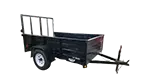
An open utility trailer is where many landscaping operations begin. The basic format is straightforward: a steel frame, wood or aluminum deck, perimeter rails, structural tie-down locations, and a rear loading gate. What separates a professional work trailer from a light homeowner trailer is not simply appearance. Look closely at the main-frame material, crossmember spacing, floor attachment, axle and brake package, coupler rating, gate construction, suspension, wiring protection, tire capacity, tie-down design, and coating process. Current Diamond C utility trailers use the DM Difference Maker multi-stage coating system, but any commercial trailer still needs damaged coating repaired before exposed steel begins to corrode.
Commercial mower weights vary much more than many buyers expect. Depending on deck width, engine, fuel capacity, collection system, and model, a professional zero-turn can weigh roughly 900 to more than 1,600 pounds. A hydro walk-behind may add approximately 500 to 700 pounds, while stand-on machines, bagging systems, sprayers, aerators, spreaders, and attachments can add hundreds more. Two backpack blowers, trimmers, fuel cans, hand tools, spare blades, and a permanently installed rack system also consume payload. A light single-axle trailer may be suitable for one compact mower and a limited tool package, but it can run out of payload quickly when used as a complete commercial crew trailer.
A practical baseline for a professional mower crew is a 7,000 lb GVWR tandem-axle open utility trailer. The current Diamond C GTU premium tandem-axle utility trailer is 83 inches wide and available in 14-, 16-, 18-, and 20-foot lengths. It uses dual 3,500 lb Lippert electric-brake axles, a 4-inch channel main frame, a 24-inch Laser Grip dovetail, integrated upright tie-downs, a treated-lumber floor, and an EZ Bi-Fold rear gate. For two heavier mowers, collection systems, or a growing equipment package, the Diamond C TUT is the next utility-trailer step. It has a 9,890 lb GVWR, an 83-inch bed, lengths from 16 to 22 feet, and dual 6,000 lb Lippert brake axles. Use the payload shown for the completed trailer rather than adding the axle ratings and assuming that total is available as cargo capacity.
What to Look for in the Gate
The rear gate is one of the most frequently used and abused components on a landscaping trailer. A commercial crew may cycle it several times per day, exposing the hinges, latches, mesh, assist mechanism, and lower edge to repeated impacts. The gate must be wide enough for the mower, strong enough for the machine’s concentrated wheel loads, and supported according to the manufacturer’s design. Gate width alone does not establish capacity, so verify the gate’s intended use before loading a compact tractor, mini skid steer, or other machine heavier than a commercial mower.
For mower work, a full-width spring-assisted or counterbalanced gate is usually the most convenient arrangement. Diamond C’s current GTU uses an EZ Bi-Fold Gate that folds at the center, reducing the gate’s upright height and wind resistance while making it easier for one person to operate. Spring assistance reduces lifting effort, but it does not increase the gate’s load rating. Inspect the assist mechanism, hinge tube, welds, latches, and expanded metal regularly, and never stand directly under or behind a gate that is not positively secured.
A dovetail at the rear of the deck reduces the transition angle between the ramp and the main floor. That matters for low mower decks, anti-scalp wheels, collection systems, and stand-on machines with limited breakover clearance. The current GTU’s 24-inch Laser Grip dovetail works with the bi-fold gate to create a smoother approach than a square-ended deck. Even with a dovetail, raise the mower deck before loading, approach straight, keep the machine centered, and confirm that the gate is resting on firm, level ground.
Dump Trailers: Essential Once Your Volume Grows
Any landscaping business performing regular mulch installations, property cleanups, brush removal, soil work, or hardscape preparation eventually benefits from a dump trailer. The advantage is not limited to dumping speed. A dump body contains loose material, supports tarping, keeps bulk loads separate from mowers, and reduces the amount of manual shoveling required at the jobsite. It also creates a safer and cleaner workflow than piling debris around equipment on an open utility trailer.
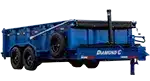
For many landscaping crews, the Diamond C MDT Medium Duty Telescopic Dump is a better starting point than a heavy-duty LPT. The MDT has a 77-inch bed, 10- and 12-foot length choices, a front-mounted three-stage telescopic hoist, a 45-degree dump angle, and dual 6,000 lb Lippert drop axles. The standard lineup is rated around 9,890 lb GVWR, with higher-rated configurations available. As one current example, a 77-inch-by-12-foot, 12,000 lb GVWR MDT offered by Spencer Trailers has an empty weight of approximately 3,420 pounds and a listed payload of approximately 8,580 pounds. That is enough capacity for substantial landscape material loads while remaining more compact than an LPT.
For heavier commercial work, step up to the Diamond C LPT Heavy Duty Low Profile Telescopic Dump. Current LPT models range from 15,500 to 24,000 lb GVWR, with 12-, 14-, and 16-foot beds approximately 81 to 82 inches wide. Standard heavy-duty configurations use dual 7,000 lb Lippert axles, a three-stage telescopic hoist, and a 45-degree dump angle, with upgraded axle packages available. A current 82-inch-by-14-foot, 15,500 lb GVWR LPT configuration at Spencer weighs approximately 4,960 pounds and provides about 10,540 pounds of payload. Material density varies dramatically: dry mulch is relatively light, while wet soil, gravel, stone, and demolition debris can reach the trailer’s weight limit long before the body is full. Use supplier weights or scale tickets instead of estimating payload solely by cubic yards.
Sidewall Height and Gate Options
Dump-body height should match the material, not just the desired volume. Current MDT and LPT configurations commonly use 24-inch steel sides, with taller-body choices or board extensions available on some builds. Higher sides and board brackets are useful for leaves, brush, clippings, and light mulch, but they do not increase GVWR or payload. In fact, the added boards, tarp hardware, and accessories reduce remaining payload slightly. A properly fitted mesh tarp is also essential for containing light debris and loose material during road travel.
Current LPT configurations use a three-way rear gate that supports conventional dumping and controlled spreading. A spreader-style opening can help place gravel or similar free-flowing material while the truck moves slowly, but results depend on particle size, moisture, gate adjustment, trailer angle, and operator experience. Load the body evenly, keep workers clear of the discharge area, dump only on firm and reasonably level ground, and never move or service the trailer beneath a raised body unless the manufacturer’s approved body-prop procedure is being followed.
Enclosed Trailers: The Mobile Crew Base
Not every landscaping company needs an enclosed trailer. The economics change once equipment must be locked overnight, crews need a weather-protected mobile base, or the trailer’s exterior is being used as a rolling advertisement. An enclosed trailer can keep trimmers, blowers, hand tools, batteries, chargers, personal protective equipment, and replacement parts together in a repeatable layout. The tradeoffs are greater curb weight, more wind resistance, less visibility, additional ventilation requirements, and the need to carefully manage interior payload.
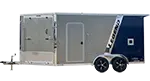
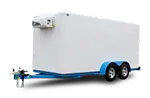
Spencer Trailers offers Darkhorse Cargo and Wells Cargo enclosed-trailer options. A tandem-axle 7×16 is a practical starting size for many two-person mowing crews, provided the specific trailer has enough payload after racks and equipment are installed. A current Darkhorse DHW 7×16 configuration at Spencer has a 7,000 lb GVWR, dual 3,500 lb electric-brake axles, a 7-foot interior height, a rear ramp door, a 36-by-78-inch side door, a high-performance 3/4-inch floor, recessed wall track, four D-rings, and flow-through wall vents. Its listed empty weight is about 2,825 pounds, leaving approximately 4,175 pounds of payload. Wells Cargo FastTrac and other work-oriented enclosed models can also be configured in suitable tandem-axle sizes, but dimensions, door openings, interior height, curb weight, and standard equipment must be verified for the individual build.
The principal operational concern is ventilation and fuel safety. Gasoline-powered equipment can release vapors even when it is not running, and a vented trailer is not a safe place to operate an engine. Shut equipment off before loading, allow hot components to cool, secure approved fuel containers upright, repair leaks immediately, and use the manufacturer’s fuel-shutoff procedures where applicable. Roof vents or opposing flow-through wall vents help reduce heat and moisture, but they do not eliminate the hazards of gasoline vapor or carbon monoxide. Wet grass and trapped moisture can also damage flooring, wall panels, fasteners, and rack hardware, so clean the trailer regularly and let the interior dry.
Side Access Doors Are Not Optional
A rear ramp is the main loading entrance, but a well-positioned side door may be used far more often during the workday. It lets the crew retrieve a trimmer, blower, hand tool, battery, or fuel can without lowering the entire rear ramp into a street or driveway. A 36-inch curb-side door is common on work-grade enclosed trailers, and current Darkhorse 7-foot-wide units at Spencer may use a 36-by-78-inch RV-style door with a bar lock. Do not assume the same door is standard on every trailer. Verify its opening size, hinge direction, lock type, step height, and relationship to interior racks before ordering, especially if bulky equipment must pass through it.
Mower Racks and Organization
Whether the crew uses an open utility trailer or an enclosed trailer, organization affects productivity as much as deck length. A poorly arranged trailer forces workers to move one tool to reach another, creates trip hazards, damages equipment, and encourages hurried securement. Assign a permanent position to every mower, trimmer, blower, fuel container, hand tool, spare part, and piece of safety gear. Frequently used items should be accessible without unloading a machine or releasing unrelated cargo.
For open utility trailers, commercial trimmer racks mounted to a structural side or top rail are a common solution. Most use upright rack posts while carrying shaft-driven tools horizontally in locking supports. The mount must fit the trailer’s actual rail shape and thickness, and the rack should not be attached only to thin expanded metal. Jungle Jim, Green Touch, Pack’em, and similar manufacturers offer professional rack systems, but compatibility, capacity, locking design, and mounting instructions vary. Position the rack so the trimmer heads, shafts, and engines remain inside the trailer’s legal width and cannot contact the tow vehicle during a sharp turn.
For enclosed trailers, E-track or compatible recessed track systems provide flexible attachment points for hooks, shelves, straps, and equipment racks. The track must be fastened into structural wall members or installed according to the trailer manufacturer’s reinforcement plan; fastening it only to interior plywood does not create a dependable cargo anchor. Wall track is useful for lightweight tools, but heavy mowers should be restrained to rated floor or frame-connected tie-downs. Use appropriately rated straps at multiple securement points, apply the mower’s parking brake, and use wheel chocks when appropriate. A parking brake by itself is not cargo securement.
The Ramp Gate Setup That Separates Fast Crews From Slow Ones
On an open utility trailer, the difference between a balanced, easy-to-operate gate and a heavy manual gate becomes significant over a full season. The Diamond C GTU combines a 24-inch Laser Grip dovetail with an EZ Bi-Fold Gate, creating a practical loading system for commercial mowers, stand-on units, and other light equipment within the gate’s intended capacity. Whatever brand you choose, test the gate before buying. One person should be able to operate it safely, both halves should latch positively, and the lower edge should sit firmly on the ground without twisting the trailer.
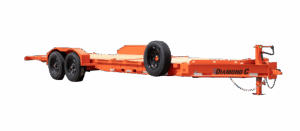
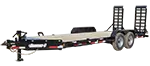
Landscapers who also move mini skid steers, compact tractors, trenchers, or excavators should use a purpose-built equipment trailer rather than assuming a mower gate can handle concentrated machinery loads. The Diamond C LPX Low Profile Extreme-Duty Equipment Trailer ranges from 15,500 to 24,000 lb GVWR, uses Lippert axles as standard, and is available in 16- to 30-foot lengths. Loading options include spring-assisted MAX Ramps on eligible lengths and an X-Ramp arrangement for compatible max-width builds. For operators who prefer a ramp-free loading process, the Diamond C HDT Hydraulically Dampened Tilt offers a low-profile gravity-assisted tilt bed in the same general 15,500-to-24,000 lb GVWR range. Choose between LPX and HDT based on the machine’s weight, track width, ground clearance, attachment length, center of gravity, and the amount of stationary deck space required.
A Quick Comparison: Which Trailer for Which Stage
| Business Stage | Recommended Trailer | GVWR | Primary Use |
|---|---|---|---|
| Solo, 1-2 mowers | Diamond C GTU 83″x14′ or 83″x16′, or Liberty LU 83″x14′ or 83″x16′ | 7,000 lb | Mowers, blowers, trimmers, and hand tools |
| Crew of 2-3, regular mulch | GTU or TUT utility plus Diamond C MDT dump | 7,000-9,890 lb / approximately 9,890-12,000 lb | Separate equipment and bulk-material hauling |
| Multi-crew, overnight lock-up | Darkhorse DHW or properly configured Wells Cargo 7×16 tandem enclosed | 7,000 lb typical; verify specific build | Secure, organized mobile crew base |
| Heavy jobs + compact equipment | Diamond C LPT dump plus LPX or HDT equipment trailer | 15,500-24,000 lb by model and package | Stone, soil, debris, skid steers, and excavators |
The Two Mistakes That Cost Landscapers Money
The first mistake is buying for the exact equipment on the trailer today instead of the likely equipment package 12 to 24 months from now. A solo operator buys a short single-axle trailer for one mower, adds a second machine or collection system, and discovers that both deck space and payload are exhausted. Size for realistic growth, but do not buy additional GVWR without considering the heavier trailer’s curb weight, larger coupler, higher tongue weight, tire requirements, brake controller needs, registration, and tow-vehicle limits. Moving from a 7,000 lb GTU to a 9,890 lb TUT or adding a separate MDT dump is often more efficient than repeatedly replacing undersized equipment.
The second mistake is looking only at the truck’s advertised maximum tow rating. A bumper-pull trailer commonly needs approximately 10 to 15 percent of its loaded weight carried as tongue weight. A 7,000 lb loaded trailer can therefore place roughly 700 to 1,050 pounds on the hitch, and that weight counts against the truck’s payload along with the driver, passengers, tools, fuel, accessories, and the hitch itself. Verify the truck’s GVWR, rear GAWR, payload label, GCWR, receiver rating, ball mount, hitch ball, brake controller, and manufacturer-approved towing configuration. A three-quarter-ton truck often provides more operating margin, but the badge alone does not guarantee compatibility. Use a weight-distribution hitch only when both the tow-vehicle and trailer manufacturers approve it for that application.
Indiana also requires compliant brakes and a breakaway arrangement on trailers in the 3,000-pound-and-higher weight class, so the braking system must be maintained rather than treated as optional equipment. A trailer exceeding 10,000 lb GVWR does not automatically trigger a Class A CDL. The federal Class A threshold generally applies when the combination has a GCWR or actual combined weight of at least 26,001 pounds and the towed unit has a GVWR or actual weight greater than 10,000 pounds. CDL rules are separate from other commercial vehicle, inspection, registration, and operating requirements, so evaluate the complete truck-and-trailer combination before assigning it to a crew.
Spencer Trailers stocks and sources Diamond C, Liberty, Wells Cargo, Darkhorse Cargo, and other work-trailer configurations at its Spencer, Indiana, location. Browse current available inventory here or call (812) 829-0226 to discuss mower dimensions, machine weights, material loads, tow-vehicle ratings, and future growth before buying. Indiana purchasers generally have 45 days to complete title and registration requirements without a late administrative penalty. Business buyers can also ask a qualified tax professional whether a qualifying trailer acquired and placed in service after January 19, 2025, is eligible for the restored 100 percent federal bonus-depreciation allowance.
What is the first task your current trailer consistently fails at: payload, loading angle, material containment, security, organization, or tow-vehicle compatibility? That answer usually points directly to the trailer your landscaping business needs next.


