


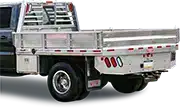





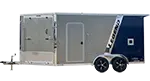
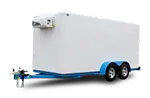
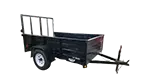

A tree service crew without the right trailer is like a chainsaw without a chain. You can still show up, but you are not getting the job done efficiently. Wood chips consume bed volume quickly. Log rounds create heavy, concentrated loads. Stump grinders and compact chippers require the right deck width, loading angle, tie-down points, axle capacity, and tow vehicle. A trailer that looks large enough can still be overloaded once its empty weight, installed options, tools, fuel, and attachment weight are deducted from its GVWR.
If you are building out a tree service operation or replacing aging equipment, the trailer decision deserves the same attention as the truck or machine it will support. The wrong trailer can mean cracked floors, weak ramps, overheated tires, hydraulic problems, poor load balance, unnecessary dump runs, and equipment that cannot be transported legally. The right trailer gives the crew enough payload and volume for the work while remaining compatible with the truck, hitch, brakes, licensing requirements, and jobsite access.
Here is what actually works for professional tree-service operations.
Dump Trailers for Wood Chips and Brush
Chipping crews can fill a dump body surprisingly quickly, but the actual production rate depends on the chipper, branch diameter, species, moisture content, operator pace, and how well the chips settle. Wood chips are usually a volume problem before they become a weight problem. That changes when the load includes wet chips, dense green wood, stump grindings, soil, rocks, or log rounds. A trailer selected only by bed length may have plenty of space while still lacking the legal payload needed for a mixed load.
For a production tree crew, a 14-foot or 16-foot tandem-axle dump in approximately the 14,000-pound-and-up class is a practical starting point. A 14-foot body about 82 inches wide holds roughly seven cubic yards with 24-inch sides before allowing for the tailgate, body taper, and safe loading clearance. Taller sides can increase volume substantially, but they do not increase GVWR, axle capacity, tire capacity, or payload. Always calculate payload by subtracting the trailer’s actual empty, as-equipped weight from its certified GVWR.
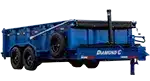
The Diamond C LPT Heavy Duty Telescopic Dump is a strong match for commercial tree work. Current LPT bumper-pull configurations are available in 12-foot through 16-foot lengths with GVWR packages from 15,500 to 24,000 pounds. The standard 15,500-pound package uses two 7,000-pound Lippert axles, while higher-capacity axle packages are available. The LPT has an 81-inch to 82-inch bed width, an I-beam main frame, a telescopic hoist, and a 45-degree dump angle. Its low-profile body helps when positioning beneath a chipper discharge chute, although crews should still compare the trailer’s actual rail height with the chipper’s discharge range. Because trailer weight varies by length, GVWR package, body thickness, side height, ramps, tarp, hydraulic jack, and other options, the payload must be confirmed from the specific build sheet and certification label rather than assumed from the model name.
H&H also offers several professional-grade dump configurations. Its Industrial and Telescopic I-Beam dump trailers are available in 12-foot through 16-foot lengths with 14,000- to 16,000-pound GVWR packages and 7,000- or 8,000-pound-per-axle ratings. Crews needing a heavier body can consider the H&H TOPLINE Telescopic Dump, offered in 14-foot and 16-foot lengths with GVWR packages from 15,400 to 22,000 pounds. Current TOPLINE specifications include 10-gauge sides, a 7-gauge one-piece floor, an I-beam frame, and a telescopic hoist. Tarp equipment differs by series and build, so confirm whether the trailer includes a mesh tarp, tarp hardware, or an optional powered system before purchase.
When to Go Bigger: 16-Foot and Heavy Dumps
If your crew handles land clearing, utility right-of-way work, municipal cleanup, or multiple removals at one location, a 16-foot dump with a 15,000-pound-or-higher GVWR can reduce the number of disposal trips. The tradeoff is a longer trailer, greater empty weight, a wider turning path, and more difficulty entering confined residential properties. Before choosing the longest body available, compare disposal-site access, truck wheelbase, expected material density, and whether the crew is routinely limited by volume or by payload.
A 16-foot Diamond C LPT preserves the low-profile dump-body design while providing more bed volume. The standard LPT body uses 10-gauge steel with the sides integral to the floor, while a 7-gauge, approximately 3/16-inch Super Duty body upgrade is available for the floor and sides. The heavier body is worth considering when the trailer will receive log rounds, stump grindings, demolition debris, rocks, or repeated loader drops. It adds empty weight, however, so the upgraded body’s durability must be balanced against the remaining payload on the selected GVWR package.
Sidewall height deserves the same attention as bed length. The LPT is currently offered with 24-inch sides as standard, with 32-inch and 44-inch side configurations available, along with board brackets and 24-inch expanded-metal side extensions. Taller sides can make a major difference when hauling light chips and brush, but they also increase wind resistance and raise the load’s center of gravity. Load evenly, keep heavy material low, and never use additional side volume as an excuse to exceed the trailer’s GVWR, axle ratings, tire ratings, hitch rating, or tow-vehicle limits.
Log Trailers and Low-Deck Dumps for Wood Hauling
Chip loads are one thing. Green log sections from storm cleanup and removals are a different load entirely. A cord is a measurement of stacked volume, not a fixed weight, and the weight changes dramatically with species, diameter, moisture content, bark, and the amount of open space between pieces. Dense green hardwood can put several thousand pounds into a trailer before the body looks full. Large rounds also create concentrated impact loads that are harder on the floor, crossmembers, suspension, tires, and hitch than evenly distributed chips.
A heavy dump trailer can be practical for hauling shorter rounds because the body contains the load and the hoist can assist with unloading. It should not be treated as an automatic solution for every log load. Long or irregular logs can bridge inside the body, shift suddenly, catch on the tailgate, or roll unpredictably when the bed rises. Use approved cargo securement, keep the load within the trailer’s dimensions, maintain a clear exclusion area behind the trailer, and unload with a loader or grapple when that is the safer method. Never raise a loaded dump body on a severe side slope or beneath overhead power lines.
For regular log hauling, a current Diamond C LPT with the 7-gauge Super Duty body upgrade is a more suitable starting point than a light- or medium-duty landscape dump. Select the GVWR package only after determining the trailer’s as-built empty weight and the heaviest realistic load. The LPT’s available stake pockets, tie-down points, taller sides, expanded-metal extensions, rear ramps, and rear stabilizer options can improve versatility, but any log containment system or bolster arrangement must be properly engineered and rated rather than improvised from loose boards or unverified attachments.
The hoist design also matters, but cylinder count alone is not a reliable measure of strength. A properly designed telescopic hoist can provide excellent leverage with fewer pivots than a multi-cylinder scissor arrangement. Compare the manufacturer’s rated capacity, hoist geometry, hinge construction, dump angle, hydraulic power unit, battery capacity, charger, wiring, and service support. Keep the battery charged, lubricate hinge points as specified, inspect hoses and fittings, and never work beneath a raised body unless it is secured with the manufacturer’s approved body-prop procedure.
Equipment Trailers for Stump Grinders and Chippers
Stump grinders range from compact machines weighing a little more than 1,000 pounds to large tracked or self-propelled units weighing several tons. The published machine weight may also exclude a blade, remote-control package, dual wheels, attachments, fuel, tools, spare teeth, or other equipment carried on the trailer. Obtain the operating or transport weight for the exact serial-number configuration before selecting the trailer.
For perspective, the Vermeer SC362 has a published weight of approximately 1,320 pounds, while the larger Vermeer SC852 is approximately 4,460 pounds. Those two machines can fit very different trailer and tow-vehicle setups even though both are professional stump cutters. Measure overall width with transport wheels or duals installed, ground clearance, wheelbase, approach angle, and the location of the manufacturer’s tie-down points. A trailer must provide enough usable deck width and ramp spacing, not merely enough total payload.
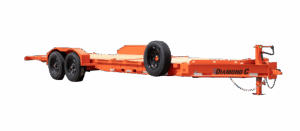
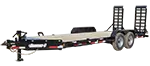
For a stump grinder in the 3,000- to 5,000-pound range, a 16-foot or 18-foot Diamond C LPX Low Profile Equipment Trailer provides substantial commercial-duty capacity. Current LPX bumper-pull models are available from 16 feet through 30 feet with GVWR packages from 15,500 to 24,000 pounds. The standard 15,500-pound package uses two 7,000-pound Lippert axles, and heavier 8,000-pound, 10,000-pound, and triple-axle packages are available by configuration. The LPX can be equipped with spring-assisted loading ramps, MAX Ramps, or other compatible loading packages based on trailer length and deck configuration. For crews that prefer a ramp-free loading process, the Diamond C HDT is a hydraulically dampened tilt equipment trailer available from 16 feet through 28 feet and from 15,500 to 24,000 pounds GVWR. Its standard system is a controlled gravity tilt; the optional Pro Tilt system allows compatible HDT and HDT-GN builds to switch between gravity and powered tilt operation.
For heavier or longer equipment, a 20-foot or 24-foot LPX or HDT usually provides better balance and tie-down geometry than selecting a short trailer solely because the machine technically fits. Do not treat GVWR as payload. Subtract the trailer’s actual empty weight, spare tire, winch, toolbox, upgraded ramps, attachments, fuel cans, and every other item carried. Then confirm that the machine’s axle or track placement does not overload one trailer axle, create excessive tongue weight, or leave the hitch too light for stable towing.
Don’t Overlook Chipper Trailers
Most towable brush chippers are designed to travel on their own running gear, so crews commonly tow them directly rather than place them on a flatbed. There are situations where a separate equipment trailer may be used for relocation, recovery, storage, or transporting a self-propelled chipper. A Bandit 200XP, for example, has a published approximate weight of 5,500 pounds, while a Morbark Eeger Beever 1215 is listed at approximately 5,200 pounds. Engine, winch, loader, tongue, tire, and other options can change the actual weight, so use the machine’s data plate or certified scale weight rather than a generic brochure number.
A 15% to 20% operating reserve above the expected cargo weight can be a useful durability target, but it is not a substitute for the legal payload calculation. First determine the trailer’s available payload from its GVWR and actual empty weight. Then verify axle ratings, tire and wheel capacities, coupler rating, safety-chain rating, ramp capacity, deck construction, tie-down working-load limits, and the tow vehicle’s ratings. Concentrated wheel or track loads can damage a trailer that has enough total payload but inadequate crossmember spacing or ramp capacity.
Which Trailer Matches Which Job Type?
| Operation Type | Recommended Trailer | Key Spec |
|---|---|---|
| Residential chipping crew | 14-foot or 16-foot H&H professional dump or Diamond C LPT | Approximately 15,000 lb or higher GVWR, suitable side height, properly fitted tarp |
| Storm cleanup / log hauling | 14-foot or 16-foot Diamond C LPT | 7-gauge body upgrade, telescopic hoist, adequate payload and approved securement |
| Compact stump grinder (under 5,000 lbs) | 16-foot or 18-foot Diamond C LPX or HDT | 15,500 lb GVWR package, dual 7,000 lb Lippert axles, correct ramp or tilt geometry |
| Large stump grinder (5,000-10,000 lbs) | 20-foot to 24-foot Diamond C LPX or HDT | GVWR selected from actual payload need, axle placement, deck length, tires and hitch capacity |
| Land clearing / full-service crew | 16-foot heavy dump plus a separate equipment trailer | Two-trailer setup with appropriately rated trucks and properly licensed drivers |
Tow Vehicle Considerations
Three-quarter-ton and one-ton pickups or chassis-cab trucks are common in tree-service fleets, but the badge on the fender does not establish towing capacity. Ratings vary by model year, engine, transmission, axle ratio, cab, bed length, drivetrain, wheel and tire package, receiver, gooseneck equipment, and factory tow package. Match the trailer to the exact truck using the owner’s manual, towing guide, door-jamb certification labels, hitch labels, and the truck’s as-equipped payload information. A truck that can pull an empty 15,500-pound-GVWR trailer may still be unable to carry the tongue weight or remain within its rear-axle and payload ratings when the trailer is loaded.
Check GCWR, truck GVWR, front and rear gross axle weight ratings, tire capacities, receiver or gooseneck rating, and the actual loaded weights of both vehicles. Licensing must also be considered before purchasing a heavy trailer. Under the federal Class A threshold, a combination generally enters Class A CDL territory when the combination’s GCWR or applicable combined weight is 26,001 pounds or more and the towed unit is over 10,000 pounds. A trailer does not trigger that Class A threshold merely because its own GVWR exceeds 10,000 pounds; the combined rating or weight threshold must also be met. Many one-ton trucks paired with a 15,500-pound-or-heavier trailer will exceed 26,001 pounds, so commercial tree companies should check the exact ratings and applicable intrastate or interstate requirements before assigning a driver.
For a conventional bumper-pull trailer, loaded tongue weight often falls near 10% to 15% of the trailer’s actual loaded weight, but material position can move it outside that range. A 15,000-pound loaded dump could therefore place well over 1,500 pounds on the hitch before accounting for passengers, tools, fuel, and equipment in the truck. Measure rather than guess. The receiver, hitch shank, ball or pintle, coupler, safety chains, truck frame, rear axle, wheels, and tires must all be rated for the load. A bumper-pull trailer cannot be converted into a fifth-wheel arrangement simply by changing the hitch; choose the manufacturer’s purpose-built gooseneck version when that connection type is required. Indiana also requires a trailer or semitrailer with a gross weight of at least 3,000 pounds to have brakes that the driver can apply from the cab and that activate automatically during an accidental breakaway.
A Word on Trailer Options Worth Paying For
Tree service is hard on equipment. These are the upgrades and specifications that tend to earn their keep on a working trailer:
- Electric-hydraulic dump power equipment should not be confused with electric-over-hydraulic trailer brakes. A commercial dump normally uses a battery-powered hydraulic power unit to operate the hoist. Prioritize a correctly sized battery, onboard charger, protected hydraulic components, clean electrical grounds, and easy access for maintenance. A solar maintainer or upgraded battery can help when the trailer makes many dump cycles between charging opportunities, but it does not replace proper battery maintenance.
- Tarp systems are a practical necessity for chips, leaves, bark, and other loose material. Indiana law prohibits operating a vehicle on a highway when its contents are dripping, sifting, leaking, or otherwise escaping. A correctly sized mesh tarp, secured tailgate, and properly loaded body help satisfy that responsibility, but the tarp does not make an overloaded or poorly contained load legal. Inspect the tarp, crank or motor, arms, stops, and attachment points regularly.
- Heavy steel dump bodies provide better resistance to abrasion and impact than light residential-grade bodies. The Diamond C LPT uses a 10-gauge body as standard and offers a 7-gauge, approximately 3/16-inch floor-and-side upgrade. The H&H TOPLINE Telescopic Dump currently uses 10-gauge sides and a 7-gauge one-piece floor. Choose the heavier body when the crew regularly loads rounds, rocks, soil, stump grindings, or demolition debris, while remembering that thicker steel reduces remaining payload.
- Sealed LED lighting and wiring improve visibility and reduce corrosion-related failures, but they still need inspection. Tree crews frequently work around mud, chips, branches, salt, and rough access roads that can damage lamps and wiring. Check the seven-way plug, junction box, grounds, breakaway battery, brake wiring, marker lights, license-plate light, and conspicuity equipment before the trailer leaves the yard.
What Spencer Trailers Carries for Tree Work
Spencer Trailers in Spencer, Indiana carries Diamond C, H&H, Liberty, and other trailer lines covering dump, equipment, tilt, utility, deckover, and gooseneck applications. For tree companies working in Owen County, Monroe County, or elsewhere in south-central Indiana, visiting the dealership makes it easier to compare actual deck heights, ramp widths, dump-body construction, side options, tarp systems, axle packages, tires, couplers, and empty weights instead of relying on a generic model description. Spencer Trailers is family-owned and lists Diamond C as its leading trailer brand, with H&H and Liberty represented in its inventory.
Dump and equipment inventory changes throughout the year, especially around busy spring and storm-cleanup seasons. An in-stock trailer may be available after financing, payment, inspection, title, and other delivery requirements are completed, while a custom factory order will have a lead time that varies by manufacturer, model, options, and production schedule. Indiana purchasers should apply for title within 45 days of purchase to avoid an administrative penalty. A qualifying trailer placed in service for business use may also be eligible for federal depreciation deductions; current IRS guidance provides 100% bonus depreciation for eligible property acquired and placed in service after January 19, 2025, subject to the taxpayer and property meeting the applicable rules. Discuss eligibility and business-use documentation with a qualified tax professional.
Browse current inventory at SpencerTrailers.com or check the recently sold page to see the trailer sizes, GVWR packages, features, and configurations that have recently moved through the dealership. Specifications and prices should always be matched to the individual stock number because model-year changes and installed options can alter weight, payload, axle equipment, ramps, tires, brakes, and final price. You can also contact the team directly at (812) 829-0226 to discuss the machine weights, material types, truck ratings, and jobsite conditions involved in your operation.
What is your current setup, what are you hauling, and where is the present trailer costing you time or capacity? Start with the heaviest machine, densest material, required bed volume, tow-vehicle ratings, driver licensing, and the properties you must enter. Those answers usually identify the trailer that solves the problem without buying unnecessary capacity or leaving the crew undersized again.


