


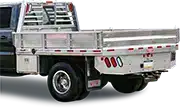
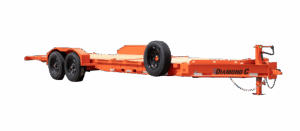


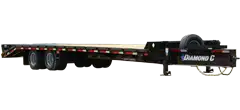

You’ve got a 12,000-pound compact excavator sitting in a gravel lot and a job starting 45 miles away at 7 a.m. The wrong trailer turns that move into a liability. The right trailer, matched to the excavator’s actual transport weight and the tow vehicle’s ratings, makes it routine. If you run an excavation company or rent equipment for site work, what goes under your iron matters as much as what sits on top of it.
This guide covers what you actually need to know when buying a gooseneck equipment trailer for excavators, dozers, compact track loaders, and other tracked machines: GVWR versus usable payload, axle configurations, hydraulic dovetails, tilt decks, ramp systems, deck dimensions, truck requirements, securement, and the legal details Indiana contractors should consider before putting a trailer into service.
Why Gooseneck for Excavation Work?
Heavy bumper-pull equipment trailers are no longer universally limited to 14,000 or 16,000 pounds GVWR. Current premium equipment trailers, including certain Diamond C LPX and HDT configurations, can reach approximately 24,000 pounds GVWR. Even so, a gooseneck is usually the more practical layout once an excavation company regularly moves long, heavy, or high-center-of-gravity equipment.
A gooseneck connects to an in-bed ball positioned over or slightly ahead of the truck’s rear axle rather than to a receiver behind the bumper. That geometry generally improves stability, permits a longer usable deck, and allows the trailer to carry substantial pin weight through an appropriately rated hitch and truck. It does not automatically increase the truck’s legal capacity. The truck’s certified payload, rear gross axle weight rating, tire and wheel ratings, hitch rating, GCWR, and manufacturer tow rating still control the combination.
Machine weights also vary more than model names suggest. A Bobcat E45 is approximately 10,100 pounds before accounting for every possible attachment or configuration. A Komatsu PC55MR-5 is listed at roughly 11,354 to 11,618 pounds. A current Cat 308 CR fixed-boom machine can range from approximately 16,500 to 18,700 pounds, while variable-angle-boom configurations can exceed 20,000 pounds. Some published excavator weights exclude the bucket, quick coupler, thumb, or other work tools. Fuel, steel tracks, counterweights, guarding, and accumulated mud can add hundreds or thousands of pounds.
That is why a trailer should be selected from the machine’s complete transport weight, not its rounded model class. A 14,000-pound trailer may not have enough payload for a nominally 10,000-pound excavator after subtracting the trailer’s own weight. Likewise, a 20,000-pound trailer is generally not a safe assumption for a Cat 308. Excavation contractors commonly move into 23,000, 25,000, 25,900, or 30,000-pound goosenecks because those ratings create more usable payload and provide access to heavier frames, axle packages, tires, brakes, and loading systems.
GVWR Ranges: What Size Do You Actually Need?
GVWR is the maximum permitted weight of the loaded trailer, including the empty trailer, the machine, attachments, chains, binders, spare tire, tools, and anything else carried on it. It is not the trailer’s payload. A useful starting calculation is GVWR minus the trailer’s actual empty weight, but the final load must also remain within every axle, tire, wheel, coupler, hitch, frame, and tow-vehicle rating.
| GVWR Range | Typical Equipment | Axle Config |
|---|---|---|
| 14,000–15,900 lb | Compact track loaders and smaller mini-excavators, generally under approximately 8,000–10,000 lb after trailer weight is deducted | Tandem 7,000 lb or 8,000 lb single-wheel axles, depending on manufacturer and certified GVWR |
| 18,000–24,000 lb | Heavier compact excavators, compact loaders, and approximately 10,000–17,000 lb machines when the configured trailer has adequate payload | Tandem 8,000, 10,000, or 12,000 lb axles, or triple 7,000 lb axles, depending on the model |
| 25,000–25,900 lb | Mid-size excavators and some smaller dozers whose verified transport weight stays within the trailer’s actual payload | Tandem dual-wheel 10,000 or 12,000 lb axles, or approved heavy super-single configurations |
| 30,000–40,000 lb | Heavier excavators, multiple compact machines, and equipment that exceeds the payload of a 25,900 lb trailer; tow-vehicle requirements increase substantially | Heavy tandem or triple-axle configurations, including triple dual-wheel packages, as specified by the manufacturer |
The axle ratings do not always add up to the trailer’s GVWR because part of a gooseneck trailer’s loaded weight is carried as pin weight by the truck. For example, a trailer may have two 10,000-pound axles and a GVWR above 20,000 pounds. That does not authorize overloading the axles, tires, wheels, truck, or hitch. It means the manufacturer has certified the complete trailer for a particular distribution of axle weight and pin weight.
For a Komatsu PC55MR-5 weighing around 11,600 pounds, an appropriately configured 18,000 or 20,000-pound trailer may work after the trailer’s certified empty weight and all attachments are included. A Cat 308 will often push the buyer toward a 25,000, 25,900, or 30,000-pound trailer because a 20,000-pound trailer may have far less than 20,000 pounds of payload.
Dozers require even more caution. A current Cat D3 is approximately 20,640 pounds in a standard configuration and can reach approximately 21,810 pounds in an LGP configuration before adding a ripper, which can add about 1,222 pounds. Many 25,900-pound goosenecks have only about 17,000 to 20,500 pounds of published cargo capacity, depending on length and equipment. A 25,900-pound rating therefore does not automatically make the trailer suitable for a D3. A current Cat D6 is roughly 48,800 to more than 53,000 pounds depending on configuration, putting it well beyond pickup-towed gooseneck territory and into purpose-built lowboy or removable-gooseneck equipment with an appropriately rated commercial tractor.
Do not buy directly at the machine’s advertised weight. Obtain the complete manufacturer build sheet, include every attachment that will travel with the machine, and use a certified scale when there is any uncertainty. Payload margin is needed for the bucket, thumb, coupler, guarding, fuel, chains, binders, spare parts, and the mud that comes back from the job.
The Hydraulic Dovetail: When It Makes Sense for Excavators
A fixed dovetail with long ramps can load many tracked machines safely, but approach and breakover angles need to be checked against the specific excavator. Track length, ground clearance, undercarriage geometry, counterweight clearance, trailer deck height, dovetail length, and ramp length all affect whether the machine transitions onto the deck without dragging or rocking excessively.
A hydraulic dovetail lowers a powered rear section to the ground and raises it after loading. It can create a longer, smoother transition than short removable ramps while eliminating the need to lift and position heavy ramps manually. The actual loading angle is determined by the tail length and trailer geometry; a hydraulic dovetail should not be assumed to provide a flat or zero-degree approach.
The hydraulic tail also has its own rated capacity and operating instructions. Confirm how much weight the tail can support during loading, whether it must rest on firm ground, how the system locks for travel, and whether manual lowering is available after an electrical or hydraulic failure. Load on stable, level ground whenever possible, chock the tow vehicle and trailer as directed, keep bystanders clear, and never stand beneath a raised tail.
A hydraulic dovetail is not the only good solution for excavators. A hydraulically dampened full or partial tilt deck can provide a continuous loading surface without a separate powered tail. Long spring-assisted ramps can also work well when the machine’s approach angle is compatible. Diamond C’s current loading choices include MAX Ramps, XDR Ramps, the X-Ramp on applicable equipment-trailer builds, hydraulic dovetails on applicable FMAX configurations, and hydraulically dampened tilt decks. The best system is the one rated for the machine and suited to the surfaces where your crews actually load.
Diamond C Equipment Trailers: The Short List
Diamond C has built trailers in Mt. Pleasant, Texas since 1985. Its current premium heavy-duty lines use Lippert axles as standard equipment, with axle count and rating determined by the selected model and GVWR package. Diamond C also uses its DM Difference Maker multi-stage coating process rather than treating paint as an afterthought. For excavation work, the most relevant choices are the FMAX flatbed goosenecks, the HDT-GN tilt trailer, and the LPX-GN low-profile equipment trailer.
Diamond C FMAX
FMAX stands for Flatbed Max and identifies Diamond C’s 102-inch-wide flatbed gooseneck family. Current model identities include the FMAX207, FMAX208, FMAX307, FMAX210, FMAX212, FMAX310, FMAX312, and FMAX216. Certified GVWR ranges from approximately 15,500 pounds on the FMAX207 to as much as 40,000 pounds on qualifying FMAX312 and FMAX216 configurations.
The numbers matter because the FMAX family is not one trailer with interchangeable decals. An FMAX207 is a 15,500-pound single-wheel tandem model, the FMAX208 is an 18,000-pound model, the FMAX307 is a 24,000-pound triple-axle model, the FMAX210 is rated at 25,000 pounds, the FMAX212 at 25,900 pounds, and the FMAX310 at 30,000 pounds. The FMAX312 is offered at 30,000 pounds with an available 40,000-pound package, while the FMAX216 is available in heavy tandem configurations up to 40,000 pounds. Lippert axle packages change with the selected model.
Loading choices vary by model, length, and build, but include MAX Ramps, XDR Ramps, hydraulic dovetails, and straight-deck configurations. For excavation companies, the FMAX210 and FMAX212 are common comparison points because they offer 25,000 or 25,900 pounds GVWR with a full-width deck. The FMAX310, FMAX312, and FMAX216 move into a class where the tow vehicle, hitch, licensing, and commercial operating requirements must be reviewed just as carefully as the trailer.
Diamond C HDT (Hydraulically Dampened Tilt)
The gooseneck version is the HDT-GN, a low-profile hydraulically dampened tilt equipment trailer rated from 15,500 to 24,000 pounds GVWR. Current lengths run from 16 to 28 feet, the bed is approximately 80 to 82 inches wide between the fenders, and published empty weights vary from approximately 4,070 to 6,950 pounds before build-specific options are considered.
The HDT-GN uses two 7,000-pound Lippert axles as its standard axle configuration, with available packages including three 7,000-pound axles, two 8,000-pound axles, or two 10,000-pound torsion axles. It is not limited to an 18,000-pound GVWR or a dual-8,000-pound axle package.
The deck uses hydraulic damping to control gravity-fed tilt movement. That is different from a power-up, power-down hydraulic dovetail. Depending on length, the HDT-GN can be configured with a stationary front deck and a tilting rear section, while certain shorter builds can be ordered as full-bed tilts. This layout is useful for excavators and other machines that benefit from a continuous transition from the ground to the deck.
Pricing should be based on the exact axle, deck, floor, tire, brake, toolbox, winch, and stationary-deck configuration. Manufacturer base MSRP is not the same as the price of a dealer-stocked commercial build, and a higher-GVWR HDT-GN with premium options can cost substantially more than a stripped base configuration.
Diamond C LPX
The LPX-GN is Diamond C’s low-profile extreme-duty gooseneck equipment trailer. Current configurations range from 15,500 to 24,000 pounds GVWR, with deck lengths from 16 to 30 feet and published empty weights of approximately 3,640 to 6,850 pounds. Standard bed width is approximately 80 to 82 inches between the fenders, with a 102-inch max-width package available on applicable builds.
Like the HDT-GN, the LPX-GN starts with two 7,000-pound Lippert axles and can be configured with three 7,000-pound axles, two 8,000-pound axles, or two 10,000-pound axles. Current loading options include wide spring-assisted MAX Ramps, while the X-Ramp can be paired with applicable max-width configurations. Exact ramp availability depends on trailer length and selected options.
The LPX-GN is a strong option when a contractor wants a lower deck than a conventional deckover but prefers ramps instead of a tilting deck. Its usable payload must still be calculated from the configured trailer’s actual empty weight. An axle or GVWR upgrade can add capacity, but options such as a steel floor, winch, additional toolbox, spare tire, and wider deck also add trailer weight.
For 2026 production, Diamond C has introduced Lippert anti-lock braking technology as standard on models equipped with 8,000-pound-and-higher axle packages and as an option on 7,000-pound axle configurations. Confirm the equipment on the individual trailer’s build sheet and VIN rather than assuming every unit on a lot has the same brake package.
Other Brands Worth Considering
Spencer Trailers’ inventory changes throughout the year, so compare the actual build sheet rather than shopping only by manufacturer name or the first two digits in a model number. GVWR, published cargo capacity, tail design, axle package, brake type, deck length, and empty weight can differ significantly between two trailers that look almost identical from the side.
Big Tex Trailers 22GN and 25GN
The current Big Tex 22GN is a 102-inch-wide tandem-dual gooseneck rated at 23,900 pounds GVWR, not 22,000 pounds. It uses two 10,000-pound dual-wheel axles. Depending on deck length and tail configuration, Big Tex publishes cargo capacities ranging from approximately 15,110 to 18,660 pounds. That cargo-capacity range is much more useful to an excavator buyer than the model name alone.
The Big Tex 25GN is rated at 25,900 pounds GVWR and uses two 12,000-pound dual-wheel axles. Current published cargo capacities range from approximately 17,130 to 20,580 pounds, depending on length and configuration. Both models are offered in several deck lengths with straight-deck or fixed-dovetail configurations. Buyers specifically seeking a powered hydraulic tail should compare the manufacturer’s dedicated hydraulic-dovetail model and its lower build-specific cargo capacity rather than assuming the same hydraulic system is an add-on to every 22GN or 25GN.
Current pricing varies too much by length, axle equipment, tail, tires, brakes, and regional freight to support a reliable blanket price range. Ask for the complete out-the-door quote and compare payload, not just GVWR and sale price.
Load Trail GN Equipment Trailers
Load Trail’s current heavy gooseneck lineup includes low-profile deckover, hydraulic-dovetail, and tilt configurations. The GP low-profile gooseneck deckover family is offered in heavy GVWR packages from approximately 22,000 to 30,000 pounds, with 102-inch-wide decks and Dexter axle packages that vary by model. That axle brand applies to Load Trail; current premium Diamond C lines use Lippert axles.
For buyers who want a powered tail, the Load Trail GL low-profile deckover uses a 9-foot hydraulic dovetail with a dual-acting hydraulic pump, onboard 12-volt battery, and charger. The long tail is helpful for equipment loading, but the exact GVWR, axle rating, empty weight, and cargo capacity need to be taken from the specific trailer’s VIN and build sheet.
Load Trail also offers heavy gooseneck tilt configurations. When comparing a tilt model with a hydraulic-tail model, look at the deck angle, stationary-deck length, hydraulic system, tail or tilt capacity, clearance between the machine and fenders, and how the trailer behaves on uneven jobsites.
H&H Trailers
H&H manufactures trailers in Clarinda, Iowa. Its current Hydraulic Tail Deckover series is a more relevant excavation comparison than a generic trim-package label. The series uses a 102-inch-wide deck, approximately 21- to 23-foot listed bed configurations, and GVWR options from 22,500 to 25,900 pounds.
Depending on the model, the trailers use axles rated at 10,000 or 12,000 pounds each. The equipment includes a 9-foot power-up, power-down hydraulic dovetail and a 12-inch I-beam frame with a torque tube. Current published empty weights for heavy hydraulic-tail builds are substantial, so buyers must subtract the configured curb weight before deciding whether a particular excavator will fit within the payload.
H&H can be a practical comparison for contractors who want a full-width deckover and powered tail. As with every heavy gooseneck, confirm axle brand, brake type, tire load range, cargo capacity, tail rating, and dealer support for hydraulic and running-gear parts before purchasing.
Deck Width and Length: Match the Machine
Low-profile equipment trailers with the deck between the fenders commonly provide approximately 80 to 83 inches of usable bed width. The Diamond C HDT-GN and LPX-GN are approximately 80 to 82 inches in their standard configurations. Deckover goosenecks such as the Diamond C FMAX, Big Tex 22GN and 25GN, and comparable Load Trail or H&H models commonly provide a 102-inch-wide deck.
Measure the excavator’s outside track width, blade width, and overall transport width. Do not use boom swing as a substitute for measuring the undercarriage. A machine with retractable tracks may have different operating and transport dimensions, while a dozer blade can be wider than the tracks.
A 102-inch deck offers more lateral placement flexibility and allows side loading of pallets or attachments, but 102 inches is also the standard 8-foot-6-inch maximum vehicle width used on the National Network. Equipment extending beyond that width may require oversize permits, signs, flags, lights, restricted travel times, and route approval. Rules differ by state and road classification, so a full-width trailer does not make an oversize machine legal without the required permits.
Deck length should be selected from the machine’s complete transport envelope and center of gravity. A 20-foot deck may be sufficient for some mini-excavators, but 24-, 25-, 28-, or 30-foot decks provide more room to position the machine for proper pin weight and axle loading. Longer decks can also carry a bucket, plate compactor, trench roller, or a second small machine when the combined weight remains within payload and securement limits.
Measure the excavator with the boom, stick, blade, and bucket in the actual transport position. Check whether the bucket must remain on the machine or can be detached and secured separately. The heaviest part of the machine should not simply be placed wherever it fits; the final position must produce stable loading without exceeding the trailer axles, truck rear axle, tires, hitch, or either vehicle’s GVWR.
Also distinguish advertised deck length from total trailer length. The gooseneck structure, hydraulic tail, ramps, rear overhang, and tow vehicle all affect overall combination length. Contractors crossing state lines should check combination-length, rear-overhang, lighting, flagging, and permit requirements for every state and route they use.
What to Check Before You Buy
- Axle ratings, payload, and GVWR: Start with the trailer’s certified GVWR, then subtract its configured empty weight to estimate payload. Verify the axle, tire, wheel, suspension, coupler, safety-chain, frame, and hitch ratings separately. A gooseneck’s GVWR may exceed the combined axle ratings because some weight is carried by the truck, but neither the trailer axles nor the truck’s rear axle may be overloaded. Ask for a build sheet and, when possible, an actual empty scale weight for the completed trailer.
- Hydraulic and tilt-system design: Determine whether the trailer uses a powered hydraulic dovetail, a power tilt, or a gravity tilt controlled by hydraulic damping. Inspect the pump, cylinder, hoses, fittings, battery, charger, wiring, control location, locking mechanism, and emergency-lowering procedure. Ask for the rated loading capacity of the tail or tilt section; it may not equal the trailer’s total payload.
- Tie-down points and cargo securement: Heavy equipment weighing 10,000 pounds or more is generally subject to the federal heavy-equipment securement rules, including a minimum of four tiedowns positioned near the front and rear or attached to manufacturer-designated securement points. Hydraulic shovels and other accessories must be lowered and secured for transport. Use tagged chains and binders with adequate working load limits, and remember that the weakest component in the securement path controls. A high-capacity chain does not compensate for an underrated or damaged anchor point.
- Deck surface and traction: Treated wood is common on flatbed equipment trailers, while steel and other premium flooring options are available on selected models. Steel tracks can wear wood rapidly, but smooth or contaminated surfaces can become slippery when covered with mud, rain, snow, fuel, or hydraulic oil. Select flooring and traction features for the equipment you haul, inspect the deck supports beneath damaged boards, and replace compromised flooring before it becomes a loading hazard.
- Brakes and brake controls: Indiana Code 9-19-3-3 requires a trailer or semitrailer with a gross weight of at least 3,000 pounds, when operated on a highway, to have brakes adequate to control, stop, and hold it. The driver must be able to apply those brakes from the tow-vehicle cab, and the brakes must apply automatically during an accidental breakaway. Heavy equipment trailers commonly use electric drum brakes, with electric-over-hydraulic drum or disc systems offered on selected builds. Use a compatible proportional controller, test the breakaway system, maintain the battery, and follow the manufacturer’s brake-burnishing and service procedures.
A Quick Q&A
Do I need a CDL to pull a 25,900 lb GVWR trailer?
For a commercial combination, the federal Class A threshold is a gross combination weight rating or actual gross combination weight of 26,001 pounds or more, whichever is greater, with a towed unit having a GVWR or actual gross weight of more than 10,000 pounds, whichever is greater. Both parts of that test matter. The threshold is not based on the trailer being 26,001 pounds by itself.
A truck rated at 14,000 pounds GVWR combined with a 25,900-pound trailer produces a rated combination of 39,900 pounds, and the trailer is over 10,000 pounds. That is a Class A combination unless a specific exemption applies. Excavation work performed as a business should not be assumed exempt. Confirm the driver’s situation with the Indiana BMV and review federal and intrastate commercial-vehicle requirements before operating.
Can a 3/4-ton truck pull a gooseneck equipment trailer?
Some current 2500- and 250-series trucks have manufacturer gooseneck tow ratings above 20,000 pounds when equipped with the correct engine, axle ratio, cab, bed, drivetrain, wheels, tires, and factory towing package. Other trucks with the same badge have much lower ratings. A generic maximum for all 3/4-ton trucks is therefore unreliable.
Rear-axle and payload capacity are often the practical limit. A heavily loaded gooseneck transfers substantial pin weight into the bed, and that weight includes the hitch, passengers, tools, fuel, and anything else in the truck. Check the door-jamb payload label, rear GAWR, tire and wheel ratings, gooseneck-ball rating, manufacturer towing guide, and GCWR for the exact VIN. For routinely loaded 20,000- to 25,900-pound excavation trailers, a correctly configured one-ton dually is often the more workable choice, but even a dually must be verified against the actual trailer and load.
What’s a realistic budget for a new gooseneck with hydraulic dovetail?
The old $12,000 to $20,000 rule of thumb no longer describes most new premium heavy goosenecks with powered tails. Recent 2026 Spencer Trailers listings have placed lower-GVWR Diamond C FMAX hydraulic-dovetail builds in the low-$20,000 range, while 25,000- and 25,900-pound FMAX hydraulic-dovetail builds have commonly ranged from the high $20,000s into the low $40,000s depending on deck length, axle package, floor, tires, brakes, hydraulic equipment, jacks, toolboxes, and other options.
Compare the advertised trailer as equipped, not a manufacturer’s base MSRP. Your out-the-door total can also include sales tax, title and registration charges, and a disclosed documentation fee. Indiana’s published indexed documentation-fee enforcement threshold was $251.05 beginning July 1, 2025; confirm the current amount shown on the buyer’s order. Used-trailer prices vary widely by age and condition, so inspect the VIN and title, frame and neck, crossmembers, suspension, tires, hubs, brakes, wiring, deck, hydraulic system, ramps or tail, and evidence of overloading before treating a used trailer as a bargain.
How long do I have to title and register a trailer in Indiana?
Indiana buyers should apply for the certificate of title within 45 days after the purchase date. A title application submitted after that window is subject to an administrative penalty. Do not wait until the temporary paperwork is about to expire to resolve a missing title, lien release, VIN discrepancy, or dealer document.
Can an excavation company claim 100% bonus depreciation on a trailer?
Current federal law restored permanent 100% additional first-year depreciation for qualifying property acquired and placed in service after January 19, 2025. A business-use trailer may qualify, and qualifying used property can also be eligible, but acquisition dates, related-party rules, business use, tax basis, elections, and placed-in-service requirements affect the result. Purchase price and financing terms do not by themselves determine the deduction. Have a qualified tax professional review the transaction before relying on bonus depreciation in the buying decision.
What’s in Stock Near You
Spencer Trailers keeps a rotating inventory of gooseneck equipment trailers at its lot in Spencer, Indiana. Specifications, options, and prices change as trailers arrive and sell, so check the current inventory online or call (812) 829-0226 with the machine’s complete transport weight, width, length, and loading requirements. Spencer also posts recently sold trailers, which can help you compare the types of axle, deck, ramp, tilt, and hydraulic-dovetail configurations other contractors have selected.
If you’re not sure what size makes sense for your equipment list, bring the manufacturer specification sheets for your excavators, dozers, loaders, and attachments. Include the tow vehicle’s VIN-specific towing information, door-jamb ratings, hitch rating, and any certified scale tickets you have. Walk through the payload calculation, axle loading, machine placement, securement points, loading angle, and brake system before choosing a trailer.
That conversation is faster than repairing an overloaded trailer, replacing a damaged truck axle, or discovering at 6 a.m. that the excavator will not clear the dovetail. Ready to get matched with the right configuration? Reach out here or stop in at 291 West State Hwy 46, Spencer IN 47460.


