







Your septic service truck is already carrying pumps, hoses, tools, fittings, and other daily equipment. The excavator still has to reach the job, an empty poly tank or heavy precast concrete tank may need to ride separately, and the driveway can be half mud by the time you arrive. Choosing the wrong trailer can mean insufficient payload, overloaded axles, poor braking, inadequate ground clearance, or a costly tank shifting during a turn. The right setup starts with verified weights, the tow vehicle’s ratings, the loading method, and the conditions septic contractors encounter every day.
Two Very Different Hauling Needs
Septic work usually creates two distinct hauling requirements. The first is equipment hauling: moving a compact excavator, skid steer, backhoe, trencher, or similar machine to the site. The second is tank and material hauling: transporting precast concrete tanks, lightweight poly tanks, chambers, risers, distribution boxes, stone-handling equipment, and pipe from the supplier to the installation. One properly configured heavy flatbed may handle both categories on different days, but a trailer selected primarily for equipment loading does not automatically have the deck layout, payload, crane access, or securement arrangement needed for concrete tanks.
Start by listing the heaviest actual load in each category. For equipment, include the bucket, hydraulic coupler, thumb, blade, fuel, tools, and any attachment carried on the deck. For tank hauling, use the tank manufacturer’s published shipping weight rather than estimating from gallon capacity. Also record the load’s width, length, height, center of gravity, approved support locations, and required lifting or securement method. Those details determine whether the job calls for a low-profile equipment trailer, a hydraulic tilt trailer, a flatbed gooseneck, or a dedicated tank-hauling arrangement.
Equipment Trailers for Excavators and Backhoes
Compact excavators used by septic contractors commonly weigh anywhere from roughly 6,000 pounds to well over 12,000 pounds once equipped for work. A five- to six-ton excavator can approach or exceed 12,000 pounds with its bucket, coupler, thumb, fuel, and other installed equipment. The trailer therefore needs usable payload above the machine’s complete transport weight. Matching a 12,000-pound machine to a trailer with only about 12,000 pounds of calculated payload leaves no practical allowance for another bucket, cribbing, chains, binders, mud accumulated on the tracks, or differences between a brochure weight and the machine’s scale weight.
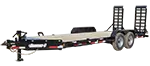
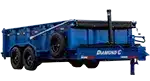
For machines in this range, the current Diamond C LPX low-profile extreme-duty equipment trailer is available in configurations from approximately 15,500 to 24,000 pounds GVWR. Current LPX packages include tandem 7,000-pound, tandem 8,000-pound, tandem 10,000-pound, and triple 7,000-pound Lippert axle arrangements, depending on the selected GVWR and build. Available deck lengths generally run from 16 to 30 feet, while deck width between the fenders is approximately 80 or 82 inches depending on the package. A max-width configuration can create a 102-inch loading surface by incorporating frame extensions and drive-over fenders, which can help with wide-track machines when the equipment, tire placement, and point loads are approved for that configuration.
The LPX normally uses a treated-lumber deck, with other current decking choices available on compatible configurations. Its low deck height and dovetail are useful for compact excavators, skid steers, and other tracked or wheeled equipment with limited ground clearance. Contractors who prefer a gooseneck connection can also consider the Diamond C LPX-GN, provided the truck has sufficient gooseneck towing capacity, rear-axle capacity, payload, hitch rating, and completed-vehicle certification for the loaded combination.
When the machine moves into the upper end of the compact-equipment category or beyond it, calculate payload carefully instead of choosing a trailer from GVWR alone. An excavator weighing approximately 18,000 to 20,000 pounds may exceed the usable payload of some 24,000-pound-GVWR equipment trailers after the trailer’s own weight is subtracted. Appropriate options may include a correctly configured Diamond C HDT, Diamond C LPX-GN, or a commercial dual-tandem deckover such as the current H&H Low Profile Dual Tandem Deckover. The H&H line is offered in heavy commercial configurations with GVWRs beginning around 22,500 pounds and extending higher, depending on axle, brake, tire, and frame selections. Before loading, verify total payload, concentrated track loads, ramp capacity, deck capacity, axle ratings, tire ratings, and the machine’s transport weight.
Ramps Matter More Than People Think
Septic sites are rarely level. The loading area may be on a pitched driveway, a roadside shoulder, soft turf, or a temporary stone entrance. Ramp length, dovetail length, breakover angle, track spacing, and ramp support all affect whether a machine loads smoothly or contacts the trailer at the transition. A low deck and gradual approach can reduce track slippage, undercarriage contact, and abrupt weight transfer onto the rear of the trailer.
Current LPX builds can be equipped with Diamond C’s heavy-duty flip-knee ramps or other compatible loading systems. The standard-style flip-knee arrangement uses spring assistance and works with the trailer’s dovetail to create a manageable loading angle. MAX Ramps provide wider loading surfaces and a longer self-cleaning dovetail on compatible builds. The full-width X-Ramp is designed for eligible max-width configurations and can be useful when track or tire spacing does not align well with separate narrow ramps. Availability depends on trailer length, width package, GVWR configuration, and other selected options.
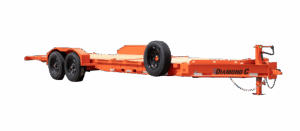
A Diamond C HDT takes a different approach. Its hydraulically dampened tilt deck allows equipment to be loaded without separate rear ramps. The gravity-fed hydraulic dampening system controls deck movement, while the available Pro Tilt arrangement adds powered operation on compatible builds. A tilt trailer can be valuable for frequent loading, but the machine must still fit within the deck’s width, payload, approach-angle, and point-load limits. Whether using ramps or a tilt deck, position the tow vehicle and trailer as straight and level as the site allows, set the parking brake, chock where appropriate, and follow the trailer manufacturer’s loading instructions.
Utility Trailers for Septic Tanks
A precast concrete septic tank is dense, rigid, and sensitive to improper lifting or support. Published weights vary by manufacturer, reinforcement, wall thickness, compartment layout, traffic rating, and design. As representative examples, a conventional 1,000-gallon precast tank may weigh approximately 8,600 pounds, a 1,250-gallon tank may be around 11,500 pounds, and a 1,500-gallon tank may approach 12,500 pounds. Traffic-rated or specially reinforced tanks can weigh more. Poly tanks are much lighter but remain bulky and require securement that will not deform or damage the shell.
Concrete tanks should generally be carried on a flat, adequately rated deck or a purpose-designed support system rather than treated like ordinary landscape cargo. The tank supplier should identify approved lifting points, bearing areas, cribbing requirements, orientation, and securement procedures. The trailer must provide enough payload after its actual empty weight is deducted, enough deck area for the tank and support material, and enough structural capacity for the tank’s concentrated load. Deck height also matters because a tall tank on a high deck raises the overall center of gravity and may create route-clearance or stability concerns.
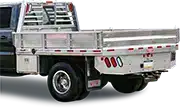
For a single smaller precast tank, a properly configured Diamond C FMAX207 may be suitable only when its actual payload, deck length, axle loading, pin weight, and the tank’s certified weight all work together. The FMAX207 is a Flatbed Max gooseneck with a 15,500-pound GVWR, a 102-inch-wide deck, and tandem 7,000-pound Lippert axles. Because the trailer itself can weigh several thousand pounds depending on length and options, its GVWR should never be mistaken for payload. Heavier configurations such as the Diamond C FMAX210, rated at 25,000 pounds GVWR, provide substantially more capacity for tanks, pipe, attachments, and commercial equipment when paired with a capable truck.
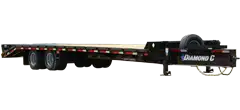
For multiple tanks, reinforced tanks, or a tank accompanied by substantial material, contractors may need a higher-capacity gooseneck or dual-tandem deckover. Current choices can include heavier FMAX models or a Delco F5 30,000-pound-GVWR dual-tandem deckover. The correct selection depends on the exact trailer tare weight, axle and tire ratings, deck dimensions, braking system, tank placement, and truck capacity. A gooseneck hitch transfers a portion of the load to the truck over or slightly ahead of the rear axle, which can improve stability compared with an improperly matched bumper-pull arrangement, but it can also overload the truck’s rear axle or available payload if pin weight is not calculated and confirmed on a scale.
GVWR and Axle Ratings: Read the Sticker
The certification label on the trailer identifies its GVWR and GAWR, but those numbers are only part of the calculation. The loaded trailer must remain within its GVWR, each axle must remain within its GAWR, and every tire, wheel, hub, spring or suspension component, coupler, safety chain, jack, brake, and hitch must be used within its applicable rating. The truck must also remain within its GVWR, front and rear GAWR, GCWR, hitch rating, and manufacturer-specific towing limits. Road, bridge, registration, and commercial operating limits may impose additional restrictions even when the equipment labels appear sufficient.
| Trailer Type | GVWR | Axle Setup | Common Use |
|---|---|---|---|
| Diamond C LPX 207 Package | 15,500 lb | Dual 7,000 lb Lippert | Compact excavator or skid steer when calculated payload is sufficient |
| Diamond C LPX 208 Package | 18,000 lb | Dual 8,000 lb Lippert | Heavier compact equipment and attachments |
| Diamond C HDT 307 Package | 24,000 lb | Triple 7,000 lb Lippert | Ramp-free loading for qualifying equipment |
| Diamond C FMAX210 | 25,000 lb | Dual 10,000 lb Lippert | Concrete tanks, pipe, and heavy equipment when payload permits |
| Delco F5 Dual-Tandem Deckover | 30,000 lb | Dual 15,000 lb axles | Multiple tanks and heavier commercial loads |
Axle ratings do not always add up to the trailer’s full GVWR because a portion of a bumper-pull trailer’s weight is carried through the tongue and a portion of a gooseneck trailer’s weight is carried through the pin and truck. That does not create extra payload beyond the certified GVWR. It means the load must be distributed correctly between the truck and trailer while keeping every individual rating within its limit.
Payload is the trailer’s GVWR minus its actual empty weight in the configuration being used. A published base weight may not include longer deck length, hydraulic equipment, upgraded ramps, spare tires, toolboxes, winches, heavier decking, or other options. The safest method is to obtain the completed trailer’s documented empty weight and confirm the working combination on a certified scale. Weigh the truck alone and then the loaded combination so you can evaluate steer axle, drive axle, trailer axle, truck GVW, trailer GVW, and total combination weight.
Indiana also requires adequate brakes on a trailer or semitrailer with a gross weight of at least 3,000 pounds when operated on a highway. The braking system must be controllable as required from the towing vehicle and must include the required automatic breakaway function. Confirm that the truck’s brake controller is compatible with the trailer’s electric-drum or electric-over-hydraulic system and that the breakaway battery, switch, wiring, and brakes are tested before use.
A trailer rated over 10,000 pounds does not automatically require a CDL by itself. A Class A CDL is generally implicated when the combination’s gross combination weight rating or applicable gross combination weight is 26,001 pounds or more and the towed unit has a GVWR or applicable gross weight over 10,000 pounds. Commercial operators may also face USDOT-number, medical qualification, inspection, registration, insurance, hours-of-service, and cargo-securement requirements below the CDL threshold, depending on whether the operation is interstate or intrastate and how the vehicle is used.
Indiana buyers should also complete title and registration requirements promptly. Indiana generally provides a 45-day period after acquisition for a newly acquired vehicle or trailer to be properly titled and registered without the late-title consequences that can follow after that window. Keep the bill of sale, manufacturer’s certificate of origin or assigned title, temporary permit documentation, and weight information with the business records.
Mud: The Real Filter
Septic sites are frequently wet, soft, uneven, or unfinished. Drain-field areas may be low-lying, spring installations can occur on saturated ground, and new construction sites may have no stabilized driveway. A trailer that performs well on pavement can still become difficult to place, turn, or recover when its tires break through soft soil. Trailer selection helps, but no axle configuration substitutes for a stable access path and a tow vehicle with adequate traction.
Choose tires according to their load rating, speed rating, construction, and suitability for the trailer. Commercial trailer tires are often designed to operate at relatively high inflation pressures and should be maintained at the manufacturer’s specified cold pressure for the application. Airing them down simply to create a larger footprint can generate heat, reduce capacity, damage the casing, or allow the tire to separate from the wheel. Any pressure adjustment should follow the tire and trailer manufacturer’s guidance rather than an off-road rule intended for a different tire type.
Additional axles place the load across more tires, but tandem, triple-axle, and dual-tandem trailers can scrub tires heavily during tight turns. That scrub can increase resistance and tear up soft turf rather than allowing the trailer to float over it. Plan a wide approach, avoid sharp backing corrections, keep the trailer as straight as practical, and stop before the tires sink deeply. Stone access lanes, timber mats, composite ground-protection mats, or properly prepared crane pads are often more effective than relying on trailer design alone.
Low deck height, sufficient frame and jack clearance, a controlled loading angle, and proper weight distribution all matter in mud. Too little tongue or pin weight can encourage sway on the road, while too much can overload the truck’s rear axle and make its front axle too light. Heavy cargo should be positioned from actual scale results and manufacturer guidance, not merely centered visually on the deck.
Deck material affects traction and maintenance as well. Current Diamond C LPX configurations commonly use 2-inch treated lumber, with Blackwood available on compatible builds and steel diamond-plate decking offered in certain configurations. Treated wood can provide useful traction for tracked equipment but requires inspection for rot, splitting, loose fasteners, and damage from concentrated track loads. Blackwood adds a durable rubber-infused wear surface. Steel can shed moisture and mud more readily, but a wet or muddy steel deck may be slippery and should be cleaned before loading. Diamond C’s steel components use the DM Difference Maker multi-stage coating process, but owners should still wash away mud and road salt, touch up damaged areas, and inspect the frame regularly.
Tie-Down Points: Don’t Overlook This
Equipment and tanks require different securement plans. Current LPX configurations include a rub rail with stake pockets and pipe spools, along with rated D-rings, while commercial H&H and Delco deckovers may provide combinations of stake pockets, rub rails, chain spools, and integrated tie-down locations. Verify the rating of each attachment point rather than assuming every pocket, rail, or opening has the same working-load limit.
A concrete tank’s lifting anchors are not automatically approved as highway tie-down points. Follow the tank manufacturer’s instructions and use properly designed dunnage, chocks, cradles, blocking, chains, binders, or straps that will not damage the tank. The tank must be restrained against forward, rearward, sideways, and vertical movement without placing damaging pressure on lids, riser openings, thin edges, inlet or outlet connections, or unsupported sections of the shell. All chains, straps, hooks, binders, and anchor points should have visible working-load ratings, and the securement system must satisfy any cargo-securement rules applicable to the commercial operation.
Machines also need attachment-specific securement. Lower buckets and attachments as directed, relieve stored hydraulic energy where appropriate, use designated tie-down points, and secure loose buckets or implements separately when necessary. Heavy equipment over 10,000 pounds is generally subject to more specific commercial securement requirements, including securement at multiple points. Inspect every binder and chain after the first few miles because tracks, mud, wooden decking, and blocking can settle as the load moves.
Matching the Trailer to Your Truck
Septic contractors commonly use one-ton pickups or medium-duty chassis cabs such as the Ford F-450, Ford F-550, Ram 4500, or Ram 5500. However, a model badge does not establish towing capacity. Ratings vary by model year, engine, cab, wheelbase, axle ratio, drive configuration, suspension, tires, factory packages, body upfit, hitch installation, and completed-vehicle certification. Two trucks that look nearly identical can have materially different GVWR, rear GAWR, GCWR, payload, and trailer ratings.
For example, 2026 Ford F-550 chassis-cab gooseneck ratings vary substantially by configuration, with properly equipped diesel combinations reaching roughly the mid-30,000-pound range while other builds are rated lower. Conventional towing ratings are also lower than the highest gooseneck figures and depend on the completed receiver installation. A chassis cab’s service body, crane, pump system, tank, tools, passengers, and fuel all consume truck payload before trailer pin or tongue weight is added. Use the truck’s certification labels, the applicable model-year towing guide, the upfitter’s completed-vehicle label, and the installed hitch manufacturer’s rating.
Gooseneck pin weight can place several thousand pounds on the truck. A 25,000-pound loaded trailer using a 15-percent planning value would transfer approximately 3,750 pounds to the truck before accounting for the hitch itself or other cargo. Actual pin weight can differ, so it should be measured. The truck must remain below its GVWR and rear GAWR, and the tires and wheels must have enough combined capacity for the loaded rear axle.
A three-quarter-ton pickup is not automatically unsuitable for every septic trailer, but it should not be assumed capable of carrying a heavy precast-tank combination. Some trucks may have enough advertised towing capacity while running out of payload, receiver capacity, rear-axle capacity, or GCWR first. Concrete tank hauling often points toward a properly equipped one-ton pickup, chassis cab, or medium-duty truck, but the final decision must be based on the exact VIN-specific ratings and completed configuration.
For contractors who want one trailer for an excavator on one day and a concrete tank on another, a gooseneck flatbed or deckover in the approximately 20,000- to 30,000-pound GVWR class can be the most versatile starting point. A Diamond C FMAX210, heavier FMAX configuration, or comparably rated Delco or H&H deckover may provide the necessary deck area and payload. The trailer still has to accommodate machine loading, tank support, crane access, track width, ramp capacity, cargo height, and proper securement. A multipurpose trailer works only when every intended load fits within the completed trailer’s actual limits.
Diamond C has built trailers in Mt. Pleasant, Texas, since 1985. Its current premium equipment, dump, and flatbed lines use Lippert axles as standard equipment, with axle size, suspension, brake type, wheel configuration, and GVWR varying by model package. When comparing two trailers, review the complete build sheet rather than assuming trailers with similar deck lengths or advertised GVWRs have the same running gear.
What to Ask Before You Buy
- What is the verified weight of the heaviest machine, tank, attachment, and material combination I will carry? Use a manufacturer’s shipping weight or certified scale weight and leave practical capacity for chains, blocking, tools, mud, accessories, and future equipment.
- How will each load get on and off the trailer? Confirm ramp width, ramp capacity, dovetail angle, tilt operation, crane reach, forklift access, concentrated-load limits, tank bearing points, and whether the loading area will be level and stable.
- What are my truck’s VIN-specific GVWR, front and rear GAWR, GCWR, payload, conventional or gooseneck tow rating, and hitch rating? Include the service body, tools, passengers, fuel, and pin or tongue weight in the calculation.
- Will the trailer spend time on muddy sites or outdoors year-round? Compare deck traction, drainage, coating quality, tire specifications, ground clearance, jack placement, wiring protection, and the maintenance required for wood, Blackwood, or steel decking.
- Does the truck have the correct receiver, gooseneck ball, safety-chain anchors, seven-way wiring, brake controller, and electric-over-hydraulic compatibility for the selected trailer? Also review CDL, commercial registration, inspection, insurance, and operating requirements before putting it into service.
- Will the trailer qualify for a business tax deduction? Federal law restored 100-percent bonus depreciation for qualifying property acquired and placed in service after January 19, 2025, but eligibility depends on the transaction, business use, tax year, and other rules. Have a qualified tax professional review the purchase rather than treating depreciation as an automatic rebate or reduction in the dealer’s sale price.
A good trailer for septic work is not simply the heaviest-rated trailer you can afford. It is the trailer whose actual payload, deck layout, loading system, running gear, securement points, and hitch requirements match your loads and your truck in the conditions where you really work.
If you’re unsure which configuration makes sense for your setup, we keep Diamond C, H&H, and Delco trailers in stock and can walk you through the truck, trailer, payload, axle, hitch, and loading numbers. Browse current inventory to see what’s on the lot, or reach out directly and we’ll spec out options based on your truck and typical loads. Because trailer weights, options, and prices change by individual build, confirm the certification label and complete build sheet for the exact unit you are considering. And if you want to see what comparable rigs have sold for recently, the recently sold page gives you a real-world price reference. Call us at (812) 829-0226 with questions.


