











You’re standing on a dealer lot, looking at two trailers with similar deck lengths and couplers. One rides on a single axle with two tires; the other uses a tandem-axle group with four. The tandem may have a higher rating, more brakes, and greater stability, but axle count alone does not tell you which trailer is right for your work.
Here’s the straight answer: buying more axle capacity than you can use adds weight, cost, tires, bearings, and maintenance. Buying too little capacity is worse because it can overload the trailer frame, suspension, tires, wheels, coupler, hitch, or tow vehicle. The right choice starts with the actual loaded weight, the manufacturer’s certified ratings, and how the trailer will be used.
What the Axle Count Actually Controls
An axle is one important part of a trailer’s capacity, but it does not establish the trailer’s GVWR by itself. Gross Vehicle Weight Rating is the maximum permitted weight of the complete loaded trailer, including the trailer, cargo, accessories, fluids, spare tires, tools, and anything else carried on it. The manufacturer assigns that rating after considering the axles, tires, wheels, suspension, frame, coupler, brakes, and expected tongue weight. A trailer with one 3,500-lb axle may be certified at 2,990 lbs or 3,500 lbs GVWR, while a tandem with two 3,500-lb axles is commonly rated at 7,000 lbs. Always use the GVWR and GAWR shown on the trailer’s certification label rather than calculating a rating from the axle count.
A tandem axle spreads the supported portion of the load across four tires and two axle assemblies. On an equalized leaf-spring suspension, the system can help transfer weight between the axles as the trailer travels over uneven pavement. That can make a properly loaded tandem feel more settled over bridge joints, potholes, and rough job-site entrances. A tandem also provides some tire redundancy after a failure, which may help the driver slow down and reach a safe stopping area. It does not make a blowout harmless, however. A failed tire can damage the fender, wiring, brake components, or neighboring tire, so the driver must reduce speed smoothly and stop as soon as it is safe.
Payload: The Number Most Buyers Get Wrong
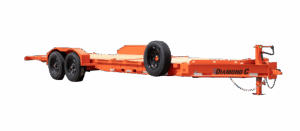
GVWR minus the trailer’s actual unloaded weight gives you its theoretical cargo capacity. The current Diamond C GTU tandem-axle utility trailer is available in 14- to 20-foot lengths with an 83-inch bed, a 7,000-lb GVWR, two 3,500-lb Lippert electric-brake axles, and a 4-inch channel frame. Its usable payload is not automatically 7,000 lbs, because the trailer’s own weight must be subtracted first. Length, ramp gate, flooring, spare tire, toolbox, sides, wheels, and other options can all change the final empty weight. Use the cargo-capacity information supplied with the completed trailer or weigh it before planning a maximum load.
For substantially heavier equipment, the current Diamond C LPX 20-foot equipment trailer belongs to a different capacity class. LPX bumper-pull models are offered in lengths from 16 to 30 feet and in GVWR packages ranging from 15,500 to 24,000 lbs. The 15,500-lb package uses two 7,000-lb Lippert axles, while higher packages can use two 8,000-lb axles, two 10,000-lb axles, or three 7,000-lb axles, depending on the selected configuration. Payload therefore varies considerably. A 20-foot LPX should be matched to the operating weight of the exact skid steer, mini excavator, attachment, bucket, fuel load, and tiedown equipment being transported, not to a generic equipment category.
That is why the real question is what you are hauling and what the complete load weighs. A landscaper moving a zero-turn mower and hand tools may be well served by a light utility trailer. A contractor moving compact construction equipment may need an LPX, HDT, or another properly rated equipment trailer. Obtain the equipment’s actual operating weight, add every attachment, and leave a reasonable capacity margin instead of planning to operate at the rating on every trip.
Towing Stability and Driver Experience
A properly designed tandem trailer often feels more planted at highway speed because its axle group has a longer footprint and the load is supported at four tire positions. That can reduce pitching over road irregularities and make the trailer less reactive to small bumps. Axle count does not cure trailer sway, though. Sway is strongly affected by insufficient tongue weight, excessive rear loading, tire pressure, speed, crosswinds, suspension condition, and the relationship between the trailer and tow vehicle. A badly loaded tandem can be less stable than a correctly loaded single axle.
Single-axle trailers are generally lighter and easier to maneuver by hand. They also pivot more readily during slow backing, which can help when entering a barn, shed, narrow driveway, or compact storage space. That quick response requires attention because a short single axle can also change direction rapidly and jackknife sooner than a longer tandem. Tandem trailers resist tight pivots and may require more room, but some drivers find their slower response easier to control once they become familiar with it.
The weight difference is real, but it should be compared using current, equivalent models. For example, a current H&H 6×12 flat-top single-axle enclosed trailer with a 2,990-lb GVWR is listed at approximately 1,375 lbs curb weight, while the 6×12 tandem version with a 7,000-lb GVWR is listed at approximately 1,750 lbs. The tandem adds about 375 lbs while providing a much higher GVWR. That additional empty weight consumes tow-vehicle payload through tongue weight and can affect acceleration and fuel use, but it also comes with additional suspension, wheels, tires, brakes, and load capacity. Compare the exact VIN-specific weight and rating rather than relying on a general single-versus-tandem estimate.
Tire Wear: The Hidden Long-Term Cost
A single-axle trailer does not automatically wear tires faster simply because it has two tires. Tire life depends on how heavily each tire is loaded relative to its rated capacity, whether it is inflated to the correct cold pressure, axle alignment, bearing condition, speed, road surface, storage, and tire age. A lightly loaded single can provide excellent tire life. A single operated continuously near its maximum rating with low pressure or an uneven load can overheat and damage its tires quickly.
Tandem axles introduce tire scrub during tight turns. Because both axles remain aligned with the trailer frame, all four tires cannot follow the same turning radius. One or more tires must slip slightly sideways across the pavement, especially during sharp, low-speed turns. Frequent pivoting on concrete or asphalt can increase shoulder wear and stress suspension hardware. Bent axles, worn spring bushings, damaged equalizers, or an axle group that is not square to the coupler can create even faster and more uneven wear.
The practical upshot is that neither axle arrangement automatically wins on tire life. A single axle has fewer tires to buy, inspect, and replace and does not experience tandem-axle scrub. A tandem provides more tire positions and some redundancy, but it doubles the number of tires and adds alignment and suspension components. Proper loading, inflation, wheel-bearing service, rotation when recommended, and regular tread inspections matter more than a broad percentage estimate.
Maintenance Costs Side by Side
| Item | Single Axle | Tandem Axle |
|---|---|---|
| Tires (per replacement cycle) | 2 tires | 4 tires |
| Wheel bearings | 2 hubs to inspect and service | 4 hubs to inspect and service |
| Brakes (if equipped) | 0 or 1 braked axle | Commonly 2 braked axles on modern 7K-and-higher work trailers |
| Leaf springs | Usually 2 springs, or one torsion axle | Usually 4 springs with equalizers, or two torsion axles |
| Annual maintenance estimate | Usually lower because there are fewer components | Usually higher, depending on mileage, brakes, tires, and suspension type |
Brake maintenance deserves special attention. Indiana law requires a trailer or semitrailer with a gross weight of at least 3,000 lbs, when operated on a highway, to have brakes adequate to control, stop, and hold the trailer. The driver must be able to apply those brakes from the tow vehicle, and the system must apply the trailer brakes automatically if the trailer breaks away. The current Diamond C GTU has electric brakes on both 3,500-lb Lippert axles. Maintenance can include adjusting or replacing brake shoes, magnets, drums, seals, bearings, wiring, connectors, and the breakaway battery. Hydraulic and electric-over-hydraulic systems have different service items, including hydraulic fluid, lines, calipers, and an actuator or pump. A trailer below the statutory threshold may be sold without brakes, but the tow vehicle and complete combination must still be capable of stopping safely.
When Single Axle Is Simply Enough
There is a real category of buyer for whom a single axle is not a compromise; it is the correct tool. Single-axle trailers can range from lightweight 2,990-lb utility and enclosed models to more specialized trailers such as the Diamond C GST Single Axle Telescopic Dump, which has a 6,000-lb GVWR and an electric-brake axle. The decision should be based on the complete trailer specification, not the assumption that every single axle is limited to 3,500 lbs. A single axle may be the better choice when:
- Recreational towing involves an ATV, motorcycle, personal watercraft, snowmobile, or other equipment that fits comfortably within the listed payload
- Landscaping work involves a residential mower, hand tools, fuel cans, and supplies that remain within the trailer and tow-vehicle ratings
- The heaviest planned cargo leaves adequate capacity after the trailer’s empty weight and installed accessories are deducted
- Occasional hauling is performed with a properly equipped half-ton or midsize truck whose payload, hitch, axle, and towing ratings are verified
- Storage, hand maneuvering, and backing through tight spaces are regular requirements
- Purchase price and maintenance cost matter, and the work does not require tandem capacity or redundancy
A current 6×12 single-axle enclosed cargo trailer can be an efficient choice for light contractor tools, motorcycles, event equipment, or a small delivery operation. A Wells Cargo Road Force or another enclosed trailer should be selected by its exact GVWR, curb weight, axle configuration, door rating, and cargo securement features rather than by model family alone. Likewise, the USA-built Diamond C GST, manufactured in Mt. Pleasant, Texas, provides a current single-axle option for dump work with a 6,000-lb GVWR. Diamond C has built trailers since 1985 and uses its DM Difference Maker multi-stage coating system on current production.
When You Should Seriously Consider Tandem
The conversation changes when your cargo approaches the practical payload limit of available single-axle trailers. For many equipment and utility applications, cargo near or above 5,000 lbs moves the buyer into tandem territory, but 5,000 lbs is not a universal legal dividing line. A properly rated 6,000-lb single-axle dump and a 7,000-lb tandem utility have different empty weights, bodies, frames, loading patterns, and intended uses. Go tandem when:
- Your normal cargo approaches or exceeds the payload capacity of an appropriate single-axle trailer
- You regularly tow at highway speed or cover long distances where a more substantial axle group and tire redundancy are valuable
- You haul skid steers, excavators, tractors, vehicles, or attachments that require a longer deck and careful axle-weight distribution
- You need a trailer with brakes on multiple wheels and a higher-rated frame, coupler, suspension, tires, and wheels
- The trailer will see frequent commercial use and the added capacity, braking, and component redundancy justify the higher maintenance cost
Brands such as Diamond C, Delco, and H&H offer tandem-axle platforms in several ratings and configurations. Dimensions alone do not establish capacity: an 83×20 utility trailer may be rated at 7,000 lbs, 9,990 lbs, or another value depending on its axles and complete design. A current 20-foot Diamond C GTU, for example, retains a 7,000-lb GVWR with two 3,500-lb Lippert electric-brake axles, a 4-inch channel frame, and treated-lumber flooring. Final price varies with the model year, ramp or gate selection, tires, wheels, flooring, accessories, freight, taxes, title, and dealer inventory, so use a current written quote rather than a broad online price range.
A Quick Q&A
Can I tow a tandem with a half-ton truck? Sometimes, but the answer comes from the exact truck rather than the number of trailer axles. Some properly configured half-ton pickups can tow many 7,000-lb tandem trailers, while other versions of the same truck may run out of payload or receiver capacity first. Check the door-jamb payload label, owner’s manual, vehicle-specific towing guide, receiver rating, rear-axle rating, tire ratings, and GCWR. Tongue weight, passengers, cargo, hitch equipment, and accessories all consume truck payload. The actual loaded weight of the truck and trailer must remain within every applicable rating.
Does tandem axle mean I need a weight distribution hitch? Not automatically. The tow-vehicle manufacturer and receiver label determine when weight distribution is required or permitted. The decision depends on loaded trailer weight, tongue weight, receiver limits, vehicle configuration, and handling, not simply axle count. A tandem loaded too heavily at the front may exceed the truck’s receiver or rear-axle rating, while a lighter, correctly balanced trailer may remain within weight-carrying limits. Never use a weight-distribution system on a trailer or surge-brake arrangement unless the hitch, trailer, and brake manufacturer allow it.
Are tandem trailers harder to license in Indiana? Axle count by itself does not create a separate driver’s-license category. Trailers used on Indiana public roads generally need the appropriate registration and plate, and Indiana residents must register a newly acquired vehicle within 45 days of purchase or acquisition to avoid late penalties. Title requirements can differ for trailers with a declared gross weight of 3,000 lbs or less, including eligibility for permanent registration, so the dealer and BMV paperwork for the specific trailer should be followed. A Class A CDL is not triggered merely because a trailer has tandem axles or a GVWR above 10,000 lbs. Under the standard combination threshold, the GCWR must be 26,001 lbs or more and the towed unit must have a GVWR over 10,000 lbs. Commercial use, hazardous materials, passenger transport, and other operating circumstances can add separate requirements.
What counts:
Buy the axle arrangement your real loads and operating conditions require, not the one that simply sounds more substantial. If your heaviest load fits comfortably within a single-axle trailer’s certified payload and you value lower empty weight, easy maneuvering, fewer tires, and simpler maintenance, a well-built single axle can serve you for years. If your work involves heavier equipment, longer decks, frequent highway miles, higher brake capacity, or a need for tire and suspension redundancy, the tandem’s additional components and capacity are usually worth the premium.
Not sure where your loads fall? Call or stop by Spencer Trailers at 291 West State Hwy 46 in Spencer. We can review the certification labels, compare your equipment’s operating weight with the trailer’s actual payload, and check your tow vehicle’s payload, hitch, axle, and combined-weight ratings. We can also show you side-by-side examples from our current inventory. Getting the axle count and complete trailer rating right from the start saves money, reduces downtime, and gives you a safer combination for every trip.


