











December does not ease up on a busy Christmas tree farm. From Thanksgiving through Christmas Eve, crews may be moving cut trees, baling and netting supplies, hand trucks, retail fixtures, wreaths, mulch, and cleanup equipment almost every day. The right trailer keeps those jobs organized and repeatable. The wrong trailer can waste labor, overload the tow vehicle, damage inventory, or create a load-securement problem on the highway.
So let us talk hardware. Not in the abstract, but specifically about the trailer types that fit Christmas tree farm operations, the ratings that matter, and the details to verify before you buy, rent, or put an older farm trailer back into seasonal service.
Why Tree Farms Have Unusual Hauling Needs
A Christmas tree farm is not a single-use hauling operation. The cargo changes by the day, and volume can matter as much as weight. Over a six-week retail season you might haul:
- Cut trees bundled in netting, which are bulky, relatively light for their size, irregularly shaped, and vulnerable to shifting or catching airflow
- Live balled-and-burlapped trees, which concentrate substantial weight in the root ball and require different blocking and securement than cut trees
- Retail display stands, signs, fencing, lighting, hand tools, balers, netting equipment, and checkout supplies
- Mulch, straw bales, decorative greenery, wreaths, garland, and other seasonal inventory that may need containment or weather protection
- Equipment and debris for post-season cleanup, recycling, chipping, field maintenance, and year-round farm work
That mix pushes most farms toward versatility, but “versatile” does not mean one trailer can safely carry anything placed on it. Deck dimensions, payload capacity, axle and tire ratings, brake requirements, tie-down locations, side construction, weather protection, and tow-vehicle limits all matter. Start with the heaviest and most awkward loads you actually move, then choose a trailer that still works efficiently for the lighter jobs.
Utility Trailers: The Workhorse Option
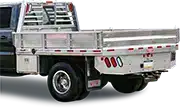
An open utility trailer handles a large share of Christmas tree farm work. A rail-side deck gives crews access from the rear and sides, while a ramp gate can help with hand trucks, mowers, balers, and other wheeled equipment. Cut trees can be carried efficiently when they remain within the trailer’s dimensions, are distributed over the axles, and are secured to rated attachment points rather than relying on the side rails alone.
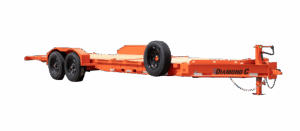
A 16-foot or 18-foot tandem-axle utility trailer with a 7,000 lb. GVWR is a practical starting point for many cut-tree and general farm loads, provided the trailer’s actual payload is sufficient. The current Diamond C GTU tandem-axle utility trailer has a 7,000 lb. GVWR, an 83-inch bed width, available lengths from 14 to 20 feet, two 3,500 lb. Lippert brake axles, a 4-inch channel frame, a 2-inch treated-lumber floor, integrated upright tie-downs, and stake pockets. Diamond C builds its trailers in Mt. Pleasant, Texas, where the company was founded in 1985, and uses the DM Difference Maker multi-stage coating system on current builds. The H&H Rail Side Utility Trailer is also available in multiple widths, lengths, and GVWR configurations, including tandem-axle versions suitable for a 16-foot farm trailer. With any brand, verify the VIN/data plate and build sheet because two trailers with the same advertised deck size may have different GVWRs, axle packages, brakes, tires, floors, and payload capacities. Treated lumber is durable, but it is not immune to trapped moisture, impact damage, fastener corrosion, or eventual decay.
For smaller pick-your-own operations moving modest loads around the property, a 10- to 14-foot single-axle utility may be enough. Diamond C’s current PSA single-axle utility is offered in 77- and 83-inch widths, has a standard 2,990 lb. GVWR configuration, and can be configured with a higher-capacity axle package. Remember that GVWR is the maximum allowable loaded trailer weight, not the amount of cargo you can add. Payload is the trailer’s GVWR minus its actual empty weight and installed equipment. For regular highway trips to an off-site lot, a tandem-axle utility can provide more load capacity, braking capability, tire capacity, and stability, but it still must be loaded correctly and matched to the tow vehicle.
Mesh Sides vs. Open Rails
Bundled trees are long, springy, and difficult to stack into a perfectly rigid load. Mesh or solid sides can help contain branches, netting, and light debris, while seasonal sideboards can increase usable containment height when the trailer manufacturer provides suitable stake pockets or an approved method of installation. Containment is not the same as securement, however. Side panels, ramp gates, mesh, and homemade lumber extensions should not be treated as rated tie-down anchors or as substitutes for straps and blocking. Keep the load within the trailer’s rated capacity, do not exceed the manufacturer’s permitted side-extension height or loading instructions, and attach securement only to points whose working load limit is known.
Dump Trailers for Tree Farms
If your farm handles post-season tree recycling, chipped material, brush, compost, soil, or loose mulch, a dump trailer can earn its keep well beyond December. It can reduce hand unloading and make repeated cleanup trips more efficient. A dump body is also useful for containing small debris, but loose material still needs an appropriate tarp or cover when required to prevent it from escaping on the road. Wet mulch, soil, and wood chips can be much heavier than they look, so load by measured weight rather than by how much empty space remains in the box.
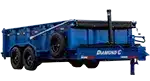
The current Diamond C LPT Heavy Duty Low Profile Telescopic Dump Trailer is available in 12-, 14-, and 16-foot lengths with an approximately 81- to 82-inch bed width and GVWR packages from 15,500 to 24,000 lb. The standard 15,500 lb. package uses two 7,000 lb. Lippert axles, while higher-capacity packages use the applicable upgraded Lippert axle and running-gear configurations. The LPT uses a heavy-duty telescopic hoist and is designed for a 45-degree dump angle. Depending on length, GVWR package, and options, current published empty weights for the LPT line span roughly 4,440 to 6,930 lb., so the precise payload must be calculated from the certification label for the specific trailer. Farms that do not need an LPT’s heavy-duty capacity can also compare the Diamond C MDT, a 9,890 lb. GVWR medium-duty telescopic dump offered in 10- and 12-foot lengths with dual 6,000 lb. Lippert brake axles.
One honest caution: dump trailers are heavy before the first tree, bucket of mulch, or load of soil goes in. Their tongue weight can consume a large share of a pickup’s payload rating, and a loaded heavy-duty dump may exceed the conventional towing, receiver, hitch, tire, rear-axle, or gross-combination ratings of many pickups. Do not choose a tow vehicle by the “half-ton,” “three-quarter-ton,” or “one-ton” badge alone. Confirm the truck’s exact configuration, payload, receiver rating, permitted trailer weight, GCWR, axle ratings, tire ratings, brake-controller compatibility, and the trailer’s loaded tongue weight. Never raise a dump body for inspection or service without following the manufacturer’s procedure and using the approved body-prop or support system.
Enclosed Trailers for Retail Operations
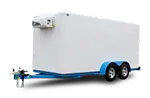
Tree farms with a retail store, holiday market booth, or off-site sales lot have different needs from wholesale growers. Enclosed trailers protect wreaths, garland, ornaments, signs, point-of-sale supplies, electrical equipment, and boxed inventory from rain, road spray, snow, and theft. They also provide lockable overnight storage at a remote lot. The tradeoff is higher aerodynamic drag, limited side access, and a need to manage payload carefully because shelving, cabinets, spare tires, generators, and interior build-outs all count against the trailer’s available capacity.
The current Darkhorse DHW 6×12 single-axle enclosed trailer is commonly sold in a 2,990 lb. GVWR configuration with a 3,500 lb. axle; actual empty weight and payload vary by door style, interior height, options, and model year. That size can work well for lighter retail inventory, but it should not be selected by box dimensions alone. Step up to a Wells Cargo Road Force 7×16 tandem-axle enclosed trailer when you need more floor space and a 7,000 lb. GVWR configuration. The Road Force uses a tubular steel frame, not an aluminum frame, and the usable payload must still be confirmed on the individual trailer’s certification label after accounting for ramps, shelving, spare tires, and other installed equipment.
Legend Manufacturing’s aluminum V-nose enclosed trailers are another option worth comparing when lower empty weight, corrosion resistance, and added front interior volume are priorities. Current Legend 7×16 tandem-axle V-nose configurations are available with a 7,000 lb. GVWR. A V-nose can change the front storage layout and airflow around the trailer, but it should not be purchased on the assumption that it will guarantee a meaningful fuel-economy improvement. Tow-vehicle shape, trailer height and width, speed, wind, tire pressure, weight, and driving conditions often have a larger effect on fuel use.
Securing Trees: Do Not Guess at This
Bundled cut trees may be light individually, but a stacked group can settle, compress, and shift after the first few miles. Netting can loosen, branches can work free, and straps can lose tension as the load changes shape. Secure the load for braking, turning, bumps, wind, and emergency maneuvers, not just for a slow trip across the farm.
- Use the correct number and capacity of tiedowns: Choose straps, chains, cables, hardware, and anchor points with legible working load limits and inspect them for cuts, abrasion, damaged stitching, bent hooks, corrosion, or missing labels. Indiana’s long-object securement rule requires at least three qualifying securement devices for covered loads or portions of loads more than 10 feet long, with one near each end and one near the center. Commercial motor vehicles may also be subject to the federal cargo-securement rules in 49 CFR Part 393, including tiedown-count and aggregate working-load-limit requirements. Use more securement whenever the load’s shape, height, or tendency to compress demands it.
- Load for weight distribution and movement control: Keep trees within the deck and legal dimensions whenever possible, place the load against an appropriate front structure or blocking when the trailer is designed for it, and distribute weight so the trailer maintains the tongue weight specified by its manufacturer. Do not pile trees so high that straps bear only on soft branches while the lower layers remain free to move. Stop after a short distance, inspect the load, and retighten as the bundles settle.
- Use rated attachment points: The trailer’s GVWR does not establish the rating of every D-ring, stake pocket, rail, or welded tab. Use the manufacturer’s documented anchor ratings and match them with compatible hardware. The combined working load limit of the securement system must satisfy the rules applicable to the vehicle and cargo. Mesh sides, ramp-gate mesh, removable sideboards, and light top rails are containment features unless the manufacturer specifically identifies them as rated securement points.
- Secure balled-and-burlapped trees at the root ball: A root ball may weigh tens or hundreds of pounds depending on tree size, species, soil moisture, and ball diameter. Set each ball in a cradle, chock, blocking pocket, pallet, or other method that prevents rolling and sliding, then secure the root ball or wire basket with a method that will not cut the burlap or damage the tree. Do not rely on a strap over the trunk as the primary restraint; controlling the heavy root ball is the key.
Indiana law does more than prohibit an object from falling completely off the trailer. IC 9-21-8-48 prohibits operating a vehicle on a highway when its contents are dripping, sifting, leaking, or otherwise escaping, subject to limited exceptions. IC 9-20-18-14 addresses securement of logs, lumber, poles, and similar long objects and requires strength-identified securement with compatible hardware. Trees, branches, loose netting, needles, mulch, and debris should therefore be contained and secured so they cannot escape. A tarp can help contain light material, but it does not replace the primary tiedowns holding the trees.
Matching Trailer to Tow Vehicle
| Trailer Type | Common GVWR | Tow-Vehicle Requirement |
|---|---|---|
| Single-axle utility (about 6×12) | 2,990 to 3,500 lb. common; higher packages exist | Vehicle, receiver, hitch, tires, payload, and GCWR must cover the actual loaded trailer and tongue weight |
| Tandem utility (7×16) | 7,000 lb. common | A properly equipped pickup or SUV may qualify; verify the exact vehicle configuration and hitch limits |
| Heavy-duty dump (14-foot LPT) | 15,500 to 24,000 lb., by package | A properly rated heavy-duty truck and hitch system; many configurations exceed half-ton limits and may affect CDL status |
| Enclosed cargo (7×16) | 7,000 lb. common | A properly rated tow vehicle with enough payload for tongue weight and enough reserve for the trailer’s aerodynamic load |
These are category-level starting points, not approvals for a specific combination. The certification label on the truck identifies GVWR and GAWR, and the tire-and-loading label helps establish available payload, but the correct trailer rating and GCWR often must be confirmed through the manufacturer’s owner’s manual, towing guide, VIN-specific lookup, or dealer system. Check the receiver, ball mount, hitch ball, coupler, safety chains, brake controller, tires, and wheels separately because the lowest-rated component controls. Weigh the truck and loaded trailer when practical, and remember that passengers, fuel, tools, bed cargo, accessories, and trailer tongue weight all consume vehicle capacity.
A Quick Q&A for Tree Farm Buyers
Can I use the same trailer year-round after the season ends?
Yes, and year-round use should be part of the purchase decision. A 16-foot utility trailer that carries properly secured trees in December can move fencing, mowers, compact equipment, firewood, pallets, or farm supplies during the rest of the year, as long as each load stays within the trailer’s ratings and is secured for its own shape and weight. A dump trailer may provide even more off-season value for mulch, compost, brush, and maintenance work, while an enclosed trailer can become protected storage or a mobile retail and tool trailer.
Is it worth buying versus renting for a six-week season?
Do not rely on a generic weekly rental estimate or an old used-trailer price. Local rates and inventory can change quickly, and the advertised rate may not include delivery, taxes, deposits, damage waivers, mileage, cleaning, late-return charges, or the exact trailer configuration you need. Compare a current written rental quote for the full season with the purchase price, financing cost, insurance, registration, maintenance, storage, expected resale value, and the value of having the trailer available for setup, harvest, cleanup, and off-season work. Renting can make sense for a one-time need; buying often makes more sense when the same capacity will be used for several seasons or throughout the year.
Do I need a CDL to tow a loaded dump trailer?
Possibly. Under the standard Class A CDL threshold, the combination reaches CDL territory when the GCWR or actual gross combination weight is 26,001 lb. or more and the towed unit has a GVWR or actual gross weight over 10,000 lb. The 26,001 lb. figure applies to the combination, not to the trailer by itself. A truck with a high GVWR paired with an LPT or another heavy dump trailer can cross that threshold even when the trailer is not loaded to its maximum. Separate CDL rules apply to certain passenger and hazardous-material operations, and limited farm-vehicle exemptions may apply only when all eligibility and operating conditions are met. Confirm the ratings, actual weights, route, business use, and licensing rules for your specific operation rather than assuming every pickup-and-dump combination is exempt.
What to Look For on a Used Trailer
Tree farms working with tight seasonal budgets often consider used equipment. That can be a sound purchase, but inspect the trailer as a complete rated system rather than judging it by paint and deck size alone:
- Check the main frame, tongue, crossmembers, spring hangers, equalizers, axle mounting points, rear corners, coupler, safety-chain attachments, and ramp or gate hinges. Look for cracks, distorted steel, fresh paint over repairs, heavy scaling, poor weld repairs, or evidence that the trailer has been overloaded or twisted. On a dump trailer, inspect the body pivots, hoist mounts, hydraulic lines, cylinder, pump, battery, wiring, and approved body-prop system.
- Safely raise each wheel according to the manufacturer’s procedure and check bearing play, roughness, noise, seal leakage, hub temperature history, and brake condition. Inspect every tire for its load range, maximum pressure, date code, weather cracking, cuts, uneven wear, repairs, and capacity. Tire capacity must support the applicable axle load, and an old tire with good tread can still be unsuitable for highway service.
- Test all running lights, brake lights, turn signals, reverse lights if equipped, electric brakes, brake controller response, breakaway switch, and breakaway battery. Indiana requires trailers over 3,000 lb. GVWR that are operated on the highway to have brakes adequate to control, stop, and hold the combination, with the brakes applied from the towing vehicle and designed to apply automatically if the trailer breaks away. A 2,990 lb. rating should not be treated as permission to load beyond the certification label.
- Inspect wood decking from above and below for softness, splitting, loose fasteners, chemical damage, and rot around the edges and between crossmembers. On enclosed trailers, check floor and wall moisture damage, roof seams, doors, ramp capacity, and interior modifications. On dump trailers, inspect the floor for bowing or severe impact damage and never crawl under a raised body that is supported only by hydraulics.
Verify the VIN, certification label, title, seller identity, lien status, GVWR, GAWR, and model information before money changes hands. After an Indiana purchase, apply for title within the state’s 45-day penalty-free window; an administrative penalty can apply after that period. A used trailer from a dealer with documented inspection and service history may be worth more than a private sale where critical ratings or repairs are uncertain. Spencer Trailers carries both new and available inventory if you want to compare utility, dump, enclosed, and used options in person before the season begins.
Timing Your Purchase
This matters more than many seasonal buyers expect. Farms often wait until October or November to inspect their hauling equipment, which leaves little time to correct a brake problem, replace tires, install rated tie-downs, match a brake controller, or order a trailer with the right axle and gate configuration. In-stock selection and factory lead times change throughout the year, and a model shown in a catalog may not be immediately available in the exact length, GVWR, color, ramp, side, or tire package you need.
Spring and summer are useful planning windows for a Christmas tree operation because they give you time to compare actual payloads, measure the tow vehicle and storage area, test loading methods, add manufacturer-approved equipment, complete title and registration work, and train employees on coupling, brakes, breakaway systems, inspections, and load securement. Earlier shopping does not guarantee a discount, but it does reduce the pressure to accept the wrong trailer simply because the season has already started.
If you are reading this close to the season and need something now, check what is physically in stock and confirm the certification label, empty weight, payload, axle package, brakes, tires, floor, gate, and tie-down equipment before making a decision. Call the team at (812) 829-0226 to ask what is currently on the lot, or stop in at 291 West State Hwy 46 in Spencer. If you are planning for next year, review the full inventory early enough to compare utility, dump, and enclosed configurations without rushing.
What is your biggest hauling headache during the tree season: bulky cut trees, heavy root balls, protected retail inventory, loose cleanup debris, or a tow vehicle that is already close to its limits? That answer usually points directly to the trailer type, GVWR, deck size, and securement system you should be evaluating.


