











January is when serious buyers start turning plans into equipment. The holiday noise is gone, the truck is sitting in the driveway, and you’ve had time to think about what the coming year actually requires. Maybe you need to move more equipment between jobs. Maybe you’re adding a landscaping crew. Maybe the farm has outgrown a borrowed utility trailer. Or maybe you’ve relied on your neighbor’s trailer long enough and it is time to own the right tool for the work.
Whatever pushed you here, the start of the year can be one of the smarter times to buy a trailer. The advantage is not a guaranteed winter discount or a universal model-year changeover. It is the opportunity to compare current inventory, order before the spring rush, arrange financing and paperwork carefully, and put the trailer to work for most of the year. Here’s how to think through it.
Why January and February Work in Your Favor
Trailer manufacturers do not all follow the same automotive-style model-year calendar. Specifications, option packages, component availability, warranties, and model-year designations can change throughout the year. By January or February, a dealer may have a mix of newly arrived current-build trailers, remaining prior-model-year units, and incoming orders. That mix can be useful because you can compare the certification label, build sheet, warranty coverage, equipment package, actual empty weight, and price on each individual trailer instead of assuming that every unit with the same model name is identical.
Dealership traffic also often slows after the holidays and before the spring construction, mowing, farming, and recreational seasons are fully underway. That gives our team more time to discuss your tow vehicle, measure equipment, compare loading systems, review payload rather than just GVWR, and check whether a particular stock unit has the axle package, deck length, ramps, brakes, tires, coupler, jack, and tie-down points your work requires. If a custom order is necessary, starting early also gives you more room for manufacturer lead time without forcing a rushed substitute when the busy season begins.
And if you’re planning a business purchase, the calendar reset matters for cash-flow planning, financing, budgeting, and tax discussions. It does not create an automatic tax benefit simply because the purchase happens in January, but it can give you nearly a full year of productive use and enough time to place the trailer in service properly. More on that below.
Set a Real Budget Before You Walk Onto the Lot
The biggest mistake buyers make is starting with a vague sense of “around $5,000” and then falling in love with a trailer that costs twice that amount. The more expensive trailer may be exactly right, especially if it provides the payload, frame, braking, loading angle, or deck length the job requires. But you should arrive at that number on purpose, not by accident.
At current market levels, and using the kinds of trailers commonly stocked at Spencer Trailers as a planning guide, this is a more realistic starting framework:
- Light utility and landscaping work: New single-axle utility trailers with approximately 2,990 to 3,500 lb GVWR commonly start in the upper-$2,000s and can move toward $5,000 or more as width, length, aluminum construction, side extensions, specialty gates, upgraded flooring, spare tires, and other options are added.
- Mid-duty hauling (ATVs, mowers, small equipment, and cargo): A basic 7,000 lb GVWR tandem-axle utility trailer may begin in the mid-$4,000s, while enclosed trailers, car haulers, low-profile designs, and powered tilt models can move into the $7,000 to $11,000 range or higher. A 7,000 lb GVWR does not mean a 7,000 lb payload; subtract the trailer’s actual empty weight and all installed options.
- Heavy equipment and commercial loads: Premium Diamond C LPX and HDT bumper-pull equipment trailers, DEC deck-over equipment trailers, and FMAX gooseneck flatbeds can range from the low-$10,000s to more than $40,000 depending on GVWR, length, axle package, tires, loading system, hydraulic dovetail, deck-on-the-neck configuration, winch equipment, and other options. Current Diamond C heavy-duty lines span roughly 15,500 lb through 40,000 lb GVWR by model and configuration, so the price spread is much wider than a single “heavy equipment trailer” category suggests.
These are planning numbers, not quotes. Inventory pricing changes with model year, manufacturer programs, steel and component costs, freight, options, and whether a unit is in stock or custom ordered. Build an out-the-door budget that also accounts for sales tax, title and registration charges, any disclosed documentation or financing costs, a compatible hitch or gooseneck ball, brake controller, weight-distribution equipment when applicable, spare tire, chains, binders, straps, winch, tarp, and delivery. That keeps you from walking in expecting a 25-foot gooseneck with a premium loading system on a basic utility-trailer budget.
New-Model Availability: What to Ask About Right Now
If you’ve been watching a specific brand or line, winter is a good time to ask what is physically on the lot, what is already scheduled to arrive, and what can be ordered. Manufacturers such as Diamond C and H&H revise features and packages as production changes, but a newer model year does not automatically mean more payload or a stronger trailer. Compare the VIN-specific certification label and build sheet. Axle ratings, GVWR, empty weight, tire capacity, deck dimensions, ramp style, brake type, frame construction, and warranty coverage matter more than the model-year number by itself.
A few current lines worth asking about when you visit:
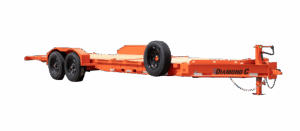
- Diamond C LPX: The LPX is Diamond C’s low-profile extreme-duty bumper-pull equipment trailer. Current manufacturer literature lists 15,500 to 24,000 lb GVWR, 16- to 30-foot lengths, and 80- to 82-inch bed widths. The standard current package uses two 7,000 lb Lippert axles, with available triple-7K, tandem-8K, and tandem-10K configurations. Some 2025 and early-2026 dealer inventory may carry a 14,900 lb certification, so the label on the exact trailer controls. Loading choices include MAX Ramps and, on compatible max-width builds, the X-Ramp system. Diamond C’s premium LPX, HDT, LPT, FMAX, WDT, and DEC lines use Lippert axles as standard, and the trailers receive the multi-stage DM Difference Maker coating system. Diamond C has built trailers in Mount Pleasant, Texas, since 1985.
- H&H steel equipment and tilt trailers: H&H offers several distinct steel work-trailer families rather than one universal flatbed specification. Current electric tilt inventory includes 7,000, 9,900, and 14,000 lb GVWR configurations, while the Industrial Equipment line is offered in 14,000 and 16,000 lb GVWR versions. Depending on the model, features can include pressure-treated pine decking, stake pockets, electric brakes, spring-assist ramps, hydraulic tilt operation, and fully sealed wiring. Compare the exact model because a 7K electric tilt and a 14K industrial equipment trailer are built for different payloads and loading jobs.
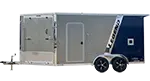
- Legend aluminum cargo: Legend builds all-aluminum enclosed cargo trailers for tools, powersports, landscaping equipment, and general cargo. Aluminum construction can reduce empty weight and avoids structural steel-frame rust, but it does not automatically guarantee a particular tongue weight or fuel-economy improvement. Those depend on trailer size, aerodynamics, axle placement, cargo distribution, tow speed, and the tow vehicle. Compare the actual curb weight, GVWR, payload, interior dimensions, door opening, floor rating, and tie-down layout for the specific Legend model.
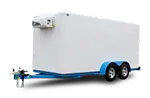
- Wells Cargo enclosed trailers: Enclosed models can be a strong fit for contractors and mobile businesses that need lockable storage and weather protection. The Wells Cargo FastTrac line currently lists a one-piece aluminum roof, LED exterior lighting, undercoated chassis, E-Z Lube hubs, and model-dependent floor, wall, door, axle, and GVWR specifications. The one-piece roof reduces roof seams, but weather resistance still depends on proper seal maintenance around vents, trim, doors, lights, and fasteners.
- Delco equipment trailers: Delco offers bumper-pull equipment trailers in heavy tandem-axle configurations, including current 14K and 16K classes, as well as utility, dump, gooseneck, and roll-off designs. A current wide bumper-pull equipment configuration uses a 102-inch-wide drive-over-fender deck, tandem electric-brake axles, an I-beam frame, treated pine floor, and slide-in ramps. Confirm axle rating, deck width, overall width, ramp capacity, coupler rating, tire load range, and payload on the exact build rather than choosing on price alone.
We carry these brands and can check current stock, incoming units, and special-order availability. Inventory can change quickly, so if a specific trailer has sold, we will verify the current lead time and available factory configuration rather than estimate from an old listing.
Planning a Business Purchase: Think About the Full Year
If the trailer is going on the business books, January planning is worth taking seriously. You do not want to reach November and discover that the crew needs equipment but cash is committed elsewhere, the correct trailer has a production lead time, or the tow vehicle is not rated for the combination you selected.
A few practical angles:
Match the trailer to the revenue it will generate. A landscaping company running two crews and moving mowers to several properties every day has a different return-on-investment calculation than a property owner hauling a compact excavator twice a year. Include downtime avoided, rental fees eliminated, delivery charges saved, labor efficiency, insurance, maintenance, tires, registration, financing cost, and resale value. A cheaper trailer that cannot legally or safely carry the heaviest routine load is not the lower-cost choice.
Consider financing early in the year. Rates, down payments, loan terms, collateral requirements, and prepayment provisions vary. Financing may make more sense than paying cash if working capital is more valuable inside the business, but compare the total amount paid rather than only the monthly payment. Ask for the selling price, down payment, amount financed, annual percentage rate, term, fees, and total finance charge. We can connect qualified buyers with lenders that finance trailers and commercial equipment.
Get the registration, titling, braking, and licensing questions settled before the busy season. Indiana residents generally must apply for title and register a newly acquired, unregistered trailer within 45 days of purchase or acquisition to avoid late penalties. Separately, Indiana requires trailers over 3,000 lb GVWR to have brakes capable of being applied from the tow vehicle and an automatic breakaway function. For CDL planning, the key Class A threshold is a combination GCWR of 26,001 lb or more when the towed trailer has a GVWR over 10,000 lb; a trailer over 10,000 lb by itself does not automatically create a Class A CDL requirement when the combination remains below 26,001 lb. Commercial use can trigger additional state or federal requirements even below the CDL threshold, so verify the complete truck-and-trailer combination and how it will be operated.
The Section 179 Note (Read This With Your CPA)
Disclaimer: The following is general information only. Tax law changes and individual business circumstances vary. Always consult a qualified CPA or tax professional before making decisions based on Section 179, bonus depreciation, financing, business-use percentages, or any other tax provision.
That said, here’s the general concept: Section 179 allows a business to elect to expense the cost of qualifying property in the tax year the property is placed in service instead of recovering the entire cost through regular depreciation over multiple years. A trailer purchased for qualifying business use is generally the type of tangible depreciable property that may be eligible, but the allowable deduction depends on ownership, placed-in-service date, cost, business-use percentage, taxable business income, annual limits, and the taxpayer’s full situation. Buying a trailer does not create a deduction until it is ready and available for its intended business use.
The reason January matters is practical, not magical. Tax law does not give a larger Section 179 deduction merely because you bought in January rather than later in the same tax year. However, an early purchase can give the business most of the year to use the asset, confirm that it is correctly titled and insured, document business use, and avoid a rushed year-end purchase that is not actually placed in service by December 31. Equipment ordered in December but delivered and made ready for use the following year generally belongs to the following year’s placed-in-service analysis.
For tax years beginning in 2026, the federal Section 179 maximum is $2,560,000, with the deduction beginning to phase down when total qualifying Section 179 property placed in service exceeds $4,090,000. Those figures are business-wide limits, not a special allowance for one trailer, and Section 179 is also limited by taxable income from the active conduct of a trade or business. Current federal law also provides 100% additional first-year bonus depreciation for eligible property acquired and placed in service after January 19, 2025. Section 179 and bonus depreciation have different rules and ordering, and the best choice is not identical for every taxpayer.
Business use generally must exceed 50% for Section 179 treatment, and a later drop in qualified business use can create recapture. Financing the purchase does not necessarily prevent a deduction if the business owns the trailer and otherwise qualifies, but cash flow and tax treatment are separate questions. Your CPA should confirm eligibility, the deductible basis, state tax treatment, and whether Section 179, bonus depreciation, regular depreciation, or a combination is appropriate.
The practical upshot: if you’re a business owner who was already planning to buy, waiting until December and rushing a capacity, financing, or tax decision is usually worse than buying deliberately, putting the correct trailer into service, and keeping clean records throughout the year.
A Quick Question to Ask Before You Buy
What’s the heaviest complete load you’ll ever put on this trailer?
Not the average machine by itself. Count the machine with fuel, bucket, forks, mower deck, loader, counterweights, attachments, spare parts, tools, pallets, debris, or other cargo that may ride with it. Then add the trailer’s actual empty weight, including factory and dealer-installed options. GVWR is the maximum allowable loaded weight of the trailer; payload is approximately GVWR minus the trailer’s actual empty weight. Axle ratings, tire and wheel capacities, coupler rating, frame limits, and load distribution also matter, so GVWR alone is not permission to load every pound at any point on the deck.
Buying too light and overloading is dangerous, can violate weight and equipment laws, increases stopping distance, and can damage tires, bearings, axles, brakes, suspension, frame, and tow vehicle. Buying more trailer than the truck can handle is not safer. A heavier trailer consumes more of the truck’s tow rating, payload, rear-axle capacity, hitch rating, and available tongue or pin-weight capacity before cargo is added.
Here’s a simple screening table to map common loads to a starting GVWR class. It is not a substitute for weighing the equipment and subtracting the exact trailer’s empty weight:
| Common Load | Approximate Weight | Suggested Minimum GVWR |
|---|---|---|
| Zero-turn mower (large commercial) | About 1,000 to 1,700 lbs before fuel and accessories | 2,990 to 3,500 lb single-axle, only after confirming adequate payload |
| Two mowers + equipment | About 2,500 to 4,000 lbs with handheld tools, fuel, and accessories | 7,000 lb tandem is a common starting point |
| Mini excavator (5,000 to 7,000 lb machine) | About 5,500 to 8,000 lbs with bucket or attachment | 12,000 to 15,500 lb equipment trailer, based on actual trailer weight and payload |
| Skid steer loader | About 6,000 to 10,000+ lbs; compact track loaders and attachments can be heavier | 14,900 or 15,500 lb class for many machines; 18,000 to 20,000+ when load and trailer weight require it |
| Full-size tractor | About 8,000 to 18,000+ lbs with loader, ballast, and implement | 20,000 to 40,000 lb gooseneck class depending on the complete load and trailer empty weight |
Pull out the operator’s manual or manufacturer specification for your heaviest piece of equipment, include every attachment that will travel with it, and verify the real weight whenever possible on a certified scale. That complete cargo weight, combined with the exact trailer’s empty weight and the tow vehicle’s ratings, is your anchor calculation.
What to Do Before Visiting the Dealership
You don’t need to arrive with everything figured out. But a few minutes of preparation makes the conversation much more useful and prevents the trailer from being selected in isolation from the truck and the load:
- Know the tow vehicle’s VIN-specific tow rating, GCWR, GVWR, rear GAWR, payload, tire capacities, receiver or gooseneck rating, and maximum tongue or pin weight. The driver’s-door labels usually show GVWR, axle ratings, tire information, and a payload or cargo statement; the owner’s manual or manufacturer towing guide is normally required for the correct tow rating and GCWR.
- Write down your three most common loads and the heaviest possible complete load. Include fuel, buckets, forks, implements, pallets, tools, and accessories, not just the base machine weight.
- Decide whether this is a personal or business purchase because that can affect financing, insurance, registration, recordkeeping, and regulatory questions. For commercial combinations, check CDL and any applicable motor-carrier requirements before choosing the final GVWR.
- If you’ve seen a specific trailer online, note the manufacturer, exact model code, stock number, model year, GVWR, length, and listed options. We can quickly confirm whether that individual unit is available and compare it with incoming or orderable configurations.
From there, we can do the rest. Browse our current inventory before you come in so you have a sense of what is on the lot, but treat every listing as a starting point until the stock number, certification label, payload, options, and current price are confirmed. If you want to talk through specifics before making the drive to Spencer, call us at (812) 829-0226.
The buyers who start planning in January are the ones most likely to show up in March with the correct truck-and-trailer combination, proper paperwork, and enough payload for the work instead of scrambling for whatever happens to be available. What does your year need to look like?
Reach out to our team or stop by 291 West State Hwy 46, Spencer IN 47460 to see what’s available now.


