








Two cars, one trailer, one trip. The math sounds simple until you account for the trailer’s empty weight, the combined length of both vehicles, axle loading, hitch weight, tow-vehicle limits, and the capacity of every tie-down and anchor point. A combination that is within the trailer’s GVWR can still be unsafe if one axle is overloaded, the tongue or pin weight is wrong, the deck is too short, or the tow vehicle exceeds its payload or rear-axle rating.
Done correctly, hauling two cars at once can save time, fuel, and wear on a second tow vehicle. Done incorrectly, it can overheat tires and wheel bearings, damage suspension components, reduce steering control, produce severe trailer sway, or contribute to loss of control at highway speed.
This is not a job for estimates based only on vehicle curb weights or a trailer’s advertised axle size. You need actual dimensions, verified ratings, and scale weights before you load both vehicles and head down the road.
Start With the Trailer’s Actual Ratings
The first number to check is GVWR, or Gross Vehicle Weight Rating. GVWR is the maximum permitted weight of the trailer and everything carried on it. It includes the trailer itself, both vehicles, ramps, winches, batteries, spare tires, toolboxes, chains, straps, wheel chocks, fuel containers, and any other equipment riding on the trailer.
Payload capacity is not the same as GVWR. To determine the trailer’s real payload capacity, subtract its actual empty weight as equipped from its GVWR. Do not rely automatically on the lightest brochure weight. Optional ramps, a hydraulic dovetail, a winch, additional batteries, upgraded flooring, extra toolboxes, and heavier axle packages can add hundreds or even thousands of pounds.
For example, if a trailer has a 15,500 lb GVWR and weighs 5,200 lb in its current configuration, its maximum theoretical payload is 10,300 lb:
15,500 lb GVWR – 5,200 lb empty trailer weight = 10,300 lb payload capacity
That does not mean every 10,300 lb load will be safe. The load must also fit within the trailer’s individual axle ratings, tire and wheel ratings, hitch or coupler rating, deck dimensions, ramp capacity, and approved cargo-securement limits.
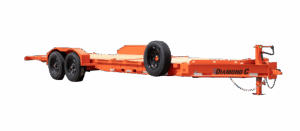
Not every trailer marketed as a car hauler is long or heavy enough for two vehicles. The current Diamond C GTF, for example, is a single-car flat-deck hauler offered in approximately 14- to 22-foot lengths with GVWR configurations from 7,000 to 9,890 lb. It is an excellent fit for one car, but it is not a general-purpose two-car platform.
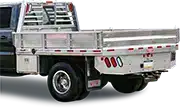
Current Diamond C trailers that may be suitable for carefully planned two-vehicle loads include longer DEC and DET deck-over equipment configurations and selected FMAX gooseneck flatbeds. The DEC is available in lengths up to approximately 30 feet with current GVWR configurations in the 15,500- to 23,000-lb range. FMAX models cover a much wider range, from the 15,500-lb FMAX207 through heavier configurations reaching 40,000 lb GVWR, depending on the exact model, axle package, length, and options. Current premium Diamond C lines use Lippert axle packages.
Deck length is frequently the first limitation. Two cars that are each 175 inches long occupy a combined 350 inches, or 29 feet 2 inches, before you provide any space between them or room for ramps, tie-down access, overhang restrictions, and safe positioning. Two vehicles that are each 198 inches long require 33 feet of deck before adding clearance. A trailer advertised as 20 or 22 feet long is normally a one-car trailer, regardless of how much unused payload capacity appears on paper.
Measure the actual overall length and width of both vehicles. Do not rely only on wheelbase. Mirrors, bumpers, hitches, brush guards, spoilers, and rear-mounted spare tires can change whether the vehicles fit. Also verify the trailer’s usable deck length rather than its overall length from coupler to tail.
Axle ratings matter separately. A trailer equipped with two 7,000 lb axles has a 14,000 lb aggregate axle rating, but each axle still has its own 7,000 lb Gross Axle Weight Rating. Tires and wheels may introduce lower limits. A tire rated for 3,520 lb, for example, supports 7,040 lb per axle when properly inflated and used in a two-tire configuration, but only if the wheels, hubs, bearings, suspension, and axle are rated accordingly.
The trailer certification label, VIN documentation, manufacturer build sheet, axle labels, tire sidewalls, and wheel specifications should all agree with the load you plan to carry. The lowest applicable rating controls.
Wedge Deck vs. Flat Deck: Pick the Right Tool
Two-vehicle loads can be carried on several deck styles, but a fixed wedge, a tilt deck, and a dovetail are not the same design. Each changes the loading angle, usable deck space, weight distribution, and loading procedure.
Wedge, Tilt, or Dovetail with Ramps
A fixed wedge trailer uses a permanently sloped rear deck to reduce the transition angle between the ground, ramps, and main deck. A dovetail uses a shorter sloped section at the back of an otherwise level deck. A tilt trailer pivots part or all of the deck hydraulically or mechanically so the rear approaches the ground during loading.
All three can help with lower-clearance vehicles, but none automatically makes a trailer suitable for two cars. The trailer must still provide enough usable deck length after accounting for the sloped or moving section. On a tilt trailer, the first vehicle’s location can also affect how the deck pivots, so tandem-vehicle loading must follow the trailer manufacturer’s approved procedure.
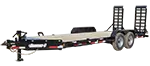
Current Diamond C equipment and flatbed trailers may be configured with loading systems such as MAX Ramps, XDR Ramps, an X-Ramp on applicable models, or a hydraulic dovetail, depending on the model. Ramp length, ramp angle, ramp capacity, rear stabilizers, and the transition between the ramp and deck all need to be checked against the vehicles being loaded.
A sports car with a long front overhang may scrape even when its ground clearance looks adequate. Approach angle, breakover angle, departure angle, wheelbase, and the location of the exhaust or battery enclosure all matter. Race cars and modified vehicles may require longer ramps, ramp extensions, wood blocking, or a hydraulic loading system designed for a shallower approach.
Flat Deck
A straight flat deck offers the most freedom to position two vehicles for proper tongue or pin weight. It also makes it easier to adjust one vehicle a few inches at a time after the combination has been weighed. The tradeoff is that a flat deck generally needs longer ramps or a hydraulic tail to create a low loading angle.
Deck width is just as important as deck length. A between-the-fenders equipment trailer may provide approximately 80 to 82 inches of usable width, depending on the model. That can be too narrow for a wide truck, SUV, dually, or vehicle with oversized tires. Deck-over trailers such as the Diamond C DEC and FMAX place the deck above the tires and provide a full-width deck of approximately 102 inches, making them more practical for wider vehicles and mixed loads.
H&H Trailers and Liberty Trailers also offer flat-deck car and equipment trailers in multiple lengths and ratings. The exact model’s current specification sheet should be checked rather than assuming that every flat-deck car hauler has the same width, axle package, ramp system, or GVWR.
For many two-car combinations, a long straight-deck or deck-over gooseneck is more practical than a short bumper-pull wedge. A tilt or hydraulic dovetail can be valuable when one vehicle has limited ground clearance, but the best configuration depends on both vehicles’ dimensions, the required deck length, and the measured load distribution. There is no single deck style that is automatically best for every two-car move.
Load Balance: Where You Put the Cars Matters as Much as What They Weigh
Proper hitch weight is essential, but the correct percentage depends on the trailer and hitch type. A conventional bumper-pull trailer commonly needs approximately 10-15% of its loaded trailer weight on the hitch. A gooseneck or fifth-wheel trailer commonly carries a higher percentage on the truck, often approximately 15-25%. The trailer and tow-vehicle manufacturers’ instructions take priority over a general percentage.
For a 12,000 lb conventional trailer, a 10-15% range would equal approximately 1,200 to 1,800 lb of tongue weight. That weight counts against the tow vehicle’s payload, GVWR, rear GAWR, tire capacity, and receiver rating. For a gooseneck carrying 20% of the same loaded weight, approximately 2,400 lb would be transferred to the truck through the ball.
Too little tongue or pin weight can allow the trailer to sway. Too much can overload the hitch, truck frame, rear axle, suspension, or tires while reducing available weight on the truck’s steering axle. A combination can therefore be under the trailer’s GVWR and still be overloaded at the tow vehicle.
Placing the heavier vehicle toward the front is a reasonable starting point, but it is not a substitute for weighing the combination. Many cars, pickups, and SUVs carry more weight over the front axle, so changing whether a vehicle faces forward or backward can materially change hitch weight. The location of the engine, battery pack, fuel tank, cargo, and spare tire all influence the vehicle’s center of mass.
Consider a trailer that weighs 5,200 lb as equipped. Add a 4,800 lb pickup and a 3,100 lb compact car, and the loaded trailer weighs approximately 13,100 lb. A conventional trailer using the general 10-15% guideline would need approximately 1,310 to 1,965 lb on the hitch, subject to the trailer manufacturer’s instructions and every tow-vehicle rating.
That example requires a trailer with at least 7,900 lb of actual payload capacity, enough usable deck for both vehicles, and adequate axle, tire, wheel, ramp, anchor, and hitch ratings. It does not prove that a particular 14,000- or 15,500-lb trailer will work. The trailer must be weighed after both vehicles are positioned.
Small changes in vehicle position can make a useful difference, but claims that every six-inch movement changes tongue weight by several hundred pounds are not reliable. The approximate change depends on the cargo weight and the distance between the hitch and the trailer axle-group centerline.
As a simplified example, moving a 4,000 lb vehicle forward by six inches on a trailer with approximately 20 feet between the coupler and axle-group center could change hitch load by roughly 100 lb. The real result will vary with the trailer geometry, suspension, vehicle orientation, and the location of the other car.
The safest procedure is to load both vehicles, secure them provisionally, and weigh the truck and trailer on a certified scale. Record the truck’s steer axle, drive axle, and trailer axle-group weights. Compare those numbers with the truck GVWR, front and rear GAWR, trailer GVWR, trailer GAWR, hitch rating, and tire capacities. Reposition the vehicles and reweigh as necessary.
Axle Ratings and the One Check Everyone Skips
Before hauling either vehicle, find the trailer certification label and the axle information shown on the build sheet or axle tags. Common light- and medium-duty ratings include 3,500, 5,200, 6,000, 7,000, 8,000, 10,000, and heavier commercial axle capacities. The installed axle package must be verified from the specific trailer rather than inferred from the model name or number of lug nuts.
Adding the axle ratings together does not give you the trailer’s “maximum floor load.” The trailer’s own weight is carried partly by the axle group and partly by the hitch or gooseneck ball. Cargo affects both. On some trailers, the stated GVWR is higher than the combined axle ratings because the design assumes that an approved portion of the loaded weight will be carried by the tow vehicle through the tongue or gooseneck.
For example, a 15,500 lb GVWR trailer with two 7,000 lb axles does not have 14,000 lb of payload. It has a maximum 14,000 lb aggregate axle rating, while part of the loaded trailer weight is expected to be transferred through the hitch. Actual payload is still calculated by subtracting the trailer’s empty weight from its 15,500 lb GVWR.
Individual axle loading also matters. Tandem-axle equalizers help share weight, but they do not guarantee a perfect 50/50 split under every condition. Trailer attitude, hitch height, suspension wear, unequal tire pressure, road grade, vehicle position, and braking forces can shift weight between the axles.
A public truck scale normally reports the tandem trailer axle group as one combined weight. It generally will not tell you whether one axle is carrying significantly more than the other. Individual wheel scales or portable axle scales are required when you need precise axle-by-axle and side-to-side measurements.
Side-to-side balance matters too. A heavy vehicle loaded off-center can overload the tires, wheel bearings, suspension, or frame on one side even when the total axle-group weight looks acceptable. Center each vehicle on the deck unless the trailer manufacturer provides another approved loading arrangement.
If scale weights show that the trailer axle group is too heavy or the hitch is too light, move one or both vehicles forward in small increments and reweigh. If the tow vehicle’s rear axle or payload is overloaded, moving the load rearward may reduce hitch weight, but it must not create an unstable, tongue-light trailer. Sometimes the correct solution is a higher-capacity trailer, a heavier tow vehicle, or two separate trips rather than another adjustment.
Also confirm that the trailer rides level when loaded. An excessively nose-high or nose-low tandem trailer can place disproportionate weight on one axle. Adjust the hitch or gooseneck height only with components rated for the full combination.
Securing Each Vehicle Properly
Each vehicle needs an independent securement system. Four properly positioned tie-down points per vehicle, one near each corner or one at each wheel, are a strong standard practice when the trailer and vehicle provide approved attachment locations. Do not run one strap across both vehicles or depend on the front vehicle to restrain the rear one.
For commercial motor vehicles operating in interstate commerce, 49 CFR 393.128 requires an automobile, light truck, or van weighing 10,000 lb or less to be restrained at both the front and rear with tiedowns that prevent movement in the required directions. The general federal cargo-securement rules also require the aggregate Working Load Limit of the securement system to equal at least one-half of the cargo’s weight.
The way tiedown capacity is counted depends on how each tiedown is attached, so do not select straps using only a simple cargo-weight-divided-by-four calculation. The lowest-rated component in each securement path controls, including the strap or chain, ratchet, hook, fitting, D-ring, stake pocket, rub rail, axle strap, and trailer anchor point.
Private haulers may not be directly subject to every FMCSA cargo-securement provision, but the federal standards provide an appropriate minimum benchmark. State requirements, the trailer manufacturer’s instructions, the vehicle manufacturer’s transport instructions, and the ratings printed on the securement equipment must also be followed.
- Wheel nets and over-the-tire straps restrain the vehicle through the tire without loading painted body panels. The net or bonnet must be sized for the specific tire and installed in the direction intended by the manufacturer. It must not contact sharp wheel edges, brake components, bodywork, or hot exhaust parts.
- Axle or frame securement should use transport points approved for that vehicle. Keep straps clear of steering linkages, suspension travel, brake hoses, wiring, exhaust components, aerodynamic panels, and sharp edges. An emergency towing eye is not automatically an approved transport-securement point.
- Chain and binders may be appropriate for heavier vehicles when attached to approved frame or transport points. Every chain, binder, hook, anchor, and connector must have an adequate WLL. Binders should be closed and secured so they cannot release from vibration.
Do not attach securement equipment to bumper covers, control arms, steering rods, brake lines, exhaust parts, or unapproved suspension components. If the vehicle manufacturer identifies dedicated shipping slots, tie-down loops, or frame locations, use the specified adapters and procedures.
Before departure, place each vehicle in Park or in gear, set its parking brake, and remove loose objects. Those measures provide backup resistance, but they do not replace the required tiedowns. Wheel chocks or approved blocking can be added when appropriate, but they must be positioned and secured so they cannot become road debris.
Inspect all securement points before moving. Stop in a safe location and inspect them again within the first 50 miles because tires can settle into wheel nets and straps can seat against their attachment points. Commercial drivers should also follow the required periodic cargo inspections, including checks after changes in duty status and at the applicable time or mileage intervals. Private haulers should adopt the same cautious practice and recheck the load at every fuel, food, or rest stop.
Replace any strap with cuts, melted fibers, damaged stitching, excessive abrasion, chemical deterioration, deformed hooks, or an unreadable rating tag. Chains, binders, ratchets, and trailer anchors should likewise be removed from service when bent, cracked, stretched, heavily corroded, or otherwise damaged.
A Quick Weight Check Table
| Scenario | Car 1 | Car 2 | Total Payload | Notes |
|---|---|---|---|---|
| Two compacts | 3,000 lb | 2,800 lb | 5,800 lb | May fit a 14,000- or 15,500-lb trailer by weight after subtracting actual trailer weight, but combined vehicle length will often require more than 30 feet of usable deck |
| Compact + full-size SUV | 3,100 lb | 5,200 lb | 8,300 lb | A long 15,500- or 18,000-lb trailer may work if payload and dimensions allow; position by measured hitch and axle weights rather than automatically placing the SUV forward |
| Two 3/4-ton trucks | 7,000 lb | 6,800 lb | 13,800 lb | Likely requires a long heavy-duty gooseneck in approximately the 23,000- to 25,900-lb-or-higher class, plus a properly rated truck; commercial Class A CDL thresholds may be crossed |
The payload figures in this table include only the two vehicles. To determine loaded trailer weight, add the trailer’s actual empty weight and every item carried on it. Published vehicle curb weight is also only a starting point. Passengers, cargo, aftermarket bumpers, toolboxes, fuel, auxiliary tanks, winches, larger tires, and other accessories can change the actual weight significantly.
A scale ticket is more reliable than an online vehicle-weight estimate. Weigh modified trucks, work vehicles, and vehicles carrying cargo before selecting the trailer whenever possible.
What About the Tow Vehicle?
The trailer’s ratings are only half of the equation. The tow vehicle must remain within its own GVWR, GCWR, front GAWR, rear GAWR, payload rating, tire capacities, hitch rating, and maximum conventional or gooseneck trailer rating. The exact limits depend on the truck’s model year, cab, bed length, engine, transmission, axle ratio, drivetrain, wheel and tire package, and factory towing equipment.
A badge such as F-250, Ram 2500, Silverado 2500HD, or Sierra 2500HD does not establish a universal towing capacity. Two trucks with the same badge can have substantially different payload and trailer ratings. Use the truck’s certification label, payload label, owner’s manual, VIN-specific towing information, and manufacturer towing guide.
Receiver opening size also does not determine capacity by itself. A 2-inch, 2.5-inch, or 3-inch receiver can have different ratings depending on its design and how it is used. Check the rating label on the receiver and confirm the ratings of the ball mount, hitch ball, pintle, gooseneck ball, coupler, safety chains, weight-distribution equipment, and every adapter. The lowest rating in the connection controls.
Hitch or pin weight becomes cargo carried by the truck. A trailer that places 2,500 lb on a gooseneck ball may be within the truck’s advertised maximum trailer rating but still overload the truck after accounting for passengers, tools, auxiliary fuel, a toolbox, the hitch, and other cargo. Rear-axle and rear-tire capacities are common limiting factors on heavy two-car combinations.
The loaded combination must also remain within GCWR. GCWR is the maximum permitted combined weight of the truck, trailer, cargo, occupants, fuel, and equipment. Do not compare GCWR with the trailer alone.
For commercial operation in Indiana, a Class A CDL is generally triggered when the combination has a GCWR of 26,001 lb or more and the towed vehicle has a GVWR greater than 10,000 lb. The 26,001-lb threshold applies to the combination, not simply to the trailer. Whether a particular trip is commercial and whether an exemption applies depends on the use, vehicle classification, and circumstances, so businesses should verify licensing and motor-carrier requirements before operating.
A half-ton truck with a maximum trailer rating below the actual loaded trailer weight is not an appropriate tow vehicle, even for a short trip. The same is true when the truck exceeds its payload, GVWR, GCWR, axle, tire, receiver, or hitch rating. A heavier truck does not correct an overloaded trailer, and a higher-GVWR trailer does not correct an overloaded truck.
If the combination cannot remain within every rating, split the load into two trips or use a properly configured heavier truck and trailer. Do not rely on air springs, upgraded shocks, a weight-distribution hitch, or heavier tires to increase a manufacturer-assigned GVWR, GAWR, GCWR, or tow rating.
Do You Need a Brake Controller?
Indiana law requires a trailer or semitrailer with a gross weight of at least 3,000 lb to have adequate brakes. The system must allow the driver to control the trailer brakes from the tow vehicle and must automatically apply the trailer brakes if the trailer breaks away from the towing vehicle. A loaded two-car trailer will be far beyond that threshold.
The law does not make one braking technology suitable for every trailer. Heavy car and equipment trailers commonly use electric drum brakes or electric-over-hydraulic disc brakes. Electric brakes require a compatible in-cab brake controller. Electric-over-hydraulic systems require a controller specifically compatible with the hydraulic actuator.
Before loading, verify that the controller communicates with the trailer, applies all trailer brakes, and is adjusted for the actual loaded combination. Perform the manufacturer’s low-speed brake test in a safe area. The trailer brakes should contribute firmly without locking prematurely or allowing the trailer to push the tow vehicle.
Inspect the breakaway switch, cable, battery, wiring, connectors, grounds, brake assemblies, hydraulic fluid where applicable, and the seven-way plug. The breakaway cable must be attached to a secure point on the tow vehicle that is separate from the safety chains. It should not be looped around the hitch ball or attached to a removable ball mount in a way that could allow the entire system to separate together.
Some current Diamond C configurations with 8,000-lb-and-heavier axle packages include Lippert antilock braking technology, while certain 7,000-lb packages may offer it as an option. ABS can improve control during hard braking, but it does not replace a compatible brake controller, properly adjusted brakes, adequate stopping distance, or routine maintenance.
If the tow vehicle does not have the correct controller and wiring, resolve that before buying, renting, loading, or moving the trailer. Brakes that are present but unpowered, incorrectly adjusted, incompatible with the controller, or connected to a discharged breakaway battery do not provide the protection the combination requires.
Finding the Right Two-Car Hauler
At Spencer Trailers, we stock and can order car, equipment, deck-over, tilt, and flatbed trailers from Diamond C, H&H, Liberty, and other manufacturers. Inventory changes regularly, and the correct choice depends on the exact weights and dimensions of the two vehicles rather than a generic “two-car” label.
A 20- or 22-foot flat-deck car hauler is normally appropriate for one vehicle. Two compact cars commonly need more than 30 feet of usable deck after allowing clearance between the vehicles and room for securement. Two SUVs or pickups may need a deck in the mid-30-foot to 40-foot range or longer, depending on their actual overall lengths.
For two short vehicles, selected 30-foot DEC or DET configurations may provide enough deck and capacity after the complete load is measured. Longer vehicle combinations may point toward an appropriately configured FMAX gooseneck flatbed. Current FMAX models span multiple GVWR, length, axle, brake, ramp, and hydraulic-tail configurations, so the model must be selected from the actual load requirements rather than from the FMAX name alone.
Current Diamond C trailers are built in Mt. Pleasant, Texas, where the company has manufactured trailers since 1985. Its premium lines use Lippert axle packages, and current builds use the DM Difference Maker multi-stage coating system. Axle rating, brake type, ABS availability, deck length, ramp system, and payload still vary by model and configuration.
Before selecting a trailer, gather the actual weight, overall length, width, ground clearance, and approximate front-to-rear weight distribution of both vehicles. Also bring the tow vehicle’s VIN, payload label information, hitch type, receiver or gooseneck rating, and intended use. Commercial operators should identify their expected operating weight and route so CDL and motor-carrier questions can be addressed correctly.
Check our current inventory to see what is available, or get in touch and we will help compare the load with the trailer’s certified empty weight, GVWR, axle package, deck dimensions, ramp system, and your truck’s ratings.
The right trailer for a two-car haul is not automatically the largest trailer on the lot or the one with the highest advertised axle capacity. It is the trailer that provides enough usable deck, adequate payload after its real empty weight is deducted, proper axle and tire capacity, approved securement points, suitable brakes and ramps, and a safe match for the tow vehicle.
Measure both cars, weigh the combination, verify every rating, secure each vehicle independently, inspect the brakes and tires, and recheck the load after the first 50 miles. When all of that math works, the rest of the trip becomes a controlled towing job instead of a highway experiment.


