












You pull up to a job site with broken furniture, old appliances, bagged household waste, and construction debris. The client wants everything gone quickly, and your trailer will either make the job look efficient or force you into an expensive second trip. Junk removal is both a time-and-volume business and a weight-management business. The trailer you choose directly affects labor hours, disposal runs, fuel use, legal payload, and the number of jobs your crew can complete in a day.
The good news is that several trailer designs work well for junk removal when they are matched to the material being hauled. The wrong choice, however, can leave an operator fighting a low payload, inadequate containment, slow unloading, or a tow vehicle that is overloaded before the trailer is full. This guide compares four practical trailer types using current configurations and realistic operating considerations.
What Junk Removal Actually Demands From a Trailer
Think about what happens during a typical job. You load mixed material, often placing dense items such as appliances, cabinets, flooring, shingles, or demolition debris underneath bulky furniture and bagged waste. You then drive to a transfer station, landfill, donation center, scrap yard, or recycling facility, unload, and repeat the process. A busy crew may complete several of these cycles in one day.
That routine punishes trailers that are not built for the work. Light floors can be damaged by concentrated appliance loads. Low or poorly supported sides make it difficult to contain bulky material. An undersized axle package reduces usable payload, while manual unloading can consume time and wear out a crew. The most important considerations are usable payload, contained volume, floor and frame construction, loading height, unloading method, axle and brake capacity, tarp compatibility, and serviceability.
GVWR is only the trailer’s maximum allowable loaded weight. It is not the amount of junk the trailer can carry. Usable payload is calculated by subtracting the trailer’s actual empty weight, including installed options, from its GVWR. Taller sides increase cubic volume but do not increase GVWR, axle ratings, tire capacity, coupler capacity, or payload. Dense debris can therefore put a trailer over its legal weight limit while the body still appears half empty.
Material type matters just as much as trailer size. Furniture, mattresses, cardboard, and bagged household contents usually fill available volume before reaching the trailer’s weight limit. Concrete, dirt, roofing, plaster, wet lumber, and masonry can reach the weight limit long before the body is full. Responsible operators should know the trailer’s as-built empty weight, distribute the load correctly, maintain proper tongue weight, and use a certified scale whenever the actual loaded weight is uncertain.
High-Side Dump Trailers: The Workhorse Choice
For a full-time junk removal business, a properly sized dump trailer is usually the most productive all-around choice. Hydraulic unloading eliminates much of the hand labor required at the disposal site and lets the crew return to the next job sooner. A clean, free-flowing load may discharge in a few minutes, although unloading time depends on the material, gate arrangement, load condition, dump-site rules, and whether debris becomes bridged or tangled inside the body.
The Diamond C LPT Heavy Duty Low Profile Telescopic Dump is a strong commercial option. The LPT family is currently offered in 12- to 16-foot lengths with GVWR configurations ranging from approximately 15,500 to 24,000 pounds. A common junk-removal configuration is the LPT207 with a 14-foot by 82-inch dump body, a 15,500-pound GVWR, and two 7,000-pound Lippert Super Lube axles. Higher-capacity LPT packages are available for operators whose tow vehicles, licensing, insurance, and operating requirements support them.
The LPT uses a front-mounted telescopic hydraulic cylinder and raises the body to approximately a 45-degree dump angle. This arrangement provides strong lifting leverage without relying on a long underbody scissor assembly. The trailer should always be positioned on firm, reasonably level ground before dumping. Operators must stay clear of the raised body, follow the manufacturer’s instructions, use the provided body-prop or safety-support system during service, and watch for overhead obstructions and unstable ground.
Current LPT configurations offer 24-inch, 32-inch, and 44-inch side heights. A 14-foot by 82-inch body with 44-inch sides has a geometric body volume of approximately 351 cubic feet, or about 13 cubic yards. The same body with 24-inch sides holds roughly 191 cubic feet, while 32-inch sides provide approximately 255 cubic feet. Those calculations describe enclosed geometric space, not guaranteed usable capacity. Irregular objects, required load securement, the tarp system, and safe loading practices reduce the practical amount of material that can be carried.
For bulky household junk, the 44-inch side option can sharply reduce the number of trips. For dense demolition debris, however, the operator may need to keep the load well below the top of the body. High sides are a volume upgrade, not a payload upgrade. They also add empty weight and present more surface area to crosswinds, especially when carrying lightweight material.
The current LPT body uses heavy steel construction with an integrated floor-and-side design, a reinforced upper rail, and a three-way rear gate that can function for spreading or conventional dumping. Standard and optional body specifications vary by package, including 10-gauge and heavier 7-gauge material choices. The trailer also uses Diamond C’s DM Difference Maker multi-stage coating system. Current builds include an easy-roll tarp arrangement, with powered tarp and remote-control options available on selected configurations. Buyers should always review the exact build sheet because body thickness, side height, ramps, tarp equipment, battery systems, brake type, and hydraulic controls affect both price and empty weight.
At the lighter end of the dump-trailer market, H&H Trailers offers a 76-inch by 12-foot Utility Dump rated at 9,990 pounds GVWR. Current specifications list tandem 5,200-pound-rated axles, a formed steel body, a one-piece smooth steel bed, a hydraulic hoist, and a combination barn-door and spreader-style rear gate. A representative 12-foot configuration has an empty weight of approximately 2,560 pounds, leaving a calculated payload near 7,430 pounds before optional equipment is installed. The trailer’s certification label and actual as-built weight remain the controlling figures.
The H&H Utility Dump is more compact and carries less than a Diamond C LPT, but it retains the labor-saving dump function. With a typical 24-inch body, the 76-inch by 12-foot box provides approximately 152 cubic feet, or about 5.6 cubic yards, before any approved extensions are added. An integrated tarp mount may be provided, but the complete tarp kit should be confirmed on the individual trailer rather than assumed to be standard. Current market pricing for a new 9,990-pound Utility Dump is generally closer to the low five figures than the older sub-$9,000 pricing sometimes associated with previous model years.
Large-Volume Enclosed Trailers: When the Load Needs to Be Contained
Some junk-removal work is better suited to an enclosed trailer. Estate cleanouts, reusable furniture, electronics, confidential records awaiting secure disposal, donation loads, and weather-sensitive household contents may need to remain hidden, dry, or physically contained while traveling. An enclosed trailer also presents a clean appearance at residential and commercial properties.
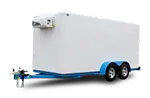
A basic 6-by-12 cargo trailer can support occasional light-duty work, but its floor area, door opening, payload, and interior height may become limiting for a dedicated junk-removal operation. A 7-by-16 tandem-axle trailer with additional interior height is a more practical starting point. A Wells Cargo FastTrac Deluxe in a 7-by-16 configuration ordered with approximately seven feet of interior height provides a nominal rectangular volume of about 784 cubic feet, or roughly 29 cubic yards. Actual usable space is lower because of the front profile, structural members, wheel boxes, door hardware, loading clearance, and the irregular shape of the material.
Current 7-by-16 FastTrac configurations are commonly rated around 7,000 pounds GVWR with tandem axles, electric brakes, and a breakaway system. FastTrac construction includes features such as an aluminum exterior, a one-piece roof design, a wood cargo floor, a side-access door, and a rear ramp-door configuration, depending on the exact order. Extra interior height must be specified rather than assumed from the nominal trailer size.
Operators needing more floor area can consider an 8.5-by-20 enclosed trailer rated around 9,990 pounds GVWR. At seven feet of interior height, an 8.5-by-20 box has a theoretical volume near 1,190 cubic feet, or about 44 cubic yards. That does not mean it can legally carry 44 cubic yards of every material. Dense debris will exhaust the available payload long before the trailer is physically full, and a large enclosed box can encourage accidental overloading if crews judge the load only by visual volume.
The main disadvantage of an enclosed trailer is unloading. A rear ramp makes it easier to use appliance dollies, rolling carts, pallet jacks on suitable surfaces, and wheeled debris containers, but the load is still normally removed by hand. Commercial hydraulic liftgates are specialized installations that add weight, cost, electrical demand, and structural requirements. Their availability and compatibility should be confirmed with the trailer manufacturer or a qualified upfitter rather than treated as an inexpensive universal option.
Some established operators use an enclosed trailer for client-facing, donation, reusable-goods, and secure-content jobs while keeping a dump trailer for mixed debris and disposal runs. That two-trailer strategy can work well once job volume is high enough to justify maintaining separate equipment.
Ramp-Load Open Trailers: Maximum Versatility at Lower Cost
Not every new junk-removal company is ready to purchase a commercial dump trailer. A correctly configured open utility trailer can provide a lower-cost entry point for furniture, appliances, yard-cleanup material, donation loads, and other bulky but relatively light items. It can also remain useful later as a general-purpose trailer after the business adds a dump trailer.
The key is selecting a trailer according to its actual frame, axle, tire, brake, floor, gate, and payload specifications. A small single-axle utility trailer can be useful for light residential work, but it leaves little margin once appliances, wet debris, tools, spare tires, and containment panels are included. A tandem-axle trailer generally offers better load distribution, more braking capacity, and improved stability for regular commercial use.
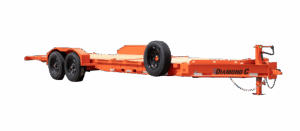
A practical example is the Diamond C GTU General Tandem Axle Utility Trailer. The GTU is rated at 7,000 pounds GVWR and is available in lengths from 14 to 20 feet. A 16-foot model has an approximately 83-inch-wide deck, two 3,500-pound Lippert electric-brake axles, a 4-inch channel main frame, treated 2-inch lumber flooring, and approximately 13-inch open sides with a pipe top rail. Current configurations use an EZ Bi-Fold rear gate and may be ordered with expanded-metal side treatments and other cargo-control options.
The GTU’s low loading height and folding gate make it suitable for rolling appliances, furniture dollies, lawn equipment, and wheeled bins onto the deck. Properly engineered and securely attached removable containment can increase the practical volume for lightweight material, but it must not interfere with lights, identification markings, gate operation, load securement, or safe visibility. Added sides also increase empty weight and wind exposure without changing the trailer’s 7,000-pound GVWR.
Operators who need to haul skid steers, compact equipment, heavy machinery, or dense materials in addition to junk may consider the Diamond C LPX Low Profile Extreme-Duty Equipment Trailer. The LPX family begins around the 14,900- to 15,500-pound class and extends to approximately 24,000 pounds GVWR, depending on configuration. It uses Lippert axles and can be equipped with loading systems such as MAX Ramps or the X-Ramp package on compatible lengths. The LPX provides substantially more equipment-hauling capability than a utility trailer, but it remains an open equipment trailer and does not provide hydraulic dumping or tall debris containment.
Liberty Trailers, also represented in Spencer Trailers’ inventory, offers utility and equipment-trailer alternatives at several sizes and weight ratings. Specifications can differ significantly between Liberty models, so buyers should compare the actual certification label, axle ratings, brake equipment, frame construction, crossmember spacing, floor material, gate capacity, and empty weight rather than selecting only by deck dimensions or advertised price.
The honest limitation of every ramp-load open trailer is unloading. At a transfer station or landfill, the crew will normally unload by hand unless the facility provides an approved mechanical unloading service. A trailer that saves money at purchase can consume that difference in labor if it is unloaded several times each day. For occasional jobs, an open utility trailer may be entirely reasonable. For frequent disposal runs, the dump function usually produces the better long-term return.
Side-by-Side Comparison
| Trailer Type | Example Model | GVWR | Est. Volume (cu ft) | Unload Speed | Approx. Price |
|---|---|---|---|---|---|
| High-Side Dump | Diamond C LPT207 14ft x 82in | 15,500 lb | Approx. 351 with 44in sides | Usually a few minutes when the load releases cleanly | About $14,800 base MSRP; higher as equipped |
| Enclosed Cargo | Wells Cargo FastTrac Deluxe 7×16 with 7ft interior | Commonly 7,000 lb | Approx. 784 nominal | Usually 15-40+ min by hand | Approx. $7,500-$10,000 depending on build |
| Ramp-Load Open | Diamond C GTU 16ft x 83in | 7,000 lb | Approx. 120 to the standard rail; more with approved containment | Usually 20-40+ min by hand | About $6,800 base MSRP; higher as equipped |
| Dump (entry level) | H&H Utility Dump 76in x 12ft | 9,990 lb | Approx. 152 with 24in sides | Usually a few minutes, depending on the load | Approx. $10,000-$12,000 depending on equipment |
All volume figures above are geometric estimates, not legal payload ratings or guaranteed usable capacities. Prices are approximate current-market reference points and can change with model year, steel costs, freight, side height, axle package, brakes, tarp equipment, ramps, batteries, hydraulic controls, paint options, dealer preparation, taxes, title fees, and available inventory. Compare itemized out-the-door quotes and the complete build sheet rather than relying on an advertised starting price alone.
Hitch, Tow Vehicle, and Weight Class: A Quick Reality Check
Every trailer on this list must be matched to a properly rated tow vehicle and hitch system. Do not select a truck only by its highest advertised towing number. The truck’s specific VIN configuration, conventional trailer rating, GCWR, payload rating, rear-axle rating, receiver rating, hitch or ball-mount rating, hitch-ball rating, tire capacity, and brake-controller compatibility all matter. The allowable combination is limited by the lowest-rated component.
A bumper-pull dump trailer also places substantial weight on the truck. Depending on the trailer, load position, and manufacturer requirements, tongue weight commonly represents a meaningful percentage of the loaded trailer weight. That tongue weight counts against the truck’s payload and rear-axle capacity along with the driver, passengers, tools, fuel, toolbox, bed accessories, and other cargo. A truck can therefore remain below its published trailer-tow rating while exceeding its payload or rear-axle limit.
A 15,500-pound-GVWR LPT will generally lead buyers toward a correctly configured three-quarter-ton or one-ton truck, but truck capability varies by model, cab, wheelbase, drivetrain, axle ratio, engine, hitch equipment, and model year. Some heavy-duty pickups are not rated to tow a fully loaded 15,500-pound bumper-pull trailer, while others may be. Many half-ton pickups are unsuitable for a fully loaded commercial dump trailer of this size even when they advertise a high maximum towing figure under a different configuration.
Trailer payload must be calculated from the actual as-built weight. For example, the theoretical payload of a 15,500-pound-GVWR trailer is 15,500 pounds minus its empty weight as delivered. High sides, heavier-gauge body material, ramps, spare tires, tarp motors, batteries, toolboxes, and other options all reduce the remaining cargo allowance. The trailer’s certification label, manufacturer’s weight documentation, and a scale ticket provide better information than a generic brochure weight.
Indiana also requires adequate trailer brakes when a trailer reaches the applicable 3,000-pound gross-weight threshold. The brakes must be capable of controlling, stopping, and holding the trailer, must be operable from the tow vehicle, and must include the required automatic breakaway function. Every trailer discussed here should have a compatible brake controller, a correctly connected breakaway system, and brakes maintained according to the axle and trailer manufacturers’ service schedules.
A Few Questions Worth Asking Before You Buy
Do you need a CDL? A trailer with a GVWR above 10,000 pounds does not automatically require a CDL by itself. Under the federal Class A threshold followed by Indiana, the combination generally enters Class A territory when the truck-and-trailer GCWR is 26,001 pounds or more and the towed unit has a GVWR greater than 10,000 pounds. Both parts of that test matter. Passenger, school-bus, hazardous-material, and other specialized operations have additional rules.
For example, a 15,500-pound-GVWR trailer paired with a truck carrying a sufficiently high GVWR or GCWR may create a combination rated at 26,001 pounds or more, even when the trailer is not loaded to its maximum at that moment. Conversely, a trailer rated slightly above 10,000 pounds does not create a Class A requirement when the qualifying combination remains below 26,001 pounds. Operators should verify the ratings on the truck and trailer labels and obtain guidance from the Indiana Bureau of Motor Vehicles, Indiana State Police Commercial Vehicle Enforcement, or FMCSA when the classification is uncertain.
Can commercial rules apply even without a CDL? Yes. CDL thresholds are not the only rules that affect a junk-removal business. Depending on the truck-and-trailer ratings, actual weight, business use, and whether the operation crosses state lines, requirements involving a USDOT number, vehicle markings, medical qualification, inspections, maintenance records, insurance, and hours of service may apply below the Class A CDL threshold. A non-CDL combination is not automatically exempt from all commercial-motor-vehicle regulations.
Do you need a tarp? Indiana does not rely on a simple universal rule stating that every open trailer must always be covered by a tarp. The operator is nevertheless responsible for preventing material from dripping, leaking, sifting, blowing, or otherwise escaping onto the roadway. Landfills, transfer stations, municipalities, and private disposal facilities may impose their own stricter covered-load policies and may charge additional fees or refuse an unsecured load. A correctly sized tarp system is therefore a practical necessity for most open junk-removal operations even when a particular facility does not use the word “tarp” in its rule.
Tall sides are not a substitute for cargo securement. Mattresses, sheet material, lightweight furniture, cardboard, branches, and bagged waste can lift out of a trailer at highway speed. Use the tarp, gates, containment system, and properly rated tiedowns appropriate for the material being carried. Never exceed the attachment-point ratings or depend on improvised boards and loose netting.
What will the disposal facility accept? Call the destination before accepting unfamiliar material. Tires, batteries, paint, chemicals, propane cylinders, refrigerant-containing appliances, asbestos-containing material, electronics, mattresses, yard waste, concrete, and roofing may require separate handling, documentation, fees, or facilities. Mixing restricted material into an otherwise ordinary load can create delays and unexpected disposal charges.
How quickly must the trailer be titled and registered? Indiana generally provides a 45-day window for completing the applicable title paperwork after purchase before an administrative penalty can apply. Registration, plate, tax, and title requirements depend on the transaction and trailer classification, so keep the bill of sale, manufacturer’s certificate of origin or assigned title, and all dealer documents together. Do not assume a temporary permit extends every filing deadline.
How should the purchase be treated for taxes? Federal law restored 100% bonus depreciation for qualifying property acquired and placed in service after January 19, 2025. A business-use trailer may qualify, but eligibility depends on ownership, business-use percentage, financing, placed-in-service date, taxable income, entity structure, and interaction with Section 179 and other deductions. A trailer salesperson should not be your tax adviser. Review the purchase with a qualified accountant before relying on a deduction to justify the budget.
How often are you doing this? One or two light loads a week may be handled effectively with a tandem utility or enclosed trailer. Several mixed-debris loads every day make hydraulic dumping much more valuable. Estimate the number of weekly disposal runs, average labor cost per unload, expected material density, disposal-site distance, and the revenue lost when a crew spends an extra half hour emptying a trailer. That calculation often makes the correct trailer category obvious.
What Spencer Trailers Recommends
For most operators launching or scaling a full-time junk-removal business in southern Indiana, a strong starting point is a 14-foot Diamond C LPT configured for the actual material being hauled. An LPT207 provides a 15,500-pound GVWR, tandem 7,000-pound Lippert axles, a low-profile 82-inch-wide dump body, a telescopic hydraulic hoist, a three-way rear gate, electric brakes, and Diamond C’s DM Difference Maker coating system. Diamond C has built trailers in Mt. Pleasant, Texas, since 1985.
For furniture, mattresses, cardboard, and general household cleanouts, the 44-inch side configuration provides approximately 13 cubic yards of geometric body volume without extending the trailer’s footprint. For remodeling waste and heavier material, 24- or 32-inch sides may provide enough volume while reducing empty weight and discouraging accidental overloading. The correct choice depends on whether the business normally cubes out or weighs out first.
Operators should also consider how the trailer will be loaded. Appliances and rolling bins may justify compatible loading ramps, while crews loading bags and loose debris by hand may prioritize lower body height and side-access convenience. A tarp system, spare tire, properly sized battery, remote hydraulic controls, gate holdbacks, secure tiedown points, and adequate truck-mounted tools can matter more in daily use than cosmetic options.
When the upfront investment in an LPT is beyond the starting budget, the H&H 76-inch by 12-foot Utility Dump offers a legitimate 9,990-pound-GVWR entry point. It provides less payload and substantially less body volume than the Diamond C LPT, but it retains the hydraulic dumping capability that saves labor at the end of every disposal run. Buyers should budget according to current low-five-figure pricing and confirm whether the individual unit includes the desired tarp, ramps, battery charger, spare tire, and control options.
For operators handling mostly furniture, donation items, appliances, and lighter bulky loads, the Diamond C GTU can reduce initial cost while providing tandem axles, brakes, a commercial-grade channel frame, treated-lumber deck, and a practical folding gate. An enclosed trailer is the better alternative when security, weather protection, privacy, or a clean client-facing appearance matters more than fast unloading. Neither option replaces a dump trailer for dense debris and high-frequency disposal work.
We carry Diamond C, H&H, and Liberty at our Spencer location, and we’re happy to walk through what makes sense for your specific rig and workflow. Browse our current trailer inventory to see what’s in stock, or reach out directly and we’ll help you match the trailer to the work. We’re at 291 West State Hwy 46, Spencer IN 47460, and you can call us at (812) 829-0226.
One more thing to consider is how quickly the business may outgrow its first trailer. Many operators eventually add capacity as job volume, crew size, and disposal frequency increase. Buying far more trailer than the truck and current workflow can safely support is a mistake, but buying a trailer with no room for realistic growth can also lead to an early replacement. Base the decision on expected six- to twelve-month workload, the tow vehicle’s verified ratings, typical material density, unloading labor, and the disposal facilities you actually use. What does your hauling schedule look like six months from now?


