







You’ve done the late-night research. You know the basic difference between a single-axle trailer and a tandem-axle trailer. You have a budget in mind, a tow vehicle in the driveway, and a reasonably clear idea of what you need to haul. Right now, there are a dozen trailers listed on Facebook Marketplace, several more on national inventory websites, a few out-of-state dealers advertising delivery, and a local trailer dealer twenty minutes away. So which way do you go?
There is no universally right answer. Online trailer shopping has genuine advantages, and so does buying from a local dealer. What matters is understanding exactly what you are trading off in each direction before you hand over money for equipment that must carry a load safely at highway speed. The advertised price matters, but so do the trailer’s exact model, GVWR, empty weight, payload capacity, axle package, brakes, tires, title status, warranty coverage, delivery cost, and compatibility with your tow vehicle.
The Case for Buying Online
The honest answer is that online trailer shopping opens up inventory you may not find within a single county or even within Indiana. If you are hunting for a particular deck length, GVWR, hitch type, ramp system, axle configuration, color, interior height, or door arrangement, your local dealer may have the right trailer in stock, may be able to order it, or may not be able to get it within your timeline. National marketplaces, manufacturer inventory searches, and out-of-state dealerships allow you to compare hundreds or thousands of listings without driving from lot to lot.
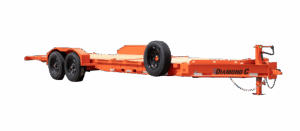
That broader selection is especially useful when shopping for configurable equipment. A Diamond C LPX, for example, is a bumper-pull Low Profile Extreme Duty equipment trailer offered in multiple lengths and GVWR configurations from 15,500 to 24,000 lb. Its current standard axle package is two 7,000 lb Lippert axles, with other axle configurations available. An H&H Speed Loader car-hauler tilt trailer in an 82-inch by 20-foot configuration can also be built with different GVWR and axle packages. A listing that gives only the brand, model family, width, and length may not tell you enough to make an accurate comparison.
Price competition is also real. When dealers know buyers can compare advertised prices from the couch, pricing becomes more transparent. You may find a Diamond C LPX, an H&H tilt trailer, an enclosed cargo trailer, or a dump trailer advertised below the prices shown by a nearby seller. That can represent a legitimate opportunity, particularly when the trailers are genuinely identical. The important phrase is genuinely identical: the same model year, GVWR, axle count and rating, tire package, ramp or tilt system, spare tire, toolbox, hydraulic equipment, decking, warranty status, and dealer-installed options.
Online purchasing can also carry less uncertainty for an experienced buyer who already owns the exact trailer and needs another unit built to the same specification. You already understand how the trailer loads, how much usable payload it provides, how it behaves behind your truck, and which features matter in daily use. Even then, verify the complete build sheet and VIN-specific equipment. Manufacturers can revise standard features, warranties, suppliers, option packages, and model configurations between production years.
Where Online Buying Gets Complicated
Convenience comes with friction that does not always appear in listing photos or the advertised price.
Shipping costs add up fast. A trailer advertised for less in another state may no longer be less expensive after delivery. Transportation cost depends on distance, trailer dimensions, weight, hitch type, whether the unit can be moved by tow-away service or must be carried, fuel prices, route requirements, and the hauler’s insurance and scheduling. Some dealers can arrange delivery and provide a written quote. Others place the responsibility entirely on the buyer. If you plan to pick up the trailer yourself, include fuel, lodging, tolls, time away from work, temporary operating paperwork, and the cost of returning if the trailer is not as represented.
Ask whether the quoted price includes destination freight, dealer preparation, optional equipment, documentation charges, title paperwork, sales or use tax, and delivery. An advertised trailer price is not automatically an out-the-door price. The correct comparison is the total amount required to get the properly titled, road-ready trailer to your location, not the number displayed at the top of the listing.
Pre-delivery inspection requires more planning. Good online dealers can provide current photographs, a live video walk-around, a VIN, a manufacturer’s statement of origin or title description, and a written list of installed equipment. That is still not the same as inspecting the trailer in person. Photographs may not reveal shipping damage, a bent fender, a misaligned door, loose wiring, incorrect tire pressure, a discharged breakaway battery, hydraulic leaks, damaged decking, corrosion, or mismatched options.
Before accepting delivery, compare the VIN on the trailer with the invoice and ownership documents. Inspect the coupler or gooseneck connection, jack, safety chains, breakaway cable, lights, tires, wheels, lug nuts, ramps, doors, latches, flooring or decking, welds, hydraulic system, battery, and included accessories. Photograph any damage before the carrier leaves and note it on the delivery paperwork. Once a trailer has been accepted and the carrier has departed, resolving a damage claim can become substantially harder.
Warranty service can get tricky. Warranty coverage is controlled by the written terms issued by the manufacturer and component suppliers. Coverage, duration, transferability, exclusions, registration requirements, and authorized repair procedures vary by brand and model. A private-party purchase may not include transferable warranty protection, even when the trailer is relatively new. A reseller that is not an authorized dealer may also be unable to register the warranty or submit a claim in the same way as an authorized selling dealer.
Even when coverage is valid, a manufacturer may require photographs, diagnostic information, proof of purchase, maintenance records, prior authorization, or inspection by an approved facility before repairs begin. Axles, tires, batteries, jacks, hydraulic components, appliances, and other installed equipment may carry separate component warranties. Do not assume that a local shop will perform warranty work merely because it repairs trailers. Confirm who will coordinate the claim, where covered repairs can be completed, whether transportation is covered, and whether you must pay first and request reimbursement.
Paperwork becomes your responsibility. For an out-of-state or private-party purchase, verify that the seller has the legal authority to transfer ownership and that the VIN on the paperwork matches the VIN plate on the trailer. Ask whether you will receive an assigned title, a manufacturer’s statement of origin, a dealer reassignment, a bill of sale, or another ownership document accepted by the Indiana BMV. Be especially cautious with altered VIN plates, missing titles, unresolved liens, handwritten corrections, or a seller whose name does not match the ownership document.
Indiana buyers still have to satisfy Indiana title, tax, and registration requirements when purchasing elsewhere. A newly acquired vehicle must generally be titled and registered within Indiana’s 45-day window to avoid administrative penalties. Buying online does not eliminate those obligations; it can simply leave more of the process for the buyer to complete.
What a Local Dealer Actually Gives You
This is not about loyalty for loyalty’s sake. A capable local dealer provides specific, practical benefits that a remote transaction may not be able to duplicate.
You See It Before You Buy It
Standing next to a single-axle 6×12 enclosed cargo trailer and standing inside a tandem-axle Wells Cargo Road Force 7×14 are two different experiences. Photographs do not fully communicate interior height, rear-door clearance, ramp angle, side-door width, roof construction, floor strength, wall spacing, or how much usable room remains after tools and shelving are installed. They also do not tell you whether you can comfortably operate the jack, lift the ramps, reach the tie-downs, or load your equipment without interference from the fenders.
An in-person inspection also lets you read the certification label, confirm the exact GVWR and GAWR, identify the tire size and load range, inspect the axle and brake equipment, and compare the trailer’s empty weight with the payload you actually need. Two trailers with the same outside dimensions can have substantially different curb weights and payload capacities.
You can also evaluate loading geometry. Trailer balance is affected by axle location, deck length, hitch design, cargo position, and actual tongue or pin weight. A dealer cannot predict every future load, but an experienced salesperson can help you determine whether the deck layout, ramp system, tilt mechanism, tie-down placement, and hitch configuration make sense for the equipment you plan to haul.
Pre-Delivery Inspection Is Already Done
A proper dealer PDI, or pre-delivery inspection, should cover the trailer itself before it leaves the lot. That includes checking the VIN and ordered equipment, coupler or gooseneck operation, jack, safety chains, breakaway system, running lights, turn signals, brake lights, electric brakes where equipped, tire pressure, wheel and lug condition, doors, ramps, latches, decking, hydraulic operation, battery condition, and visible structural components.
The brake controller is normally part of the tow vehicle, not the trailer, so the final hookup still matters. Once connected, the trailer plug, lighting, breakaway cable, safety chains, hitch height, coupler engagement, and brake response should be verified with the customer’s truck. Electric-brake gain may need to be adjusted for the tow vehicle, trailer, and load rather than treated as a permanent one-setting-fits-all number.
At Spencer Trailers, the trailer is checked before you hook up rather than leaving the customer to discover an electrical, tire, ramp, or brake issue after arriving home. A PDI does not replace the owner’s responsibility to inspect the combination before every trip, but it provides a much better starting point than an unopened shipment or an undocumented private sale.
Service After the Sale
Trailers require maintenance even when they are built for commercial use. Tires age and wear. Brake assemblies require adjustment and inspection. Breakaway batteries need to hold a charge. Grease-lubricated wheel bearings and hubs require service according to the manufacturer’s schedule, while oil-bath systems need oil-level and seal checks. Suspension hardware, lug nuts, fasteners, hydraulic components, doors, ramps, jacks, decking, wiring, and safety chains all deserve periodic inspection.
Wood decking and enclosed-trailer flooring can be damaged by water, chemicals, concentrated loads, forklifts, tracked equipment, or unsecured cargo. Brake magnets and shoes wear. Seals can leak. Wiring can be damaged by road debris or corrosion. A trailer that works every day will eventually need parts or service, regardless of where it was purchased.
When you buy locally, you already know where to take the trailer for inspection, routine maintenance, parts, and diagnosis. Warranty approval still depends on the manufacturer’s written terms, but an authorized local dealer can often document the problem, identify the correct parts, communicate with the manufacturer, and coordinate approved repairs. That relationship becomes valuable when downtime affects your work schedule.
Finance and Trade-In
Private-party online sales are usually paid with cash, a cashier’s check, or financing the buyer arranges independently. Online dealerships may offer financing, but approval, rates, down payments, collateral requirements, and terms vary. A local dealership can provide financing applications for qualified buyers and help connect the exact trailer, purchase price, down payment, and trade value within one transaction.
That matters when you are purchasing a commercial dump trailer, a Delco gooseneck, a Diamond C FMAX, or a customized Darkhorse Cargo trailer rather than a basic utility trailer. Financing is always subject to lender approval, and the lowest monthly payment is not automatically the least expensive option. Compare the annual percentage rate, term, total finance charge, required insurance, prepayment provisions, and final amount paid.
A local dealer may also be able to evaluate your current trailer as a trade-in. The trade value may be lower than the maximum price obtainable through a private sale, but it can eliminate advertising, buyer meetings, separate title transfer, and the risk of owning two trailers while waiting for one to sell. The right choice depends on whether convenience or maximum sale price matters more to you.
A Side-by-Side Look
| Factor | Online | Local Dealer |
|---|---|---|
| Inventory breadth | Wide national selection, including uncommon sizes and configurations | Limited to current lot stock, but factory orders and dealer searches may be available |
| Price | Advertised price may be lower; freight, preparation, travel, and delivery can offset the difference | Easier to obtain a written out-the-door quote showing trailer, options, fees, tax, and title costs |
| Configuration comparison | Requires careful review of model year, VIN, GVWR, axles, tires, brakes, ramps, and options | Units can be compared side by side with certification labels and equipment visible |
| Pre-purchase inspection | Photos, video, documents, or a paid third-party inspection may be required | Buyer can inspect the trailer in person and operate doors, ramps, jacks, and tilt systems |
| Pre-delivery inspection | Scope varies by seller; buyer must confirm what was checked and document arrival condition | Dealer PDI and final hookup checks can be completed before the trailer leaves the lot |
| Warranty service | Depends on authorized-dealer status, warranty transferability, location, and manufacturer approval | Local dealer can help document and coordinate eligible claims under the manufacturer’s terms |
| Financing | Available from some online dealers; uncommon in ordinary private sales | Financing options may be available for qualified buyers through dealership lenders |
| Trade-in | Usually requires a separate private sale or another transaction | Current trailer may be evaluated and included in the purchase transaction |
| Title and registration | Buyer may have to manage out-of-state documents, tax credit, VIN verification, and BMV submission | Dealer can prepare the normal sales and ownership paperwork for the transaction |
| Delivery | May require buyer-arranged transport, pickup travel, or acceptance from a third-party carrier | Trailer can usually be picked up directly; delivery quotes may also be available |
| Post-sale support | Ranges from strong remote dealer support to no assistance in a private sale | Ongoing local access to parts, service, maintenance, and product guidance |
When Online Makes Sense
Online purchasing can make sense when you know the exact model and configuration, have verified the seller, and receive a complete written description of the trailer. For a new trailer, confirm that the business is an authorized dealer for the brand, that the VIN and build details match the invoice, that the warranty can be registered properly, and that the delivery and damage-claim process is documented before payment.
It can also make sense when an authorized dealer in a neighboring state has the exact trailer you need and the total delivered price remains competitive after freight, taxes, paperwork, and travel. Ask for photographs of the actual unit rather than manufacturer stock images. Obtain a purchase agreement showing the VIN, model year, GVWR, installed options, included accessories, delivery terms, deposit conditions, and refund or cancellation policy.
For used trailers, expanding the search radius can uncover good equipment that is not available locally. Driving a reasonable distance to inspect a used utility, dump, equipment, or enclosed trailer can be worthwhile. Check the frame, tongue or gooseneck, crossmembers, suspension, axle alignment, tires, wheels, bearings, brakes, breakaway system, wiring, deck, ramps, hydraulic equipment, and ownership paperwork. When you cannot inspect personally, hire a qualified independent inspector rather than relying entirely on photographs and the seller’s description.
For specialty trailers that are not commonly stocked locally, such as a custom enclosed car hauler, mobile business trailer, refrigerated unit, livestock trailer, or equipment trailer with a specific deck and loading arrangement, casting a wider net online is practical. Just recognize that custom equipment can be harder to return, resell, modify, or repair if the original specification is wrong.
When Local Makes More Sense
A local dealer is usually the stronger choice when you are buying your first trailer, selecting a trailer for daily commercial use, financing the purchase, trading an existing unit, or buying a new trailer whose warranty and service access matter. It is also valuable when you are uncertain about payload, tongue weight, hitch height, brake requirements, electrical connections, loading angle, ramp capacity, or the difference between two apparently similar GVWR packages.
A dealer can show you how to engage the coupler, cross the safety chains where appropriate, route the breakaway cable independently from the chains, connect the seven-way plug, check the lights, test the trailer brakes, and adjust the tow vehicle’s brake-controller gain. That walkthrough does not replace the tow vehicle owner’s manual or the trailer manual, but it is more useful than receiving a set of keys and discovering the details at home.
Weight ratings also deserve more attention than they receive in online listings. Payload is not the same as GVWR. Approximate payload is the trailer’s GVWR minus its actual empty weight, and installed options can increase empty weight. The tow vehicle must have adequate towing capacity, hitch capacity, payload capacity, rear-axle capacity, tire capacity, and gross combination rating for the loaded combination. A heavy trailer does not become safe merely because the truck can pull it forward.
Indiana requires a trailer or semitrailer with a gross weight of at least 3,000 lb, when operated on a highway, to have adequate brakes that can be applied from the tow vehicle and automatically applied in a breakaway. Licensing is a separate question. A trailer rated above 10,000 lb does not, by itself, automatically create a Class A CDL requirement. For a Class A combination, the federal threshold generally involves a GCWR or GCW of at least 26,001 lb together with a towed unit having a GVWR or GVW above 10,000 lb, subject to the vehicle’s use and any applicable exemptions. Buyers planning commercial hauling should verify their exact licensing, registration, insurance, and operating requirements rather than relying on a marketplace comment or a salesperson’s guess.
Spencer Trailers carries Diamond C, Liberty, Delco, Darkhorse Cargo, H&H, Legend, and Wells Cargo, covering the kinds of trailers used throughout Owen County and south-central Indiana. Current inventory can include compact 2,990 lb single-axle utility trailers, higher-capacity single-axle models, tandem utility trailers, enclosed cargo trailers, car haulers, dump trailers, equipment trailers, tilt trailers, and heavy gooseneck configurations.
For buyers comparing Diamond C premium models, the exact model identity matters. The LPX is a Low Profile Extreme Duty bumper-pull equipment trailer, the HDT is a hydraulically dampened tilt equipment trailer, the LPT is a Heavy Duty Low Profile Telescopic Dump, the DEC is a Heavy Duty Deck Over Equipment trailer, and the FMAX family covers Flatbed Max gooseneck configurations with model-specific GVWRs extending from 15,500 lb to 40,000 lb. Current premium Diamond C lines use Lippert axles, with axle count and capacity determined by the selected model and package. Browse the current inventory here to review the actual units, VIN-specific specifications, prices, and availability before making any calls.
The Part Nobody Talks About
There is a hidden cost to buying online that does not appear in the advertised purchase price: your time and exposure to uncertainty. Coordinating transport, verifying the seller, reviewing documents, arranging an inspection, handling a delivery appointment, correcting title paperwork, documenting shipping damage, finding a repair facility, and managing a remote warranty claim can consume hours or days. None of those problems is guaranteed to occur, but the buyer should assign them a realistic value rather than treating time as free.
The same principle applies to local purchases. Do not assume that a nearby trailer is automatically the better deal. Compare the exact equipment, out-the-door price, financing cost, trade allowance, warranty terms, PDI, service access, and delivery options. Ask for every charge in writing. A transparent local transaction can be less expensive in real terms than a lower advertised price that requires freight, travel, outside inspection, document corrections, or unpaid downtime.
The best comparison is a landed-cost worksheet. Include the trailer price, installed options, freight or pickup travel, dealer or documentation charges, sales or use tax, title and registration, temporary permits, financing charges, inspection expense, immediate repairs, missing accessories, and the value of your time. Also consider what happens if the trailer arrives damaged, does not match the listing, cannot be titled promptly, or needs warranty work during the first year.
That is not a pitch against online buying or for any particular dealership. It is simply an accurate way to compare transactions. Once you include the costs and risks outside the advertised price, some online deals remain excellent, some local deals become more attractive, and some trailers should be avoided regardless of where they are being sold.
Bottom Line
Online buying works when you know exactly what you want, have verified the seller and trailer, understand the ownership documents, and are prepared to manage transportation, inspection, registration, and warranty logistics. It can be a good way to locate uncommon configurations or buy from a reputable authorized dealer outside your immediate area.
Local buying works when you want to see and operate the trailer before paying, compare several units side by side, receive a documented PDI, arrange financing or a trade-in, and have access to service after the sale. It is particularly valuable for first-time buyers and commercial users who cannot afford to discover after delivery that the payload, loading system, hitch arrangement, brakes, or tow-vehicle match is wrong.
If you’re in Owen County or anywhere in south-central Indiana and want to see what is available without taking a sight-unseen shipping gamble, call or text Spencer Trailers at (812) 829-0226 or stop by 291 West State Hwy 46 in Spencer, Indiana. Reach out here if you would rather send a message first. To see the kinds of trailers local buyers have recently selected, the recently sold page provides a useful look at the models, sizes, and configurations moving through this market.


