


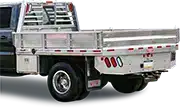
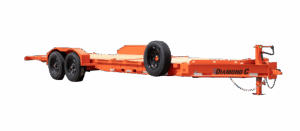


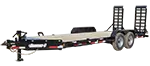





You’ve got a compact track loader, a mini excavator, a dozer, or another piece of equipment to move. You order a Diamond C flatbed or equipment-hauling trailer, reach the loading-options screen, and face an important choice: the standard angle-cleat dovetail or a wood-filled dovetail and ramp configuration. That choice deserves more attention than it usually gets.
The rear loading surface is where every machine you own transitions from the ground to the ramps, across the dovetail, and onto the main deck. The wrong surface for your undercarriage can create unnecessary metal-on-metal contact, extra noise, accelerated wear, or less predictable traction. The right setup gives the tracks or tires a stable path onto the trailer and makes repeated loading easier.
The most important distinction is straightforward: Diamond C positions its wood-filled dovetail and MAX Ramp option for equipment with steel tracks. The standard angled steel cleats are the more common general-purpose choice for rubber tracks, rubber tires, and mixed construction or agricultural hauling that does not regularly involve steel-tracked machines.
What the Dovetail Actually Does
On a Diamond C trailer equipped with ramps, the dovetail is the sloped rear portion of the trailer deck. It lowers the breakover point between the ramps and the flat cargo deck, helping equipment transition onto the trailer without requiring an excessively long ramp system.
The dovetail works together with the ramp length, ramp angle, trailer deck height, machine wheelbase or track contact length, ground clearance, and rear overhang. A low machine can still drag even when the trailer has a dovetail if the machine has limited clearance or a long attachment extending behind the tracks. That is why the complete loading geometry matters more than the deck surface by itself.
Diamond C offers several loading systems across its current trailer lineup, including MAX Ramps, XDR Ramps, the X-Ramp, hydraulic dovetails, and straight-deck configurations with slide-in ramps. The wood-filled-versus-angle-cleat decision applies most directly to compatible MAX Ramp configurations on the FMAX, PX, and SDX families.
Both dovetail surfaces can support safe loading when the trailer is properly matched to the machine. Their biggest differences involve the type of tracks or tires contacting the surface, the amount of metal-on-metal interaction, maintenance requirements, noise, and how the ramps behave when contaminated with mud, snow, or job-site debris.
Wood-Filled Dovetail: The Steel-Track Specialist
A wood-filled setup replaces the standard exposed steel cleats on compatible MAX Ramp dovetails and ramps with wood-filled running surfaces. Diamond C specifically identifies this configuration as an option for hauling heavy equipment with steel tracks.
That application is important. Steel track pads and grousers behave differently from rubber tracks. When steel tracks climb directly across steel cleats, the contact is hard, noisy, and potentially more prone to sliding or chipping the trailer’s finish if the machine turns, spins, or changes direction on the loading surface. A wood-filled path gives the steel undercarriage a broader sacrificial surface instead of concentrating every contact point on painted steel cleats.
The wood can also reduce the harshness and noise associated with loading steel-tracked excavators, dozers, and similar machinery. Steel grousers can press into the wood rather than striking each cleat edge. That does not make the trailer immune to damage, but it gives the undercarriage a surface better suited to repeated steel-track use.
Do not assume that every wood-filled dovetail uses the same lumber species. Diamond C uses 2-inch treated lumber as the standard floor material on many models and offers oak flooring on certain heavier trailer configurations. The wood-filled ramp or dovetail material should be confirmed on the final factory build sheet, especially when the main deck is being upgraded to oak or another flooring package.
Wood does require inspection. Look for deep gouges, loose fasteners, splitting, crushed sections, rot, and boards that no longer sit securely within the ramp or dovetail structure. Steel grousers can damage wood quickly when an operator turns sharply, counter-rotates, or applies excessive throttle while partly on the ramps. The machine should travel straight up the loading path whenever possible.
Indiana weather also matters. Treated lumber is designed for outdoor exposure, but repeated wetting, freezing, road salt, trapped debris, and long-term outdoor storage still affect it. Keep drain paths open, remove packed mud, and allow the wood to dry rather than leaving wet soil compressed against it for weeks.
For an operator who regularly hauls steel-tracked excavators, dozers, or machines fitted with steel track shoes, the wood-filled dovetail and ramps are generally the purpose-built choice. Rubber-tracked and wheeled equipment can still use the surface, making it practical for a mixed fleet when steel tracks are part of the regular workload.
Angle-Cleat Dovetail: Standard Traction for Rubber Tracks and Wheels
The standard MAX Ramp dovetail uses steel angle cleats installed across the loading surface. On current compatible FMAX, PX, and SDX configurations, Diamond C lists a 60-inch dovetail with 2-inch by 2-inch by 1/8-inch angle cleats. The cleats create raised traction points instead of presenting a smooth sheet of steel.
Diamond C’s MAX Ramps also use an open, self-cleaning design and aggressive angled cleats intended to maintain traction in demanding conditions. The open areas allow loose dirt and some debris to fall through instead of accumulating on a solid plate. That is useful for machines leaving muddy construction sites, farms, landscaping projects, and utility jobs.
Angle cleats are well suited to rubber-tracked compact track loaders, rubber-track mini excavators, skid steers, tractors, telehandlers, and other equipment running on tires. The raised edges give the rubber multiple points to grip as the machine climbs. They also avoid the long-term board replacement associated with a wood-filled system.
The cleats produce a more noticeable ribbed feel as pneumatic tires move across them, especially with smaller tires or a slow-moving machine. That is normal. The operator should stay centered, use steady throttle, and avoid abrupt steering corrections while the machine is on the ramps or dovetail.
Angle cleats are not maintenance-free simply because they are steel. Inspect the ramp frames, hinges, spring system, latches, welds, cleats, and coating regularly. Damaged coating should be touched up before corrosion spreads, particularly after exposure to road salt or repeated steel contact.
For steel-tracked machines, a cleated steel surface creates direct metal-on-metal contact. Occasional use may be possible when the machine, ramp capacity, and loading geometry are appropriate, but regular steel-track hauling is where the wood-filled factory option makes the most sense.
Diamond C Models That Offer Both Options
The cleat-versus-wood decision is most directly associated with Diamond C trailers configured with MAX Ramps in the FMAX gooseneck, PX pintle-hitch, and SDX step-deck families. The current factory configurators for these lines list a 60-inch angle-cleat dovetail as the standard MAX Ramp surface and a wood-filled dovetail and ramp option intended for steel-tracked equipment.
The FMAX is Diamond C’s Flatbed Max gooseneck family. Current model identities include FMAX207, FMAX208, FMAX210, FMAX212, FMAX216, FMAX307, FMAX310, and FMAX312, along with certain specialized variants. GVWR varies substantially by model and package, beginning around 15,500 pounds and reaching as high as 40,000 pounds on select heavy configurations. These premium trailers use Lippert axles as the factory standard, with axle count, axle rating, suspension, brakes, tires, wheels, frame, and coupler matched to the selected GVWR.
The PX family uses a pintle-ring connection and offers many of the same heavy-duty loading choices, including MAX Ramps, XDR Ramps, hydraulic dovetails, and straight-deck configurations on applicable models. The SDX step-deck family is designed for longer commercial hauling applications and also offers MAX Ramp configurations with either angle cleats or a wood-filled loading surface.
MAX Ramps are 44 inches wide per ramp on the FMAX, PX, and SDX families. They use heavy-duty spring assistance, a two-part hinge arrangement, multiple high-strength steel ramp frames, and an over-center hold-down system. When stowed flat, they can provide additional usable rear deck surface; certain loads may also require the ramps to travel upright.
XDR Ramps are a separate loading system. These are 24-inch-wide by 60-inch-long spring-assisted knee ramps intended for concentrated equipment such as excavators and backhoes where clearance between the ramps may be important. Selecting XDR Ramps changes the ramp arrangement and should not be treated as merely a different surface on the same MAX Ramp system.
The LPX Low Profile Extreme-Duty Equipment Trailer uses a different current loading menu. The LPX is offered in bumper-pull and gooseneck forms, with current GVWR choices from approximately 15,500 to 24,000 pounds and lengths from 16 to 30 feet, depending on package. Standard running gear begins with dual 7,000-pound Lippert axles, with factory packages that may include three 7,000-pound axles, dual 8,000-pound axles, or dual 10,000-pound axles.
Current LPX loading choices include extra-wide flip-knee ramps with a 24-inch diamond-plate dovetail and cleats, 37-inch-wide MAX Ramps with a 36-inch self-cleaning dovetail on compatible lengths, and the full-width X-Ramp when ordered with the appropriate Max Width configuration. An LPX buyer should select from those current factory options rather than assuming that every Diamond C equipment trailer uses the same wood-filled MAX Ramp menu as the FMAX, PX, or SDX.
Trailer capacity must always be evaluated from the complete factory configuration and data plate. Adding together the advertised axle ratings does not automatically determine legal payload or GVWR. Trailer empty weight also changes with length, ramp system, flooring, axles, tires, hydraulic equipment, toolboxes, jacks, and other options.
Side-by-Side: What the Deck Means at the Job Site
| Factor | Wood-Filled | Angle-Cleat |
|---|---|---|
| Traction and contact for rubber tracks | Good, with a broad and relatively smooth loading surface | Excellent general-purpose traction from raised steel cleats |
| Suitability for steel tracks | Excellent; Diamond C’s recommended application for the option | Possible in appropriate conditions, but creates direct metal-on-metal contact |
| Suitability for wheeled equipment | Good, with a smoother feel under pneumatic tires | Very good; cleats provide positive traction but create a more ribbed ride |
| Mud and loose debris | Must be cleaned so packed material does not hide damage or reduce grip | Open cleated design allows some debris to fall through and is easier to wash out |
| Rain, snow, and ice | Can provide useful contact, but contamination and ice can still make it slick | Aggressive cleats help, but the surface must still be cleared before loading |
| Long-term maintenance | Inspect boards, fasteners, splits, crushing, rot, and gouging; replacement may eventually be required | Inspect cleats, welds, hinges, springs, latches, coating, and corrosion |
| Noise with steel tracks | Quieter and less harsh than direct steel-on-steel contact | Louder because the track shoes contact exposed steel cleats |
| Best fit | Regular steel-track hauling or a mixed fleet that frequently includes steel tracks | Rubber tracks, tires, tractors, skid steers, and general equipment hauling |
A Practical Q&A
I run a Kubota SVL75-3 compact track loader. Which do I want?
The angle-cleat MAX Ramp setup is the logical general-purpose choice. The SVL75-3 uses rubber tracks, and the raised cleats give the rubber a positive loading surface. Keep the tracks and ramps free of packed mud, load straight, and avoid counter-rotating while the machine is on the ramps or dovetail. Use the machine’s actual transport weight, including the bucket or attachment, fuel, options, operator, and carried material, when calculating trailer payload.
I mostly haul a John Deere 35 P-Tier compact excavator on rubber tracks, but I occasionally haul a machine with steel tracks. Which deck handles both?
Either surface can carry the rubber-track excavator when the trailer and ramps are properly rated. If the steel-track machine is hauled regularly, the wood-filled dovetail and ramps are the better mixed-fleet selection because that is the application Diamond C designed the option to serve. If the steel-track use is rare and most of your work involves rubber tracks or tires, the standard cleated system may still be the more practical everyday configuration. Discuss the exact steel-track machine and frequency of use before ordering.
Does the dovetail deck choice affect ramp performance?
Yes, because the surface is part of the complete loading system rather than an unrelated cosmetic selection. On compatible MAX Ramp builds, choosing wood-filled changes the running surface on the dovetail and ramps. The ramp structure, hinge system, spring assistance, width, and rated capacity must still be matched to the equipment.
Measure the machine’s overall outside track or tire width, inside track spacing, ground clearance, track contact length, and any low points beneath the machine. Excavators may also need enough open space between ramps for boom, blade, bucket, counterweight, or undercarriage clearance. Never assume that a machine fits simply because its advertised overall width is less than the trailer’s deck width.
What does the upgrade cost?
Factory MSRP, option prices, freight, dealer preparation, and availability can change. The current Diamond C configurators generally present the angle-cleat MAX Ramp dovetail as the standard selection and the wood-filled dovetail and ramps as an added-cost option. Call us at (812) 829-0226 for a current quote based on the exact FMAX, PX, or SDX model, length, GVWR, ramp system, flooring, and other options you need.
The Durability Question Over Time
Both systems are durable when used with the equipment they are intended to carry, but neither should be described as maintenance-free. The better long-term value depends on the undercarriage crossing the ramps every day.
With a wood-filled system, the lumber functions partly as a replaceable wear surface. That is an advantage for steel-track owners because damaged wood can be serviced without treating every loading cycle as direct steel contact against the cleats and their finish. The trade-off is that boards and fasteners need regular inspection and may eventually require replacement.
Wood life cannot be predicted accurately with a fixed number of years. A covered trailer used occasionally may keep its boards much longer than a commercial trailer loaded several times per day. Track design, machine weight, operator technique, storage, climate, salt exposure, mud, and the amount of turning performed on the ramps all affect service life.
Sharp steel grousers can gouge or crush wood, especially when the machine is turned instead of driven straight. Clean the boards before inspection so dirt does not conceal a split or loose fastener. Replace structurally damaged pieces rather than filling deep damage with temporary patches.
The angle-cleat system eliminates wood replacement but adds its own inspection points. Look for bent cleats, cracked welds, loose or damaged ramp hardware, weak spring assistance, hinge wear, latch problems, and exposed steel. A ramp that has been overloaded or struck from the side should be inspected before the trailer returns to service.
Diamond C uses its DM Difference Maker multi-stage powder-coating system rather than a basic single-coat finish. Even a durable coating can be chipped by steel tracks, chains, buckets, or job-site debris. Clean exposed areas, remove loose corrosion, and apply an appropriate touch-up coating before Indiana road salt and moisture reach farther beneath the finish.
Whatever surface you choose, keep the ramp hinges and latches clean, follow the manufacturer’s lubrication and inspection instructions, and verify that both ramps are fully deployed on firm, level ground. Never load with one ramp supported by a hole, loose shoulder, curb edge, frozen rut, or soft fill while the other ramp is on solid ground.
Which One Should You Order?
If your fleet consists mainly of rubber-track compact loaders, rubber-track excavators, skid steers, tractors, telehandlers, or wheeled agricultural and construction equipment, the standard angle-cleat setup is usually the best daily choice. It provides aggressive traction, sheds loose material through the open structure, and avoids the board inspection and replacement associated with a wood-filled system.
If you regularly haul steel-tracked excavators, dozers, drilling equipment, or other machines with steel track shoes, order the wood-filled dovetail and ramps on a compatible MAX Ramp trailer. It is the factory-positioned option for that undercarriage type and reduces repeated direct contact between the steel tracks and exposed steel cleats.
For a mixed fleet, base the decision on the machine that is hardest on the loading system, not merely the machine you haul most often. A rubber-track loader can use a wood-filled ramp, while frequent steel-track loading is the situation most likely to justify selecting the wood-filled configuration from the beginning.
Do not make the final choice from machine weight alone. Bring us the make, model, undercarriage type, overall width, actual transport weight, attachments, and any unusually low clearance points. We will also account for the tow vehicle, hitch rating, trailer empty weight, available payload, axle package, tires, brakes, coupler, ramp capacity, and intended loading frequency.
And if you’re still deciding between Diamond C and other brands, or comparing equipment trailer specifications in person, we’ve got current Diamond C inventory on the lot in Spencer. Browse what’s available or stop in at 291 West State Hwy 46 and compare the loading systems yourself. Seeing the cleat spacing, ramp width, dovetail angle, and wood-filled option in person can make the decision much easier.
Questions before you order? Reach out here or call (812) 829-0226. We’ll match the dovetail, ramps, GVWR, and trailer configuration to what you’re actually hauling.


