






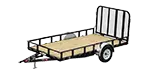

You rent a 10-ton excavator for a site job, then discover that the 14,000 lb. number on your equipment trailer is its maximum gross vehicle weight rating, not the amount of machinery it can carry. Once the trailer’s own empty weight is subtracted, its available payload is well below 14,000 lbs. and nowhere close to the roughly 20,000 lbs. represented by a 10-ton machine. That is how equipment gets damaged, axles and tires get overloaded, tow vehicles are pushed beyond their ratings, and drivers end up facing fines or an out-of-service order. Getting the right trailer under the machine before leaving the yard is where safe equipment hauling begins.
Heavy equipment trailers are not a single product category. They range from tandem-axle bumper-pull trailers for compact machines to high-capacity gooseneck flatbeds and purpose-built detachable-neck lowboys with nominal payload ratings measured in tens of tons. A compact excavator weighing 4,000 lbs., an 18,000 lb. short-radius excavator, and a nearly 50,000 lb. full-size excavator require completely different combinations of trailer, hitch, tow vehicle, axle capacity, brakes, and cargo securement.
Trailer GVWR is only the first number to check. Available payload is generally calculated by subtracting the trailer’s actual empty weight from its GVWR, but the usable capacity can also be limited by axle ratings, tires, wheels, coupler or lunette capacity, hitch rating, brake equipment, load placement, and the tow vehicle’s ratings. Never assume that every trailer carrying the same advertised GVWR has the same payload.
Start With Machine Weight, Not Trailer Length
Most buyers begin by asking, “How long is the machine?” Length matters for deck fit and weight distribution, but operating weight is the correct starting point. A current Kubota U17-5 is published at approximately 3,700 to 3,900 lbs., depending on the specification being referenced, while a Bobcat E20 is listed at about 4,167 lbs. A Caterpillar 308 CR can range from approximately 16,700 to 18,700 lbs. depending on configuration. A Cat 320 GC is around 48,500 lbs., and a Cat 320 is approximately 49,800 lbs. Those machines do not belong on the same class of trailer.
Use the machine’s actual transport or operating weight for its specific configuration. Cab versus canopy, rubber versus steel tracks, blade type, counterweight, fuel, quick coupler, bucket, hydraulic thumb, guarding, and other options can change the weight substantially. The figure printed in a general brochure may not match the machine sitting in your yard, so check the serial-number-specific specification, rental agreement, manufacturer data plate, or a certified scale ticket whenever possible.
Your trailer’s available payload must cover the complete transported load, not merely the base machine. Include buckets, forks, augers, breakers, grading attachments, spare tracks, fuel tanks, toolboxes, chains, binders, and anything else carried on the deck. Instead of relying on a blanket percentage rule, calculate the complete load and retain a practical capacity margin so that a small attachment change or imperfect load placement does not put the trailer, an axle, or a tire over its rating.
Deck fit also matters after capacity has been confirmed. The machine must sit where the trailer can maintain appropriate tongue or gooseneck load without overloading the tow vehicle’s rear axle, hitch, or tires. A trailer may be long enough to hold a machine yet still be unsuitable if the machine cannot be positioned correctly between the front of the deck and the axle group.
Quick Reference by Machine Class
| Machine Weight | Example Machines | Typical GVWR Starting Point | Typical Trailer Style |
|---|---|---|---|
| Under 6,000 lbs. | Kubota U17-5, Bobcat E20, compact mini-excavators, and smaller loaders | 10,000–12,000 lb., after confirming actual trailer payload | Tandem-axle equipment trailer or properly rated tilt deck |
| 6,000–14,000 lbs. | Kubota U35-4, John Deere 35 P-Tier or 50 P-Tier, compact track loaders, and larger mini-excavators | 14,000–24,000 lb., depending on machine weight and trailer tare | Heavy tandem-axle bumper pull, tilt trailer, or low-profile equipment trailer |
| 14,000–25,000 lbs. | Cat 308 CR, Cat 309 CR, heavier Kubota KX080-5 configurations, and mid-size construction equipment | 25,900–40,000 lb. or a commercial equipment trailer selected by net payload | High-capacity gooseneck flatbed, deckover, or commercial equipment trailer |
| 25,000–50,000 lbs. | Cat 320 GC, Cat 320, Komatsu PC210-class excavators, and large loaders | Commercial trailer selected by rated payload, axle configuration, and applicable weight laws | Detachable-neck lowboy, fixed-neck lowboy, or other heavy-haul semitrailer |
These ranges are shopping starting points, not automatic approvals. For example, a 14,000 lb. GVWR trailer weighing 3,500 lbs. empty has approximately 10,500 lbs. of theoretical payload before considering axle loading, tongue weight, installed options, or additional cargo. A different 14,000 lb. trailer may be lighter or heavier. Use the VIN-specific certification label and the actual empty weight of the completed trailer.
Bumper Pull vs. Gooseneck vs. Pintle
For compact equipment, a bumper-pull trailer with a properly rated 2-5/16-inch ball coupler can be practical and easy to use. The important limit is not a universal machine-weight cutoff. The receiver hitch, ball mount, ball, coupler, truck frame, rear axle, tires, suspension, and trailer must all be rated for the loaded combination and its actual tongue weight. Weight-distributing equipment may be required or prohibited depending on the trailer, hitch, and tow vehicle, so follow the manufacturers’ instructions rather than treating it as a substitute for adequate capacity.
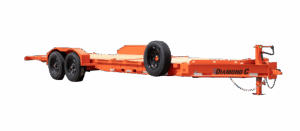
Current Diamond C bumper-pull equipment lines demonstrate how broad this category can be. The LPX Low Profile Extreme-Duty Equipment Trailer and HDT Hydraulically Dampened Tilt Trailer are offered in configurations ranging from 15,500 to 24,000 lbs. GVWR. The LPX uses a low-profile deck between the fenders and can be configured with loading systems such as MAX Ramps or the X-Ramp. The HDT uses a hydraulically dampened tilt deck, with powered and switchable gravity/power tilt options available on applicable builds. Current standard axle packages on these premium Diamond C lines use Lippert axles, with axle count and rating changing by configuration.
A gooseneck is the common step up when a contractor needs more deck length, greater trailer capacity, or a more stable connection for frequent commercial hauling. It couples to a ball mounted over or slightly ahead of the tow vehicle’s rear axle, rather than to a receiver behind the bumper. This arrangement can provide substantially more hitch capacity, but it does not make the truck unlimited. Pin weight still counts against the truck’s payload, rear gross axle weight rating, tire ratings, and GVWR.
The Diamond C FMAX is a gooseneck flatbed family that spans a much wider capacity range than a single 22,000 or 24,000 lb. trailer. Current models begin with the 15,500 lb. GVWR FMAX207 and extend through configurations rated as high as 40,000 lbs. GVWR. Depending on the model, the line includes 102-inch-wide decks, engineered main beams, multiple axle packages, and several loading-tail options. Standard gooseneck configurations commonly use a 2-5/16-inch ball, while applicable 40,000 lb. packages use a 3-inch ball and corresponding structural upgrades. Every component in the hitch system must match the trailer’s rating.
A pintle connection is common behind dump trucks, municipal trucks, military vehicles, and heavy service trucks. The trailer carries a lunette ring, while the tow vehicle carries the pintle hook. The connection allows more articulation than a conventional ball coupler, which can be useful on uneven jobsites. A pintle system is not automatically stronger than every ball or gooseneck system; its allowable load is determined by the lowest-rated component, including the lunette, pintle hook, mounting plate, fasteners, truck structure, and trailer tongue.
Choose the hitch style from the actual operating combination. A high-capacity bumper pull may be appropriate behind a correctly equipped medium-duty truck, while a gooseneck can be the better choice for a pickup-based contractor who needs additional deck and capacity. A pintle may be preferable when the trailer regularly follows a dump truck onto rough terrain. The label on the trailer does not override the limits of the tow vehicle or hitch hardware.
Deckover: Why It Matters for Big Machines
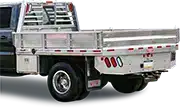
On a conventional low-profile equipment trailer, the main deck usually sits between the fenders. Common usable bed widths are approximately 80 to 83 inches, although certain max-width packages use drive-over or removable fender arrangements to provide additional usable width. This low deck height is valuable for compact excavators, skid steers, compact track loaders, and machines with limited ground clearance.
A deckover places the deck above the wheels and provides a flat surface across the trailer’s full legal width. For ordinary highway operation in Indiana, 102 inches, or 8 feet 6 inches, is the maximum standard vehicle width. A machine or loaded trailer wider than that generally enters oversize-permit territory; buying a deckover does not make an over-width machine legal without the required permit and route compliance.
The flat deck is useful for equipment with a wide undercarriage, attachments that extend beyond a between-fender deck, pallets loaded from the side, and mixed construction cargo. It also eliminates fixed fenders as loading obstructions. The tradeoff is height. Because the deck sits above the tires, the loading angle is generally steeper and the loaded machine raises the combination’s center of gravity and overall transport height.
Loading-tail design becomes especially important on a deckover. Long MAX Ramps or XDR Ramps, a hydraulic dovetail, or another manufacturer-approved loading system can reduce the approach angle and improve breakover clearance. Ramp capacity must be adequate for the machine and for the way its weight transfers while climbing. The total machine weight is not always divided evenly across both ramps, particularly when loading tracked equipment at an angle or when the machine crosses the deck hinge.
For frequent mid-size equipment moves, the workhorse setup is typically a 102-inch deckover or gooseneck flatbed with enough net payload, an axle and brake package suited to the duty cycle, and a loading system selected for the machine’s clearance. Securement points must be positioned where chains can pull in effective directions without contacting tires, hydraulic hoses, steps, or sharp deck edges. Do not assume that a tie-down point is adequate merely because it is welded to the trailer; verify its working-load limit and use the trailer manufacturer’s designated anchor locations.
Federal cargo-securement rules require heavy vehicles, equipment, and machinery weighing 10,000 lbs. or more to be restrained with at least four tiedowns, each attached as close as practical to the front and rear of the equipment. Articulated components and accessory equipment such as booms, blades, buckets, and hydraulic attachments must also be lowered and secured as required. Additional tiedowns may be necessary to achieve the required aggregate working-load limit or control an attachment independently.
The FMAX: When You Need More
The Diamond C FMAX deserves a separate look because it is a family of Flatbed Max gooseneck trailers rather than one fixed-capacity equipment model. The current lineup includes the FMAX207, FMAX208, FMAX210, FMAX212, FMAX216, FMAX307, FMAX310, and FMAX312. Published GVWRs range from approximately 15,500 lbs. on the FMAX207 to as much as 40,000 lbs. on specified FMAX216 and FMAX312 configurations.
That range makes the exact model code important. The FMAX207 is listed at 15,500 lbs. GVWR, the FMAX208 at 18,000 lbs., and the FMAX307 at 24,000 lbs. The FMAX210 is rated at 25,000 lbs., while the FMAX212 is rated at 25,900 lbs. The FMAX310 is a 30,000 lb. model, and higher FMAX216 and FMAX312 packages can reach 30,000 or 40,000 lbs. A dealer quote that simply says “FMAX” does not provide enough information to determine payload, axle capacity, coupler size, brake package, or tow-vehicle requirements.
Current FMAX construction uses engineered main-frame beams rather than a single generic beam size across every model. Depending on model and rating, published beam depths range from approximately 14 to 18 inches. Diamond C’s current Fleetneck 2.0 construction describes Grade 100 steel in the main-frame beams and a Grade 80 neck web. Models such as the FMAX207 and FMAX212 use 3-inch I-beam crossmembers on 16-inch centers as standard equipment, with build-specific options available.
Axle packages also change with the model. For example, the FMAX207 is published with tandem 7,000 lb. Lippert axles, while the FMAX212 uses tandem 12,000 lb. Lippert axles. Higher-capacity FMAX models use appropriately larger Lippert axle systems. Brake type and available upgrades vary by GVWR and configuration, so buyers should verify whether the specific VIN includes electric drum brakes, antilock equipment, electric-over-hydraulic disc brakes, or another listed package.
Payload must still be calculated from the completed trailer’s actual empty weight. Diamond C publishes an approximate empty-weight range of 6,250 to 12,060 lbs. for the FMAX212, depending on length and options. Against its 25,900 lb. GVWR, that produces a theoretical payload range of approximately 13,840 to 19,650 lbs. before checking axle distribution and other component limits. A long trailer with a hydraulic dovetail, toolboxes, spare tires, additional decking, and other equipment can carry materially less cargo than a shorter, lighter configuration with the same GVWR.
That distinction is critical when matching the trailer to an excavator. A lighter Cat 308 CR configuration may fit certain high-capacity FMAX builds after every weight and dimensional check is completed, while a heavier configuration may require a different trailer. A Cat 320 weighing approximately 48,500 to 49,800 lbs. exceeds the entire GVWR of even a 40,000 lb. FMAX before the trailer’s empty weight is considered. That machine belongs in commercial lowboy territory, not on a pickup-style gooseneck flatbed.
Loading options vary by FMAX model and build. Current factory choices include MAX Ramps, XDR Ramps, a hydraulic dovetail, and straight-deck configurations with slide-in ramps. The FMAX207’s published hydraulic dovetail is 12 feet long with an approximately 12.5-degree approach angle. The best tail is the one that provides sufficient ramp capacity, traction, and breakover clearance for the actual equipment while preserving the payload needed for the job.
For contractors making several equipment moves each week, the benefits are not limited to headline GVWR. An engineered frame, properly selected Lippert axles, commercial-duty brakes, accessible securement points, tool storage, and the correct loading system all affect uptime. Diamond C finishes current trailers with its DM Difference Maker multi-stage coating process, but the deck, frame, wiring, brakes, hydraulic system, and fasteners still require regular inspection and maintenance in commercial service.
Mini-Excavator Moves: Don’t Overthink It
On the smaller end, mini-excavators are often paired with more trailer than the job requires, but under-trailering them is the more serious mistake. A Kubota U35-4 has a published base operating weight around 8,129 lbs., with actual configurations varying according to cab, blade, tracks, counterweight, coupler, bucket, and other equipment. A John Deere 35 P-Tier is also listed at approximately 8,135 lbs. Those machines can consume most of the payload available on a typical 10,000 lb. GVWR trailer.
A properly configured 14,000 to 16,000 lb. GVWR equipment trailer will often be a practical starting point for an 8,000 lb.-class mini-excavator, but only after its empty weight is subtracted. If a 14,000 lb. trailer weighs 3,800 lbs. empty, it has about 10,200 lbs. of theoretical payload. That may cover the excavator and one bucket, but a hydraulic thumb, quick coupler, second bucket, breaker, chains, toolbox, and spare tire can reduce the remaining margin quickly.
A tilt trailer can make loading a one-person operation without handling separate ramps. The deck angle, hinge location, damping system, traction surface, and rated capacity still need to suit the machine. Diamond C’s HDT is a bumper-pull equipment trailer with a hydraulically dampened tilt deck and published GVWR choices from 15,500 to 24,000 lbs. The standard bed is approximately 80 to 82 inches wide, so track width and attachment clearance must be checked before ordering.
A ramp-equipped LPX is another current option for contractors who prefer a fixed low-profile deck. Its available MAX Ramps and X-Ramp configurations provide different loading approaches, while axle and GVWR options allow the trailer to be matched more closely to the machine. The right choice depends on how often the machine is moved, whether other equipment will share the trailer, the machine’s ground clearance, and whether the operator prefers a tilt deck or removable/folding ramps.
H&H also currently lists equipment trailers in this capacity class. Its Industrial Equipment Trailer is offered with an approximately 82-inch bed, lengths from 14 to 26 feet, and 14,000 to 16,000 lb. GVWR configurations. H&H’s gravity-tilt lineup also includes 14,000 and 16,000 lb. choices. As with any brand, compare the completed trailer’s empty weight, axle ratings, deck length, ramp or tilt capacity, brake equipment, and tie-down layout rather than selecting from GVWR alone.
The tow vehicle does not automatically need to be a one-ton diesel simply because the cargo is a mini-excavator. It must, however, be rated for the actual loaded trailer, tongue weight, hitch, and combined weight. Depending on the trailer and machine, the correct vehicle may be a properly equipped three-quarter-ton pickup, one-ton pickup, cab-and-chassis truck, or heavier commercial truck. Use the truck’s certification labels, towing guide, hitch documentation, and configuration-specific ratings.
Tow Vehicle Matching
The trailer is only half of the combination. A 25,900 lb. GVWR gooseneck does not become safe behind a truck rated to tow 12,000 lbs., and a high advertised tow rating does not guarantee enough payload for the gooseneck weight. Check the tow vehicle’s GVWR, front and rear GAWR, GCWR, maximum trailer rating, hitch rating, tire capacity, and available payload after accounting for the driver, passengers, fuel, tools, auxiliary tanks, bed equipment, and cargo in the truck.
Use actual loaded weights whenever possible. A scale ticket should show the steer axle, drive axle, and trailer axle group separately. This reveals problems that a single combined number can hide. The combination may remain below GCWR while the rear axle or trailer axle group is overloaded because the machine is positioned incorrectly. Moving the machine changes tongue or pin weight, but it cannot correct a trailer or truck that is fundamentally undersized.
There is no universal rule that every combination above 20,000 lbs. requires a three-quarter-ton or one-ton diesel. Gasoline and diesel trucks can both be rated for substantial trailers, and ratings vary considerably by cab, wheelbase, drivetrain, axle ratio, bed, hitch, and option package. At the upper end of the FMAX line, a medium-duty or properly configured heavy pickup may be required. Full-size excavators around 45,000 to 50,000 lbs. generally require a commercial tractor or heavy truck and a lowboy selected for the machine’s weight, dimensions, axle distribution, and route.
For Indiana and federal CDL classification, the key Class A threshold is a combination with a gross combination weight rating or actual gross combination weight of 26,001 lbs. or more when the towed unit has a GVWR or actual gross weight greater than 10,000 lbs. A trailer exceeding 10,000 lbs. does not by itself create a Class A CDL requirement when the qualifying combination does not reach 26,001 lbs. Commercial use, interstate operation, vehicle design, passenger capacity, hazardous materials, and other circumstances can create additional licensing or regulatory obligations, so operators should verify how the rules apply to their operation.
Indiana also requires brakes on trailers over 3,000 lbs. GVWR. On heavy equipment trailers, buyers should confirm brakes on the required wheels, a compatible in-cab brake controller or electric-over-hydraulic system, a correctly functioning breakaway system, adequate battery condition, and proper adjustment. Having brake hardware installed is not enough if the controller, wiring, breakaway switch, hydraulic actuator, or individual wheel brakes are not working correctly.
Equipment dimensions can trigger requirements even when the weight is legal. Indiana’s ordinary maximum width is 8 feet 6 inches, and ordinary maximum vehicle height is 13 feet 6 inches. A wide excavator undercarriage, boom position, bucket, or elevated deck can put the loaded combination outside those limits. Oversize or overweight operation may require permits, approved routing, signs, flags, lighting, escorts, and travel-time restrictions.
Common Questions
Can I use the same trailer for a mini-excavator and a skid steer? Often, yes, provided both machines fit within the trailer’s actual payload, deck dimensions, axle ratings, and loading-system capacity. A 14,000 to 16,000 lb. GVWR ta


