






You’ve got a properly rated tow vehicle, a USDOT number and operating authority when your operation requires them, and the drive to start running loads. The trailer is the last major piece, and it is one decision that can either strengthen your hot shot business or quietly drain it through downtime, overweight citations, poor fuel economy, premature tire wear, and freight you cannot legally or safely accept.
Hot shot hauling is one of the more accessible entry points into commercial freight transportation. You may not need a Class 8 tractor, a team driver, or a terminal, but accessible does not mean simple. Your pickup or medium-duty truck, hitch, trailer, tires, brakes, cargo-control equipment, insurance, licensing, and operating authority all have to work as one correctly rated system.
What Hot Shot Hauling Actually Means
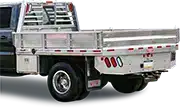
Hot shot freight generally refers to expedited or time-sensitive cargo delivered directly with a pickup or medium-duty truck and an open gooseneck, step-deck, equipment, or similar trailer. Common loads include oilfield components, farm machinery, construction materials, steel, building products, powersports units, vehicles, and job-site equipment. Many operations use Class 3 through Class 5 trucks, although heavier combinations may use Class 6 through Class 8 power units.
There is no universal 20,000- or 25,000-pound cargo limit for every hot shot rig. Legal payload is calculated from the specific truck, trailer, hitch, axle, wheel, tire, and brake ratings, along with the rig’s measured empty weight and the way the load is distributed. Trailer payload is the trailer’s GVWR minus its actual as-built empty weight, but that number alone does not prove the truck can tow it. The truck’s GCWR, rear-axle rating, tire capacity, available payload, hitch rating, and loaded pin weight can become the limiting factors first.
A gooseneck hitch places the connection in the truck bed over or slightly ahead of the rear axle instead of behind the rear bumper. That positioning generally provides better stability and weight distribution than a conventional bumper-pull connection, which is why gooseneck flatbeds are common in hot shot work. However, a substantial portion of the loaded trailer weight still transfers to the truck as pin weight. That weight counts against the truck’s payload, rear GAWR, tires, wheels, suspension, and hitch ratings.
CDL: Do You Need One?
Many serious hot shot combinations require a Class A Commercial Driver’s License, but commercial use by itself is not the Class A trigger. Under the federal standard, a Class A CDL is required when the combination has a gross combination weight rating or actual gross combination weight of 26,001 pounds or more, whichever is greater, and the towed unit has a GVWR or actual gross weight of more than 10,000 pounds, whichever is greater. The 26,001-pound threshold applies to the combination, not to the trailer by itself. :contentReference[oaicite:0]{index=0}
For example, a truck with a 14,000-pound GVWR paired with a 15,500-pound-GVWR trailer produces a 29,500-pound combined rating, placing the combination in Class A territory because the trailer is also rated above 10,000 pounds. A trailer rated above 10,000 pounds does not independently create a Class A requirement when the combination remains below 26,001 pounds, although other commercial motor vehicle regulations may still apply.
A non-CDL hot shot rig is not automatically exempt from federal safety rules. In interstate commerce, a vehicle or combination with a GVWR, GCWR, GVW, or GCW of 10,001 pounds or more generally meets the federal definition of a commercial motor vehicle. Depending on the operation, that can bring driver qualification, medical certification, vehicle inspection, maintenance, hours-of-service, cargo-securement, marking, and recordkeeping requirements into play even when a CDL is not required.
A USDOT number and interstate operating authority are also different requirements. Interstate carriers operating qualifying commercial motor vehicles generally need a USDOT number. A for-hire carrier transporting federally regulated property across state lines generally also needs operating authority, commonly identified by an MC number, along with the required insurance filings and process-agent designation. Private carriers and strictly intrastate carriers can fall under different rules, so the correct registration depends on what you haul, who owns the freight, where you operate, and whether you are paid to transport it. :contentReference[oaicite:1]{index=1}
Do not select a trailer rating simply to stay below a licensing threshold unless the resulting truck-and-trailer combination genuinely fits your freight plan. The certification labels, manufacturer ratings, actual scale weights, axle loads, and operating configuration are what matter during an inspection. A Class A CDL can expand the equipment and freight you are qualified to operate, but it does not authorize an overloaded truck, an improperly secured load, or a combination that exceeds its component ratings.
The 40-Foot Question
Trailer length is a real business decision, not just a number on a build sheet. A longer deck may increase the number of loads you can quote, but it also adds empty weight, turning radius, tire scrub, purchase cost, maintenance expense, and space requirements.
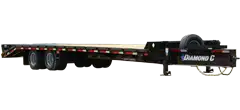
A nominal 40-foot gooseneck deck is common in long-haul hot shot work because it provides room for long steel, building materials, multiple vehicles, machinery, or separated freight that cannot be safely stacked. Diamond C offers FMAX configurations from approximately 20 feet through 44 feet depending on the exact model and loading style, so 40 feet is not the manufacturer’s absolute maximum. The correct length should be based on the freight you expect to haul rather than the assumption that the longest available trailer is automatically the most profitable.
A 40-foot trailer is not automatically permit-free in every state. Trailer deck length, total combination length, axle spacing, rear overhang, load width, load height, axle weight, and gross weight can all affect legality. A 102-inch-wide trailer may be suitable for normal legal-width operation on appropriate routes, but cargo extending beyond the legal width can require oversize permits, signs, flags, lights, escorts, or route restrictions. Overall length rules and permit practices also vary, especially off the National Network and on local roads.
Many operators remain productive with 30-, 32-, 35-, or 38-foot decks. Shorter trailers generally weigh less, maneuver more easily, fit into tighter equipment yards, and reduce the amount of unused steel being pulled when loads are small. Longer decks are valuable when your lanes consistently offer long or multi-piece freight. Study actual load-board dimensions, customer requirements, loading locations, and expected revenue before deciding how much deck you need.
Diamond C FMAX: Built Specifically for This Work
The Diamond C FMAX, meaning Flatbed Max, is Diamond C’s premium flatbed gooseneck family and is well suited to hot shot freight, equipment transport, agriculture, construction, and commercial hauling. It is not one trailer with one fixed GVWR. Current FMAX identities include the FMAX207 at 15,500 pounds, FMAX208 at 18,000 pounds, FMAX307 at 24,000 pounds, FMAX210 at 25,000 pounds, FMAX212 at 25,900 pounds, FMAX310 at 30,000 pounds, and the FMAX312 and FMAX216 with packages reaching as high as 40,000 pounds. All use Lippert axles, with the axle count and rating determined by the model. :contentReference[oaicite:2]{index=2}
Every FMAX has a 102-inch-wide deck-over design, while available deck lengths and tail configurations vary by model. The FMAX210, for example, uses two 10,000-pound Lippert axles and is offered in lengths from 20 through 40 feet. The FMAX212 uses two 12,000-pound Lippert axles and carries a 25,900-pound GVWR. Triple-axle and 16,000-pound-axle models serve heavier applications, but the trailer’s stated GVWR, rather than the simple sum of its axle ratings, remains the maximum certified trailer weight.
Air-ride suspension is an available upgrade on eligible longer FMAX configurations; it is not standard on every FMAX. Standard and optional suspension choices vary by model and can include heavy-duty slipper-spring systems, Hutch heavy-duty adjustable suspension, and a Cush-designed air-ride package. The available air-ride system includes a front lift axle and can improve ride quality for the trailer and cargo, but it adds cost, weight, air and electrical components, and maintenance points. It does not increase the truck’s tow rating or allow the rig to exceed its legal axle, tire, GVWR, or GCWR limits. :contentReference[oaicite:3]{index=3}
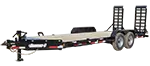
Loading equipment can be handled through several current FMAX configurations. MAX Ramps are 44 inches wide, spring-assisted, and built with a two-part hinge system. They can fold flat over the dovetail to preserve a usable loading surface or be carried upright when the load requires the dovetail area. Depending on the FMAX model and build, other choices can include XDR heavy-equipment ramps, a straight deck with rear slide-in ramps, or a hydraulic dovetail. The correct choice depends on whether you primarily load wheeled equipment, steel-tracked machines, vehicles, pallets, or long material. :contentReference[oaicite:4]{index=4}
Current FMAX construction includes Diamond C’s fabricated Engineered Beam technology, with the beam size matched to the model and rating. Fleetneck 2.0 uses higher-strength material and integrated routing provisions intended to improve strength-to-weight efficiency. The completed trailer receives Diamond C’s DM Difference Maker multi-stage powder-coating process, which includes steel-shot blasting, a multi-stage wash, corrosion-resistant preparation, primer, and powder topcoat. Diamond C has manufactured trailers since 1985 and remains family owned and operated in Mt. Pleasant, Texas. :contentReference[oaicite:5]{index=5}
Diamond C HDT: When the Load Demands More
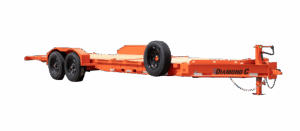
The Diamond C HDT is the Hydraulically Dampened Tilt equipment-trailer family. For a gooseneck connection, the correct configuration is the HDT-GN. It is a low-profile, between-the-fenders equipment trailer designed to reduce the loading angle for skid steers, compact excavators, lifts, tractors, and other machinery. It serves a different purpose from the 102-inch-wide, deck-over FMAX.
The HDT and HDT-GN are available from 15,500 through 24,000 pounds GVWR, with lengths from 16 through 28 feet and bed widths generally ranging from 80 to 82 inches depending on the axle and frame package. The standard 15,500-pound package uses two 7,000-pound Lippert axles, while available configurations can include two 8,000-pound axles, two 10,000-pound torsion axles, or a triple-7,000-pound-axle package. The exact length, axle configuration, deck width, tire package, and frame must be selected together. :contentReference[oaicite:6]{index=6}
The standard tilt action is a gravity-fed, hydraulically dampened system. The hydraulic cylinder controls the bed’s movement so the trailer can be unlatched, tilted, loaded, returned to transport position, and locked without lifting conventional ramps. Because gravity provides the basic movement, the standard dampened system does not require an electric hydraulic power unit. Electric-over-hydraulic powered tilt and Pro Tilt are available options on qualifying configurations. Pro Tilt allows the operator to switch between gravity tilt and powered control when terrain, load balance, or multiple pieces of equipment make precise bed movement useful. :contentReference[oaicite:7]{index=7}
Frame construction varies with the HDT package. Lower-rated configurations use conventional I-beam construction, while higher-GVWR and qualifying longer configurations use Diamond C Engineered Beam technology. That distinction matters because an HDT should be ordered as a complete package rather than judged by one frame dimension. Bed length, stationary-deck length, axle selection, deck material, tilt system, tire size, brakes, and expected concentrated equipment weight all influence the correct build.
Trailer Specs That Affect Your Bottom Line
| Spec | FMAX (up to 40ft) | HDT (low-profile tilt) |
|---|---|---|
| GVWR | 15,500 to 40,000 lbs by model; common dual-wheel hot shot choices include 25,000- and 25,900-lb configurations | 15,500 to 24,000 lbs by axle and frame package |
| Deck Width | 102 inches, deck-over | Approximately 80-82 inches between the fenders |
| Available Length | Approximately 20-44 feet across the family; exact range depends on model and loading style | 16-28 feet; stationary-deck and full-tilt availability depend on length |
| Axles | Lippert axles from tandem 7K packages through tandem 16K or triple-axle packages, depending on model | Lippert axles; tandem 7K standard package with tandem 8K, tandem 10K torsion, and triple 7K configurations available |
| Suspension | Model-dependent slipper-spring or heavy-duty suspension; Hutch and air ride available on eligible configurations | Slipper-spring or torsion suspension depending on the selected axle package |
| Braking | Electric brakes with current ABS availability by axle package; electric-over-hydraulic options are available on qualifying builds | Electric brakes with current ABS availability by axle package; electric-over-hydraulic disc options are available on qualifying builds |
| Loading Style | MAX Ramps, XDR Ramps, straight-deck slide-in ramps, or hydraulic dovetail depending on the build | Hydraulically dampened gravity tilt, powered tilt, or Pro Tilt depending on the build |
| Best Use | Hot shot freight, long material, vehicles, equipment, pallets, agriculture, and construction cargo | Skid steers, compact excavators, tractors, lifts, and other equipment that benefits from a low loading angle |
Those GVWR figures do not represent cargo payload and do not create a universal permit threshold. Payload is the trailer’s GVWR minus its actual empty weight, and the finished trailer can become substantially heavier when equipped with a hydraulic dovetail, air ride, hydraulic jacks, extra storage, winches, additional spare tires, steel decking, or other options. Legal road weight is also controlled by the truck and trailer certification ratings, actual axle weights, tire and wheel capacities, hitch rating, bridge and axle-spacing rules, and state-specific size and weight laws.
Braking requirements must be treated separately from CDL rules. In Indiana, a trailer or semitrailer with a gross weight of at least 3,000 pounds must have brakes adequate to control, stop, and hold it. The driver must be able to apply the trailer brakes from the cab, and the system must automatically apply the brakes if the trailer separates from the tow vehicle. Every hot shot trailer discussed here is well beyond that threshold, so a functioning brake controller, charged breakaway battery, properly adjusted brakes, and regular inspection are essential. :contentReference[oaicite:8]{index=8}
For 2026 production, Diamond C has introduced Lippert trailer ABS as standard on models using 8,000-pound and larger axle packages and as an option on 7,000-pound-axle models. Availability can depend on the exact model, axle package, production timing, and selected brake system, so confirm the VIN-specific build sheet rather than assuming every trailer on a dealer lot has identical braking technology. :contentReference[oaicite:9]{index=9}
What to Look For Beyond the Model Name
Brand and model are starting points. The details that determine whether a working hot shot trailer is profitable, serviceable, and legal run much deeper.
- Axle rating: Verify the axle manufacturer, axle count, GAWR, suspension type, brake system, hub lubrication, wheels, and tires on the actual trailer. Diamond C’s current premium heavy-duty models use Lippert axles, but FMAX packages range from tandem 7,000-pound axles through tandem 16,000-pound or triple-axle arrangements. A larger axle package does not automatically create usable payload if the truck, coupler, tires, wheels, frame, or legal axle weights are lower. Always calculate from the certification labels and weigh the completed rig by axle.
- Coupler: Do not assume every gooseneck uses the same ball diameter or coupler rating. Current Diamond C goosenecks rated up to 30,000 pounds can use the CURT Cushion Coupler, while the 40,000-pound FMAX package uses a 3-inch-ball, 40K Telescoupler. Confirm the coupler label, truck ball size, hitch rating, vertical adjustment, bed clearance, tailgate clearance, safety-chain attachment, and required breakaway connection before delivery.
- Tie-down points: FMAX trailers include a rub rail with stake pockets and pipe spools, and configurations can be ordered with 5/8-inch D-rings, welded ratchets, sliding ratchets, and full-length slide track. Cargo-control capacity must be evaluated as a complete system because the lowest-rated anchor, chain, strap, binder, hook, or connector controls the working load limit. Federal rules generally require the aggregate working load limit of the securement system to equal at least one-half the cargo weight, with additional rules for cargo length and for heavy vehicles, equipment, and machinery. :contentReference[oaicite:10]{index=10}
- Floor: Current FMAX choices can include 2-inch treated lumber, 2-inch oak, and AlumaTrax aluminum flooring, depending on the model and configuration. Treated lumber is practical and comparatively easy to replace. Oak provides a denser hardwood surface for tougher service. Aluminum can reduce deck weight and eliminate wood rot but changes cost, traction, and repair considerations. Choose the floor for the actual point loads, steel tracks, forklift traffic, weather exposure, maintenance plan, and desired empty weight rather than selecting a material solely because it sounds more premium.
Building a Hot Shot Business on the Right Foundation
Many new hot shot operators focus on available loads and underestimate how strongly the trailer controls which freight they can quote. A properly configured FMAX flatbed can cover a broad mix of machinery, vehicles, long material, and general open-deck freight. A 25,000- or 25,900-pound model may be a practical middle ground for some CDL operations, but the usable cargo capacity must be calculated from the trailer’s as-built weight and the capacity of the truck. A 40,000-pound FMAX rating is useful only when the tow vehicle, hitch, tires, axles, licensing, insurance, and road-weight limits support the intended load.
An HDT-GN can be the better investment when your business repeatedly transports equipment that benefits from a low loading angle. Eliminating conventional ramp setup can simplify loading, but a tilt trailer is shorter and narrower than a deck-over hot shot flatbed and may not fit long steel, wide freight, or multi-pallet loads as well. A tilt deck does not automatically recover its additional purchase cost within a fixed period. Its financial value depends on how often it saves labor, enables a load, reduces loading risk, or replaces separate loading equipment.
Your truck matters just as much as your trailer. A Ram 3500 single-rear-wheel truck, a Ram 3500 dual-rear-wheel truck, an Ford F-450 pickup, and a medium-duty chassis-cab can have significantly different payload, rear-axle, tire, hitch, GCWR, and conventional or gooseneck towing limits even when their engines appear similar. Published maximum towing claims usually apply only to specific cab, bed, axle-ratio, drivetrain, wheel, tire, and equipment combinations. Use the door certification label, owner’s manual, manufacturer towing guide, hitch label, and an actual scale ticket for the exact truck.
Pin weight is especially important. A loaded gooseneck may place thousands of pounds in the truck bed, and adding a toolbox, auxiliary fuel tank, passengers, cargo, hitch hardware, and accessories reduces the payload remaining for that pin weight. A truck can be below its advertised maximum tow rating and still be overloaded on the rear axle or tires. Load position must also maintain stable pin weight without overloading the trailer axles or reducing steering-axle weight excessively.
Before buying, compare insurance eligibility, maintenance access, tire availability, brake-controller compatibility, spare-parts support, deck height, loading angle, empty weight, and expected annual mileage. A trailer that fits your legal ratings but cannot be insured for your intended operation, cannot enter your customers’ sites, or requires hard-to-source tires can still become an expensive limitation.
The hot shot market rewards operators who can say yes to more loads, but only when the truck, trailer, license, insurance, securement, and measured axle weights make that yes legal and safe.
Spencer Trailers carries Diamond C gooseneck trailers, including FMAX flatbeds and HDT-family equipment tilts, at our lot in Spencer, Indiana. We’re a family-run dealership in Owen County, and we regularly talk through trailer specifications with customers, including operators entering hot shot hauling for the first time. If you’re deciding whether a 30-, 35-, or 40-foot deck fits your freight targets, whether MAX Ramps or a hydraulic dovetail makes sense, or whether an HDT-GN tilt is better for your equipment, that is a conversation worth having before you buy. Reach out to us directly or come by the lot at 291 West State Hwy 46.
You can also browse our current trailer inventory to see which Diamond C models and configurations we have on hand. Inventory, factory options, braking systems, suspension packages, empty weights, and pricing can change, so confirm the model code, GVWR, axle package, loading style, coupler, and VIN-specific build details before matching a trailer to your truck and business plan.
What freight type are you targeting first? That answer should shape everything from truck capacity and CDL status to trailer GVWR, deck length, loading system, suspension, floor material, tire package, and cargo-securement equipment.


