







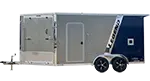

You’ve watched it happen. One operator spends valuable time pulling out ramps, lining them up, checking that they are fully seated, and easing a low-clearance machine over the breakover point. The operator next to him releases a tilt deck, drives the machine aboard, secures the deck, and moves on to the next job. The difference is not driving skill. It is choosing a loading system that matches the equipment.
Tilt-bed trailers are built to solve a specific problem: loading wheeled or tracked equipment without handling separate ramps. They are especially useful for compact excavators, skid steers, compact track loaders, scissor lifts, mini loaders, mowers, and other machines with limited ground clearance. A tilt trailer is not automatically the best answer for every load, but when the machine’s approach angle, wheelbase, weight, and loading frequency line up with the trailer, it can save time on nearly every trip.
Gravity Tilt vs. Hydraulic Tilt: What’s the Real Difference?
Both designs use a deck that rotates around a pivot built into the trailer frame. As the rear of the deck moves toward the ground, the front portion rises. Once the load moves forward across the pivot, the deck returns to its transport position. The important distinction is not simply whether hydraulics are present. It is whether gravity moves the deck or a powered hydraulic system actively raises and lowers it.
Gravity tilt uses the weight of the deck and load to control the tilting motion. On Diamond C’s hydraulically dampened tilt models, a hydraulic cylinder, reservoir, and adjustable flow-control valve slow and regulate that motion. The hydraulic system is acting as a dampener rather than as the power source. You release the mechanical deck lock, allow the rear of the deck to settle, load the machine, and let the load’s position bring the deck back down. The standard dampened system does not need an electric hydraulic pump or a charged pump battery to tilt, but the cylinder, hydraulic fluid, valve, hoses, pivot components, and latch still require routine inspection. :contentReference[oaicite:0]{index=0}
Powered hydraulic tilt uses an electric-over-hydraulic power unit to move the deck up and down on command. This is useful when the load is too light, too short, or positioned too unevenly to operate a gravity deck predictably. Diamond C’s DET and DET-GN deck-over tilt trailers use an electric/hydraulic powered tilt system. Diamond C also offers Pro Tilt on applicable HDT, HDT-GN, HXD, and HXD-GN configurations, allowing the operator to switch between gravity operation and powered control. A powered system adds flexibility, but it also adds a battery, charging system, pump, electrical connections, and additional hydraulic components that need to be maintained. :contentReference[oaicite:1]{index=1}
So which is better? It depends on how the trailer will be used. A gravity-fed, hydraulically dampened deck is simple and efficient when one properly positioned machine provides enough weight to cycle the deck. Powered tilt earns its keep when a crew loads several pieces of equipment, handles machines with unusual weight distribution, works on imperfect terrain, or needs to hold the deck at a controlled position. For operators who encounter both situations, a selectable gravity-and-power system can provide the most versatility.
Why Tilt Beats Ramps for Low-Clearance Equipment
Ramp trailers work well when the ramps are long enough, properly rated, correctly supported, and matched to the machine’s clearance. Problems begin when a short ramp creates a steep approach or when the transition from the ramp to the main deck is too abrupt. A compact excavator may clear the first part of the ramp but drag its undercarriage at the breakover point. A mower deck, trencher attachment, or track frame can create the same problem.
A low-profile tilt trailer replaces a short ramp-and-deck transition with a longer inclined loading surface. That generally produces a smoother approach and breakover, but there is no single loading angle that applies to every tilt trailer. The angle changes with deck length, tire and axle package, deck height, pivot geometry, and whether the trailer has a full tilt bed or a stationary front deck. Before buying, compare the machine’s approach angle, departure angle, wheelbase, undercarriage clearance, and attachment position with the dimensions of the exact trailer being considered.
Ground conditions matter too. A trailer parked with its rear facing uphill can have a very different effective loading angle than the same trailer sitting on level pavement. Soft ground can let the tires settle, while a curb or raised driveway can change the transition at the end of the deck. A tilt trailer makes loading easier, but the operator still needs a firm, level loading area whenever possible.
There is also the speed factor. There are no loose ramps to pull from a carrier, align, pin, lift, or return to storage. There is less chance of reaching a job and discovering that a ramp was left behind. With the correct operating procedure, the deck itself becomes the loading surface: unlock it, tilt it, load the machine, return the deck to transport position, engage the lock, secure the cargo, and perform a walk-around before moving.
Diamond C Tilt Models Worth Knowing
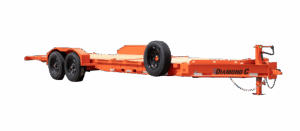
Diamond C’s current tilt lineup covers everything from compact single-axle applications to low-profile heavy equipment haulers and 102-inch-wide deck-over trailers. Diamond C was founded in 1985 and builds its trailers in Mt. Pleasant, Texas. Current trailers receive the DM Difference Maker coating system, a multi-step process that includes steel-shot blasting, a five-stage wash, force drying, zinc epoxy primer, powder topcoat, and oven curing. :contentReference[oaicite:2]{index=2}
Diamond C DSA Single-Axle Tilt Trailer
The DSA is Diamond C’s compact single-axle hydraulically dampened tilt trailer. It has a 7,000 lb GVWR, a 7,000 lb Lippert axle, available 10- and 12-foot lengths, and bed-width choices from 59 to 77 inches. It is intended for compact machines such as scissor lifts, small stand-on loaders, and other equipment that fits within the trailer’s deck dimensions and available payload. Because the trailer itself consumes part of the 7,000 lb GVWR, buyers must subtract the actual empty trailer weight from the GVWR before deciding whether a machine is light enough to haul. :contentReference[oaicite:3]{index=3}
The DSA uses a gravity-fed hydraulic dampening system with a speed-control valve, not a powered dump-style hoist. Its compact dimensions can make it easier to store and maneuver than a tandem-axle equipment trailer, but it is a specialized solution. Machine width, concentrated wheel or track loading, attachment overhang, and tie-down access are just as important as the machine’s published operating weight.
Diamond C HDT and HDT-GN
The HDT is Diamond C’s low-profile hydraulically dampened bumper-pull tilt equipment trailer, while the HDT-GN places the same general loading concept on a gooseneck platform. Current HDT and HDT-GN configurations cover 16- to 28-foot lengths, approximately 80- to 82-inch bed widths depending on the package, and GVWR choices from 15,500 to 24,000 lbs. The standard package uses two 7,000 lb Lippert axles, with higher-capacity tandem and triple-axle packages available according to trailer length and configuration. Higher-GVWR packages use Diamond C’s Engineered Beam frame technology where specified. :contentReference[oaicite:4]{index=4}
Buyers can configure shorter HDT models with a full tilting bed or select a split-deck arrangement with a stationary section at the front. Available stationary-deck lengths depend on the trailer’s overall length. That choice matters when hauling more than one machine. A stationary front deck can carry an attachment or compact second unit while the rear section tilts, but the machine being loaded must have enough wheelbase or track contact to move across the pivot and settle the deck safely.
The standard HDT system is gravity-fed and hydraulically dampened. Powered tilt and Pro Tilt are available on eligible builds when the operator needs active deck control. Current floor choices include treated lumber and oak, with steel diamond-plate flooring available on compatible powered configurations. Because specifications and option compatibility change with GVWR, deck length, and pull type, the build sheet for the individual VIN is more reliable than assuming every HDT is equipped the same way. :contentReference[oaicite:5]{index=5}
Diamond C HXD and DET Wide-Deck Tilt Trailers
The HXD and HXD-GN are 102-inch-wide, low-profile tilt trailers built for equipment or vehicles that need more width than an between-the-fenders HDT provides. Current HXD configurations are offered in 22- and 24-foot lengths with GVWR choices from 15,500 to 23,000 lbs. They use drive-over fenders, a stationary front deck, gravity-fed hydraulic dampening, and two 7,000 lb Lippert axles in the standard package. Higher-capacity Lippert axle packages and Pro Tilt are available on eligible builds. The HXD is bumper pull, while the HXD-GN uses Diamond C’s engineered gooseneck design. :contentReference[oaicite:6]{index=6}
The DET and DET-GN take a different approach. These are 102-inch-wide deck-over tilt trailers with the deck above the tires, eliminating fenders from the loading surface and allowing material to be side-loaded. Current lengths run from 20 to 30 feet, with GVWR packages from 15,500 to 23,000 lbs. The standard package uses two 7,000 lb Lippert axles, while higher-capacity axle packages are available. The DET family uses an electric/hydraulic powered tilt deck and can be configured with a full-bed tilt or a stationary front section where offered. The bumper-pull DET is also available with a pintle-ring configuration, while the DET-GN uses an engineered gooseneck. :contentReference[oaicite:7]{index=7}
The tradeoff is deck height. A deck-over provides the full 102-inch loading width and easier side access, but the deck sits higher than a low-profile, between-the-fenders trailer. That can increase the loading angle even though the deck tilts. The right choice depends on whether the machine needs maximum width, minimum deck height, side-loading capability, or room for pallets and attachments in addition to the primary machine.
What to Check Before You Buy
A few things often get overlooked when people are shopping for tilt trailers:
- Pivot point and load balance. Do not assume that moving the pivot farther forward or farther back automatically makes a trailer better. The pivot location works together with the axle position, tilt-deck weight, stationary-deck length, and expected center of gravity. A short, rear-heavy machine may cycle a gravity deck differently than a long excavator carrying most of its weight near the center. Ask how the exact machine should be positioned and where the manufacturer expects the load center to sit for transport.
- Deck and tilt-section length. A split-deck trailer does not necessarily lose usable cargo space, because the stationary section can still carry cargo. What changes is the amount of deck that actually reaches the ground. Measure the machine’s overall length, wheelbase or track length, attachment overhang, and center of gravity. Confirm that the machine can cross the pivot without an attachment striking the stationary deck, tongue box, truck, or ground.
- Tie-down positioning and ratings. Look at the location and rating of D-rings, stake pockets, rub rail, chain spools, chains, binders, and attachment points on the machine. Under federal cargo-securement rules applicable to commercial carriers, the aggregate working load limit of the securement system must be at least one-half the cargo weight. Heavy equipment weighing 10,000 lbs or more is subject to additional requirements, including restraint against movement in every direction and at least four tiedowns attached near the front and rear. The weakest rated component limits the securement system. :contentReference[oaicite:8]{index=8}
- Tilt lock system. Check how the deck is secured in the transport position and how clearly the operator can confirm full engagement. On a used gravity-tilt trailer, inspect the mechanical latch, pivot pins, bushings, and latch mounting points for looseness, deformation, or cracked welds. On a powered deck, inspect the manufacturer’s transport-lock procedure as well. Do not rely on trapped hydraulic pressure as a substitute for a required mechanical lock.
- Actual payload. Payload is the trailer’s GVWR minus its actual empty weight as equipped. Optional steel flooring, winches, hydraulic jacks, larger batteries, spare tires, toolboxes, and heavier axle packages can change empty weight. Add the machine, attachments, fuel, buckets, forks, chains, binders, and anything else carried on the deck before deciding that a trailer has enough capacity.
- Hydraulic and electrical condition. On a dampened deck, inspect the cylinder rod, seals, fluid level, valve, reservoir, and hoses. On a powered trailer, also load-test the battery and inspect the charger, pump, solenoid, wiring, remote, circuit protection, and ground connections. A pump that operates correctly with an empty deck may still struggle under load if the battery or electrical connections are weak.
A Quick Comparison: Tilt vs. Ramp for Common Loads
| Load Type | Tilt Trailer | Ramp Trailer |
|---|---|---|
| Compact excavator (6,000–10,000 lbs) | Often an excellent fit when deck length, payload, and pivot geometry match the machine | Can work well with long, properly rated ramps and a suitable dovetail; verify undercarriage clearance |
| Skid steer / track loader | Fast loading with no separate ramps; load position must produce safe tongue weight | Works well when ramps, support feet, and breakover angle are appropriate for the machine |
| Zero-turn mower | Smooth approach and convenient for frequent daily loading | Usually works well with long landscape ramps or a properly supported gate |
| Large tractor (high clearance) | Works if the tractor fits the payload, deck, axle, and securement limits | Often a practical choice because the tractor may not need the lower approach of a tilt deck |
| ATV / side-by-side | Convenient but frequently more trailer than the load requires | A lighter utility or equipment trailer is often the more economical match |
Matching Tilt Capacity to Your Tow Vehicle
This is where buyers can get into trouble. A trailer’s advertised GVWR is not its empty weight, and the truck does not necessarily have to pull the trailer at maximum GVWR on every trip. However, the actual loaded trailer and truck must remain within every applicable limit. Check the tow vehicle’s VIN-specific maximum loaded trailer weight, payload capacity, GVWR, rear GAWR, GCWR, receiver rating, hitch-ball or gooseneck rating, tire ratings, and any weight-distributing-hitch requirements. Also check the trailer’s GVWR, GAWRs, tire capacities, coupler rating, and actual loaded weight. The lowest applicable rating controls.
For a conventional bumper-pull trailer, tongue weight is commonly targeted at roughly 10 to 15 percent of actual loaded trailer weight, although the correct amount depends on the trailer and tow-vehicle manufacturers’ instructions. At 14,000 lbs of actual trailer weight, that general range would be approximately 1,400 to 2,100 lbs on the hitch. That load counts against the truck’s payload along with passengers, tools, fuel, and cargo in the bed. The only dependable way to confirm the combination is to weigh the loaded truck and trailer and compare the axle and total weights with the certification labels and towing guide. :contentReference[oaicite:9]{index=9}
Do not choose a truck only by calling it a half-ton, three-quarter-ton, or one-ton. Trucks with the same badge can have very different payload, axle, receiver, and towing ratings based on cab, bed, engine, axle ratio, drivetrain, suspension, and installed towing equipment. A weight-distributing hitch should be used only when it is required or approved by the tow-vehicle, receiver, hitch, and trailer manufacturers. It does not increase the truck’s GVWR, rear-axle rating, payload rating, or GCWR.
Indiana also requires a trailer or semitrailer with a gross weight of at least 3,000 lbs to have brakes that the driver can apply from the tow vehicle, along with automatic brake application in a breakaway. A heavy tilt trailer therefore needs a compatible brake controller, functioning trailer brakes, and an operational breakaway system. For commercial operation, the Class A CDL threshold generally applies when the combination has a GCWR or GCW of 26,001 lbs or more and the towed unit has a GVWR or GVW over 10,000 lbs. A trailer rating above 10,000 lbs by itself does not create a Class A CDL requirement when the combination remains below 26,001 lbs, although hazardous-material, passenger, farm, and non-business-use rules or exemptions can affect a particular situation. :contentReference[oaicite:10]{index=10}
If you’re not sure what your truck is actually rated to tow and carry, bring the truck’s information when you come in. The door-jamb certification label, receiver label, owner’s manual, factory towing guide, and VIN-specific equipment list are more useful than a generic online towing number. Bring the machine’s operating weight, attachments, length, width, track or wheelbase, and clearance information too. We can work through the combination using the real numbers rather than guessing from the truck or trailer name.
New vs. Used Tilt Trailers
Used tilt trailers can be a good value, but they have more moving components to inspect than a fixed-deck trailer. Cycle the deck several times and watch for binding, uncontrolled movement, hesitation, unusual noise, or movement at the pivot. Inspect the pivot pins and bushings, deck latch, hydraulic cylinder, hoses, valve, reservoir, pump, battery, wiring, charger, frame, crossmembers, coupler, safety chains, breakaway switch, brakes, suspension, tires, wheels, flooring, tie-downs, and welds. Confirm that the VIN plate is readable and that the GVWR, GAWR, tire size, and cold-inflation information match the equipment installed.
New 2026-model Diamond C trailers are covered by Diamond C’s Warranty 2.0, which provides a six-year limited structural warranty and two-year limited comprehensive coverage, subject to the complete warranty terms, exclusions, start date, proper use, and claim-approval process. Pre-2026 trailers fall under the earlier warranty program, so a used trailer should not be advertised or valued as though it automatically has the same coverage as a current model. Warranty coverage can also be affected by overloading, misuse, accidents, or unauthorized modifications and repairs. :contentReference[oaicite:11]{index=11}
Whether the trailer is new or used, compare its paperwork with the physical trailer before purchase. In Indiana, a newly acquired vehicle must be titled and registered within 45 days to avoid the applicable administrative penalty. Keep the purchase agreement, assigned title or manufacturer’s certificate of origin, VIN information, and any lien documents together so the paperwork can be completed on time. :contentReference[oaicite:12]{index=12}
What We Have in Stock
Inventory changes quickly, especially on equipment and tilt trailers. The specifications of an in-stock unit may differ from a manufacturer’s base configuration because axle packages, deck lengths, flooring, tilt controls, brakes, winches, jacks, tires, and stationary-deck choices are build-specific. The best way to see what is currently on the lot is to check our full inventory page or give us a call at (812) 829-0226. We’re at 291 West State Hwy 46 in Spencer, Indiana, and we’ll tell you plainly whether a trailer fits the machine, tow vehicle, and work you have in mind. :contentReference[oaicite:13]{index=13}
If you’ve already got a machine in mind and you want to talk through which tilt trailer makes sense for it, the contact page gets you to us fast. Bring the machine’s operating weight, attachment weights, overall length, width, wheelbase or track length, and ground-clearance information. Also tell us whether you carry one machine or several, how often you load, and whether you need bumper-pull or gooseneck. That conversation goes a lot faster with real numbers. :contentReference[oaicite:14]{index=14}
What are you hauling, how is its weight distributed, and what truck will pull it? Those are the first questions. Start there, verify the ratings and dimensions, and the right loading system usually becomes clear pretty quickly.


